

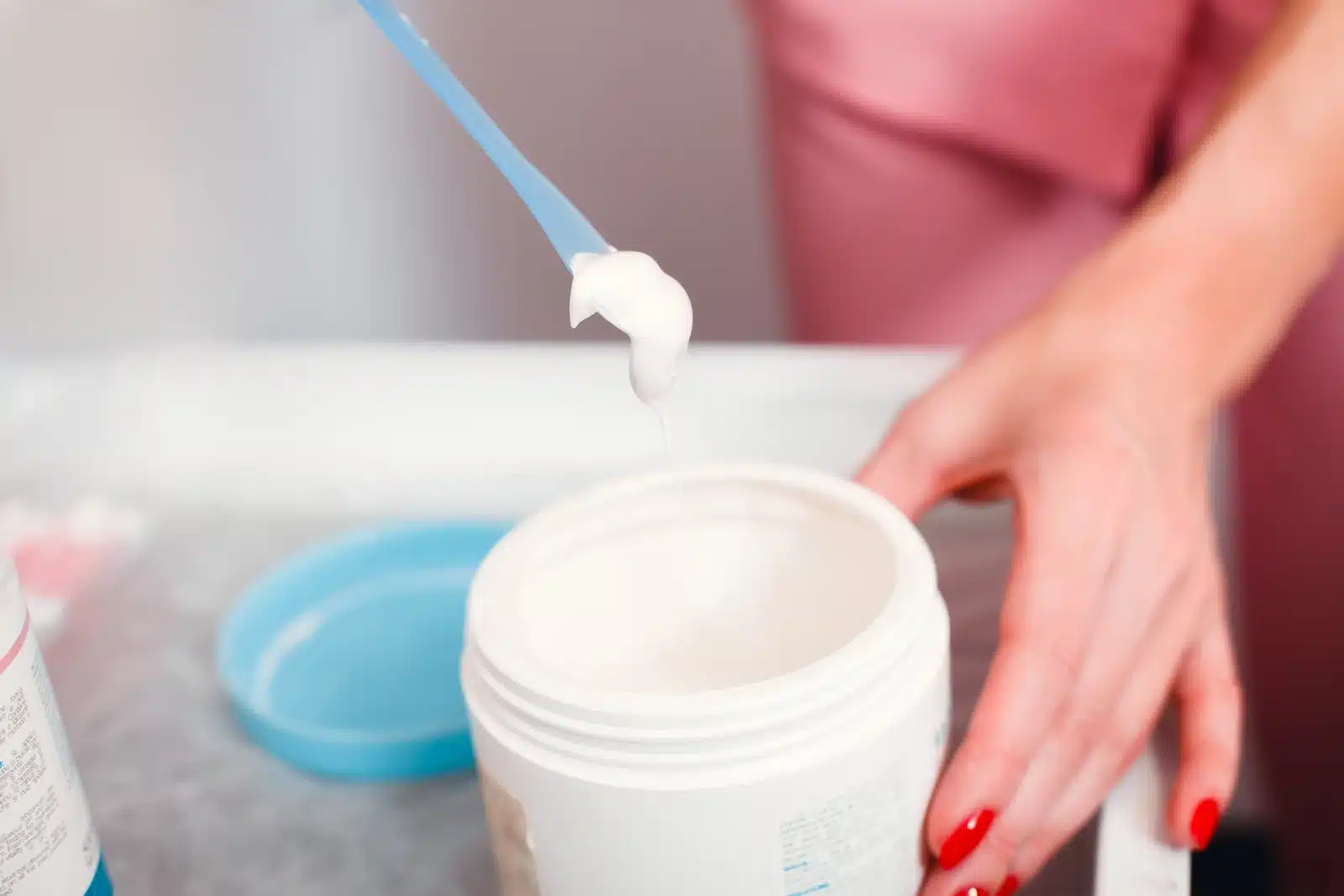
A cream made with honey or royal jelly can feel light or rich. A cleansing milk may share most of its ingredients with a moisturiser and still do a different job. To understand how a cream works, look at the water, the oil and what holds them together.
Ready-made hand and face creams


One cream is intended for the hands, the other for the face. Both contain fragrance and additional ingredients listed on the label. Read the full INCI list. The trial discussed in this article tested a separate formula.
Compare the full formulas
- Check the emulsion type, intended use and complete ingredient list.
- Ask whether a study tested the individual ingredient or the finished cream.
Here is how an emulsion is put together, what each hive ingredient contributes, and how to read a formula or a claim about royal jelly.
How a cream is made
EMULSION STRUCTURE
Inside a face cream
Water
Forms the continuous phase in this diagram.
Oils and fats
Disperse as small droplets in the water.
Emulsifier
Acts at the boundary between the two phases.
Diagram of an oil-in-water emulsion. The drawing shows neither actual proportions nor a microscopic view. Beeswax can add body; the formula still needs an emulsifier.
Most creams are oil-in-water emulsions, with tiny oil droplets dispersed in a continuous water phase. The emulsifier helps the droplets stay dispersed. Whisking alone can give a creamy appearance for a few hours, even when the oil and water will eventually separate.
| Part of the formula | Typical ingredients | Purpose |
|---|---|---|
| Water phase | Water, glycerine, honey | Carries water-soluble ingredients and supplies moisture |
| Oil phase | Oils, butters, wax | Softness, protective film and texture |
| Emulsifier | A specific emulsifier with a technical data sheet | Helps keep the two phases mixed |
| Added during cooling | Extracts, royal jelly, fragrance | Protects heat-sensitive ingredients |
| Preservative | A specific preservative at its recommended dose | Limits the growth of bacteria, yeasts and moulds |
Beeswax can give the oil phase body. The formula still needs an appropriate emulsifier.
Identify the emulsifier and its use level
Products sold as emulsifiers may have very different compositions. Some self-emulsifying bases include emollients and fatty alcohols; the Guinama L-200 lotion base, for example, is used at 15–18% of the emulsion. Olivem 1000 uses a different system, combining cetearyl olivate and sorbitan olivate. Follow the technical sheet for the chosen material before substituting one base for another.
A recipe that lists only “emulsifier, 16%” leaves out essential information. Ask the supplier for its INCI name, technical data sheet, recommended level and an example process before you start.
The roles of honey, glycerine and wax
Honey and glycerine attract and retain water. They can help a cream moisturise, but too much may make it sticky.
Wax provides structure and can leave a longer-lasting film. Balance it against the oils and butters. A thicker consistency does not establish greater moisturising efficacy.
Honey is not the preservative for the cream. Once diluted in the water phase, it no longer has the conditions that protect it in the jar. The finished cream needs its own preservation system.
What does “3% pollen extract” mean?
A pollen extract contains only what the solvent and extraction method recover from the raw pollen. Our guide to cosmetic extracts explains how to choose one.
“3% pollen extract” usually describes the proportion of the supplier’s complete ingredient in the cream. That ingredient may already contain water, glycerine or other constituents. It does not mean the cream contains 3% pollen or 3% active material.
Royal jelly and wrinkles: what the 2025 trial found
A trial published in 2025 tested a cream with protease-treated royal jelly extract for 12 weeks. Healthy Japanese women aged 44–60 applied the cream to one side of their face and the same base without the extract to the other. Data from 64 participants were analysed.
The maximum depth of the most pronounced crow’s-foot wrinkle fell by an average of 14% on the treated side and rose by 5% on the placebo side. Wrinkle area decreased on both sides, with no statistically significant difference between treatments for that measure. Skin hydration was maintained on the treated side and fell on the placebo side. Yamada Bee Company funded the study and employed nine of the twelve authors. The researchers acknowledge the limited sample size.
The tested product was a preserved gel containing an extract standardised for 10-HDA, a fatty acid characteristic of royal jelly. The results concern that preparation. They cannot be extrapolated to fresh royal jelly stirred into a homemade cream or to a different, untested product.
When assessing a wrinkle claim, look for a human study of the finished product, how long it lasted and which endpoint actually changed. The EU criteria for cosmetic claims require evidence before an ingredient’s properties can be attributed to a finished cosmetic.
Moisturiser or cleansing milk?
A cleansing milk is designed to lift dirt and, depending on the formula, make-up. It is then removed. A moisturiser stays on the skin. Both might contain honey, royal jelly or cucumber extract; the oil phase and the instructions for use explain how the cleansing milk does its job.
| If you want… | What to look for |
|---|---|
| An everyday cream | Its texture, how well you tolerate it and how your skin feels afterwards |
| A cleansing milk | What it removes, how to take it off and which area it is intended for |
| A particular effect on wrinkles | Whether the finished product was tested, for how long, and with what results |
| To add an extract to a formula | Its identity, solvent, recommended level and compatibility |
How to read the percentages
“Water, q.s. to 100” means enough water to bring the formula to 100%. If the other ingredients total 32%, water accounts for 68%. In 50 g of cream that is 34 g of water and 16 g of other ingredients. The preservative, fragrance and pH adjuster are all included in the total.
In a 50 g batch, 3% of an ingredient means 1.5 g of that ingredient and 48.5 g of everything else. Adding 1.5 g to 50 g of ready-made cream produces 51.5 g and changes the percentage.
Check your understanding of the formula
Two questions to answer before you start weighing.
The other ingredients add up to 32%. How much water does “q.s. to 100” mean?
Water makes up the remaining 68%. For a 50 g batch, weigh 34 g of water and 16 g of the other ingredients. The latter include the preservative, fragrance and pH adjuster.
Does a thicker cream moisturise better?
Thickness alone cannot tell you. Consistency describes the texture. The effect depends on the whole formula and how it behaves on the skin.
Why you should leave a purchased cream as supplied
Adding water, honey or an extract to a purchased cream changes its composition. It dilutes the preservative, can alter the pH and may break the emulsion. The manufacturer assessed the product as sold.
A supplier’s technical sheet for a formulated base specifies which additions it can take and at what levels. A concentrated base that still needs emulsifying is different from a ready-to-use cream.
What to check in a homemade cream
A fresh emulsion can look uniform and separate a few days later. Record its appearance, smell, consistency and pH on the first day, then check after one and four weeks under the intended storage conditions. This tells you about physical stability. It cannot establish microbiological safety or shelf life.
A water-containing formula needs a preservation system appropriate to that formula, at a suitable level and pH, with evidence that it works. For a first project with hive products, a water-free wax-and-oil balm or lip balm is a simpler starting point.
Choosing a ready-made cream
Our shop carries a honey, beeswax and lemon hand cream and a face cream with royal jelly. Our guide to hive ingredients in cosmetics (in Spanish) covers the role of each ingredient.
IN OUR SHOP
Choosing a ready-made cream
Our hand cream and face cream have different ingredients and uses. Open the product page for the full details.

Honey, beeswax and lemon hand cream, 75 ml
A 75 ml tube with honey, beeswax and lemon for hand care. See the product page for the full ingredient list.
View product and price →
Royal jelly face cream with collagen and elastin, 50 ml
A 50 ml face cream with royal jelly, collagen and elastin. See the ingredients and directions for use.
View product and price →

