

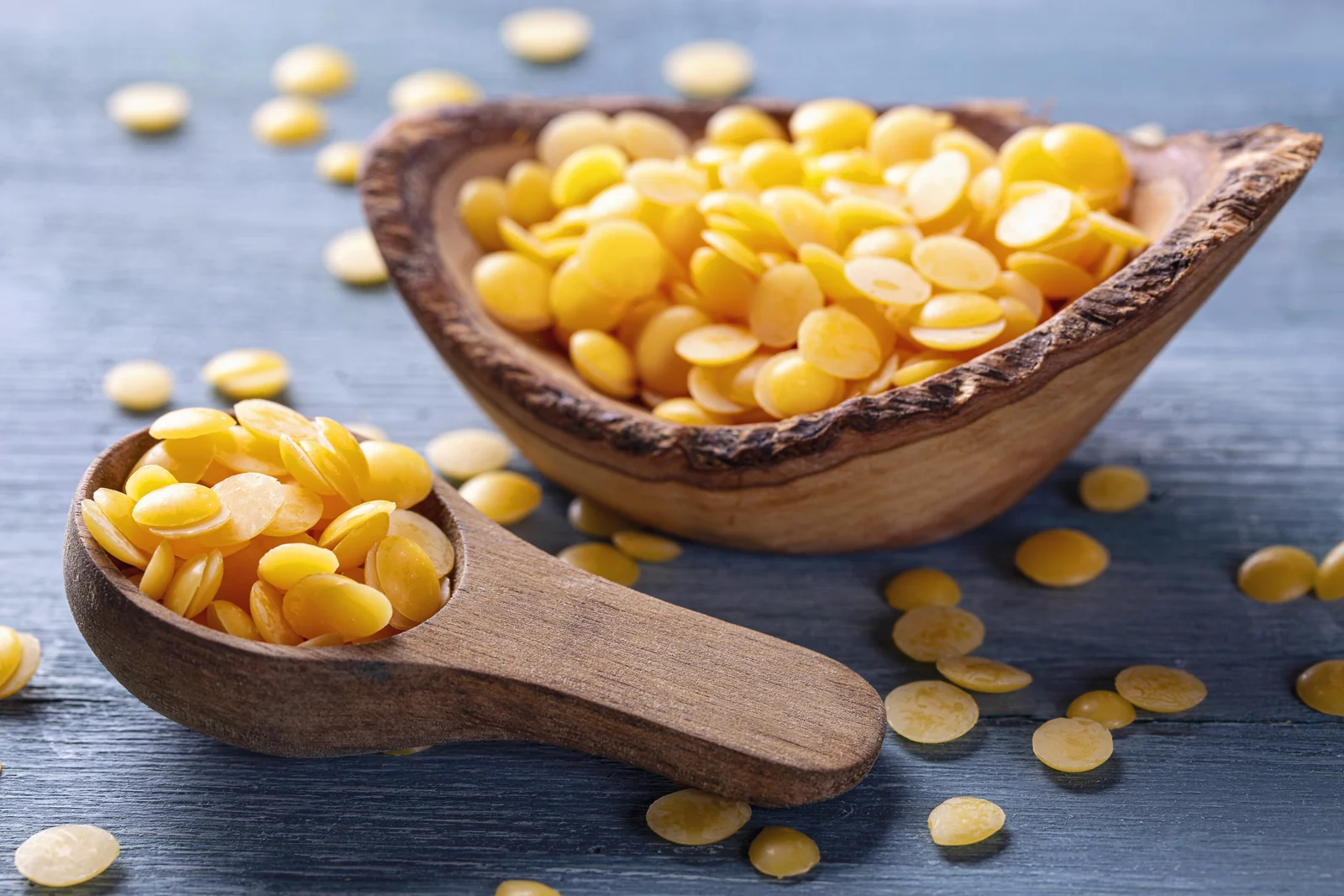
If you keep bees, you already have wax. A little of it can turn oil into an ointment. What you cannot see is what the wax has picked up in the hive. As a beekeeper, you have a useful piece of information: you know which frames it came from.
Ready-made products containing beeswax


The cream and soap below already contain beeswax. Check the full ingredient list and intended use for each product. A batch of wax from your own apiary needs its own documentation.
Identify the wax in each test jar
- Write down its origin, batch number and weight percentage.
- Change one variable at a time when comparing texture.
Here is how to select a batch, melt the wax gently and decide how much to use. The three-jar trial at the end lets you compare three beeswax-to-olive-oil ratios for a simple dry-skin ointment.
Which wax from the apiary should you choose?
Fat-soluble synthetic Varroa treatments such as fluvalinate and coumaphos can accumulate in beeswax. Melting, filtering or sterilising wax does not remove those residues. Our guides cover melting and cleaning beeswax and sterilising and lightening it (in Spanish).
For a product intended to go on skin, start by checking where the wax came from.
- A good starting point. Choose well-drained cappings wax or comb wax from honey supers. These tend to contain fewer residues than old brood-comb wax. In the results discussed in our beeswax quality guide, levels were around a third of those in brood wax.
- Set these aside for other uses. Avoid old dark brood combs, frames in direct contact with synthetic treatment strips, wax from colonies lost to disease, commercial foundation sheets and candle remnants. Recycled foundation can combine wax from many apiaries and lacks the traceability you want for a balm.
Knowing the origin is a first step. An average from a study cannot tell you the composition of your particular batch. Batch-specific analysis documents its suitability for use on skin.
When buying beeswax
Ask for white beeswax (Cera alba) or yellow beeswax (Cera flava) with a batch number and certificate of analysis. Where available, request results for residues and adulteration with paraffin or stearin. “100% natural” on the label tells you little about either.
Yellow or white beeswax?
Yellow beeswax is filtered wax from the hive. White beeswax has been bleached and usually has less odour. Choose according to the colour and scent you want in the finished product. Colour alone says little about quality.
In a British clinical study, four of 55 patients allergic to propolis also reacted to beeswax (Rajpara et al., 2009). The group had already been selected for propolis allergy, so those figures cannot establish the prevalence of beeswax allergy in the general population. If you have a diagnosed contact allergy, check which ingredients you need to avoid.
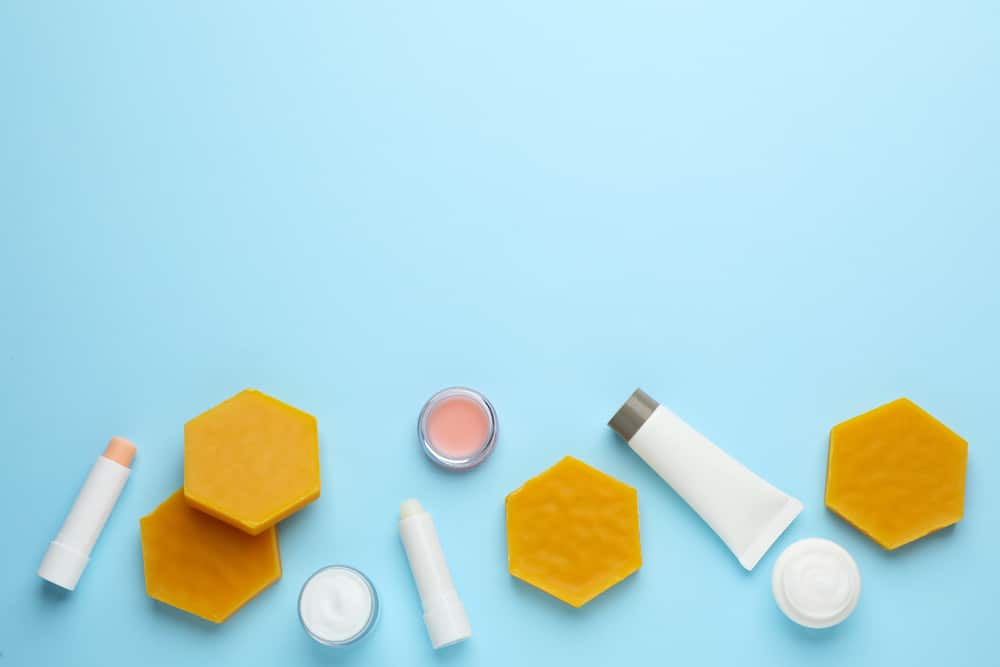
How to melt beeswax
- Melt the wax in a water bath. Keep the wax container away from a direct flame and stay beside it while it heats.
- Cut blocks into small pieces or use pellets so the wax melts evenly.
- Beeswax melts at around 62–65 °C. For a balm, melt it with the oil and remove it from the heat as soon as the last pieces disappear.
- Use a thermometer. The outside of the container is a poor guide to the mixture’s temperature.
- Keep water from the bath out of the mixture.
How much wax? Try three small jars
COMPARISON BY WEIGHT
Three jars, one variable
JAR A · 30 g TOTAL
10% wax
3 g wax
27 g olive oil
JAR B · 30 g TOTAL
15% wax
4.5 g wax
25.5 g olive oil
JAR C · 30 g TOTAL
20% wax
6 g wax
24 g olive oil
Use the same oil, wax batch, containers and cooling conditions. Compare at the same temperature. The weights alone cannot predict the exact texture of your batch.
More wax generally makes the balm firmer, as beeswax manufacturer Koster Keunen explains. The ratio you prefer depends on the oil, the temperature of the room and what the balm will be used for.
Make three jars at once, using the same olive oil and different amounts of wax. These two ingredients are enough for the trial. Each jar in the following table holds 30 g.
| Beeswax | Olive oil | Approximate texture | |
|---|---|---|---|
| Jar A, 10% | 3 g | 27 g | Soft ointment |
| Jar B, 15% | 4.5 g | 25.5 g | Intermediate firmness |
| Jar C, 20% | 6 g | 24 g | Close to the firmness of a lip balm |
The texture descriptions are a starting point. Using your own wax and oil lets you see where your batch falls on the scale.
- Weigh each jar’s ingredients separately. Use scales that read to 0.1 g for the 4.5 g portion. If yours only show whole grams, make 60 g jars and double all the weights.
- Melt each batch in its own heat-resistant container over a water bath, or directly in its final jar if it is metal or heat-resistant glass.
- Stir until the last piece of wax has melted. Remove from the heat and pour into the jars if you used separate containers.
- Let all three cool together in the same place. Put the lids on once the mixtures have cooled.
- Wait 24 hours before judging firmness. The surface may harden while the centre is still warm.
The following day, compare the jars at the same temperature.
- In the jar. Does the ointment keep its shape when you tilt the jar?
- When taking some out. Can you lift a little with a finger or spatula without pressing hard?
- On the skin. Does it spread in a thin layer or drag across the skin?
- In warm conditions. Leave the jars for a day in the warmest room. If oil appears on the surface, the mixture is separating at that temperature. Record the temperature and compare after your next adjustment.
If jar A suits you, keep that ratio. If you prefer something between B and C, try 17% or 18% wax. Change one thing at a time so you can tell what made the difference.
The oil matters too. Using another oil or adding shea or cocoa butter will change firmness at the same wax concentration. Run the test with the oil you actually plan to use.
Try the three-jar test
Compare the weights and conditions for each preparation.
How much should I weigh for a 60 g jar at each ratio?
| Jar | Wax | Oil |
|---|---|---|
| A · 10% | 6 g | 54 g |
| B · 15% | 9 g | 51 g |
| C · 20% | 12 g | 48 g |
Double the amounts in the 30 g trial. These are three separate batches with no tocopherol, so you compare just wax and oil.
What should stay the same across all three jars?
Use the same wax batch, oil, jars and cooling conditions. Compare at the same temperature after 24 hours, so the main difference is the wax proportion.
A simple ointment for dry skin
Once you have chosen a ratio, wax and oil can be the only ingredients in the ointment.
If you expect to use it over several months, 0.5% tocopherol (vitamin E) can help slow oxidation of the oil. Count it within the total and subtract its weight from the oil. In a 30 g jar that is 0.15 g, which needs scales reading to 0.01 g.
| Wax proportion | Beeswax | Olive oil | Tocopherol | Total |
|---|---|---|---|---|
| 10% | 3 g | 26.85 g | 0.15 g | 30 g |
| 15% | 4.5 g | 25.35 g | 0.15 g | 30 g |
| 20% | 6 g | 23.85 g | 0.15 g | 30 g |
Tocopherol slows oil oxidation. It does not preserve against microorganisms. “Vitamin E” is sold in several forms, so choose a cosmetic-grade ingredient and check what the supplier’s technical sheet says it contains.
Use this ointment sparingly on intact dry skin, such as elbows, knuckles, heels or working hands. Spread a thin layer and let it settle. Excess will leave a greasy film on tools or paper.
This ointment is unsuitable for wounds, burns or persistent cracks. An area that is painful, inflamed or oozing calls for appropriate care.
Why the formula leaves out honey and propolis
Honey and oil do not mix. Even after thorough stirring, the honey eventually forms separate droplets.
The extract matters when using propolis. In a laboratory comparison, 10 g of propolis made up to 100 ml with olive oil and steeped for five hours at room temperature yielded 0.5 mg of phenolic compounds per ml, expressed as gallic acid equivalents. The result with 70% alcohol was 12.7 mg/ml (Kubiliene et al., 2015). Other solvents and heating conditions gave different results. An alcohol tincture also mixes poorly with wax and oil. Choose a documented extract made for the oil phase when formulating a propolis ointment.
Storing the ointment
A water-free ointment offers microorganisms very little available water. Its protection can change if water gets in during use (DGK, 2025). Oil can also oxidise with time, light and heat. Our guide to preserving homemade cosmetics explains the difference.
- Keep the jar closed, away from light and heat.
- Use dry fingers or a clean spatula and keep water out of the jar.
- Make a small amount and write the date on the lid.
- Discard it if the oil smells rancid.
Beeswax in creams
In a water-containing cream, beeswax adds body and gives a richer texture. A separate emulsifier keeps the water and oil dispersed. Our guide explains how an emulsion with honey or royal jelly is put together.
If you prefer a ready-made product containing beeswax, we stock a honey, beeswax and lemon hand cream.
IN OUR SHOP
Beeswax in ready-made cosmetics
Two products that include beeswax for different uses: a hand cream and a bar of soap.


Frequently asked questions
Can I use wax foundation sheets for cosmetics?
Commercial foundation can contain recycled wax from many apiaries and residues of hive treatments. Use cappings wax of known origin or purchased beeswax with batch-specific analysis for cosmetics.
How much beeswax goes into lip balm?
The other ingredients and the container matter. A stick made with wax and liquid oil usually needs more wax than a soft jar balm. Jar C is approaching that firmness. Cocoa butter or another firm fat can reduce the amount of wax needed. Our lip balm recipe with shea butter and grapeseed oil uses 3 g of wax for a 28 g jar.
Does beeswax expire?
Clean beeswax is very stable when kept covered, away from heat and strong odours, which it absorbs. In an ointment the oil usually deteriorates first.
Should beeswax be sterilised before cosmetic use?
Melting and filtering do not establish sterility. Control of spores requires a validated process with specified time and temperature. One temperature reading alone cannot demonstrate that it worked. For cosmetics, choose a batch with specifications appropriate to the intended use. Recovering wax from an apiary does not establish its suitability for skin.


