

At a glance
Chestnut honey
Castanea sativa
Colour
Amber to dark amberat least 49 mm Pfund, sometimes with a greenish-brown cast
Aroma
Dry wooda floral aroma with a pronounced woody note
Taste
Sweet and savourybitterness can increase with heather
Crystallisation
Lowunless legumes contribute significantly
Season
Summerflowering from June to July
Region
North-western Spain and Andalusiamountain ranges with chestnut woodland
Pollen reference
75%the highest pollen reference in the guide
Electrical conductivity
at least 0.80 mS/cma high minimum for a blossom honey
Among the honeys in the Iberian guide, chestnut has an exceptionally high pollen reference and high electrical conductivity. Its bitterness varies with the harvest.
For sweet chestnut, the guide sets a 75% pollen reference and a minimum electrical conductivity of 0.80 mS/cm. The honey is generally dark and full-flavoured, and often tastes much less sweet than a pale blossom honey.
The sensory description distinguishes the savoury notes typical of chestnut from the extra bitterness that nearby heather can contribute. Chestnut itself can also taste bitter.
Resources for tasting chestnut honey

This Spanish-language reference links botanical origin, tasting and analysis. Use the full profile when interpreting a jar or laboratory report.
Compare chestnut and heather on the same sheet
- Record bitterness alongside aroma and the origin of the lot.
- Interpret the whole analysis before deciding on floral origin.
Where does the bitterness come from?
Chestnut honey often brings bitterness to mind. Its Iberian profile combines sweetness with a saline note. Heather in the harvest frequently accentuates bitterness, while bramble can contribute a sharper, slightly acidic note.
Chestnut woods in north-western Spain commonly share the landscape with heaths. Bees can therefore work both in the same season, which helps explain why many local harvests have a pronounced bitter finish.
Two genuine chestnut honeys can taste different. Andalusian harvests from areas with less heather may be less bitter than some from Galicia or León. The other flowers visited matter as much as the regional name.
The guide’s sierra honey profile also describes bitter chestnut notes in an Alpujarra chestnut landscape without heather. Heather can intensify bitterness, but its presence is not a prerequisite.
Chestnut and heather: what 0.80 mS/cm tells you
These honeys can come from neighbouring sites, and their pollen can occur in the same sample. Electrical conductivity helps interpret the result alongside the aroma, taste and other analytical findings.
| Chestnut | Heathers (Erica species) | |
|---|---|---|
| Electrical conductivity | at least 0.80 mS/cm | 0.50 to over 0.80 mS/cm |
| Pollen reference | 75% Castanea | 30% Erica |
| Colour | at least 49 mm Pfund | 49–114 mm Pfund |
| Aroma | Dry wood | Leaf litter, humus and mushrooms |
| Typical taste | Sweet with a savoury note | Sweet, bitter and savoury |
| Crystallisation | Low | Varies with the other forage |
The guide allows a northern sample to be classified as heather honey despite over-represented chestnut pollen if it fits the expected sensory profile, the chemical marker named in the guide is below 400 mg/kg and electrical conductivity is below 0.8 mS/cm. Chestnut’s reference starts at that value. The threshold helps interpret this particular overlap. See the comparison in our heather honey profile honey.
Colour and the greenish-brown tint
The guide gives a minimum of 49 mm Pfund and no upper limit. Samples can exceed 114 mm. A greenish-brown cast can sometimes be seen where the honey touches the glass, especially when the edge of the jar is held to the light. Eucalyptus honey can show a similar effect.
Chestnut honey on the Pfund scale
Chestnut honey can extend into the darkest class. The guide sets a lower reference and no upper colour limit. Along with ling and honeydew, it includes some of the darkest Iberian honeys. Screen colours are approximate.
Aroma, taste and texture
Sensory profile
Our interpretation of the descriptions in the Guía de mieles monoflorales ibéricas. The dots are our visual interpretation of the guide’s words. The bitterness assessment takes into account the heather often present in the same harvest.
Aroma
The aroma is floral with a distinctive dry-wood note. In this series eucalyptus honey is often described as smelling of wet wood. Smelling the two side by side makes the difference easier to pick out.
Taste
Look for sweetness and a saline note. Heather can strengthen the bitterness and bramble can add acidity. These extra notes give some indication of the other forage available to the bees.
Crystallisation
Chestnut honey has a low tendency to crystallise, unless legumes make a significant contribution. Like acacia and some honeydew honeys, it may remain liquid for a long time. This reflects composition and is not a quality grade. See why honey crystallises.
Interpreting the laboratory profile
| Parameter | Reference in the guide | How to interpret it |
|---|---|---|
| Colour | at least 49 mm Pfund | The guide gives a lower colour reference but no upper limit. Compare a pale sample with the rest of the profile. |
| Moisture | up to 18% | Fermentation risk rises as moisture increases. The general Spanish statutory limit is 20%. |
| Fructose and glucose combined | at least 60% | A characteristic of blossom honey. This figure on its own cannot exclude added syrup. |
| Sucrose | up to 5% | One of the sugars reported in the analysis. |
| Electrical conductivity | at least 0.80 mS/cm | A lower reference for chestnut. Use it with sensory and pollen results when distinguishing heather and chestnut. |
| Free acidity | up to 50 meq/kg | Can rise with fermentation or extended storage. |
| HMF | up to 40 mg/kg | Tends to rise with heat and time. Levels are usually low in freshly harvested honey. |
| Diastase activity | at least 8 Schade units | Indicator of enzyme activity, which can decline with heat. |
| Castanea pollen | at least 75% | High because chestnut pollen is strongly over-represented relative to nectar. |
Reference ranges from the Guía de mieles monoflorales ibéricas, fourth edition (2023). These characterise the variety. Spanish statutory limits are set by Royal Decree 1049/2003 as amended by Royal Decree 68/2025, including a general maximum of 20% moisture and 40 mg/kg HMF, subject to the exceptions in the legislation.
Why the pollen reference is 75%
Chestnut produces abundant pollen. A modest contribution of chestnut nectar can leave enough grains to dominate a pollen count. The guide therefore uses 75% for chestnut, compared with 12% for rosemary and 8% for ling heather. Those figures reflect different pollen representation. They are not percentages of nectar or measures of purity.
This is why identifying a honey from northern Spain can require more than reading the largest number in a pollen report. Chestnut pollen can be abundant even when the honey’s main sensory character comes from heather.
Other plants in the harvest
- Heathers
- Legumes
- Rockroses (Cistaceae)
- Bramble
The guide notes that rockrose pollen is less frequent or absent in the north of the peninsula. Northern heaths and the landscapes around southern chestnut orchards offer different companion plants.
Growing areas and harvest season
Spanish chestnut honey is harvested in mountain chestnut woods in the north-west and in Andalusia. Examples include Galicia, Asturias, León, Zamora, El Bierzo, the Sierra de Francia, Las Hurdes, the Genal valley and the Sierra de Aracena. These chestnut landscapes often combine woodland, cultivation and a long history of local management.
Chestnut calendar
Flowering Flowering and harvest
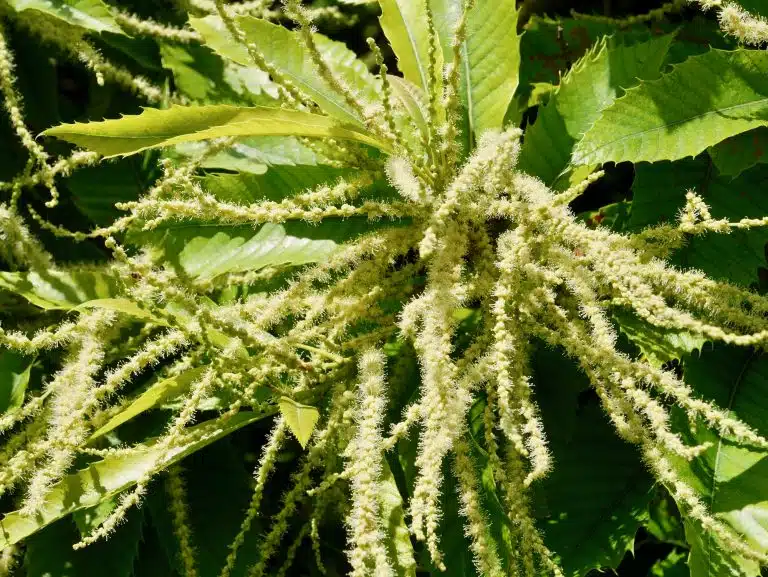
The guide places the main harvest in summer. Flowering begins relatively late, into June. Yellowish catkins cover the trees and the scent can carry beyond the chestnut wood.
How to recognise chestnut honey
- 1Check the colour. The reference starts at 49 mm Pfund. Consider the other characteristics as well when assessing a pale sample.
- 2Look for the greenish-brown tint. Hold the edge of the jar up to the light where the honey meets the glass.
- 3Smell for dry wood. Damp woodland floor, leaf litter and mushrooms point more towards heather.
- 4Check electrical conductivity. The guide gives a chestnut minimum of 0.80 mS/cm. Interpret it alongside aroma and pollen.
- 5Liquid honey is common. Chestnut honey often crystallises slowly because of its composition.
For a broader view, see how to assess honey quality and our guide to Spanish honey labelling requirements.
Composition and health claims
Chestnut honey is sometimes credited with improving circulation because it is dark or its electrical conductivity is high. Conductivity tells you about the honey, including the contribution of mineral salts. It cannot establish an effect on circulation. EU rules require the relevant authorisation and conditions of use for food health claims.
The laboratory and sensory profiles support more practical comparisons.
- Electrical conductivity is high. The chestnut profile uses a minimum of 0.80 mS/cm. Mineral salts are a major contributor to the measurement.
- Perceived sweetness is relatively low. Saline and bitter notes can soften the impression of sweetness.
- It can stay liquid for a long time, which makes it easy to pour or weigh without warming.
- It works with strong flavours. Try it alongside blue cheese, mature cheese, game, roast chestnuts or dark chocolate.
Who should take particular care?
Children under 12 months. Do not give honey to infants under one year. It can contain spores of Clostridium botulinum that may cause infant botulism. This applies to all types of honey.
Diabetes. Chestnut honey still contains sugars even if it tastes less sweet. Include it in the dietary plan.
Known allergy. Anyone with a diagnosed allergy to honey or bee products should consult their clinician if unsure what is safe for them.
Frequently asked questions
Why is chestnut honey bitter?
Chestnut can taste bitter in its own right. In north-western Spain, heather frequently flowers within reach of the same colonies and can make that bitterness stronger. Bramble can add a sharper note.
How do you distinguish chestnut honey from heather honey?
Dry wood is typical of chestnut, while heather tends towards leaf litter, humus and mushrooms. Conductivity and pollen analysis help: the Iberian chestnut profile starts at 0.80 mS/cm, while Erica heather ranges from around 0.50 to over 0.80 mS/cm. Interpret an overlap using the full profile.
Why is my chestnut honey still liquid?
Chestnut honey naturally crystallises slowly, unless other forage such as legumes changes its composition. A liquid texture on its own does not show that the honey was heated or finely filtered.
Why does the guide use 75% chestnut pollen?
Chestnut pollen is abundant relative to the nectar contribution. A modest amount of nectar can therefore leave a large pollen share. By comparison the guide uses 12% for rosemary and 8% for ling heather. These figures are botanical references.
Why is there a greenish tinge in the jar?
The Iberian profile mentions greenish-brown tones where the honey meets the glass. Viewing the edge of the jar against the light can make them easier to see. Eucalyptus honey may show similar reflections.
Who should take particular care?
Never give honey to a child under twelve months. People with diabetes should count its sugars. If you have a diagnosed allergy to honey or other bee products, ask your clinician if you are unsure.
Where to buy chestnut honey
Ask a beekeeper in a producing area about the harvest and lot. Galicia, El Bierzo, Asturias, the Sierra de Francia, Las Hurdes, the Genal valley and the Sierra de Aracena are all places to look. Much of our shop’s honey comes instead from beekeepers on Spain’s Mediterranean side.
For a dark honey with a strong flavour, our shop carries raw heather honey. Our range of raw honeys harvested in Spain also includes milder varieties.
Sources
The reference ranges come from the fourth edition (June 2023) of the Guía de mieles monoflorales ibéricas by J. Orantes, F. Gonell, C. Torres and A. Gómez-Pajuelo, published by Laboratorios Apinevada and Pajuelo Consultores Apícolas. Their work draws on a series reaching back to 1980 and more than 3,600 analyses a year across the two laboratories. The printed guide in Spanish is available in our shop.
This profile is part of our series on Iberian honeys. Compare it with heather honey from similar landscapes, eucalyptus honey for another woody aroma, or much paler rosemary honey (in Spanish).


