

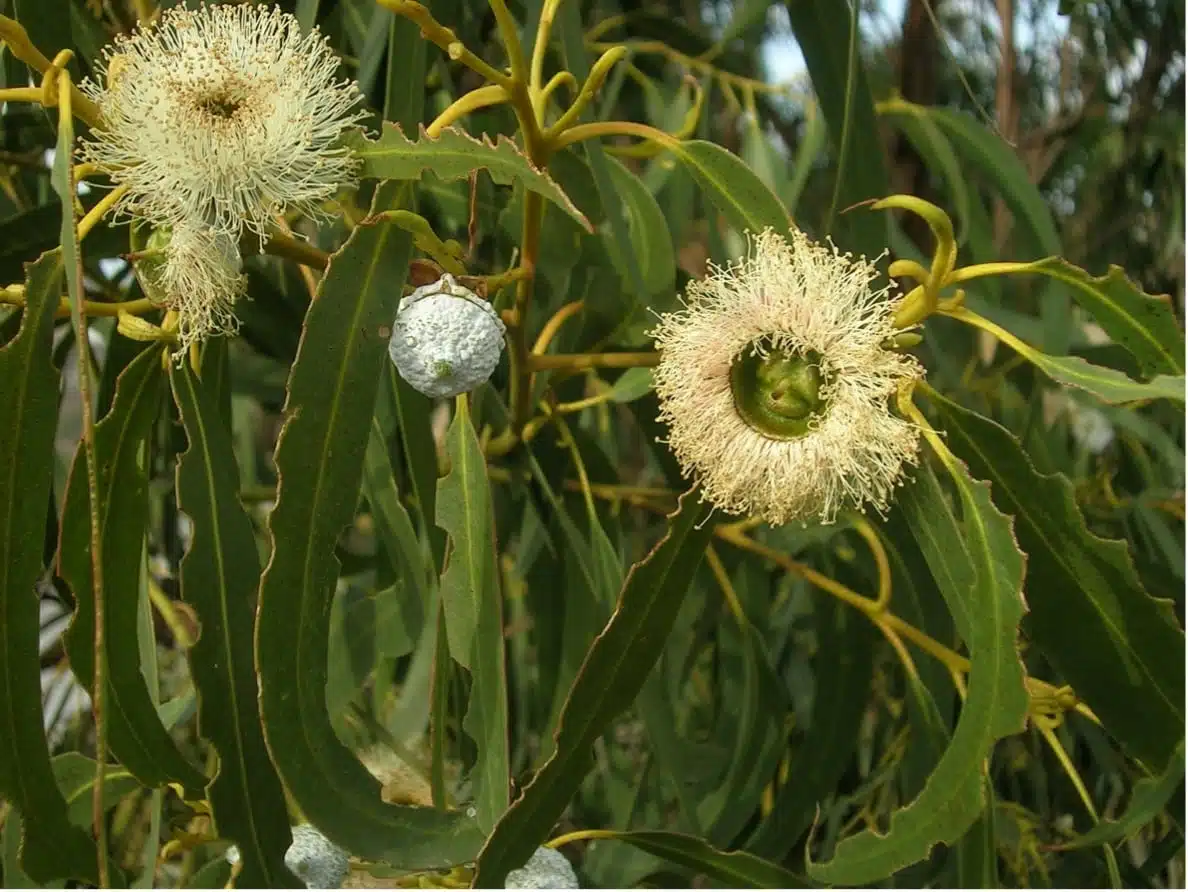
At a glance
Eucalyptus honey
Eucalyptus camaldulensis, E. globulus
Colour
Light amber40-80 mm Pfund, with greenish glints
Smell and aroma
Wet woodvery intense and persistent
Taste
Sweetwith slight acidic notes
Crystallisation
Medium, fine crystalsneither fast nor slow
Season
Summerand the occasional winter in Huelva
Growing areas
Extremadura and the coastssouthern Mediterranean and western Cantabrian
Minimum pollen
70%the second highest in the guide
Conductivity
min. 0.40 mS/cmit has a minimum, not a maximum
Let’s start with what nobody tells you: eucalyptus honey does not smell of eucalyptus. It smells of wet wood. And that changes things quite a bit.
Almost everyone comes to eucalyptus honey expecting something minty, that throat-sweet or steam-inhalation register. That is not what you get. The guide describes it in far more precise terms: an aroma of wet wood, very intense and very persistent. It is a powerful, light amber honey with a visual trait of its own that no other honey has —greenish glints you can see against the glass— and the second highest pollen requirement in the Iberian catalogue.
The fact that it does not smell of eucalyptus has consequences, above all for what many people expect from it. We go into detail further down, but it is worth saying now: eucalyptus honey does not contain eucalyptol.
Colour, and the greenish glints
Light amber, between 40 and 80 mm Pfund. It darkens when it contains some broom or heather. But what really identifies it is a detail the guide records and almost nobody mentions:
Characteristic greenish notes, especially in the upper area where the honey touches the glass of the container. In other words: hold the jar up to the light and look at the top edge, where the honey meets the glass. That greenish tinge is a trait of eucalyptus.
It is one of the few identification criteria you can apply without opening the jar or tasting anything.
The Pfund scale · where eucalyptus falls
Eucalyptus sits in the middle band. It has a minimum and a maximum: not as pale as rosemary, not as dark as heather. The colours of the bar are an on-screen visual approximation, not a laboratory measurement.
Smell, aroma, taste and texture
Sensory profile
Our own reading of the descriptors in the Guía de mieles monoflorales ibéricas. The guide describes in words, not numbers: these dots translate those words into a scale that can be compared across profiles.
Smell and aroma
Wet wood, very intense and very persistent. In terms of power it is in the same league as heather and chestnut, and a long way from rosemary or acacia. In the mouth the olfactory sensation increases retronasally, as with orange blossom: it is one of those honeys that express themselves more on the palate than on the nose.
Taste
Sweet, with slight acidic notes. And if it contains broom or heather —the same companions that darken it— slight salty notes also appear. It is a broad-flavoured honey but without bitterness: it has neither the edge of heather nor that of chestnut.
Crystallisation
A medium tendency, with fine crystals. Neither as slow as acacia nor as fast as oilseed rape: it stays in the middle ground, and the fine crystal gives it a pleasant texture even once it has set. We have a dedicated guide to the process itself.
Composition: the analytical profile, explained
| Parameter | Guide reference | What it means |
|---|---|---|
| Colour | 40-80 mm Pfund | Light amber. It has a minimum and a maximum: outside that band another flowering is involved. |
| Moisture | max. 18% | Above it the risk of fermentation increases; the legal limit is 20%. It is one of the parameters that most determine how well the honey keeps. |
| Fructose + glucose | min. 60% | The value typical of a blossom honey. Meeting it does not, on its own, rule out adulteration with syrups. |
| Sucrose | max. 10% | Double that of most honeys, as with orange blossom. Note: the standard only allows 10% for river red gum, Eucalyptus camaldulensis; for E. globulus the general 5% applies. |
| Electrical conductivity | min. 0.40 mS/cm | Here it is a floor, not a ceiling. Low conductivity rules out eucalyptus. |
| Free acidity | max. 50 meq/kg | Rises if the honey has fermented or has been stored for a long time. |
| HMF | max. 40 mg/kg | The tell-tale sign of heat and time. In freshly harvested honey it is almost zero. |
| Diastase activity | min. 8 Schade | A bee enzyme, destroyed by heat. |
| Eucalyptus pollen | min. 70% | The second highest in the guide, behind only chestnut. Eucalyptus is heavily over-represented. |
Reference values from the Guía de mieles monoflorales ibéricas, fourth edition (2023), used to characterise this honey: they are not legal limits. The legal requirements are those of Spain’s Real Decreto 1049/2003, as amended by RD 68/2025: in general, a maximum moisture content of 20% and a maximum HMF of 40 mg/kg.
Why a 70% pollen threshold is required
Because eucalyptus releases an enormous amount of pollen and it ends up in the honey. It is the exact opposite of orange blossom, where Navel orange trees produce hardly any pollen and a chemical marker is needed to identify the honey. Each species has its threshold calibrated according to how much pollen it contributes relative to nectar: the threshold does not measure purity.
| Honey | Min. pollen | Why |
|---|---|---|
| Ling heather (calluna), strawberry tree | 8% | Heavily under-represented: they contribute almost no pollen. |
| Rosemary, thyme | 12% | Mint family: plenty of nectar, little pollen. |
| Orange blossom | 15% | Citrus, and on top of that selected to be pollen-free. |
| Heather | 30% | Contributes a fair amount of pollen. |
| Eucalyptus | 70% | Heavily over-represented: it fills the honey with its pollen. |
| Chestnut | 75% | The extreme case in the catalogue. |
If you are interested in how that count is done, we explain it in what pollen analyses are for (in Spanish).
What else turns up in eucalyptus honey
- Legumes
- Daisy family
- Rockroses (except in the north)
- Viper’s bugloss (Echium)
- Sometimes broom or heather
Where it is produced and when it is harvested
Extremadura, the southern Mediterranean coast and the western Cantabrian coast. It is a plantation honey: eucalyptus was introduced into Spain to produce timber and pulp, and the large eucalyptus plantations of Huelva, Extremadura, Galicia and the Cantabrian coast are today a first-rate nectar resource.
In Galicia and along the Cantabrian coast, that resource is changing. The eucalyptus snout beetle (Gonipterus), recorded in Galicia in 1991 and in Cantabria in 1999, reduces the growth of Tasmanian blue gum (E. globulus) by between 20 and 25% (Agronomy, 2022), and the leaf diseases caused by Mycosphaerella and Teratosphaeria appear in practically all the globulus stands studied in Galicia (Aguín et al., 2013). In the high, cold inland areas of Lugo and A Coruña, plantations are being replanted with shining gum (E. nitens), which copes better with frost and the snout beetle.
For the bees it is not the same thing. Nitens takes years to flower, flowers sparsely and irregularly, and there is hardly any data on its nectar and pollen: the University of Vigo began studying its honey potential in 2019 (Campo Galego) and we are not aware of any published results. On top of that comes felling age: according to the Agrupación Apícola de Galicia, eucalyptus gives its best for bees from 20-30 years of age onwards, while pulp rotations are 12 to 16 years. In Cantabria, beekeeper Manuel Barquín described the same replacement in 2026 in his talk “Nuevas decisiones en la apicultura ante el cambio climático” (in Spanish), although we have not found figures for that region.
Eucalyptus calendar
Flowering Flowering and harvest Exceptional
The guide places it in summer, but records two exceptions worth knowing about: in the occasional year there is a winter harvest in Huelva, from E. globulus, and also in favourable springs on the Cantabrian coast. It is one of the few Iberian honeys that can turn up out of season.
How to recognise genuine eucalyptus honey
- 1Look for the green in the glass. Hold the jar up to the light and look at the upper area, where the honey touches the glass. That greenish tinge is typical of eucalyptus.
- 2It smells of wet wood, not menthol. If you were expecting a balsamic throat-sweet note, this is not the honey — and if one does smell like that, suspect added flavouring.
- 3Light amber, between 40 and 80 mm Pfund. Too pale or too dark means another flowering is involved.
- 4Ask for the conductivity. Here it is a minimum: below 0.40 mS/cm, it is not eucalyptus.
- 5Pollen analysis does work for this honey. With a 70% threshold, genuine eucalyptus honey shows it without difficulty. It is the opposite of orange blossom.
For the general criteria, we have a guide on how to tell whether a honey is good quality and another on what the regulations require on the label.
Properties: what can and cannot be said
Here we need to be especially clear, because the misconception is strong and very widespread. Eucalyptus honey does not contain eucalyptol, which is the balsamic compound in the tree’s leaves and the one found in throat sweets and inhalation products. Honey is made from the nectar of the flower, not the leaf, and its aroma —as the guide says— is of wet wood. The mental association between “eucalyptus” and “airways” comes from the essential oil, not from the honey.
And, as in the rest of the series: in the European Union there is no authorised health claim for honey. Regulation (EC) No 1924/2006 only permits claims on the approved list, and honey has none. Neither eucalyptus honey nor any other can be advertised as good for coughs or colds.
What can be stated, because it is in the analysis and the tasting:
- It has relatively high conductivity. Its profile requires a minimum conductivity of 0.40 mS/cm, and conductivity depends mainly on mineral salts.
- It is one of the most aromatic honeys in the catalogue, with intensity and persistence comparable to heather.
- It stands up well to the heat of an infusion without disappearing, thanks to its aromatic power — although it is best added once the liquid is no longer scalding, so as not to push up the HMF.
- Its fine crystals make it easy to spread even when it has fully crystallised.
Real precautions
Children under 12 months: no. Honey can contain spores of Clostridium botulinum, harmless to an adult but capable of causing infant botulism. It is the only contraindication with international health consensus, and it applies to all honey.
Diabetes: honey is sugar. It counts as such in any dietary plan, with no exception for being natural or monofloral.
Allergy to hive products: uncommon, but it exists. If you are allergic to pollen or bee venom, seek advice first.
Frequently asked questions
Is eucalyptus honey good for coughs?
That cannot be claimed. In the European Union there is no authorised health claim for honey. And it is worth clearing up the original misconception: eucalyptus honey does not contain eucalyptol, which is the balsamic compound in the leaf and the one found in throat sweets. Honey is made from the nectar of the flower, and its aroma is of wet wood.
What does eucalyptus honey really taste like?
Wet wood, with a very intense and very persistent aroma that increases in the mouth retronasally. The taste is sweet with slight acidic notes and, when it contains broom or heather, slight salty notes too. There is nothing minty or balsamic about it.
Why does my eucalyptus honey have a greenish tinge?
It is a characteristic trait of this honey, not a defect. The guide records these greenish notes and specifies where they are easiest to see: in the upper area where the honey touches the glass of the container. Hold the jar up to the light and look at the top edge.
Does eucalyptus honey crystallise?
Yes, with a medium tendency and fine crystals. Neither as slow as acacia nor as fast as oilseed rape. The fine crystal makes it easy to spread even when it has set completely.
When is eucalyptus honey harvested?
In summer, as a rule. But the guide records two exceptions: in the occasional year there is a winter harvest in Huelva, from Eucalyptus globulus, and also in favourable springs on the Cantabrian coast. It is one of the few Iberian honeys that can turn up out of season.
What are the contraindications of eucalyptus honey?
It should not be given to children under 12 months because of the risk of infant botulism. People with diabetes should count it as sugar. And anyone with a diagnosed allergy to hive products should seek advice first.
Where to buy eucalyptus honey
We encourage buying locally: when you buy local, you support small beekeepers and pollination in your area. If you do not have one nearby, in our shop you will find raw eucalyptus honey harvested in Spain.
The source
The parameters in this profile come from the Guía de mieles monoflorales ibéricas, fourth edition (June 2023), by Orantes, J.; Gonell, F.; Torres, C.; and Gómez-Pajuelo, A., published by Laboratorios Apinevada and Pajuelo Consultores Apícolas. Behind those figures are more than 3,600 analyses a year between the two laboratories and a series dating back to 1980. The printed edition of the guide (in Spanish) is available in our shop.
This profile is part of our series on Iberian monofloral honeys (in Spanish). If you are interested in the pollen contrast, move on to orange blossom honey (in Spanish), which is the opposite case: so little pollen that it has to be certified with a chemical marker. And if you are looking for another powerful honey, try heather honey (in Spanish).


