

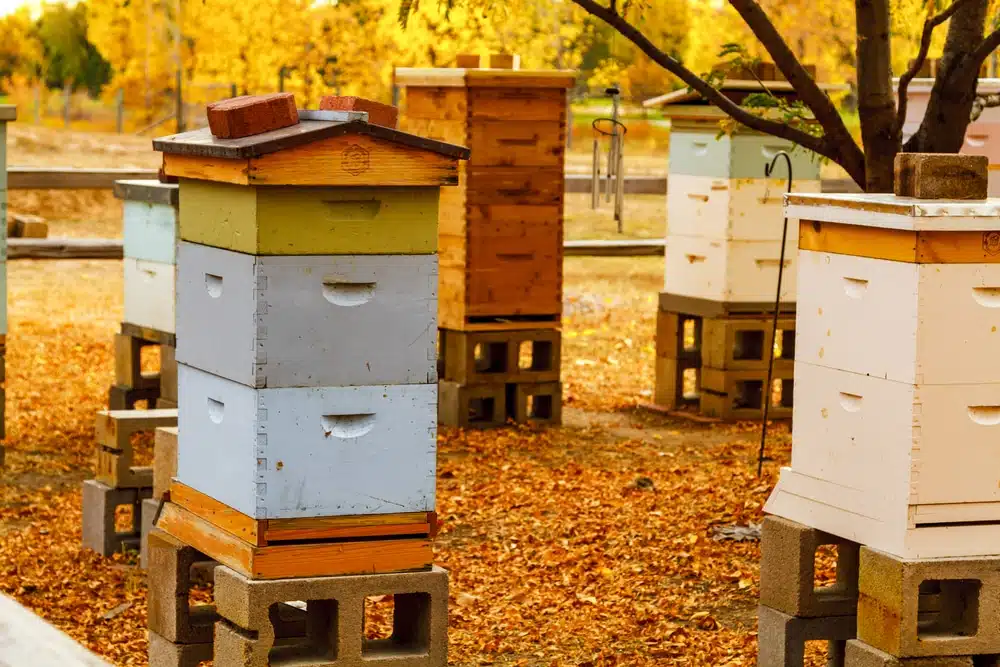
Autumn does not close the season: it opens it. Between September and November the bees that will carry the colony through to March are born and, at the same time, varroa peaks on an ever-shrinking brood nest. What you do in these weeks (treating on time, feeding protein, replacing the queen that is not up to it, adjusting space and stores) decides how many colonies start the spring and how strong they are. This guide sets out those decisions with the figures behind each one.
The five autumn tasks
- Varroa: measure when you take the supers off, treat without waiting and check efficacy two weeks later. Target: a follow-up count close to zero (Véto-pharma suggests fewer than 50 residual mites per colony).
- Winter bees: protein in September so that they are born “fat”. If no pollen is coming in, patties of around 10 % protein (Pajuelo Consultores manual).
- Queen: assess the laying and replace the queen that is not up to it, before the cold closes the window.
- Space and stores: 10 to 20 kg of stores depending on the area, volume matched to the bees, weak colonies united and entrances reduced.
- Forage and defence: make the most of the autumn flowers and keep Asian hornets, robbing and mice in check.
Equipment for this task
 Varroa Easycheck
 Megabee protein powder for bees
 Tartago® water-tray harp kit: harp, 15 W solar module and tray
Monitoring, feeding and hornet protection meet different needs. The counter measures mites; prepare the protein powder according to its exact label and select harp protection for observed pressure.
Seasonal guide. It follows on from summer beekeeping (in Spanish) and continues in winter beekeeping (in Spanish). The whole year is in the beekeeping calendar.
1. Why autumn decides the spring: winter bees
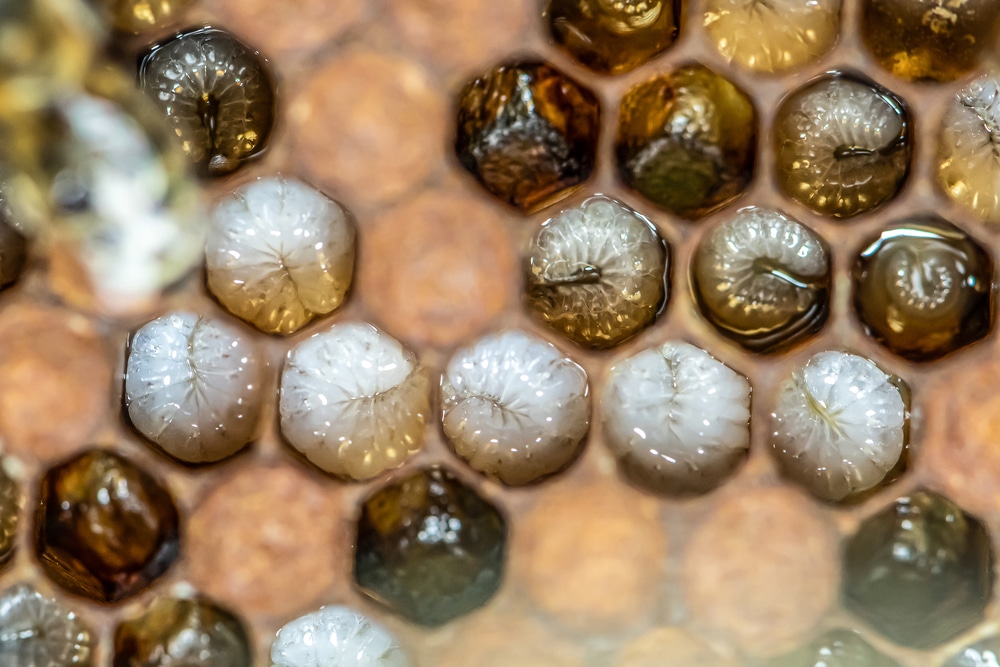
A colony raises two different bees over the year. The summer bee lives 4-6 weeks: it emerges, nurses brood, builds comb, forages and dies worn out. The winter bee, the diutinus bee, lives 160-200 days. It emerges between mid-August and mid-September depending on the area, does very little brood rearing, and builds up vitellogenin in its fat body, a storage protein that gives it longevity, immune defences and the ability to produce royal jelly in February for the first larvae of the following year.
| Bee | Lifespan | What defines it | What ruins it |
|---|---|---|---|
| Summer bee | 4-6 weeks | Few body reserves; emerges and works | The normal wear and tear of the season |
| Winter bee (diutinus) | 160-200 days | Fat body loaded with vitellogenin; sustains the cluster until March and rears the first larvae | Emerging parasitised by varroa or without pollen: it lives fewer than 160 days and the colony runs out of replacements in January |
The curves that cross. From July the bee population falls while the varroa population keeps rising until October. In a temperate-climate model, if nothing is done, the load goes from 6 mites per 100 bees in July to 35 per 100 in September-October. A colony carrying that load can look healthy in November and be empty in January: it is a common picture of winter loss, one of those often grouped together as colony collapse disorder (in Spanish). Autumn varroa, residues in the wax and poor nutrition tend to add up in it, and each case has to be diagnosed, because the name does not explain the cause.
The mite feeds precisely on the fat body. A diutinus bee parasitised as a pupa has less vitellogenin, a less developed immune system, wings damaged by deformed wing virus (DWV) and a shorter life. That is why everything that follows in this guide hangs on the same thing: winter bees that emerge healthy and well fed.
2. Varroa: measure, treat on time and check
When to treat
As soon as you take the supers off, not on a fixed date. The idea of “I treat in September, after the harvest, not a day before” is the one that loses the most colonies: if the harvest drags on, the winter bees emerge under the mite’s peak load. If you want to squeeze a late flow, measure first: if the load is already high, the colony is worth more than that honey. And no treatment goes on with the honey supers in place: what each product allows is set out in its summary of product characteristics.
In Spain, at least one treatment a year with a registered medicine is a legal requirement, but not all of them require a prescription. According to CIMAVET, the database of the Spanish Agency of Medicines, as of September 2026 amitraz (Apivar, Apitraz, Amicel), flumethrin (Bayvarol), tau-fluvalinate (Apistan) and Formicpro are dispensed with a veterinary prescription, and thymol (Apiguard, Thymovar), oxalic acid (Api-Bioxal, Oxybee, Varroxal, Calistrip Biox) and Varromed without a prescription. CIMAVET also holds the up-to-date list and the summaries of product characteristics. The ones that require a prescription, and how to order them, are in varroa treatments with a veterinary prescription; the rest, in varroa treatments; the background to the problem, in what Varroa destructor is and how to treat it (in Spanish).
| Figure | Value | What it means |
|---|---|---|
| Spring monitoring | Measure and record | It shows the trend; the action level is agreed with the vet according to method, season and area |
| Damage threshold (MAPA technical guide, 2019) | More than 3-5 mites per 100 adult bees | Loads that can be harmful. In autumn, with the winter bees being reared, you do not wait |
| Mite population growth | x2 a month without drones, x3 with drones | Every month of delay multiplies the problem |
| Target after treatment (Véto-pharma, 2024) | Fewer than 50 residual mites per colony | Checked with a new count using the same method, which should come out close to zero |
How to measure
- Which colonies: all of them, if the apiary is small. If that is not possible, a sample combining the suspect ones (bees with damaged wings at the entrance, dead mites on the floor, restless colonies or colonies being robbed), those at the ends and in the front row, where foragers loaded with mites drift in, and a few chosen at random.
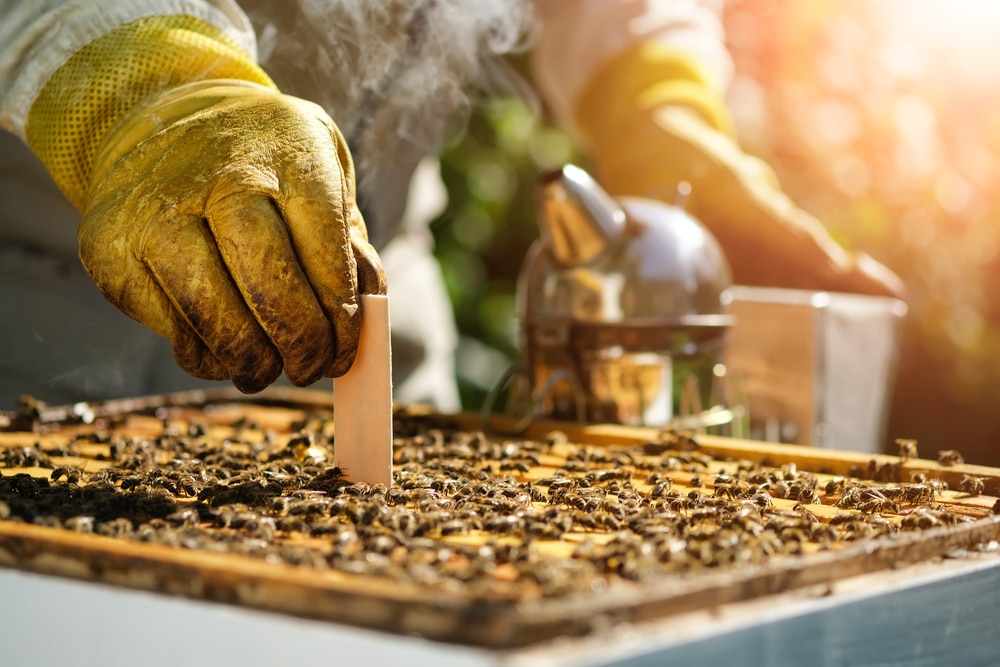
- On worker brood: a square of 100-200 sealed cells in the upper front quarter of the comb, uncapped with a short, very sharp knife. Count the mites that move, count the pupae and divide. Drone brood is no use: it gives erratic percentages.
- On adult bees: 200-300 workers with icing sugar (it dislodges fewer mites than alcohol, and with damp conditions or honeydew the count comes out low), alcohol or CO₂. Looking with the naked eye does not work: 80 % of the mites ride on the underside of the bee.
The procedure with photos is in varroa diagnosis, and the equipment in disease diagnosis.
Which treatment to choose in autumn
There is no product that suits everyone: it depends on how warm your autumn is, whether there is brood and what you used last year. This table summarises the active substances registered in Spain as of January 2025; the summary of product characteristics of each medicine prevails over any overview.
| Active substance | How it works | When it fits in autumn | Watch out for |
|---|---|---|---|
| Amitraz (Apivar, Apitraz strips; Amicel in 2 applications 12 days apart) | Contact, long-acting: covers several brood cycles | The main treatment with brood present. Very effective, although reduced sensitivity to amitraz has already been described in Spain (Hernández-Rodríguez et al., 2025): check efficacy with a follow-up count | Remove the strips at the end of the treatment period and rotate with another substance to preserve its efficacy |
| Flumethrin, tau-fluvalinate (Bayvarol, Apistan) | Contact, long-acting strips | Rotation alternative | Resistance is common: always check efficacy with a follow-up count |
| Formic acid (Formicpro, Varromed with oxalic acid) | Vapour; the only molecule that gets under the cappings | Mild autumn, between 15 and 29 °C with flight activity. Allowed in organic beekeeping | Not in weak colonies; entrance open; it stops laying for about 5 days and increases defensiveness in the first few days |
| Thymol (Apiguard, Thymovar) | Vapour, two applications 2-4 weeks apart | Autumn with flight activity and 15-30 °C. Allowed in organic beekeeping | In the cold it stops evaporating; it drives bees away from the area where it is applied |
| Oxalic acid (Api-Bioxal, Oxybee, Varroxal by trickling or sublimation; Calistrip Biox in strips) | Contact; does not get under the cappings. Applied according to its summary of product characteristics and without supers, it does not accumulate in the wax; misapplied, it can raise its content in the honey | With little or no brood: late autumn and the winter clean-up treatment. Slow-release strips can be used with brood if bees pass over both faces. Allowed in organic beekeeping | Corrosive: gloves, goggles and mask. The application temperature depends on the product and the method: it is set in its summary of product characteristics |
The 40-day rule. A contact acaricide takes about 3 days to spread over the bees’ body hair. The mites that were under the cappings at the start emerge over the next 12 days, spend 3-11 days on adult bees and go back under the cappings for another 12. For the product to reach that second cycle it needs about 40 days of action, and one more week if there is drone brood. That is why strips are left in for the full period stated in the leaflet and not a day longer: leaving them in all winter does not kill more mites, it only selects the resistant ones.
Three handling rules, whatever the product: never with the honey supers on; place the strips in the centre of the brood and move them if the cluster shifts; and protect whoever applies them with suitable gloves, clothing and mask. The wax in the brood box accumulates residues from all these treatments and passes them back into stored pollen: above 100 ppb in pollen, brood mortality and winter colony losses are already measurable. It is one more reason to renew 20-30 % of the combs every year and to have foundation made only from super wax, which carries three times fewer residues.
Checking efficacy
A treatment that is 90-95 % effective leaves alive between 5 and 10 % of what was there. If you started with 500 mites, 25-50 are left and you are safe; if you started with 10,000, 500-1,000 are left and the colony is still in danger. That is why the count after treatment is the one that tells you whether you have finished: do it one or two weeks after removing the product.
| Mites at the start | Left at 95 % efficacy | Left at 90 % efficacy | Situation |
|---|---|---|---|
| 500 | 25 | 50 | Target met |
| 2,000 | 100 | 200 | A second hit is needed |
| 10,000 | 500 | 1,000 | Colony at risk even though the product has worked |
If the count is still high, before talking about resistance go over the usual explanations: a huge initial infestation, an application that was too short or made outside the temperature range, and above all reinfestation. Colonies collapsing from varroa are an irresistible target for robbing by their neighbours, which carry off the honey and the mites. Remove any dead colony from the apiary the same day you see it and do not reuse its equipment until the cause has been ruled out: if it was varroa, the mite does not survive many days without bees; if there are signs of foulbrood or another disease, tell your vet before touching it. If there is still a load after all that, the way out is a clean-up treatment with oxalic acid when there is no brood, which in much of Spain is December or January and on the Mediterranean coast sometimes never comes. We cover it in the winter guide (in Spanish) and in the integrated varroa control strategy.
3. Autumn feeding: protein now, a strong start in March
The Mediterranean autumn arrives dry. If it does not rain in September, the colony rears its winter bees with old bees and little pollen from few plants, and that is the scenario for autumn malnutrition (in Spanish): larvae almost dry of jelly, workers whose abdomen is shorter than their wings, cannibalised pupae, pollen cells all of one colour. The right diet is 80 % honey and 20 % pollen from at least 4-5 different plants; when the countryside does not provide it, you do.

| Goal | What to give | How much | Condition |
|---|---|---|---|
| Build up the population (laying queen and scarce pollen) | Protein patty of around 10 % protein, with 1:1 syrup if stimulation is needed | Small portions, about 250 g a week, that are finished within a few days | With flight activity and the colony eating it. If it is not finished within a few days, it dries out or ferments: adjust the portion |
| Top up stores without stimulating | Thick 2:1 syrup or honey substitute | 1-2 kg per colony a week for 3 weeks; never more than 5 kg a week | Above that amount it is stored in the combs and contaminates the next harvest |
| Maintain (cold, no laying) | Candy or fondant with no more than 4 % protein if there is no stored pollen | About 1.5 kg per colony a month | Solid, on top of the cluster. No more syrup: below 12 °C the bees that visit it get chilled and drown |
Two placement rules that prevent most failures. Feed goes in the heated zone, no more than 10 cm from the brood: outside that zone the bees do not touch it once it turns cool, and in a Layens hive that means opening a gap next to the top bars of the brood frames. And syrup goes in at dusk, without spilling a drop, with the entrance reduced: in autumn there is no flow and any smell of sugar sets off robbing. A colony that does not eat should be marked and checked: it almost always hides a queen or disease problem.
How much in stores to leave
There is no universal weight: it depends on the climate, the length of the winter and the hive. As a guide, a colony needs 10 to 20 kg of stores, depending on the area. You estimate them by weighing the hive and subtracting the tare of your equipment, or by looking at the frames: a British Standard brood frame full of honey holds about 2.3 kg. If there is a shortfall, make it up now, in October, not in January.
With autumn honey there is a temptation and a trap. The temptation is to harvest it: experience says that leaving it costs less than the syrup that replaces it, and that what is not harvested in November is harvested in March as spring honey (autumn feeding (in Spanish) goes into this). The trap is to count on it blindly: ivy honey and ling heather honey crystallise in the comb within days, so hard that in midwinter the cluster cannot eat them. If your stores come from those flowers, also leave combs of summer honey or top up with thick syrup in good time.
4. The queen: replace her now or pay for it in spring
The autumn queen check is done after treatment and before the cold closes the window: in most of Spain, September and the first half of October. You look at the same things as in spring, but the consequence is different: a queen that fails now will not lay the diutinus bees you need, and by November there is no way to fix it.

| What you see | What you do |
|---|---|
| Compact laying, more than 90 % of sealed cells with live brood, stores in the arch | Nothing. This is the queen you want |
| Spotty brood after treatment, with no varroa or foulbrood to explain it; frayed wings; declining laying | Replace her now with a mated queen, while there is still some flow and warmth for her to be accepted |
| Several eggs per cell, drone brood in worker cells | Drone-laying colony: a queen will not save it. Unite its bees with a queenright colony |
| Queen two years old or more that is laying well | Assess laying and brood before deciding: annual requeening can reduce swarming, but age alone does not justify replacing her |
In most of Spain queens are no longer reared in autumn: without mature drones there is no mating. Queens are bought in or come from the rearing you did in summer. If you are going to introduce them, do it as early as possible in September: with plenty of young brood and syrup, acceptance is good; in November, with the colony closing down, it is a lottery. Mated queens and nucs, in live bees.
5. Balancing the apiary: space, weak colonies and storage
In autumn a colony should occupy only the space its bees can keep warm. Brood needs 33-35 °C and bees lose mobility below about 12 °C: every empty frame you leave is wasted heat, condensation and a corner for wax moth. The list is short and done in a single visit:
- Remove empty supers and frames without bees. Compress the nest with dividers and, in cold areas, with a plastic sheet (poncho) that leaves an air gap at the front and back.
- Unite colonies too small to winter in your area and in your hive type, after ruling out disease as the cause of the weakness. They rarely get through the winter, and if they do they reach March without the strength to build up. One live colony is worth more than two dead ones: the Farrar rule explains why, and how to unite colonies (in Spanish) puts it into practice.
- Frames of honey beside the cluster, never far from it: food left outside the warm zone is not eaten, and the colony starves with stores in the hive.
- Reduce the entrance. It works against robbing, against Asian hornets and against mice, which from October look for a warm place full of pollen.
- Check roofs and siting before the rains: watertight roofs, stones against the wind and away from hollows where water can wash hives away. The details on insulation and condensation are in hive insulation and ventilation.

What goes into storage
The drawn combs you remove are among the most valuable things you have, and a mild autumn is the favourite season of the wax moth: in warm weather its cycle speeds up and in three weeks it destroys a super. Store combs below 12 °C with air circulation. A freezer at -15 °C for two hours kills all stages. Mark the old, dark combs now, and those that have had strips next to them: they are the ones to melt down in winter and not go back into the brood box. How to do it, in working with wax.
No sulphur and no homemade fumigants: treating stored equipment with a chemical product requires it to be authorised for that use, and then you follow its label. Cold and freezing need no authorisation.
6. Defending the apiary: Asian hornet, robbing, bee-eaters and mice
Autumn is the season when the most creatures want to eat your colony. In the northern half of Spain, the most serious is the Asian hornet: its nests reach their peak number of workers between August and November, and those workers hunt bees while hovering in front of the entrance. The direct damage is smaller than the indirect: the colony stops flying out, no pollen comes in just when the diutinus bees are being reared, and it starves with the countryside in flower.
| Threat | When | Sign | Measure |
|---|---|---|---|
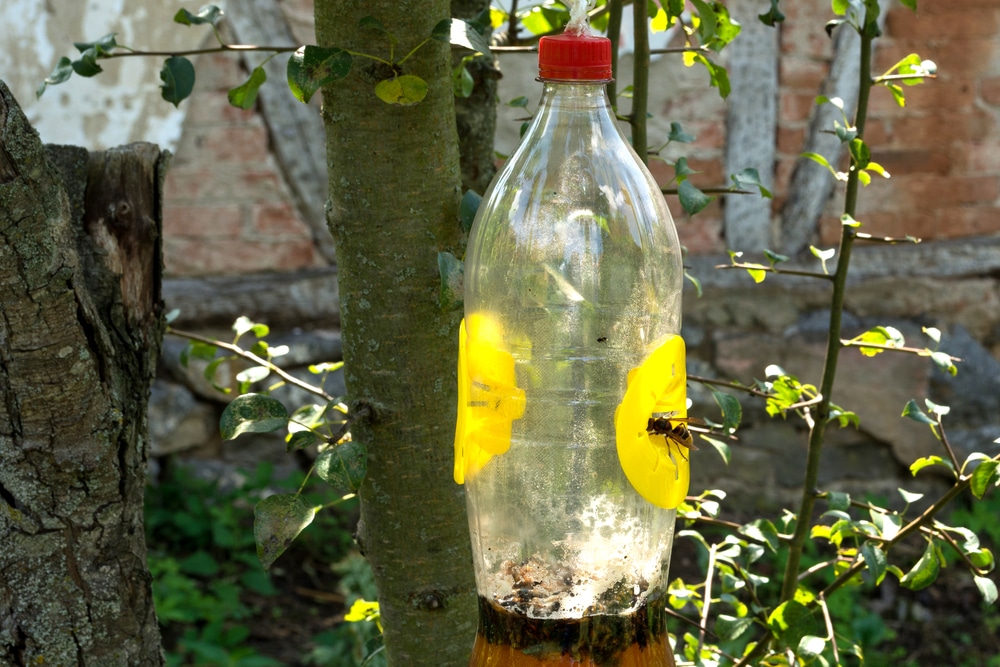
| Asian hornet | August-November | Hornets hovering in front of the entrance; bees bunched up inside that do not fly out | Entrance reducer or entrance barrier tested on your hive, electric harp and selective traps within your autonomous community’s programme. Homemade bottle traps catch more other insects than Asian hornets |
| Robbing | Any day without a flow | Fighting at the entrance, light-coloured wax crumbs at the entrance, bees leaving heavy | Entrance reduced, short inspections, no honey or syrup left in the open, weak colonies united or moved |
| Bee-eater | Migration, August-September | Flocks over the apiary, bees that do not fly out while they are there | It is temporary: the colony recovers if it has stores. More in bee-eaters and hives |
| Mice | October onwards | A trail of dark crumbs leading to the hive; gnawed pollen comb | Entrance reducer or 6-7 mm mouse guard before they get in, not after |
| Nosema | Damp, cold autumn | Dead bees in an arc in front of the entrance, bees with a short abdomen; N. ceranae does not cause diarrhoea | Sunny apiary sites free of fog, proper nutrition. Diagnosis and management in nosemosis |
7. Autumn flowers: where the forage is and what it gives
Autumn is not a desert, but its forage runs at two speeds. In Atlantic Spain the damp keeps plants flowering until the cold arrives; in Mediterranean Spain everything depends on the September rains: if they come, the scrubland sprouts again and the bees find 13-14 types of pollen again, against 3-4 in summer (Pajuelo, 2018). If they do not, the colony rears its diutinus bees on whatever it has stored. These are the plants that mark the beekeeping autumn in the Iberian Peninsula.
| Plant | Flowering | Where | What it gives | Watch out for |
|---|---|---|---|---|
| Ivy (Hedera helix) | September-November | Throughout the Peninsula: riverside woodland, walls, hedges | Plenty of nectar and pollen just when the diutinus bees are emerging | Its honey crystallises within days, very hard and bitter: poor as the only winter store |
| Ling heather (Calluna vulgaris) | August-October | Siliceous north: Galicia, the Cantabrian coast, the Central and Iberian ranges | Nectar | Jelly-like honey, almost impossible to extract; crystallises in the comb. More in heather honey (in Spanish) |
| Winter-flowering heath (Erica multiflora) | September-December | Mediterranean coast: Catalonia, Valencia region, Balearic Islands | Nectar and pollen; the autumn flowering of the coastal scrub | Limestone soils |
| Strawberry tree (Arbutus unedo) | October-December | Mediterranean coast, Sierra Morena, south-west | Nectar; can give a harvest in hill country | Bitter honey that not every market accepts; good as stores. Profile in strawberry tree honey (in Spanish) |
| Carob (Ceratonia siliqua) | September-November | Mediterranean coast | Nectar, and pollen from the male trees | Dark, astringent honey. Profile in carob honey (in Spanish) |
| Autumn rosemary (Rosmarinus officinalis) | October-December, after the rains | East and south-east Spain, on limestone | Nectar; it is the start of the rosemary (in Spanish) season | Without September rain it does not flower. Usually left as stores |
| Loquat (Eriobotrya japonica) | November-December | Alicante, Valencia, Málaga, Canary Islands | Nectar and pollen when almost nothing else is in flower | One of the few autumn honeys that are harvested. Profile in loquat honey (in Spanish) |
| Tasmanian blue gum (Eucalyptus globulus) | November-February | Galicia, Cantabrian coast, Huelva | Lots of nectar | Its pollen is low in isoleucine: without other pollens, the bees fall ill. More in eucalyptus honey |
| Gorse (Ulex europaeus) | Autumn-winter | Atlantic coast | Pollen when there is no other | Little nectar |
| Holm oak and oak honeydew | Late summer-autumn, depending on the year | Dehesa wood pasture and mountains | Honeydew: holm oak honey (in Spanish) | Irregular: some years it does not appear. Rich in minerals, not always a good winter store |

Two autumns, two ways of managing
In the damp north the problem is not food, it is damp: honeys that crystallise in the comb, nosema in foggy apiary sites and Asian hornets at the entrance. There it pays to leave summer honey as stores, choose sunny sites and finish the varroa treatment properly before the cold rules out formic acid or thymol. On the Mediterranean coast the opposite happens: with winter-flowering heath, strawberry tree, carob and rosemary the colony can keep rearing brood all autumn and sometimes all winter. That gives well-fed diutinus bees, but it also means that varroa never stops: the broodless oxalic treatment in December never comes, and control relies on the autumn treatment and on counts.
A dry autumn is no longer just a Mediterranean thing. In 2025, in southern Cantabria and northern Castile and León, some colonies went three and four months without brood replacement: they reached winter with few bees, of poorer quality, and mortality was higher. Beekeeper Manuel Barquín described it in his talk “Nuevas decisiones en la apicultura ante el cambio climático” (Asociación Montañesa de Apicultores, 2026, in Spanish), as what he saw by asking around the area, not as a study. If September arrives dry, even if you are in the north, look at the brood and the pollen coming in: that is when autumn protein makes the difference.
If you migrate hives in autumn to strawberry tree or heather, the rule is the same as in summer: only strong, already treated colonies go; moving a colony loaded with varroa to a flow does not save it, it just puts it on the lorry with its mites. In high areas, where laying stops with the first frosts, the opposite happens and it is an advantage: use that break for a broodless treatment, which is the most effective of the year and also gives the queen a biological rest.
8. Autumn month by month
| Month | What to do | Adjustment by area |
|---|---|---|
| September | Remove supers and extract. Varroa count (every colony or a representative sample) and treatment when the supers come off. Protein patties if no pollen is coming in. Assess queens and replace those that are failing. Asian hornet: measures from your autonomous community’s programme | North: use the last warm days for formic acid or thymol. Mediterranean: if it rains, wait to see what sprouts again before harvesting the autumn honey |
| October | Follow-up count 1-2 weeks after treatment. Top up stores with thick syrup if short. Unite weak colonies, remove empty supers, reduce entrances. Surplus combs into storage, in the cold or after freezing | Cold inland areas: the last weeks for liquid syrup. Coast: heath and strawberry tree pollen keeps coming in; laying continues |
| November | Switch to maintenance candy. Plastic sheet or divider where it is cold. Secure roofs, check sites against wind and water. Melt old wax and prepare equipment | High areas: laying stops; plan the broodless oxalic treatment for December. Coast: loquat, carob and rosemary; the colony is still active and robbing needs watching |
And when the cold closes the colony down, the work goes on in the store and at the entrance. Continue with winter beekeeping (in Spanish).
What should you do with your hives in autumn?
Five things: measure and treat varroa as soon as the supers come off, feed protein so that the winter bees emerge in good condition, assess the queen and replace the one that is failing, adjust space and stores (10 to 20 kg depending on the area, weak colonies united, entrance reduced) and defend the apiary against Asian hornets, robbing and mice.
When do you treat for varroa in autumn?
As soon as the honey supers come off, without waiting for a fixed date. Winter bees emerge between mid-August and mid-September and need to emerge with the lowest possible mite load. One or two weeks after removing the product, do a follow-up count, which should come out close to zero (Véto-pharma suggests fewer than 50 residual mites per colony).
How much honey should you leave a colony for winter?
There is no universal figure: it depends on the climate and the hive. As a guide, 10 to 20 kg of stores, estimated by weighing the hive and subtracting the tare, or by looking at the frames. If there is a shortfall, top it up in October with thick 2:1 syrup, without going over 5 kg per colony a week.
Can you feed bees syrup in autumn?
Yes, as long as the bees are active and the feeder is less than 10 cm from the brood. When the temperature drops below about 12 °C syrup no longer makes sense: the bees that visit it get chilled and die inside. From then on, switch to candy or fondant on top of the cluster.
Which plants flower for bees in autumn?
Ivy throughout the Peninsula; ling heather, gorse and Tasmanian blue gum in the Atlantic north; winter-flowering heath, strawberry tree, carob, autumn rosemary and loquat on the Mediterranean coast; and holm oak and oak honeydew in dehesa wood pasture and mountains. Ivy and ling heather honey crystallise in the comb and are no good as the only winter store.
Can you replace the queen in autumn?
Yes, but early: in September or the first half of October, with young brood and some flow, a mated queen is readily accepted. In November it is a lottery. In most of Spain queens are no longer reared in autumn, because there are no mature drones to mate them.


