

A strong colony can produce more honey per bee than several smaller colonies with the same total population. That is the useful management lesson behind Farrar’s rule. However, the familiar square-law example — 3 kg of bees giving 9 kg of honey and 6 kg giving 36 kg — is not a reliable yield forecast or the equation established by Farrar’s 1937 study. Colony strength matters, but so do forage, timing, health and management.
Colony strength and relative efficiency
| Adult bees per colony | Relative production per bee |
|---|---|
| 15,000 | 1.00 — reference |
| 30,000 | 1.36 |
| 45,000 | 1.48 |
| 60,000 | 1.54 |
In this guide
- the formula and where it comes from;
- five practical lessons from Farrar’s work;
- how to apply it in the apiary;
- synchronisation with nectar flows;
- the model’s limits.
Beekeeping involves far more than smoking bees and harvesting honey. Understanding the relationship between population and production helps us manage colonies for a nectar flow. American entomologist and beekeeper Clayton L. Farrar investigated that relationship using colony populations and honey gains measured over short, comparable periods. His work supports building strong colonies, not predicting a fixed harvest from bee weight alone.
The formula: useful shorthand, not a yield calculator
The square-law illustration takes a population weight and squares its numerical value: 3 squared is 9, and 6 squared is 36. Those figures can illustrate a hypothetical advantage of concentrating population, but they must not be labelled as kilograms of honey. Squaring kilograms does not itself produce a honey-yield unit; a calibrated relationship, a time period and comparable conditions would all be needed. Farrar’s original analysis instead used regression and standardised production factors.
The practical issue is how the workforce is allocated. A growing colony needs workers for brood care and other in-hive tasks as well as foraging. Farrar noted that smaller colonies reared more brood relative to their adult population. Larger colonies can therefore have a productive workforce advantage, but there is no universal forager percentage that can be inferred simply from counting total bees.
Five lessons from Farrar’s work
- In the study, honey production per bee generally increased with colony population over the range examined; a universal square law was not established.
- A comparison must use equivalent nectar availability and observation periods. A larger crop in a different season does not, by itself, isolate a population effect.
- Smaller colonies can rear more brood relative to their adult population; do not reverse that relationship or assign a fixed adult-to-larva ratio to every hive.
- Strong colonies are particularly useful for short nectar flows, because small colonies have less time to build up during the flow.
- Over a longer flow, smaller colonies may gain strength and narrow the initial advantage. Monitor the colony’s trajectory, not just one population estimate.
| One colony | Same total bees in smaller colonies | Reported relative honey production |
|---|---|---|
| 30,000 bees | 2 × 15,000 bees | 1.36 times the combined output |
| 45,000 bees | 3 × 15,000 bees | 1.48 times the combined output |
| 60,000 bees | 4 × 15,000 bees | 1.54 times the combined output |
How to apply it in the apiary
For honey production, the lesson is to build healthy colonies to an appropriate strength before the target nectar flow. Translate it into management decisions, rather than treating it as an instruction to maximise hive size at any cost:
- Assess strength in the context of your hive system. Brood-frame counts are not comparable unless frame size, brood coverage and adult coverage are considered. Provide suitable space and monitor swarming.
- Split for a defined purpose. Swarm management, replacement queens and apiary increase may justify division; weigh those aims against the immediate honey crop.
- Two-queen systems are a specialised way of building population, not a matter of simply placing two queens together. They need suitable equipment and experienced management.
- If you plan to increase the apiary, schedule the work around colony development, queen availability and the target flow, with enough season left for new colonies to establish.
- Before deciding to unite weak colonies (in Spanish), establish why they are weak. Do not combine suspect diseased colonies or transfer their combs to healthy ones; obtain appropriate bee-health advice first.
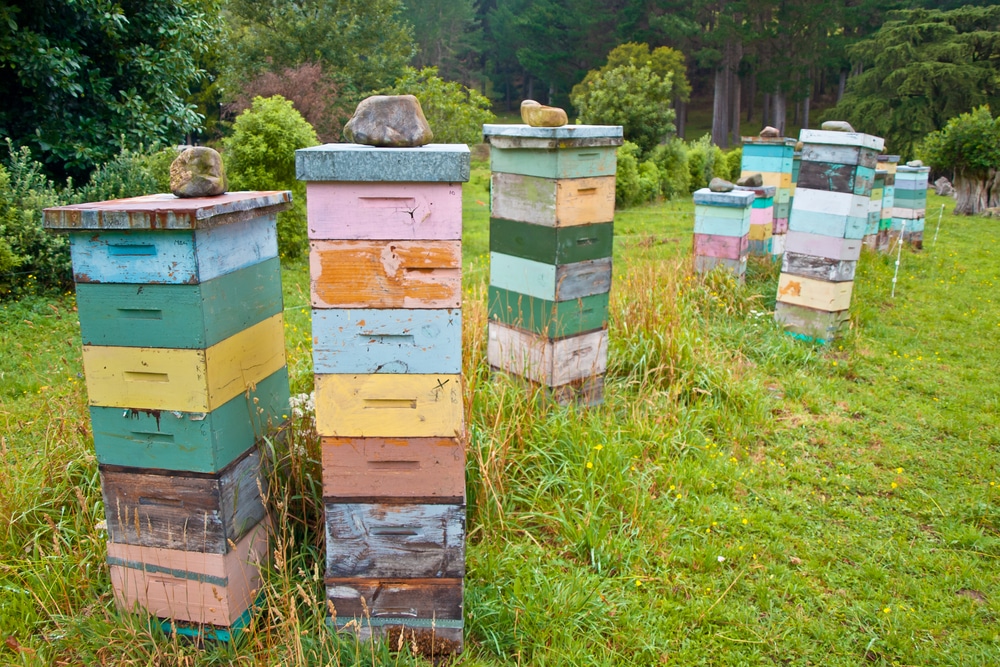
Timing colony strength to nectar flows
Timing matters during seasonal build-up. If the main flow is in May, reaching peak strength in July will not recover that missed crop. The example is about timing, not a universal calendar: work to the nectar flows in your own climate, and allow time for brood to emerge and the workforce to develop.
Know the calendar of nectar and pollen flows in your area (in Spanish) and work backwards from it. Reassess that calendar against current flowering and weather. A late frost, drought or prolonged rain can change what a large population is able to collect.
The limits of the rule
Farrar’s findings are useful evidence, not a physical law or a guarantee for every colony. They came from particular colonies, seasons and short observation periods. His study also contained periods in which the per-bee advantage did not increase. Do not extrapolate the numerical factors to every region, unlimited colony size or an entire season.
Where the advantage is limited: more bees cannot create nectar where there is none. A populous colony still has maintenance and brood-rearing needs and can consume reserves during a dearth. Consider forage availability, colony health, queen performance, swarm risk and adequate space together. Neither a large hive nor a mathematical rule replaces inspection and sound judgement.
Test, measure and adapt to your own conditions. Keep records of each colony’s performance, including inspections, feeding, super changes and harvests. A whole-hive weight includes equipment, comb, food and bees; it is not a direct measurement of adult bee population. Compare like with like before changing your management.
Frequently asked questions
What is Farrar’s rule?
It is a practical idea associated with Clayton L. Farrar’s work: strong colonies can produce more honey per bee than smaller colonies under comparable nectar-flow conditions. It is not a universal square-law yield calculator.
Can I calculate honey yield by squaring the weight of the bees?
No. The familiar 3-to-9 and 6-to-36 example is a simplified illustration, not a prediction in kilograms of honey. Yield also depends on the flow, time period, colony health and management.
Why can a strong colony produce more per bee?
Workforce allocation and the balance between brood rearing and adult population can favour a strong colony during a flow. The proportion of foragers varies; it cannot be read from a fixed population-percentage table.
Is it better to keep fewer strong colonies or many weak ones?
For a target honey crop, healthy colonies at suitable strength can use labour and equipment efficiently. Breeding, replacement colonies and swarm management may justify splits. Diagnose weakness before uniting colonies and never use uniting to conceal suspected disease.
Is the advantage of a strong colony always the same?
No. Weather, forage, colony condition and the length of the nectar flow affect it. Smaller colonies can build up during a long flow, while any colony may consume stores during a dearth.
Continue reading
- How and when to unite hives (in Spanish), the direct application of this rule.
- Increasing the apiary, and when a split is worthwhile.
- Hive monitoring (in Spanish), to measure weight instead of estimating it.
- Is beekeeping profitable?, where this translates into euros.
Primary reference: C. L. Farrar, The influence of colony populations on honey production, Journal of Agricultural Research 54 (1937), pages 945–954. This English edition clarifies the numerical examples against the original study. The linked shop pages and related blog articles are currently in Spanish.

ISNI 0000 0005 1801 1100 | Joshua Ivars is the manager of LA TIENDA DEL APICULTOR and the author of this blog, where he shares technical and practical guidance for beekeepers. Drawing on extensive experience in the beekeeping sector, he offers advice and solutions based on beekeepers’ real needs, sharing his knowledge of equipment and essential beekeeping practices.


