

Beekeeping is the care and management of bees for honey and other hive products, and for pollination. This guide focuses on the western honeybee, Apis mellifera, the species commonly kept in Europe. The person tending the bees is a beekeeper; a site where hives are kept is an apiary or bee yard. Start with practical training, a suitable site and a realistic budget for bees, equipment and their continuing care. The registration and legal sections below apply to Spain; readers elsewhere should check their own local requirements.
The short answer: how to become a beekeeper in 5 steps
- Get training before buying bees. A practical course, a mentor or a local association can help you avoid common first-year mistakes.
- Find the site. Morning sun, wind protection, access to water, discreet access, and compliance with legal distance requirements.
- Complete the required registration. In Spain, this includes registering the holding in REGA and keeping its required records, even for one hive.
- Consider starting with 2 to 4 colonies if your resources allow it. Use compatible hive equipment and keep some spares.
- Learn to read the colony before thinking about a harvest: a functioning queen, an even brood pattern, adequate stores and Varroa under control.
What you will find in this guide
- what apiculture is and what each element is called;
- what a beekeeper does throughout the year;
- what you need to get started and the realistic kit;
- how many hives to have in your first year;
- where to place the apiary and legal distance requirements;
- registration, REGA, and the logbook;
- how much it costs to start properly;
- the most expensive mistakes made in the first year.
What beekeeping is (and what everything is called)
The technical term apiculture comes from the Latin apis (‘bee’) and cultura (‘cultivation, rearing’): literally, bee rearing. Beekeeping combines practical skills with an understanding of bee biology. Observation, consistency and sound judgement matter more than rushing towards a first harvest.
As in any craft, everything has a name. These are the terms you will hear from day one and should not confuse:
| The term… | Meaning… |
|---|---|
| Apiculture | The practice of keeping and managing honeybees. The everyday English word is beekeeping. |
| Beekeeper (a gender-neutral term) | The person who keeps and cares for bees. |
| Apiary or bee yard | A site where hives are kept. An apiary may be used for honey production, queen rearing or other beekeeping work. |
| Hive | The box or structure that houses the colony. There are several models (Langstroth, Dadant, Layens…). |
| Colony and swarm | A colony is the living social unit, normally with a queen, workers and seasonally drones. A reproductive swarm is a queen and workers leaving to establish a new colony. The terms are not interchangeable. |
| Honeybee | Apis mellifera, the species managed in Europe, with several subspecies or strains. |
| Meliponiculture | The keeping of stingless bees, with methods suited to their biology. It is practised beyond the Americas, including parts of Asia and Africa; this guide concerns Apis mellifera, not stingless-bee husbandry. |
People come to beekeeping for different reasons: honey for their own household, time outdoors, an interest in bees or a possible livelihood. As their skills develop, they may explore selection, queen rearing, colony population dynamics and preventive bee health. None of those ambitions removes the need to master the basics.
The golden rule: beekeeping is local. What works during a Mediterranean orange-blossom flow may not work on upland heather. Be wary of any recipe that ignores the region, the forage and the year.
What a beekeeper actually does throughout the year
Many people imagine beekeeping as simply ‘putting down a box and collecting honey’. In reality, the work follows an annual cycle governed by flowering and nectar flows, not the working calendar. In broad terms:
| Season | Main work | Objective |
|---|---|---|
| Winter | Check stores and external signs while avoiding unnecessary opening in cold weather; intervene appropriately if the colony needs help. Repair spare equipment. | Bring the colony through winter alive and with adequate stores. |
| Spring | Inspections, space management, swarm prevention and adding supers. | Build the colony population in time for the main nectar flow. |
| Summer | Harvesting, Varroa control, water and shade, and robbing prevention. | Harvest without compromising the colony’s winter preparations. |
| Autumn | Complete timely Varroa control, provide feed if stores are low, and investigate weak colonies before considering uniting them. | Rear healthy, well-fed winter bees. |
For more detail, see the seasonal tasks in our beekeeping calendar: spring, summer and winter.
What you need to start beekeeping
You need three things before you need hives: basic training, a viable site and a bee-health plan. The rest is equipment, time and many hours spent looking at frames until you can truly ‘see’ what is happening.
What really makes a difference at the beginning is humility. Beekeepers with 20 or 30 years of experience will tell you, without pretence, that they are still learning. Bees are not machines: weather changes, nectar flows fail and Varroa pressure rises and falls. The best thing to acquire at first is not a hive, but the habit of asking ‘why?’ before copying a recipe.
Essential kit for a beginner beekeeper
| Item | Purpose | What to consider |
|---|---|---|
| Smoker | Calm and manage the colony during inspections. | Use a sound smoker and clean, untreated fuel that gives cool smoke. Follow local fire restrictions and extinguish it fully before transport. |
| Hive tool | Loosen and separate frames and supers. | Good leverage saves your wrists and your patience. |
| Protective clothing, veil and gloves | Protection. | Choose secure closures and a suitable fit. Protective clothing reduces exposure but cannot guarantee freedom from stings. |
| Brush | Remove bees from a frame. | Better still, learn to move bees without excessive brushing. |
| Feeder | Supply suitable sugar syrup or bee fondant when energy stores are inadequate. | Match feed and feeder to conditions; do not allow sugar feed to enter honey intended for harvest. |
| Frames and wax foundation | Spares and expansion. | Keep a few assembled and wired: when you need them, it is too late to start preparing frames. |
| Notebook or app | Record of every visit. | Date, strength, brood, stores, Varroa and actions taken. Without records, mistakes recur. |
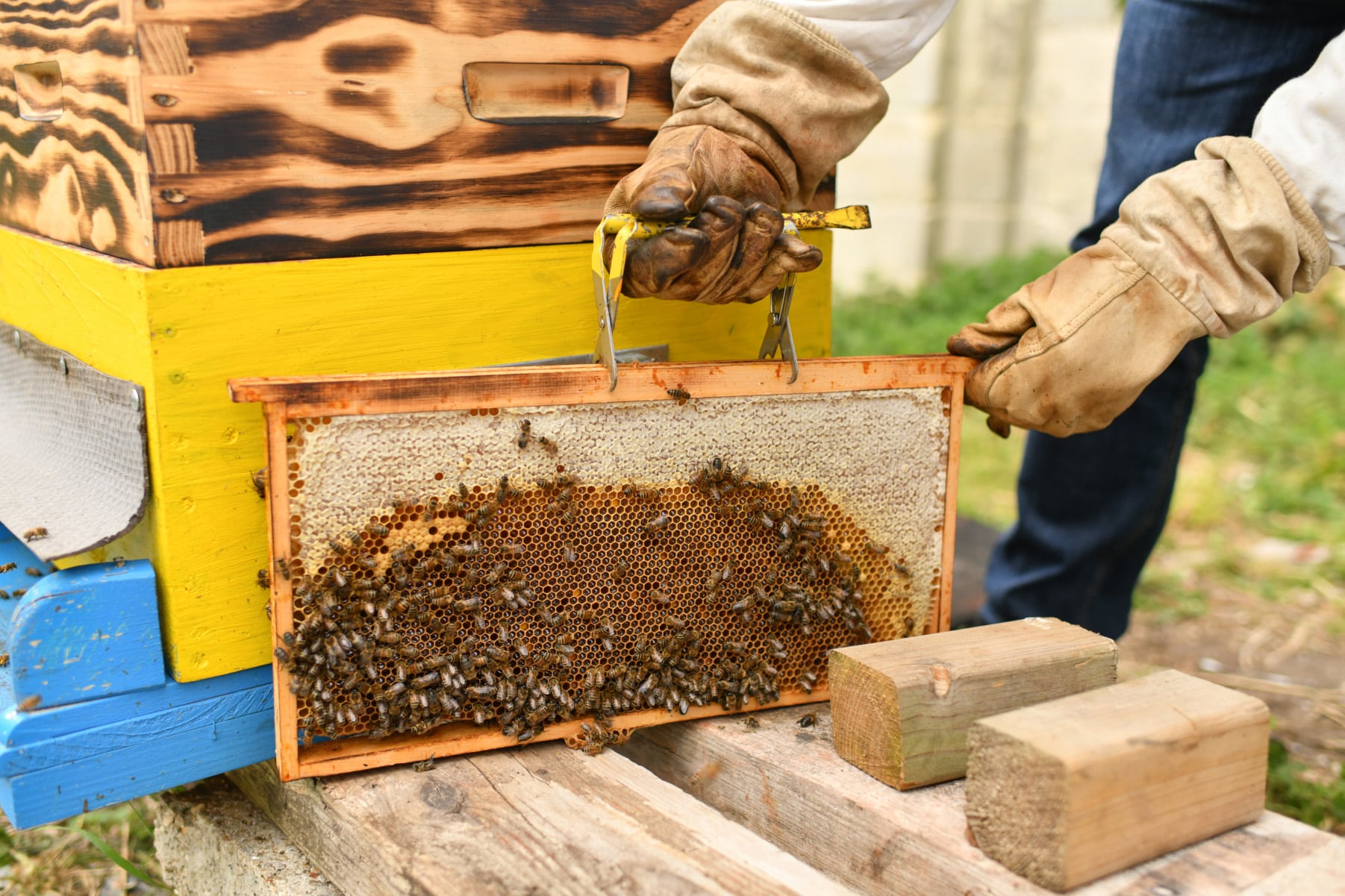
For your first apiary, do not think in terms of buying one isolated hive. Build a small system that can absorb setbacks: use one hive model, interchangeable frames and some spare equipment from day one. Before the first nectar flow, decide how you will extract honey. If you do not intend to extract, that is fine; if you do, arrange help or your own equipment before the supers are full.
How many hives do you need to start?
Two to four colonies can be a manageable starting range if your time, budget, site and local support allow it. This is a practical suggestion, not a minimum requirement: learning with one colony is possible, especially with a mentor.
1
hive: possible with good support, but no second colony for comparison
2–4
hives: a practical range for comparing colony development
15
hives: maximum for Spain’s family-consumption category, if its conditions are met
150
hives: threshold for Spain’s professional holding category
With one colony, you cannot compare its development directly with another at the same site, and a serious setback may leave you without bees. A mentor can still help you interpret what you see. With two or more colonies, comparison becomes easier, but moving brood or stores between them is not an automatic solution: check their health first and obtain experienced help so that you do not spread disease or weaken the donor colony.
Where to place hives: site selection
An apiary is not simply any place where the hives fit. Consider forage, wind, water, safe access, neighbours, landowner permission and the law. A suitable site makes day-to-day care much easier. Look for these conditions:
- Morning sun for an early start, with the option of light shade during heatwaves.
- Protection from prevailing winds: a hedge, ridge or natural screen.
- A reliable water source, with safe landing places. Provide it before the bees establish an inconvenient alternative, such as a neighbour’s pool.
- Easy access with a vehicle, but discreet: theft and vandalism exist.
- Stable ground, good drainage and hives slightly elevated.
- A succession of forage in the surrounding area, rather than one exceptional month followed by a dearth.
We dedicate a full guide to this point, as it is the one that most determines the outcome: how to choose the correct site for your hives.
Minimum legal distances in Spain
In Spain, Royal Decree 209/2002 sets baseline minimum distances. These are legal requirements, not recommendations. Check the applicable regional rules and site conditions before installing hives:
| Minimum distance | Measured from |
|---|---|
| 100 m | Occupied rural dwellings and livestock installations |
| 200 m | National roads |
| 50 m | District roads (carreteras comarcales) |
| 25 m | Local roads or tracks (caminos vecinales) |
| 400 m | Public collective-use establishments, urban areas and population centres |
Legal requirements: registration, REGA code and holding register
In Spain, registration applies even to a single hive. The national classification distinguishes professional holdings with at least 150 hives and non-professional holdings with fewer. The family-consumption category additionally requires all hive products to be exclusively for the family’s own consumption, with no more than 15 hives. Hive count alone does not establish that status.
- Register from the first hive in Spain. Ask which holding category fits your intended activity.
- Administrative registration: apply through the relevant regional agricultural office to enter the holding in REGA and obtain its code.
- Bee-health arrangements: follow the applicable health programme and arrange veterinary support as required. An animal-health association (ADS) can help; membership is not a substitute for meeting your obligations.
- Identification: follow the current official rules for marking and identifying your hives.
- Health and record-keeping duties: comply with the Spanish Varroa programme, including at least one mandatory annual treatment under the applicable veterinary supervision or prescription arrangements. Maintain the required census, treatment and movement records; one annual treatment is not necessarily sufficient control.
Why is it worth doing from day one?
- Plan for liability. Registration does not prevent accidents or automatically provide insurance. Check public-liability cover, exclusions and costs with your insurer or association.
- Use authorised veterinary medicines correctly. Prescription requirements depend on the product. Follow its authorised instructions and the applicable health programme, with veterinary advice; do not assume that every Varroa medicine is prescription-only.
- Check support-scheme eligibility. Registration may be a prerequisite, but it does not guarantee a grant, subsidised treatment or other assistance.
- Maintain traceability. Before moving hives, check the identification, documentation and notification requirements that apply to the journey.
Do not leave registration until you have more hives. Ask the competent regional authority what documents, identification and ongoing records it requires. Processing times, fees and administrative arrangements vary; there is no reliable promise that it will be quick or take only a few minutes each year.
If you want the full step-by-step —documents, estimated costs, transport and obligations— you have the dedicated guide: how to become a beekeeper in Spain: procedures, requirements and bureaucracy. And if you plan to sell honey, it is advisable to also review the beekeeper’s tax obligations and the mandatory labelling.
How much does it cost to start beekeeping?
There is no single starting cost. Your hive system, colony supplier and choice of new or used equipment all matter. Obtain current quotations, check the provenance and condition of used kit, and budget for ongoing care as well as the initial purchase:
| Item | Comment |
|---|---|
| Stocked hive | Budget for a full colony or nucleus colony and compatible housing. Prices vary by region, season and what the supplier includes. |
| Apiary equipment | Smoker, hive tool, protective clothing, brush and feeder, with allowances for cleaning, maintenance and replacement. |
| Frames and wax foundation | Budget for spare frames and a planned brood-comb replacement programme. |
| Spare hive components | Keep compatible spares, including supers where your system uses them, so you can provide space when needed. |
| Bee health | Monitoring supplies, authorised treatments and veterinary support as needed. Requirements and costs depend on the product, programme and colony needs. |
| Registration and insurance | Check administrative fees, any association subscription and suitable insurance rather than assuming a standard low price. |
| Your time | The most undervalued item, and the one that determines whether the endeavour is sustainable. |
If you are considering moving beyond a hobby, our guide Is beekeeping profitable? explores the costs and returns to consider. Use current local figures in your own budget, rather than assuming a particular yield or income.
The most costly mistakes in the first year
- Starting without support. With only one colony, a mentor is especially helpful because you have no second colony for comparison.
- Mixing incompatible equipment. Check actual frame and box dimensions, not just the model name, before adding equipment.
- Neglecting Varroa monitoring and control. Heavy infestation is a major threat to colony health. Use an appropriate control programme, check its effectiveness and do not wait until winter bees have already been damaged.
- Opening without a purpose. Plan inspections around colony needs and suitable weather; unnecessary disturbance can chill brood and disrupt work.
- Harvesting in the first year at all costs. The initial goal is for the colony to reach winter strong.
- Not keeping records. Without records, each season starts from scratch.
There is a full guide dedicated to this, written in the first person: mistakes I would not make if I started beekeeping today.
How to progress to the next level
Your first goal is not a honey harvest. It is to learn to read a colony and keep it healthy: a functioning queen, an even brood pattern, adequate stores, well-managed space and Varroa under control.
To progress, do three things: learn from a reputable course or mentor, keep useful records so that decisions rest on observations rather than impressions, and standardise your equipment so that its components are compatible. Once those foundations are sound, you can explore production, making nucleus colonies and increasing colony numbers, selection, queen rearing and, where appropriate, migratory beekeeping.
Frequently asked questions about becoming a beekeeper
What is beekeeping?
Beekeeping is the care and management of bees for hive products such as honey and wax, and for pollination. This guide focuses on Apis mellifera, the western honeybee commonly kept in Europe. Apiculture is the technical term for honeybee keeping.
What do you call someone who keeps bees?
A beekeeper. An apiary, also called a bee yard, is a site where hives are kept. A hive is the housing; the colony is the living group of bees. A swarm is not simply another word for any established colony.
What is required to become a beekeeper in Spain?
Before buying bees, arrange practical training, a suitable lawful site, the necessary holding registration and records, compatible equipment and a bee-health plan. Confirm the current requirements with the competent regional authority, including Varroa control and hive identification.
How many hives do you need to start?
Two to four colonies can be a practical starting range when your budget, time and site allow it. Comparing colonies helps you learn. Starting with one is also possible, particularly with a mentor; do not buy more bees than you can care for.
In Spain, must you register with just one hive?
Yes: registration applies from the first hive. The family-consumption category allows at most 15 hives and requires the products to be exclusively for the family’s own consumption. Confirm the registration and identification procedure with your regional authority.
Is meliponiculture the same as keeping honeybees?
Meliponiculture means keeping stingless bees. Their biology and management differ from those of Apis honeybees. It is practised in several tropical regions, not only the Americas. This guide focuses on Apis mellifera, so its hive-management advice should not be transferred directly to stingless bees.
Sources
- Royal Decree 209/2002, establishing rules for the management of beekeeping operations.
- MAPA: beekeeping sector, official information and sector rules.
- MAPA: sectoral intervention for beekeeping, support and the current programme.
Educational guidance, not a site-specific authorisation or veterinary treatment plan. The legal sections concern Spain. Confirm current national, regional and local requirements with the competent agricultural authority before setting up; your animal-health association (ADS) or veterinary surgeon can help with bee-health questions.

ISNI 0000 0005 1801 1100 | Joshua Ivars is the manager of LA TIENDA DEL APICULTOR and the author of this blog, where he shares technical and practical guidance for beekeepers. Drawing on extensive experience in the beekeeping sector, he offers advice and solutions based on beekeepers’ real needs, sharing his knowledge of equipment and essential beekeeping practices.


