
Nectar, honey and pollen provide the foundation of honey bee nutrition. Nectar and honey are the main energy sources; pollen supplies most of the protein, lipids and other nutrients needed for growth. Bees also need water. A shortage caused by poor forage, weather or management can weaken a colony before the consequences become obvious. The aim of feeding is to address the actual shortfall, not simply to add another bag of feed.
Three checks before feeding
Energy needs
vary with colony size, brood rearing, activity and the length of the season
Winter stores
must cover the local winter and the rise in demand as brood rearing resumes
Colony strength
depends on healthy bees, the queen and brood—not a universal five-frame guarantee
Why nutrition needs close attention
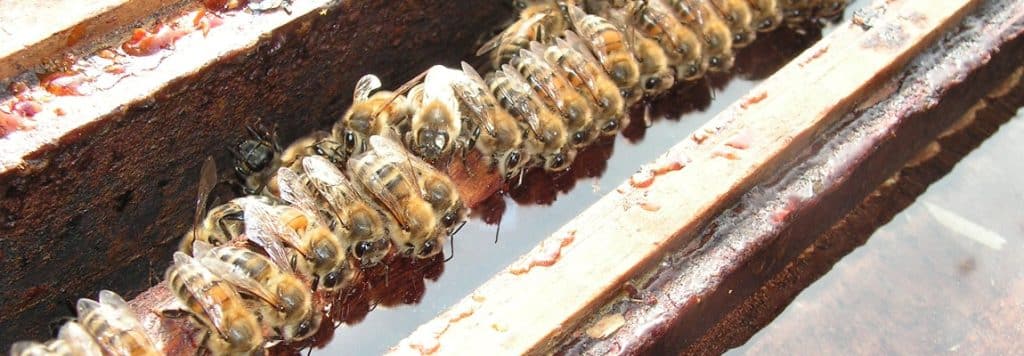
Honey bees gather much of their own food. Foraging commonly takes place within a few kilometres of the hive, but two kilometres is not a fixed profitable limit: bees can travel farther when resources justify it. Beekeepers harvest part of the stores while ensuring that sufficient food remains until dependable forage returns. Distance alone does not tell us whether the apiary has enough food.
Drought, prolonged rain, wind, unusual heat and gaps between flowering periods can interrupt nectar or pollen supplies. Climate and land-use changes can also alter their timing. A landscape in flower is not proof of a nectar flow, nor does incoming nectar guarantee adequate pollen. Check the colony’s stores and development alongside the forecast and local forage.
Bees store honey and pollen in comb cells. Honey supplies mainly carbohydrates; pollen is the main source of protein, lipids, vitamins and minerals. Water is collected separately when needed. Sustained deficiencies can impair brood rearing, adult health and colony survival. Sugar feed can replace missing energy, but it cannot provide all the nutrients normally obtained from pollen.
Carbohydrates: the energy supply
Nectar contains mainly sucrose, glucose and fructose, in proportions that depend on the plant and conditions. Honeydew is a different resource, commonly derived from the sugary excretions of plant-feeding insects. The practical distinctions are:
| Resource or process | Nutritional point |
|---|---|
| Nectar | Sucrose, glucose and fructose in plant-dependent proportions |
| Honey ripening | Water is removed and enzymes modify part of the sugar mixture |
| Honeydew | A variable sugar mixture commonly derived from plant-feeding insects; not uniformly fructose-rich |
During honey ripening, bees add enzymes and reduce the water content. One important reaction is the breakdown of sucrose into glucose and fructose; this is more precise than saying all sugars are freely converted into one another. Nectar concentration varies widely. The table below summarises selected constituents of honey, not a complete formula or a composition that every honey must share.
| Water | Glucose | Fructose | Sucrose and other sugars | Minerals | Proteins | Other minor constituents |
|---|---|---|---|---|---|---|
| About 17% in an illustrative ripe honey | About 31% in this example | About 38% in this example | Variable; not included fully in these examples | Small, variable amounts | Trace amounts | Enzymes, organic acids and aroma compounds, among others |
Carbohydrates provide energy for flight, movement and colony temperature control, including heating and ventilation. They also support comb building: worker bees manufacture wax in their wax glands using dietary resources. A colony drawing substantial new comb needs both sufficient food and the workforce to process it.
Annual consumption, winter stores and the amount of supplemental feed are different quantities. The original article’s estimates of about 40 kg of annual carbohydrate use and 8–12 kg of winter honey consumption describe a local context, not universal minimums or a safe stocking target. Winter requirements can be substantially higher. Assess actual stores, colony size, climate and the expected start of brood rearing; do not assume that supplying a fixed amount guarantees survival.
Pollen: more than protein
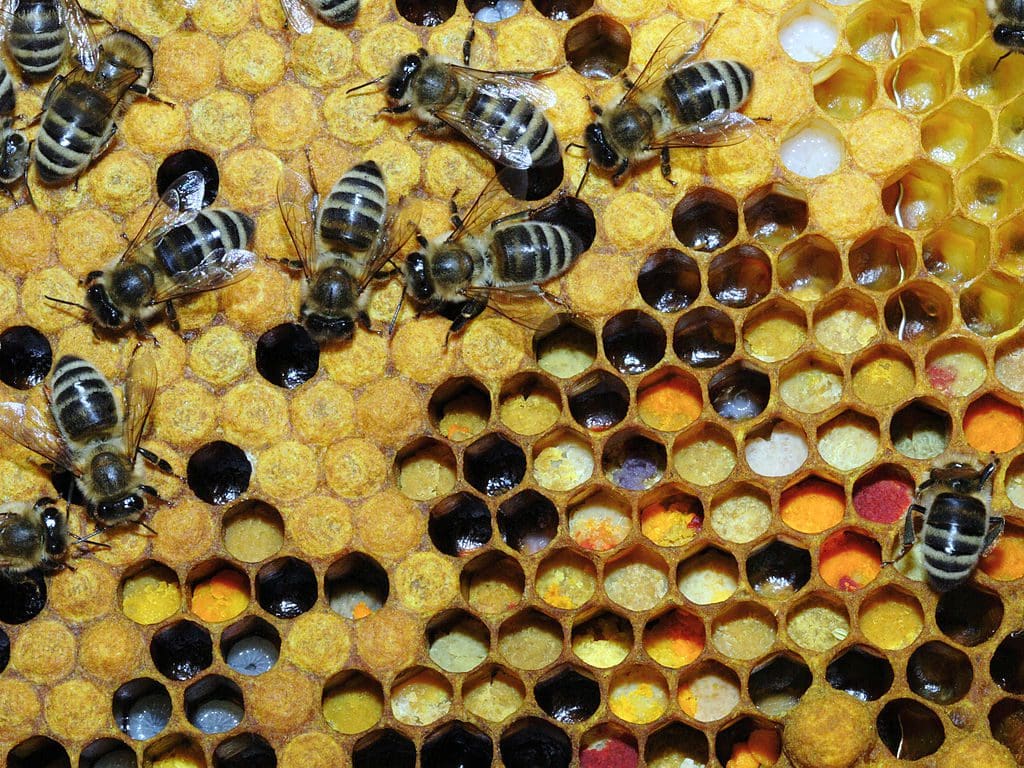
Pollen composition varies considerably between plants and harvests. The original article cites protein contents of roughly 7–35% as an illustration of that variation, not an exhaustive range. Protein percentage alone does not establish nutritional quality: amino-acid balance, lipids, digestibility and freshness also matter. Comparisons must use the same basis, such as fresh weight or dry matter.
Access to a range of suitable pollen sources over the season helps reduce the risk of nutritional gaps. A mass-flowering crop may provide useful, abundant forage, but a landscape dependent on one short bloom can leave a dearth before or afterwards. Not every single-source pollen is equally poor, and mixing pollens is not automatically a guarantee of a balanced diet.
| Water | Sugars | Proteins | Lipids | Minerals | Cell-wall material | Vitamins |
|---|---|---|---|---|---|---|
| Variable with freshness and storage | Variable; added nectar also affects bee-collected pollen | Highly variable in amount and amino-acid balance | Variable; includes fatty acids and sterols | Variable by botanical origin | Includes less readily digested structural material | B-group and other vitamins; composition varies |
Pollen supplies B vitamins and other micronutrients, as well as amino acids and lipids. Young workers use these nutrients to develop the glands that produce brood food. Their nutritional condition also supports wax production and other tasks. Adding vitamins is not a substitute for correcting a shortage of energy or suitable protein.
Nutrition and developing bees
Larvae obtain much of their nutrition through food supplied by nurse bees. This supports the development of muscles, organs, glands and immune function. Adult workers continue to need appropriate nutrition after emergence, particularly while nursing brood. Poor diets can affect several aspects of health:
- Poor pollen nutrition can reduce body condition and longevity; the size of the effect varies rather than always being a fixed 50%.
- It can impair brood-food gland development and nutrient reserves in the fat body, affecting the workforce available for nursing and overwintering.
- Nutritional stress can increase vulnerability to disease, but nutrition does not replace diagnosis or appropriate bee-health management.
- Pollen nutrition can affect tolerance to some pesticides. This is not protection against unsafe exposure or permission to relax pesticide precautions.
These effects help explain why nutrition matters during the production of long-lived winter bees, but they do not predict an individual bee’s lifespan or guarantee survival until a particular month. For field signs and other possible causes of weakness, see malnutrition and starvation in honey bee colonies (in Spanish).
When supplemental feeding is needed
Feeding may be prompted by weather, the surrounding forage or a management objective. Identifying the cause helps determine what to supply and how long support may be needed:
| Cause | What happens | Purpose of feeding |
|---|---|---|
| Weather | Rain, wind, frost, drought or extreme heat reduces forage availability or flight opportunities | Bridge the shortfall before colony development suffers |
| Landscape | Insufficient forage, an inadequate nutrient profile or a gap between blooms | Supply what is missing while improving access to suitable forage |
| Management | A planned change in colony development or a demanding production objective | Support brood rearing, winter preparation, queen or royal-jelly production, pollen collection or a pollination service (in Spanish) |
Act before a nutritional shortfall causes serious decline. A very weak colony may be unable to use feed effectively, rear replacement workers or maintain brood temperature. Check queen status, disease and mite levels as well as food. Feeding alone cannot repair every failing colony, and five frames of bees is not a universal threshold across different hive sizes and climates.
Choosing a bee feed
There are many feeds for bees. Start with two questions: which nutrient supply is inadequate, and what is the feeding intended to achieve? Then compare the label, intended use and supporting technical information. A low price per bag is not necessarily a low cost per unit of usable nutrition.
Check composition, declared analytical constituents, instructions, storage conditions and traceability. EU feed-labelling obligations depend on the type of product under Regulation (EC) No 767/2009; not every feed material carries the same declarations as a compound feed. Ask the supplier for a technical sheet if the information is insufficient to assess suitability. A nutritional feed must not be presented as a cure for disease.
| Situation | Objective | Feed to consider |
|---|---|---|
| Low honey stores, adequate pollen | Supply energy | A suitable carbohydrate feed |
| Pollen shortage | Support nursing and replacement-worker production | A suitable protein patty or pollen substitute; percentage alone is not a quality test |
| Both are lacking | Address energy and other nutrient shortages | An appropriate combination of energy and protein support |
| Autumn, insufficient workforce | Assess causes and prepare a healthy winter population | Timely nutritional support where needed, alongside queen and bee-health assessment |
| Early spring | Support a planned build-up when forage is inadequate | Syrup where suitable, with adequate pollen nutrients |
| Winter | Prevent starvation and maintain accessible stores | Fondant or suitable solid feed where needed; monitor access and consumption |
Carbohydrate feeds
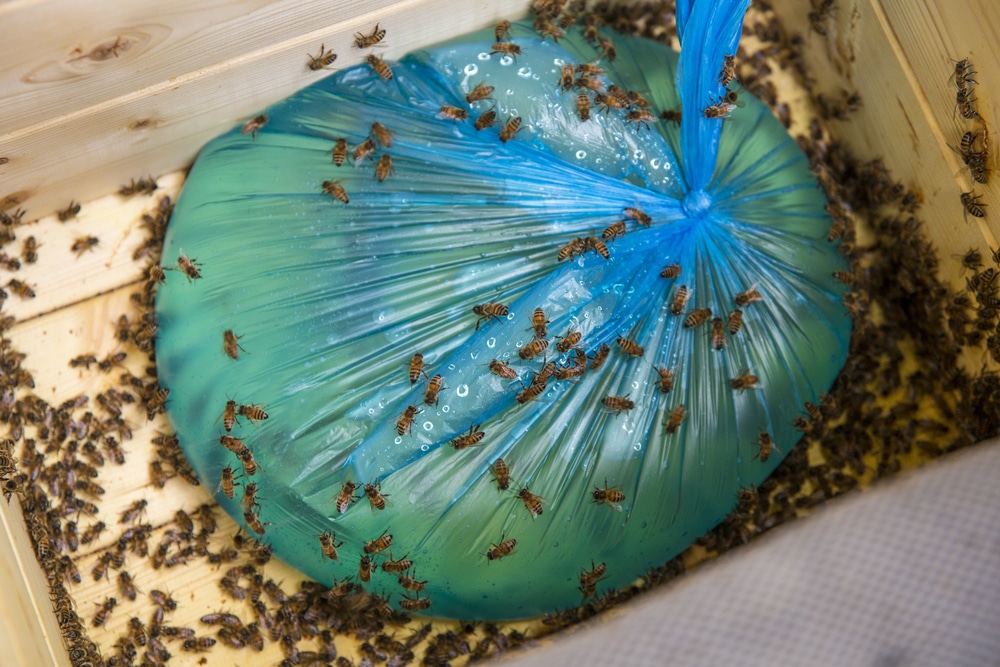
Carbohydrate feeds address an energy shortage. When adequate pollen is available, that may be the main missing input. If pollen is also scarce, sugar still helps prevent energy starvation, but it does not correct the accompanying protein and lipid shortage. Assess both sides of the diet rather than saying sugar is useless without pollen.
Choose sugar sources with demonstrated suitability for bees, such as white sucrose or a properly formulated commercial bee syrup. Glucose and fructose are also usable energy sources, but not every mono- or disaccharide is safe, and digestibility cannot be judged solely by those categories. Avoid starch-rich household mixtures, unsuitable additives and degraded syrup; industrial processing and final composition matter more than the feedstock’s name.
Compare the following features and use the manufacturer’s directions for the chosen product:
- Water content and consistency. Match these to the objective, weather and feeder. Light syrup is commonly used for spring support; heavier syrup is useful for storing food while conditions remain suitable. Do not dilute syrup further as a response to cold weather.
- Usable carbohydrate content and quality. Consider digestibility, purity, stability and the amount of energy supplied, not simply the highest possible concentration.
- Added vitamins or amino acids. Look for an identified need and evidence relevant to the intended use; more additives do not automatically improve performance.
Avoid improvised acid inversion or prolonged heating, which can increase the risk of harmful hydroxymethylfurfural (HMF). Use clean equipment and discard spoiled feed. The practical cautions are explained in our article on homemade invert syrup (in Spanish).
Feeds supplying several nutrients
Some feeds combine sugars with protein sources, lipids and micronutrients. They may help address more than one shortfall, but a mixed ingredient list does not make a product nutritionally complete. Check the intended role, analytical declaration and main ingredients. Compare products according to:
- The quality and amount of usable sugars in the finished feed.
- The protein content, amino-acid balance and digestibility, considered alongside the pollen already available.
- The lipid contribution and its balance with other nutrients, not a universal 1% target.
- The role and declared quantities of vitamins, minerals and other additives, where present.
Protein patties
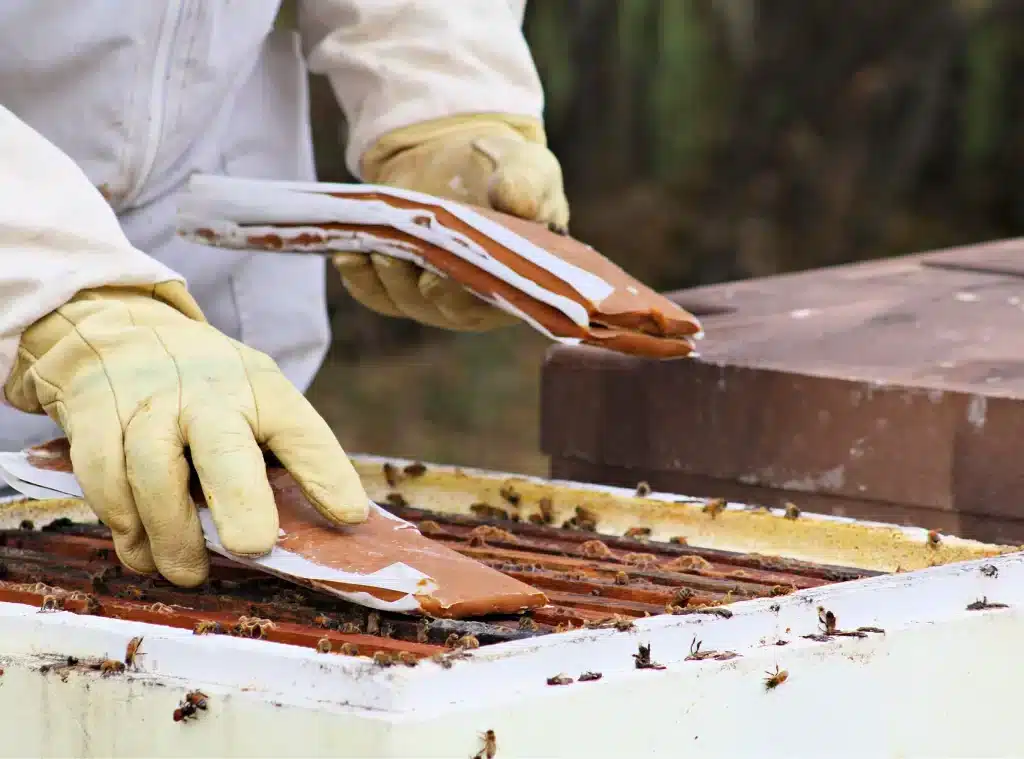
Where suitable pollen is genuinely lacking, a well-formulated protein patty or pollen substitute may support brood rearing. The benefit depends on colony condition, timing, acceptance and the quality of the feed. A declaration above 8% protein is not a universal efficacy threshold, and protein supplementation should not be automatic when good forage already meets the colony’s needs.
The intended benefits of protein supplementation are to support normal nutritional functions, not to promise a fixed production increase:
- Support brood-food production: appropriate nutrition helps nurse bees maintain functional hypopharyngeal glands; a patty does not guarantee an excess of royal jelly.
- Support brood rearing: adequate nurse nutrition helps larvae receive suitable food. Eggs do not eat royal jelly, and food alone cannot overcome every limit on colony growth.
- Support the adult workforce: nutrients are shared through trophallaxis, but feeding is not proven to rejuvenate every older bee or extend lifespan by a fixed amount.
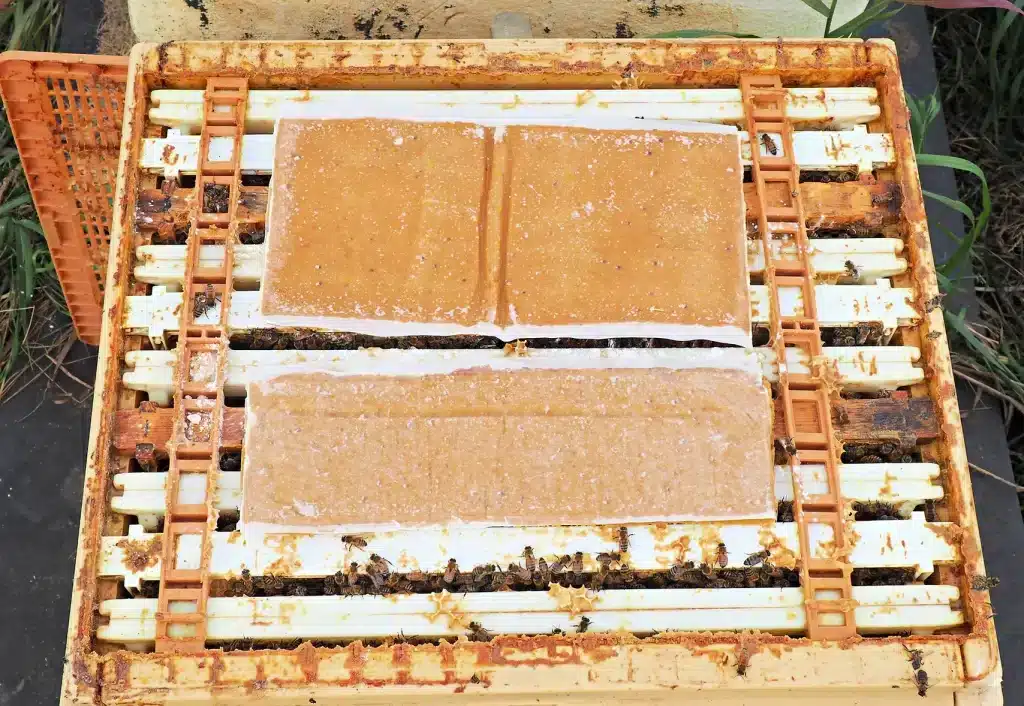
Brewer’s yeast and appropriately processed soya ingredients are used in some formulations, but their protein content and suitability vary. The dry ingredient’s protein percentage is not the percentage in the finished sugar-based patty. Compare the declared composition of protein feeds, and offer only what the colony can consume before it deteriorates. Do not assume that a household flour mixture is equivalent to a tested bee feed.
Syrup, fondant or solid feed?
| Form | Typical composition | Suitable use |
|---|---|---|
| Syrup | A 1:1 sugar:water mixture by weight is 50% sugar; heavier syrups contain less water | Support or store-building while bees can take and process it; not a fixed 18°C rule |
| Fondant or solid feed | Low moisture; the exact value depends on the product | Accessible energy support, often practical in cold weather; not a protein substitute |
Fondants such as Apipasta with vitamins and Apifonda are energy feeds, not replacements for a protein patty. Syrup is useful in suitable weather, including for building stores before winter; fondant is often more practical during cold periods. Feed inside the hive, prevent leaks and clear up spills to reduce robbing. Keep supplemental feed out of honey intended for harvest, and respect any concurrent medicine’s feeding restrictions.
Where to place the feed
Place feed where the bees can actually reach it. Protein patties normally sit on the frame top bars close to the brood; emergency fondant in cold weather should be accessible directly above the cluster, which may be broodless. There is no universal ten-centimetre rule. Use a suitable feeder or the product’s packaging as directed, avoid crushing bees and minimise unnecessary disturbance. A heavy hive can still suffer isolation starvation if the cluster cannot reach its stores.
Conclusion
Feeding practice depends on the climate, hive type, available labour and whether the operation focuses on honey, pollination or bee production. The common principle is to match support to a measured need, while maintaining access to good forage wherever possible. More feed is not automatically better nutrition.
When the landscape does not meet the colony’s needs, consider suitable forage elsewhere or targeted supplemental feeding, then check the response. Continue with when and what to feed and autumn feeding (in Spanish). For supporting guidance, see the National Bee Unit’s feeding article and USDA research comparing natural forage with protein supplements; local conditions still determine the feeding plan.
How much food does a colony need each year?
There is no single annual ration for every colony. Consumption depends on population, brood rearing, weather and forage. Annual carbohydrate use is not the same as the quantity of feed to supply. Assess winter stores locally and keep checking them as brood rearing increases; the original article’s 40 kg annual and 8–12 kg winter examples are not universal minimums or guarantees.
Why is pollen so important?
Pollen is the main natural source of protein, lipids and several essential micronutrients. It supports nurse-bee development, brood-food production and colony growth. Its quality varies, and nutritional shortage can reduce health and longevity. Neither a fixed 50% lifespan reduction nor a guaranteed benefit from every protein supplement applies to all colonies.
When should I use syrup rather than fondant?
Use syrup when the colony can take and process it and the weather suits the intended purpose. A 1:1 sugar-to-water mixture by weight is about 50% sugar; a heavier syrup may be appropriate for building stores before cold weather. Fondant is often useful when liquid feed is impractical. Eighteen degrees at midday is not a universal threshold, and syrup should not be made more dilute merely because it is cold.
Where should feed go inside the hive?
Feed must be accessible to the bees. Place protein patties near the brood and cold-weather emergency fondant directly above the cluster, following the product and feeder instructions. Do not rely on an arbitrary ten-centimetre distance or assume that stores elsewhere in the hive are reachable during cold weather.
Is any sugar suitable for feeding bees?
No. Use white sucrose or a suitable commercial bee feed, not arbitrary sweet foods. Sugar type, impurities, additives and storage damage all affect suitability. Brown sugar, starch-rich mixtures and overheated or spoiled syrup are poor choices. An energy feed cannot replace the protein, lipids and other nutrients supplied by pollen.

Con más de 50 años dedicados exclusivamente a la apicultura, Antonio Gómez Pajuelo ha trabajado en colaboración con agrupaciones de apicultores, administraciones y empresas en América, Europa y Oceanía. Desde 1992, ofrece desde Castellón servicios de asistencia técnica en manejo de colmenas, calidad de la miel, formación y estudios para productores y empresas apícolas. Licenciado en Ciencias Biológicas por la Universidad Complutense de Madrid, ha trabajado en diversas instituciones, incluyendo la Universidad Autónoma de Barcelona y la Facultad de Veterinaria de Córdoba.
Su trayectoria incluye más de 160 publicaciones en congresos y revistas técnicas, la autoría del libro “Cata de Mieles de España y Portugal” y la participaciónen múltiples publicaciones científicas y monografías sobre sanidad apícola, polinización y calidad de la miel.


