
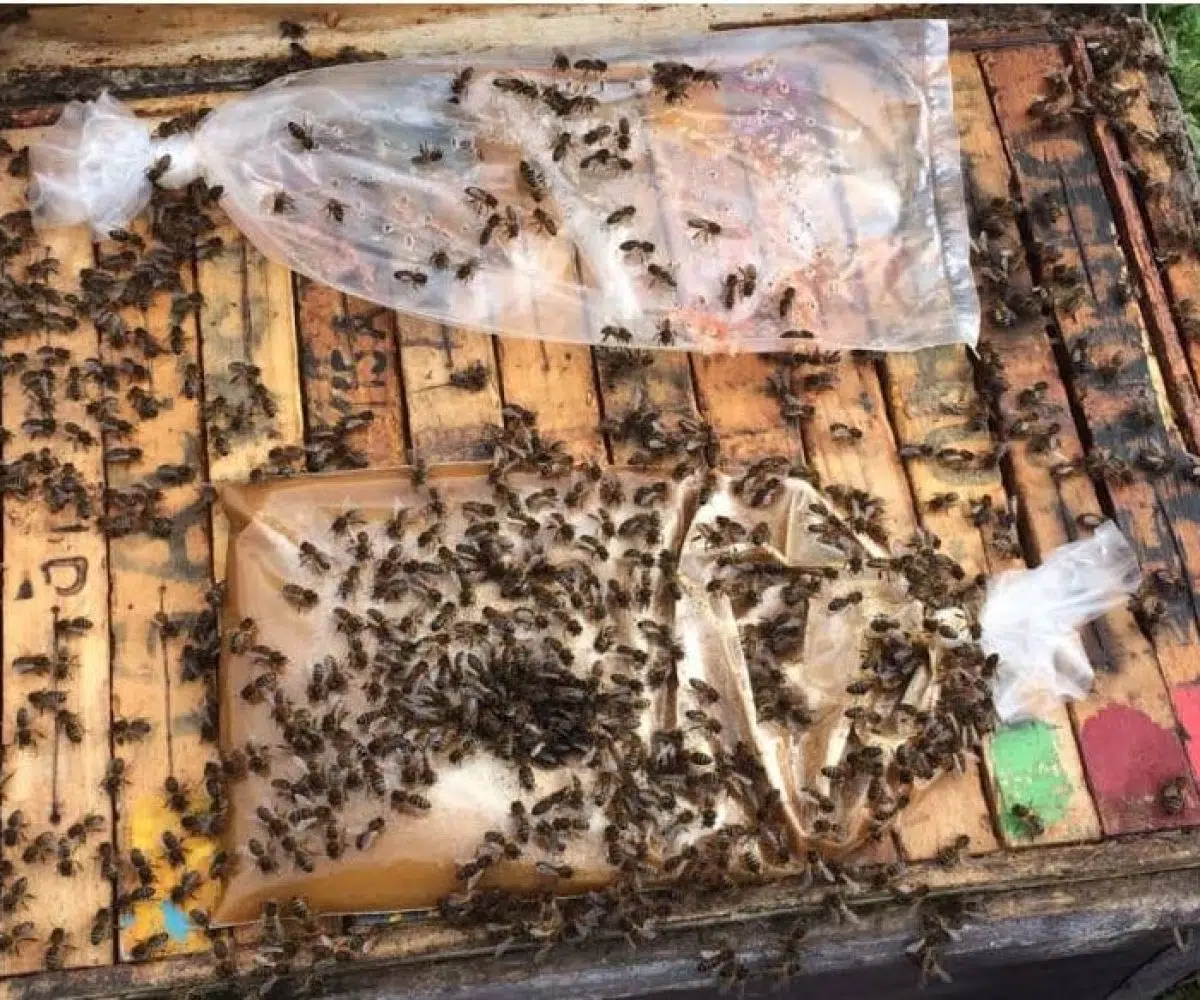
Feed a colony when an inspection shows that it lacks energy, protein or access to feed—not simply because a particular month has arrived. Before choosing syrup, fondant or a protein patty, assess its stores, pollen, brood, population, weather and the next nectar flow.
Supplementary feeding may prevent starvation, replenish reserves removed during honey harvest, or support a management goal. It may also cause robbing, moisture, syrup fermentation, brood rearing beyond the colony’s capacity, or contamination of honey intended for harvest if not properly controlled.
Quick decision in four questions
- Is there a risk of running out of reserves? If yes, immediate access to energy is the priority.
- Is there brood and a lack of quality pollen? Consider a protein supplement in addition to energy; protein and sugar are not interchangeable.
- Can the colony consume the chosen form of feed? In cold weather, syrup placed away from the cluster may be useless. Feed must remain within reach of the cluster without chilling the brood nest.
- Are honey supers on the hive, or is a nectar flow intended for harvest approaching? Avoid supplementary food ending up stored in commercial honey.
There is no universal amount: start with a quantity that the colony can consume before it spoils, record consumption and adjust. Colony size, climate, objective, type of feed and the colony’s ability to process it all affect the response.
What to check before feeding bees
Inspection should first answer ‘what is missing’ and then ‘what will I provide’. A small colony with few stores, a strong colony after honey harvesting and a colony being built up before a nectar flow require different decisions.
1. Energy reserves
Check the quantity and, above all, the location of frames containing honey or feed. Weighing or hefting the hive helps you track changes, but you need a baseline for that hive type and apiary. In cold weather, stores may be on the opposite side of the hive, yet isolation starvation can still occur if the cluster cannot reach them.
Do not take a honey crop without leaving enough stores for the coming dearth. If hive weight falls rapidly, only narrow bands of stores remain around the brood or the bees are consuming the last frames of stores, intervention is more urgent than any stimulation plan.
2. Pollen, brood and population
Energy sustains activity; protein, lipids, vitamins and minerals are particularly important for rearing new bees. Check whether pollen is coming in, how much is stored, whether there is floral diversity and how much brood the colony must tend. A protein patty cannot compensate for a colony without energy stores, and fondant cannot correct a protein deficiency.
Before stimulating, also check the queen, brood pattern, adult population and signs of disease. Increasing egg-laying does not fix a poor queen or high disease burden; it may increase food demand and leave the colony more vulnerable if the bloom fails later.
3. Weather, flowering and access to water
Check local forecasts and observe the field: temperature, rain, wind and drought determine whether bees can forage and process syrup. Do not copy months from another region. The useful date in a coastal area may be too early or late in a mountain apiary.
Colonies need water for brood rearing and to process solid food. Ensure a clean, stable and safe water source before they seek pools, livestock troughs or treated areas. Stones, floats or other support surfaces reduce drowning risk.
4. Objective and stopping point
Define in writing whether the aim is to save a colony, replenish stores, support a nucleus colony or stimulate brood rearing. Set a stopping criterion: recovered weight, sufficient stores, a stable natural nectar flow, feed consumption stopping, or the approach of the target nectar flow and the fitting of honey supers. Feeding without a planned end point increases the risk of syrup blocking the brood nest or being stored where it should not be.
Energy, protein or both: what feed does the colony need?
| What you observe | Likely need | Management options | What to check afterwards |
|---|---|---|---|
| Very low reserves or risk of starvation | Immediate energy. | Move a sound frame containing the colony’s own stores closer to the cluster, or provide fondant or syrup according to the temperature and the colony’s ability to consume it. | Actual access to feed, consumption, hive weight and cluster survival. |
| Low reserves after harvest or drought | Replenish energy. | Use syrup to replenish stores while the weather still allows the bees to process it; switch to fondant if it is already too cold. | Target weight, storage and absence of drips or robbing. |
| Increasing brood rearing with insufficient pollen | Protein plus available energy. | Appropriate protein supplement and sufficient energy reserves. | Patty consumption, mould, pests, brood development and natural resources. |
| A strong colony before a nectar flow | Planned stimulation, only if it adds value. | Small syrup feeds, and if pollen is lacking, protein support; with space and swarming control. | Brood, population, reserves, queen cells and date of feed removal. |
| The colony is not taking the feed | This does not necessarily mean it needs more feed. | Check temperature, feed position and type, spoilage, accessibility, colony strength and natural forage availability. | Correct the cause; remove spoiled feed. |

In our section on bee feed you can compare energy feed formats. Protein supplements serve a different purpose and should be assessed according to brood and pollen availability.
Three scenarios: emergency, maintenance and stimulation
Emergency feeding
An emergency arises when the colony may die before sufficient natural forage becomes available. In winter, open the hive only if conditions allow and keep disturbance to a minimum. If the cluster is separated from its stores, move sound, usable frames containing the colony’s own stores closer, or place fondant directly over the area occupied by the bees.
In cold weather, syrup may remain out of reach, crystallise in some feeders or add water that the colony cannot manage. In mild weather, light syrup can provide quickly available energy. Check promptly whether the bees are taking it: a colony on the verge of starvation cannot wait weeks for inspection.
Maintenance or replenishment feeding
Used when reserves do not cover the expected nectar-free period: after honey removal, during drought, or before cold weather. The starting point is not simply that it is autumn, but the difference between what the colony has and what it needs for its climate, size and hive type.
While bees can take syrup down and evaporate its excess water, a more concentrated syrup helps them build stores with less water to evaporate. When they can no longer process it, solid feed placed close to the cluster is more accessible. Monitor hive weight and stop replenishment when the target is reached to avoid blocking brood space.
Stimulation feeding
Stimulation mimics a sustained nectar flow and may increase brood rearing before a nectar flow or encourage comb building. It only works if the colony is healthy, has enough adult bees to care for the brood, has protein available, and can sustain the growth when supplementation ends.
Plan backwards from the local nectar flow, not from a generic date. Monitor space, queen cells and swarming risk. Stop feeding well before fitting honey supers and record the final feed; feed-derived markers can persist and reach the honey if feeding and honey production overlap.
Do not feed blindly during a nectar flow
Feeding may be necessary for survival, but stored syrup is not floral honey. Separate health or welfare needs from the harvest objective; exclude feed-contaminated honey from the commercial honey crop and retain records of date, product, quantity, and hives fed.
Syrup, fondant and protein patties: when to choose each type
Sugar syrup
Syrup is useful when the colony can take it down and evaporate the excess water. A thin syrup for stimulation provides immediate energy; a more concentrated syrup is used to replenish stores. The National Bee Unit gives the following recipes, measuring sugar by weight and water by volume:
- Light syrup: 1 kg of granulated white sugar dissolved in 1.26 litres of warm water.
- Concentrated syrup: 1 kg of granulated white sugar dissolved in 0.63 litres of water.
These are technical starting points, not colony-specific dosages. Use white sugar, potable water, and clean containers. Warm water helps the sugar dissolve, but do not boil the syrup or overheat it. Do not use brown sugar, molasses, or mixtures of unknown composition. Prepare only what you can store hygienically: if it ferments, smells bad, or develops mould, remove it.
A ready-to-use commercial feed may provide more consistent concentration and stability. In either case, follow the label and our guide on how to prepare bee feed.

Fondant or sugar paste
A maintenance fondant or candy feed contains much less free water than syrup and can be placed on the top bars or over the feed hole in the crownboard, directly above the cluster. It is particularly useful as an emergency reserve in cold weather, in nucleus colonies or when a colony cannot reach stores at the sides.
Keep an opening in the wrapper facing the bees and avoid placing the block far from the occupied area. Check that it does not harden out of reach, trap condensation or leave gaps where comb may be built as the colony grows.

Protein patty or pollen substitute
It is used when the colony is rearing brood or needs to build up and natural pollen intake is insufficient. Not all formulations provide the same digestible protein, amino acids, fat, or palatability. Crude protein percentage alone does not predict how well a feed will support the colony.
Place a thin portion near the brood and observe how much is consumed before adding more. Remove any remains affected by mould, beetles or other pests. In warm weather, a protein patty that is too large may deteriorate before it is consumed. Consult our protein supplementation guide to understand composition, timing and monitoring.
Can honey or pollen be used for feeding?
Do not feed honey from a source with unknown disease status. Spores of American foulbrood and other agents may travel with it. Even your own honey requires traceability and absence of disease history. Pollen may also carry contaminants and pathogens if its origin and treatment are unknown.
When assessing these raw materials, first review the risks of feeding bees with honey and pollen (in Spanish). In most situations, white sugar or a formulated bee feed makes biosecurity easier to manage than purchased honey.
How to place feed and avoid robbing, drowning, and mould
- Feed inside the hive. Open feeding mixes colonies, encourages robbing, and may spread disease.
- Feed in the evening, when flight activity has subsided. During a dearth, feed all the planned colonies in the same visit and reduce the entrance size on weaker colonies.
- Do not spill syrup. Clean up any residue on hives, ground, containers, or vehicles; the smell attracts bees and wasps.
- Prevent bees from drowning. Use the feeder’s intended design, floats or mesh screens, and check for leaks.
- Place feed within reach of the bees. In cold weather, a few centimetres and a barrier of empty frames can make a difference.
- Check consumption and condition. Remove fermented syrup, inaccessible fondant and mouldy protein patties; do not refill automatically.
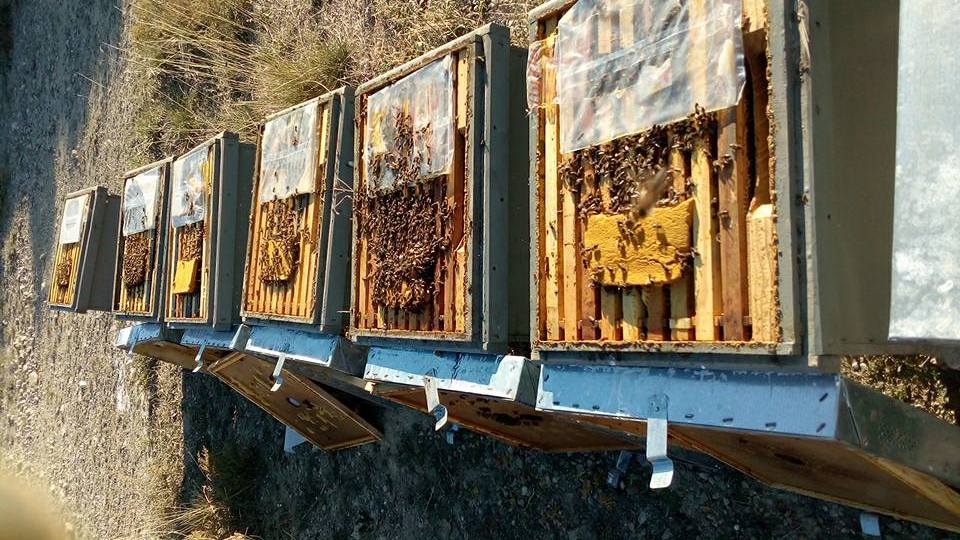
If robbing occurs—fighting at the entrance, erratic flight, bees trying to enter through gaps—close up the hives, reduce entrances, and remove the odour source. Do not continue opening hives or leaving feed exposed.
How much feed to give and how to know when to stop
There is no valid weekly or monthly amount for all hives. A fixed dose ignores initial reserves, population, consumption, natural forage availability and management objectives. To make a reproducible decision:
- record the weight or estimate of reserves before starting;
- record product, batch, quantity, date, and hive;
- check how much remains and in what condition at the next visit;
- observe brood, available space, incoming nectar and pollen, and behaviour;
- adjust only one variable at a time and define why you continue or stop.
Stop or reconsider feeding if the colony is not consuming it, the feed spoils, the brood nest becomes blocked, robbing starts, a nectar flow intended for the crop begins or the data already show sufficient stores. Stimulation without enough space and appropriate management can increase swarming instead of improving honey yield.
Common feeding mistakes
| Error | Risk | Better approach |
|---|---|---|
| Feeding by calendar | Does not respond to weather or actual reserves. | Inspect the colony and follow local flowering and weather conditions. |
| Giving protein without energy | The colony starts brood rearing that it may not be able to sustain. | Ensure reserves and assess pollen and population. |
| Using purchased honey | Introduction of pathogens. | Do not use honey from a source with unknown disease status. |
| Leaving syrup open or spilt | Robbing, wasps, and disease transmission between colonies. | Feed inside the hive in the evening and prevent leaks. |
| Feeding while honey supers are on the hive | Stored syrup and loss of honey authenticity. | Keep feeding separate from honey production and record when feed is removed. |
| Overfeeding | Fermentation, mould, pests, or nest blockage. | Adjust to observed consumption. |
| Placing feed far from the cluster | The colony may die before reaching it. | Place feed on or next to the occupied area. |
Frequently asked questions about bee feeding
When should hives be fed?
When stores or natural forage do not meet the colony’s needs, after a harvest that left insufficient feed, during a weather emergency or for a planned management objective. Inspection findings and local weather matter more than the calendar month.
What should I feed bees in winter?
If stores are insufficient and it is cold, fondant or sugar paste placed directly above the cluster is usually more accessible than syrup. First check whether sound frames containing the colony’s own stores can be moved closer. Do not open or break up the brood nest in unsuitable conditions.
How can I make bee feed at home?
The simplest option is white sugar syrup made with clean equipment and without boiling. Choose a light or concentrated syrup depending on the objective and weather conditions. Do not add ingredients without a technical justification, and discard any mixture that has fermented or developed mould.
Can I use brown sugar?
It is not the recommended option. Use granulated white sugar without additives. Brown sugar, molasses and other less-refined sugars contain components that bees tolerate less well and may contribute to digestive problems.
How do I know if they need protein?
Assess brood presence, stored pollen, incoming pollen and nearby forage. A colony without brood or energy stores will not improve simply by adding a protein patty. If one is used, consumption and brood development should confirm that the decision was justified.
Why aren’t they taking the syrup or fondant?
It may be too cold, too far from the cluster, fermented, crystallised, or unnecessary because of natural forage. The colony may also be weak or affected by disease. Check these causes before adding more food.
Can I feed all my colonies from an open feeder?
It is not good practice. Open feeding causes competition, makes it difficult to determine how much each colony is taking, encourages robbing and increases contact between bees from different hives.
Sources and resources for further reading
- National Bee Unit, best practice guide for feeding bees with sugar.
- Utah State University Extension, bee nutrition and feed types.
- Government Chemist, persistence and possible carry-over of feed markers into honey.
Learn to design a feeding plan
The self-paced Bees Academy online course, taught in Spanish, covers nutritional assessment, feed formulation, feed types and apiary management.

ISNI 0000 0005 1801 1100 | Joshua Ivars is the manager of LA TIENDA DEL APICULTOR and the author of this blog, where he shares technical and practical guidance for beekeepers. Drawing on extensive experience in the beekeeping sector, he offers advice and solutions based on beekeepers’ real needs, sharing his knowledge of equipment and essential beekeeping practices.


