
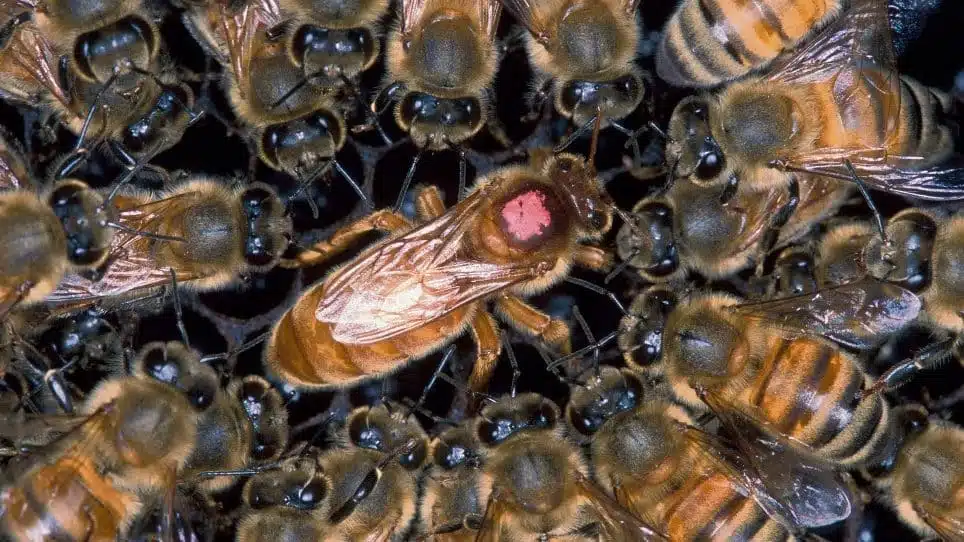
Supersedure is the colony’s natural replacement of its queen: the workers rear a new queen without dividing the colony by swarming. Changes in the queen’s chemical signals can play a part, but this is not a simple response to one universal pheromone threshold. The practical question is whether the colony is replacing its queen, preparing to swarm or responding to sudden queen loss.
Supersedure and swarming are not the same
| Supersedure | Swarming | |
|---|---|---|
| What happens? | The colony replaces its queen | The colony reproduces by division |
| The old queen | May remain alongside her daughter for a time | Normally leaves with the prime swarm |
| A new colony? | No colony division as part of supersedure | Yes, if the swarm establishes successfully |
| Queen cells | Often relatively few | Often more numerous |
| Adult bees | No departing swarm as part of the process | A substantial proportion leave with the swarm |
| The beekeeper’s response | Assess replacement and mating prospects | Use an appropriate swarm-management plan |
In this guide
- what supersedure means;
- the role of queen pheromones;
- when replacement is more likely;
- why an apparently good queen may be replaced;
- how the beekeeper should respond.
What is queen supersedure?
A colony may begin supersedure while its old queen is still present and laying. Queen cells without clear signs of swarming are consistent with this, but are not conclusive on their own. In the seasonal conditions described here, replacement is commonly observed in spring, summer and early autumn; successful completion depends on conditions for queen development and mating.
The key distinction from swarming is colony division. In a typical prime swarm, the old queen leaves with a substantial proportion of the adult bees. Supersedure replaces the queen within the existing colony. The old queen and her daughter may coexist for a time, but this overlap is not guaranteed. Emergency queen rearing after sudden queen loss is a separate situation.
How the colony responds: queen pheromones
Supersedure can be associated with declining reproductive performance, ageing, injury or poor queen health. The quality and viability of stored sperm can also matter. Workers may respond to problems that are not obvious during a brief inspection; conversely, finding queen cells does not identify the underlying cause.
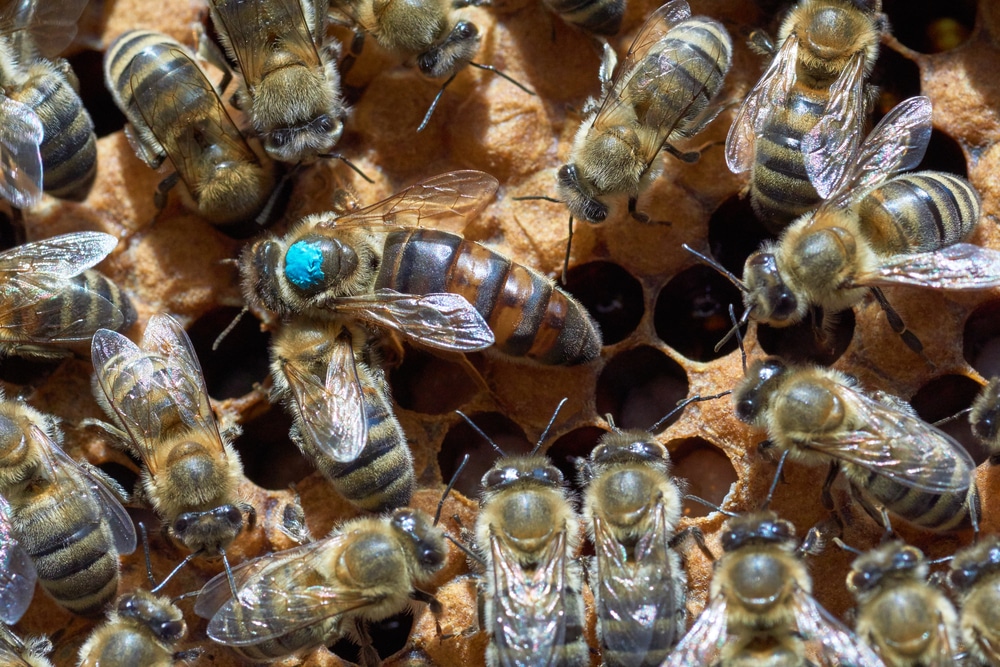
The colony receives information about its queen through several chemical signals and interactions. One important component is queen mandibular pheromone, or QMP, a blend produced by the mandibular glands. Attendant workers contact and groom the queen, helping to distribute her signals through the colony.
Queen pheromones help regulate worker behaviour and reproduction, including queen-cell rearing and worker ovary development. However, pheromone composition, worker responses and colony conditions interact. It is misleading to describe replacement as a meter falling below one fixed level, or to diagnose it from colony size alone.
A young queen is not automatically protected from supersedure. Age, mating history and reproductive condition can influence her signals, but more pheromone does not simply mean a better queen. Nor does a queen’s age provide a complete explanation of the colony’s response.
When is supersedure more likely?
- Ageing queens. Declining performance can make replacement more likely, but age alone is not a diagnosis.
- Changes in colony conditions. Population and the distribution of queen signals can affect worker responses. A large population does not, by itself, prove supersedure; distinguish it from congestion and preparations to swarm.
- Injury or poor queen health. A young queen can also be affected. Assess the evidence rather than assuming every replacement has the same cause.
Why replace a queen that seems to be doing well?
Sometimes workers supersede a young queen that appears vigorous and has a compact brood pattern. A good-looking patch of brood is useful evidence, but it does not reveal every aspect of queen quality. Problems such as Nosema infection or viral infection cannot be diagnosed merely because supersedure occurs; suspected disease requires its own assessment.
The reverse is also possible: a patchy brood pattern without queen replacement. Nutrition, brood disease, pesticide exposure and hygienic removal of affected brood can all complicate what you see. Assess eggs, larvae, adult bee population, food reserves and the recent inspection history together, rather than treating either the brood pattern or the queen cells as a verdict.
What should the beekeeper do?
- Assess before intervening. If the colony is queenright, there are few developing queen cells and no clear swarm preparations, allowing supersedure to proceed may be appropriate. Keep an inspection record and follow up; do not mistake an uncertain diagnosis for permission to ignore swarm risk.
- Do not remove queen cells indiscriminately. If the existing queen is failing, destroying her potential replacements can leave the colony queenless. Confirm the situation and your replacement plan first.
- Check the mating opportunity. The new virgin queen needs suitable weather and access to mature drones. A failed replacement can leave a queenless colony or one unable to rear normal worker brood; see drone-laying colonies and laying workers for the distinction.
- Mark queens and keep records. An unfamiliar or unmarked queen may indicate replacement, but paint can wear off. Compare your notes, the queen’s appearance and the brood history before drawing a conclusion.
- For greater control over timing and breeding stock, plan your requeening schedule and follow an appropriate protocol for introducing a mated queen. Introduction still requires careful management and is not a guarantee of acceptance.
For more help interpreting what you find on the comb, see how to identify different types of queen cell. Position and number are clues, not a substitute for assessing the whole colony.
Frequently asked questions
What is a supersedure queen?
A queen reared by the workers to replace the colony’s existing queen without division by swarming. The old queen and her daughter may coexist for a time, but this is not guaranteed.
How does supersedure differ from swarming?
Supersedure replaces the queen within the existing colony. In a typical prime swarm, the old queen leaves with many adult bees to establish another colony. Queen-cell number and position can help, but do not settle the diagnosis on their own.
Why do bees replace their queen?
Ageing, injury or declining reproductive performance may be involved. Queen pheromones help convey information about her condition, but replacement is not governed by one simple universal pheromone threshold.
Should I remove supersedure cells?
Not without assessing the colony and having a replacement plan. If the queen is failing, removing the cells may leave the colony queenless. Check for swarm preparations and whether conditions will allow a new queen to mate successfully.
Can bees supersede a young queen with a good brood pattern?
Yes. A compact brood pattern does not reveal every aspect of queen quality. Equally, supersedure alone cannot diagnose an infection or explain exactly why the colony replaced her.
Does a large colony necessarily need to supersede its queen?
No. Population and pheromone distribution are part of a more complex picture. A strong colony may instead be preparing to swarm. Inspect the queen, brood, developing queen cells and recent colony history together.
Further reading
- Identifying queen cells: the companion guide.
- The queen honey bee: her role and how to recognise her.
- Finding the queen during an inspection.
- Drone-laying colonies and laying workers, if replacement fails.

ISNI 0000 0005 1801 1100 | Joshua Ivars is the manager of LA TIENDA DEL APICULTOR and the author of this blog, where he shares technical and practical guidance for beekeepers. Drawing on extensive experience in the beekeeping sector, he offers advice and solutions based on beekeepers’ real needs, sharing his knowledge of equipment and essential beekeeping practices.


