
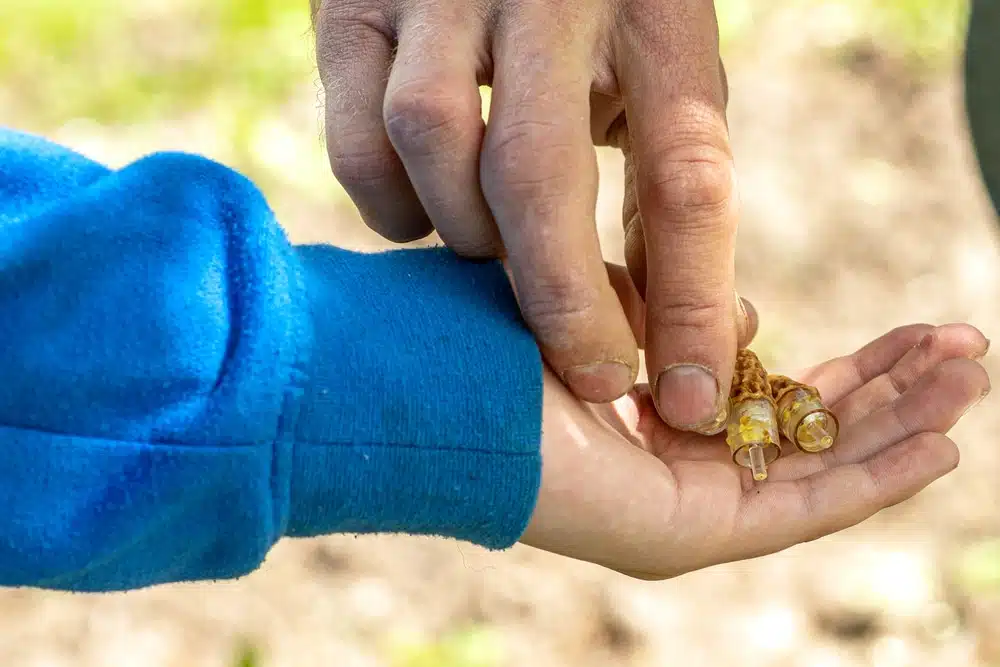
A colony’s productive potential depends to a large extent on its queen, although she is not the only factor. Timely requeening, supported by good colony management, can help maintain production. The difficult part is knowing whether poor brood development points to a failing queen or to another problem in the colony.
A productive queen or a brood problem?
| Encouraging signs | Signs that need investigation |
|---|---|
| Compact, orderly brood with similar-aged brood grouped together | Patchy brood with scattered empty cells |
| Plump, pearly-white larvae | Drone brood in worker cells where worker brood is expected |
| Brood production that keeps pace with colony development | A restricted brood area when conditions should favour expansion |
How to assess a queen
For a less experienced beekeeper, it is not always easy to tell whether a low laying rate reflects the queen’s quality or external conditions limiting her performance. That distinction matters: replacing a sound queen will not solve a shortage of food or a brood disease, and an unnecessary brood break can compromise the season.
Look for a compact, orderly brood pattern, with brood of similar ages grouped together and healthy larvae that are plump and pearly white. A queen commonly works outwards across an area of comb, but a perfect spiral is not a diagnostic requirement. Judge the pattern in the context of the season, available laying space and the number of bees able to rear the brood.
Before blaming the queen, rule out these causes
- Food shortage. (in Spanish) Under nutritional stress, workers may cannibalise young larvae, leaving a patchy brood pattern that can be mistaken for queen failure.
- Varroa and brood diseases, including American foulbrood, European foulbrood and chalkbrood.
- Harmful residues in comb wax, which can affect brood survival.
- Chilling or too few adult bees to cover and care for the brood area.
If these causes have been ruled out and the poor pattern persists, queen failure becomes a stronger possibility. Assess the colony as a whole before deciding to replace her.
More than one egg in a cell is a warning to investigate, not proof that the queen must be replaced. A newly laying queen may initially lay several eggs in some cells, especially where empty drawn comb is limited. Multiple eggs can also indicate laying workers. Check whether a queen is present and whether the brood develops into workers or drones; do not confuse laying workers with a drone-laying queen. If the situation is unclear, a follow-up inspection can be more informative than an immediate requeening attempt.
How often should you replace a queen?
In our work as professional queen breeders and suppliers of live bees, we look for two qualities in queens used for intensive honey or pollen production:
- A laying rate that builds an adequate workforce in time for the main nectar and pollen flows.
- Good overwintering performance, with a colony that uses its stores efficiently and has enough food to reach spring safely.
Annual or two-yearly requeening?
For this type of management, around two productive seasons is a useful requeening benchmark, not a fixed biological expiry date. Planned annual replacement may suit intensive operations or a breeding programme aimed at greater consistency. In either case, replace a genuinely failing queen sooner rather than waiting for the calendar.
Timely replacement can help maintain a strong, productive colony. It is not, on its own, a treatment for disease or a guarantee of resistance: genetics, nutrition, parasite control and management still matter. The right interval depends on the colony and your production goals, but requeening is, in our experience, one of the most useful management tools available to a beekeeper.
How to requeen a colony
Your approach depends on where the replacement queen comes from and how much control you need:
| Approach | When it is useful | Further guidance |
|---|---|---|
| Introduce a mated queen | When you want control over timing and breeding stock | Queen introduction protocol |
| Rear your own queens | When you have selected breeding colonies and enough demand | Getting started with queen rearing |
| Natural supersedure | When the colony replaces its queen itself | Supersedure queens |
Allow enough time for acceptance and for the new queen to establish a useful laying rate before the colony needs the next generation of workers. If you use a virgin queen or a queen cell, successful mating must also be allowed for; a purchased mated queen does not need that step. Plan the work around local conditions and the colony’s needs, including spring colony management.
How often should I replace a queen?
Around two productive seasons is a practical benchmark for the production system described here, not a fixed lifespan. Some intensive operations requeen annually. Replace a failing queen sooner, after checking that food shortages, disease or other conditions are not the real cause.
How can I recognise a failing queen?
Persistent patchy brood, drone brood in worker cells or a brood area that fails to expand in favourable conditions deserve investigation. Assess the brood, food supply, disease status and available laying space together; no single pattern proves queen failure.
Does patchy brood always mean the queen is poor?
No. Food shortage, Varroa, brood diseases, harmful residues in wax and too few bees to cover the brood can all affect brood survival. Requeening will not remove those underlying causes.
Do several eggs in a cell mean I should replace the queen?
Not necessarily. Newly laying queens sometimes lay multiple eggs, and laying workers can do so too. Check the queen’s presence and the type of brood being produced before acting. A follow-up inspection may help distinguish the two situations.

ISNI 0000 0005 1801 1100 | Joshua Ivars is the manager of LA TIENDA DEL APICULTOR and the author of this blog, where he shares technical and practical guidance for beekeepers. Drawing on extensive experience in the beekeeping sector, he offers advice and solutions based on beekeepers’ real needs, sharing his knowledge of equipment and essential beekeeping practices.


