
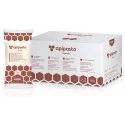
 Apipasta with vitamins 15kg
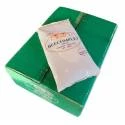 Beecomplet® Spring 14Kg
 Beekeeper suit with round veil
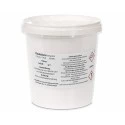 Oxalic acid 1kg
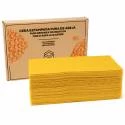 Beeswax Foundation 5kg
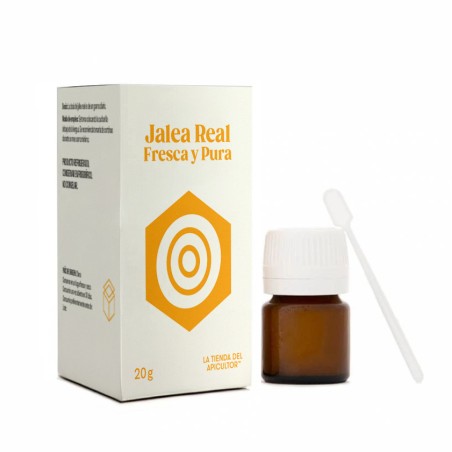
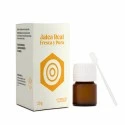 Fresh royal jelly 20g
 Classic honey jar 1kg comb-lines TO77 - Pack of 16 units
 Promotor L Apis 1 litre
Royal Jelly
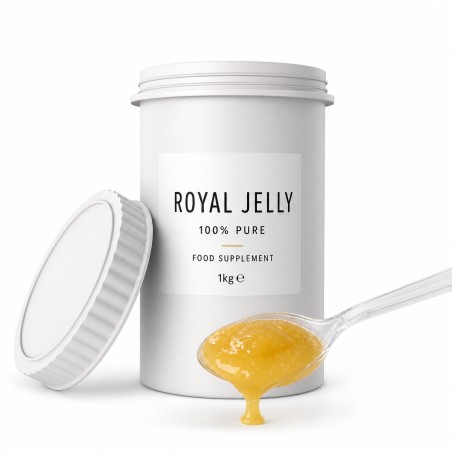
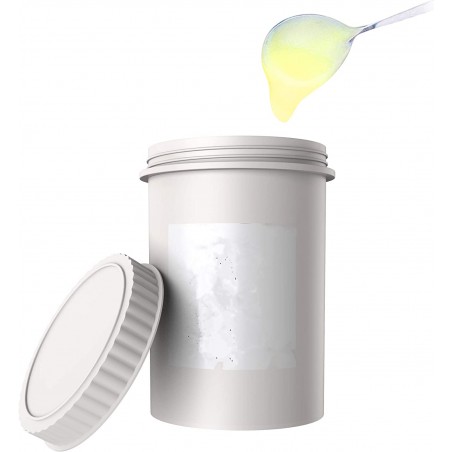
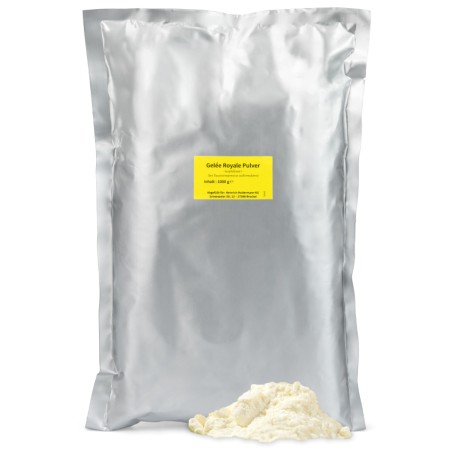
Fresh and freeze-dried royal jelly, from 20 g to 1 kg. Fresh royal jelly is kept chilled from harvest onwards; the freeze-dried form is dehydrated and needs no refrigeration.

How to choose and sell royal jelly well
Royal jelly is one of the most delicate products of the hive. I wouldn't buy it just by price or by “energy” or “miracle product” claims. If it's for final consumption, I'd look above all at freshness, cold storage, traceability, appearance, smell, taste and quality parameters like 10-HDA. A good fresh royal jelly must be treated as a sensitive product: little light, constant cold, a suitable container and clean handling. If it's going to be sold to the consumer, you have to communicate it well, but without exaggerating benefits. For me, the value lies in offering a natural product, well preserved, with a clear batch and with defensible quality.
If you're a beekeeper or professional and you buy royal jelly in a large format to repack, the critical point is not to break the quality chain. The 1 kg format can make a lot of sense for sale in small doses, natural cosmetics or specialized distribution, but it demands cold, hygiene, suitable jars, batching, correct labelling and speed of work. If you want greater stability or ease of conservation, freeze-dried royal jelly can be more practical than fresh, although it doesn't serve the same type of use. And if you use it for queen rearing, I'd look at it as a technical tool: it must be fresh, clean and well preserved, because in that context you're not selling a food, you're working with sensitive biological material.
And here I'll take a clear stand: with royal jelly I wouldn't compete on being the cheapest. It's a product of a lot of labour, a lot of technique and a lot of conservation. To differentiate yourself, I'd go for quality, origin, organic if applicable, declared 10-HDA when you want to position it as premium, and an honest explanation to the customer. Badly preserved royal jelly loses value very fast; well-handled, on the other hand, it can be a product that's small in format but big in margin, trust and differentiation.
Royal Jelly
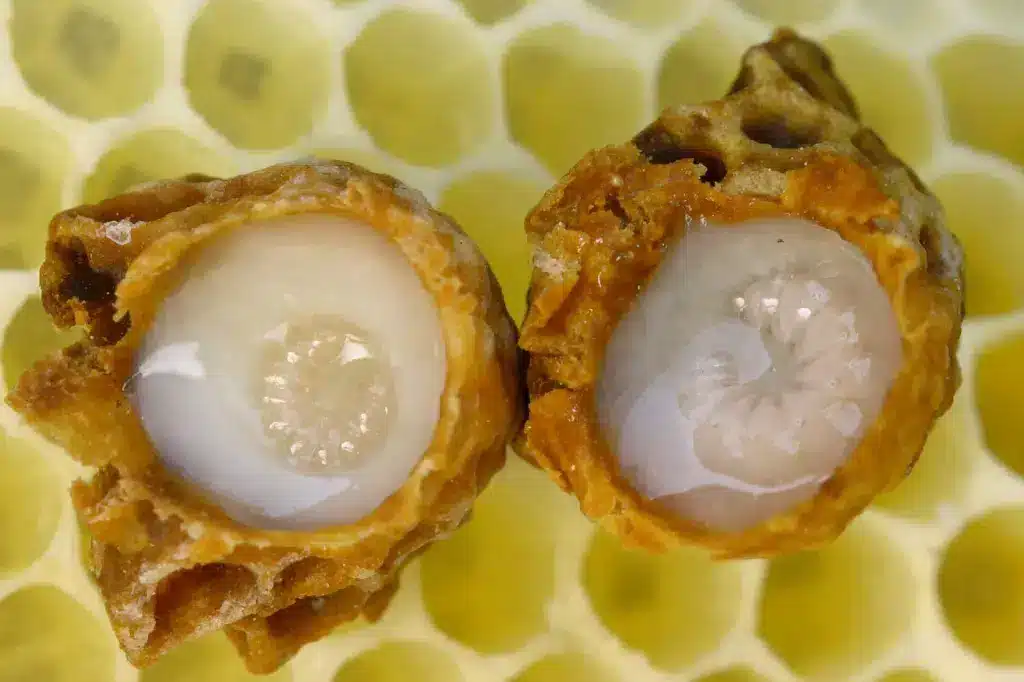
Royal jelly is the secretion of the hypopharyngeal glands of young nurse bees. Inside the hive it feeds every larva during its first three days and is the queen's only food for her entire life.
"What is it for" is the question we get most, and it deserves a straight answer: outside the hive it is bought for cosmetics, for food supplements packed by third parties and for direct sale fresh. What we are not going to tell you is what it does to whoever takes it, because there is no authorised health claim for royal jelly in the European Union. What can be demonstrated is composition, freshness, origin and traceability. That is what the rest of this page is about.
The three parameters it is bought on
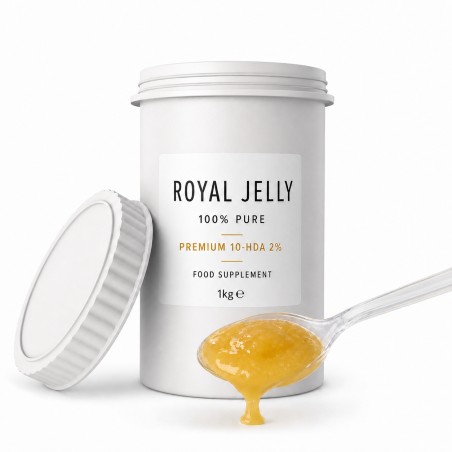
- 10-HDA (10-hydroxy-2-decenoic acid) — the fatty acid exclusive to royal jelly and the marker that defines its authenticity. Below the expected level, the product is not pure royal jelly. Commercial quality sits above 1.5 %; 2 % is what is paid for as premium.
- Moisture — fresh royal jelly carries between 60 % and 70 % water. Outside that range it points to adulteration or improper drying.
- Furosine — the deterioration marker: it reveals that the batch has been through heat or long storage in poor conditions.
These are the three analyses an industrial buyer asks for before agreeing a price, and the same ones you should be able to ask about.
Fresh or freeze-dried
Fresh royal jelly is thermolabile and photosensitive: it travels cold and in opaque packaging from the moment it is drawn. Freeze-dried has the water taken out, so it needs no cold chain and is far easier to handle.
That has a consequence worth being clear about before comparing prices: a kilo of freeze-dried is not the same as a kilo of fresh, because that 60-70 % of water has been removed. Putting the two price-per-kilo figures side by side makes freeze-dried look extremely expensive when, per unit of dry matter, it usually works out the other way round.
What explains the price differences
Format weighs more than quality. The 20 g jar works out at around €424/kg, while a kilo of fresh royal jelly is €82.50: five times less per unit of product. The 20 g is the consumption or trial format; the kilo is for repacking, formulating or supplying. Between kilos, the step for declared quality is far smaller: the premium with 2 % 10-HDA is €96.25 against €82.50 for the standard, 17 % more.
And it is expensive because of how it is produced: you have to rear queens, graft with precision and keep a continuous population of young nurse bees. It is skilled labour on strong colonies, not a by-product of the harvest.
How to keep it
Fresh, refrigerated and away from light. Badly kept royal jelly darkens and turns rancid — it starts off whitish-yellow and drifts towards yellow over time — and the palate notices before any analysis does. Freeze-dried keeps at room temperature in a closed container, out of the light.
What is royal jelly?
Royal jelly is the secretion produced by the hypopharyngeal and mandibular glands of young worker bees. It feeds every larva during its first days and is the queen's exclusive food throughout her life. It contains water, proteins, sugars, lipids, B-group vitamins and minerals. Its most widely used quality marker is 10-hydroxy-2-decenoic acid (10-HDA), found only in royal jelly.
What is 10-HDA and why does it appear on the label?
10-HDA (10-hydroxy-2-decenoic acid) is a fatty acid found only in royal jelly, which is why it serves as a marker to verify that the product is genuine and has not been diluted. The higher its percentage, the more concentrated the jelly. In the trade, good commercial quality is reckoned from 1.5 % upwards, and some batches reach or exceed 2 %.
How can I tell whether royal jelly is pure?
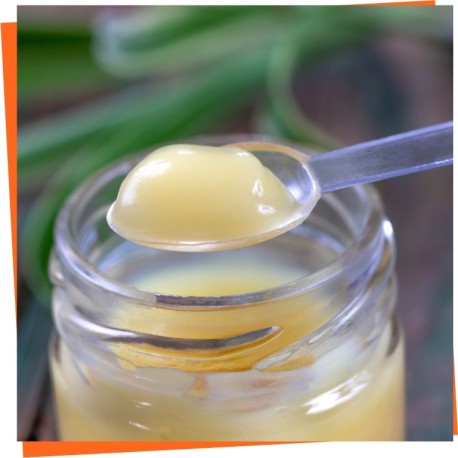
- Appearance and texture: Pure royal jelly is pearly white or slightly yellowish, with a thick, creamy texture. Significant changes in colour or consistency may mean it is not pure.
- Taste and smell: It has an acidic, slightly sharp taste. Sugary or artificial flavours can be a sign of adulteration. The smell should also be fresh and slightly strong.
- Certification and origin: Look for products with quality and origin certification. These guarantee that the royal jelly has undergone purity checks and comes from reliable sources.
- Laboratory testing: In some cases, specialised laboratory analysis can be carried out to verify purity.
What is fresh royal jelly?
Fresh royal jelly is the substance secreted by the hypopharyngeal and mandibular glands of young worker bees. It is the queen bee's exclusive food throughout her life. "Fresh" means that the royal jelly has not undergone dehydration or freeze-drying, so it keeps all its properties in their natural state.
How long does fresh royal jelly last and how is it stored?
It is a fresh product, so it goes in the fridge from day one: under optimum storage conditions it usually keeps for around 6 months.
What degrades it is heat and light, not time by itself. So keep it in the cold part of the fridge, in its original container well closed, without taking it in and out repeatedly: every return to room temperature costs it. Freezing extends storage, but it is best thawed only once.
What is the best way to store royal jelly?
Fresh royal jelly must always be kept cold, preferably refrigerated between 2 and 8 °C, so that its nutritional properties stay intact.
How is royal jelly stored and how long does it last?
Fresh royal jelly is perishable: it goes refrigerated from day one and, under optimum conditions, keeps for around 6 months. Frozen it lasts considerably longer, but it is best thawed only once.
What degrades it is heat and light, not time by itself: original container well closed, the cold part of the fridge, and no taking it in and out repeatedly. Freeze-dried royal jelly, having lost its water, keeps at room temperature — that is the real difference between the two formats.
How is royal jelly taken?
Fresh royal jelly has a sharp, intense flavour, so it is commonly taken alongside honey. The amount, the frequency and the way of taking it are those the manufacturer states on each product's label: check it before starting and keep to what it says.
Bear the format in mind, because it changes how the product is stored: fresh royal jelly is kept cold from harvest to consumption, while the freeze-dried form comes dehydrated and needs no refrigeration. In both cases the storage conditions are given on the packaging.
If you are pregnant or breastfeeding, are following any treatment, or have a known allergy to hive products, consult a health professional first.
What is the difference between fresh and freeze-dried royal jelly?
Fresh royal jelly is the natural product, harvested straight from the hive, which keeps all its biological properties intact, although it needs to be kept cold. The freeze-dried form has been dehydrated by vacuum freezing; it retains most of its properties and is easier to store and transport, though slightly less active than the fresh product.
Does royal jelly have any contraindications?
Royal jelly is generally safe for most people. However, anyone allergic to pollen, to bees or to hive products should avoid taking it or consult their doctor first. Caution is also advised for people with asthma or a significant history of allergy.
How long does royal jelly keep once opened?
Once the container is opened, fresh royal jelly should be used within 30 days at most, always kept refrigerated so that it retains all its properties. Freeze-dried royal jelly, being dehydrated, can last several months somewhere cool, dry and out of direct light.
Is it safe to take royal jelly during pregnancy?
In principle there is no clear evidence against taking royal jelly during pregnancy, but given the lack of conclusive studies it is advisable always to consult a doctor before making it a regular part of the diet while pregnant.
Is royal jelly suitable for children?
Royal jelly is a food and, like any hive product, should not be given to anyone allergic to bees or their products. In the case of children, the sensible course before adding it to their diet is to ask the paediatrician. In any event, follow the instructions on the packaging.