
Beeswax is a complex natural material secreted by worker bees, and building comb requires a substantial investment of food and energy. Good nutrition, enough workers and suitable conditions all matter. Two common shortcuts need correcting: bees do not have to heat the whole hive to 40 °C to work wax, and 4.9 mm small-cell foundation is not a reliable substitute for Varroa monitoring and control.
Beeswax: the key points
| Topic | Practical interpretation |
|---|---|
| Food used to produce wax | Substantial but variable; not a fixed honey-to-wax conversion |
| Temperature for comb building | Warmth helps; 40 °C is not a universal requirement |
| Wax-secreting workers | Mainly younger adults; age and activity vary |
| Common European worker-cell foundation | Often around 5.3–5.4 mm |
| Smaller worker-cell patterns | Around 4.8–4.9 mm are available; suitability is colony-dependent |
| Drone cells | Larger, commonly around 6.2–6.4 mm |
| New wax in drawn foundation | Variable; not automatically 50% |
In this guide
- What beeswax is and how bees make it;
- Cell size and the small-cell claim;
- Comb replacement;
- Wax quality and bee health;
- Good management practices.
What is beeswax?
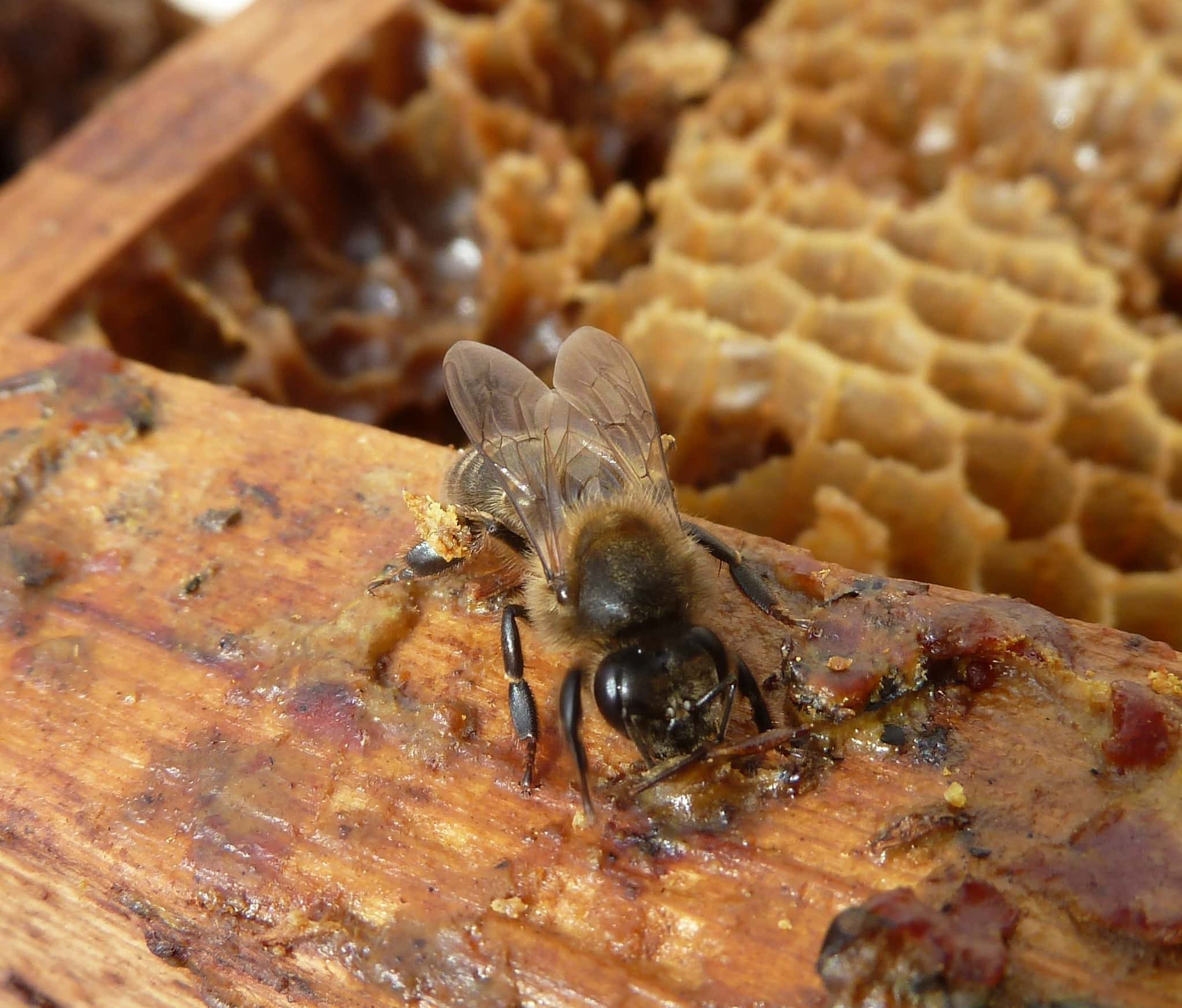
Beeswax is solid at room temperature. Chemically, it is a mixture of esters, hydrocarbons, free fatty acids and other components, rather than a simple fat such as an oil or tallow. Workers secrete it through four pairs of wax glands on the underside of the abdomen, where it forms thin scales (photo 1).
Wax secretion is associated mainly with young adult workers, but it does not follow a universal optimum of 15–30 days. In Muller and Hepburn’s study of Cape honey bees, wax-secreting workers formed a cohort aged 3–21 days, with activity also changing with the season. Carbohydrate supply, nutritional condition and colony needs affect production; the age range is not a rigid schedule for every bee or population.
Workers move wax scales with their legs and mouthparts, then manipulate and join the material with their mandibles to build cell walls. They also generate heat while working. However, direct observations by Bauer and Bienefeld recorded comb construction at wax temperatures of 33.6–37.6 °C. Warmth helps, but 40 °C is not a universal threshold below which comb cannot be built, and it is not a target for artificially heating a colony.

What helps a colony produce wax?
A colony is more likely to draw foundation when it has:
- An adequate carbohydrate supply, usually from nectar or appropriate supplementary feed where needed;
- Adequate pollen nutrition, with suitable supplementation considered when natural resources are insufficient;
- Enough workers and favourable conditions to build while keeping brood properly covered and warm. A cold, weak or poorly nourished colony should not be pushed to draw large amounts of foundation.
The original article gives 4–12 kg of honey per kilogram of wax as an indication of the cost of comb building. Such estimates depend on how production is measured, colony strength, food supply and conditions; they are not a fixed conversion rate or a feeding prescription. The practical point is to provide new foundation when the colony has the resources and population to draw it.
DID YOU KNOW?
Olszewski, K., Dziechciarz, P., Trytek, M., & Borsuk, G. (2022). A scientific note on the strategy of wax collection as rare behavior of Apis mellifera. Apidologie 53, 40.
Honey bees can also collect existing wax. A 2022 scientific note by Olszewski and colleagues documented workers gathering wax fragments into their pollen baskets. This observation does not justify leaving old comb exposed in an apiary: that can encourage robbing and the movement of contaminated material between colonies.
Cell size and small-cell foundation
Comb is not a perfectly repetitive manufactured grid. Bees adjust the geometry where comb sections meet or where cell sizes change. The drawings below illustrate different possible arrangements rather than a rule that every irregular cell indicates a problem.

Cell dimensions vary between bee populations, between worker and drone brood, and within a single comb. Foundation, comb age and the way cell width is measured also affect comparisons. A broad climate map cannot determine the correct foundation size for a particular colony.
Many foundation presses and rollers for European honey bees produce worker-cell patterns around 5.3–5.4 mm. Smaller patterns, including 4.8–4.9 mm, are also sold; their suitability should not be inferred from a simple racial or climatic label. Drone cells are larger, commonly around 6.2–6.4 mm, rather than 5.6 mm as a universal standard. Small cells alone do not reliably control Varroa. In Ellis and colleagues’ field study, small-cell foundation did not significantly reduce mite levels. This does not mean that smaller cells always increase brood or mites either. Resistance in some bee populations involves several biological and behavioural traits and cannot be attributed to cell size alone.
Replacing old comb
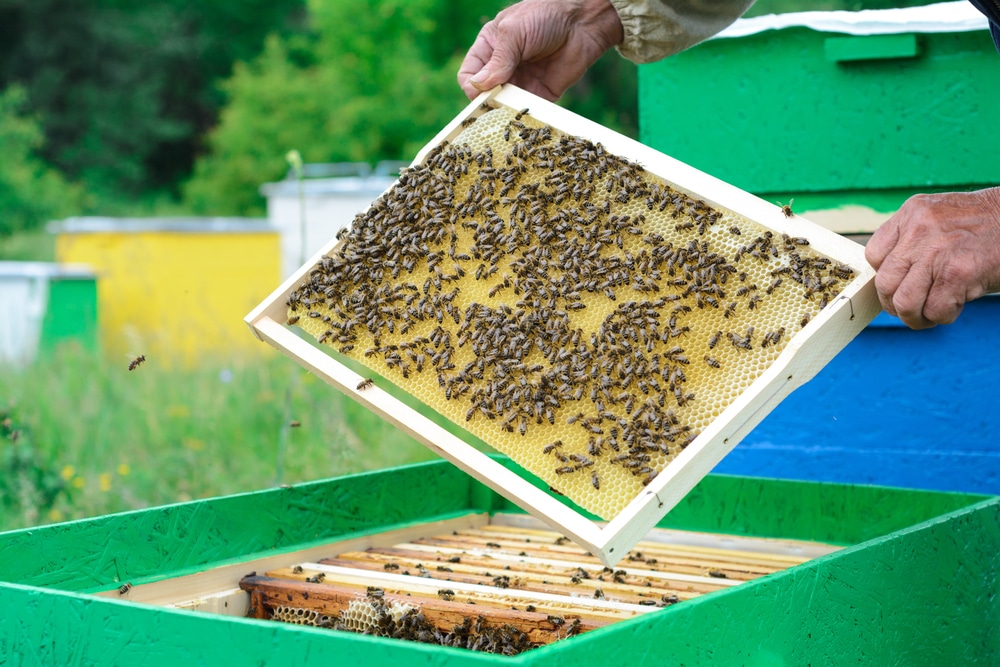
When bees draw a sheet of wax foundation, they redistribute some of the sheet’s wax and add wax of their own. The original Layens example uses a roughly 100 g sheet and another 100 g added during construction. That illustrates the contribution of foundation, but a drawn comb is not invariably 50% newly secreted wax: the proportions depend on the sheet, frame, cell depth and bees’ work. Good-quality foundation matters because its material remains part of the comb.
Brood comb becomes darker and heavier as successive generations leave cocoons and other material in the cells. The original example of a comb weighing about 400 g after three or four years is illustrative, not a universal age-to-weight relationship. Cell walls thicken and usable space may decrease. Old comb can also retain contaminants and disease-associated material; its history and condition matter more than colour alone.
Ordinary melting and straining are not a guarantee of either disinfection or pesticide removal. Some persistent, fat-soluble residues can remain in recovered wax. Specialist processing may reduce particular contaminants, but ask for validated evidence and batch analysis rather than assuming that filtered wax is residue-free. Keep material from colonies with suspected brood disease out of routine recycling and seek advice from the responsible bee-health professional; this article is not a disinfection protocol.
Plan comb replacement instead of waiting for every frame to become unusable. Fresh white wax along the top bars and growing comb edges is a useful sign that a colony is building. Introduce foundation in manageable amounts while there are enough bees, food and suitable weather to draw it.
Replacing roughly 20–30% of brood comb each year can be a practical rotation plan, but it is not a universal minimum or a substitute for inspecting individual frames. Mark frame ages and remove damaged or suspect comb sooner where necessary. Place new foundation beside the actively occupied brood area without splitting brood that the colony cannot keep warm. Retire old frames once their brood has emerged; do not treat honey in disease-suspect comb as automatically suitable for harvesting or feeding elsewhere.
Honey-super comb that has never contained brood accumulates less cocoon material than brood comb. This does not make it automatically free of pesticide residues. Some synthetic Varroa treatments, including tau-fluvalinate and coumaphos, can leave persistent residues in wax; other active substances behave differently. Traceable wax sources and treatment records are more informative than a blanket claim that all acaricides dissolve in wax or that all super wax is clean.
Unprotected stored comb can be damaged by wax moths, notably the greater wax moth, Galleria mellonella, and the lesser wax moth, Achroia grisella. Their larvae can consume wax as well as associated food and organic material. Old brood comb and comb containing pollen are particularly attractive, but new comb is not guaranteed to be immune. Keep colonies strong and inspect stored frames rather than relying on their colour or apparent newness.
Assessing beeswax quality
Wax quality can also suffer during rendering, handling and storage. Excessive or prolonged heating, dirty equipment, mouldy combs and unsuitable storage can affect the recovered material. Use controlled, indirect heating and suitable equipment; avoid naked flames, unattended heating and unnecessary overheating. A single temperature such as 90 °C is not a universal boundary between acceptable and damaged wax: the process and exposure time also matter.
There are legal specifications for beeswax in particular uses. For example, EU Regulation 231/2012 defines white and yellow beeswax as food additive E901 and sets identity and purity criteria. These should not be confused with a complete guarantee that a batch is suitable for brood foundation. Food-additive compliance, authenticity and pesticide-residue risk are related but separate questions.
A laboratory can assess several complementary characteristics. The examples below distinguish specified E901 values from broader compositional indicators; they are not a special legal standard for Apis mellifera iberiensis:
- Melting range: the E901 specification gives 62–65 °C; the test method and sample still matter.
- Saponification value: expressed as milligrams of potassium hydroxide equivalent per gram of wax; E901 specifies 87–104. This is not the amount of household caustic soda to add to a batch.
- Acid value: E901 specifies 17–24 mg KOH/g, measuring free acidity rather than pH.
- Ester value and ester-to-acid ratio: useful supporting indicators interpreted against an appropriate reference and analytical method, not a standalone guarantee of authenticity.
- Peroxide value: an oxidation indicator; E901 gives a maximum of 5. Use the laboratory’s method and units when comparing results, rather than an unsupported universal limit of 0.25.
- Hydrocarbon profile: examine the characteristic compounds and their distribution, including evidence of added paraffin or other mineral waxes.
- Ester profile: beeswax contains several ester classes, not only monoesters; their distribution contributes to its chemical identity.
- Free fatty acids: assess their composition and proportions, including unusual additions that may alter brood compatibility.
- Free long-chain alcohols: a minor part of the natural mixture, assessed alongside the other fractions rather than through one percentage alone.
Adulterants can alter melting behaviour, the chemical profile and mechanical strength. Storage and processing may also change odour or oxidation indicators. Poor acceptance, distorted drawing or extra comb built away from the sheet are reasons to investigate, but none proves adulteration on its own. Foundation placement, colony readiness and other conditions must also be considered.
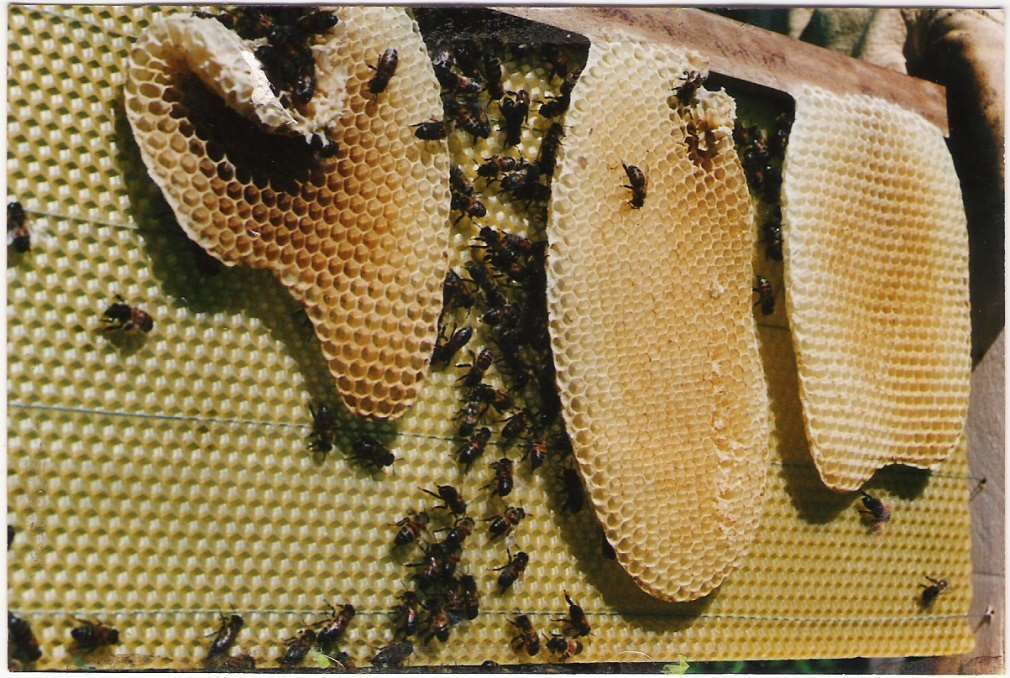
Beeswax adulteration with cheaper materials has been documented, including paraffin, microcrystalline waxes, stearin and other fats or waxes. They are not chemically interchangeable, and their effects differ. A low price is not proof of adulteration, while a familiar smell or pale colour is not proof of purity.
No simple home test can establish authenticity and bee safety with certainty. Use appropriate laboratory testing, supplier traceability and batch records. A controlled study of stearin-adulterated foundation found reduced brood survival, whereas the tested paraffin mixtures affected comb strength without the same brood-survival result. Patchy brood or poor foundation acceptance is therefore a warning to investigate, not a chemical diagnosis.
Effects on bee health
Pesticide residues in wax may expose developing bees through contact and, for some substances, through transfer to food or other hive materials. The extent depends on the compound, concentration and conditions. There is no universal two-month deadline after which stored pollen becomes toxic, nor can a fixed pollen-fat percentage predict the risk. Brood losses require assessment of the queen, nutrition, Varroa and disease as well as possible contamination.
Sublethal exposure to particular pesticides can affect development, adult longevity or other aspects of bee health, depending on the substance and exposure. Research on contaminated brood comb found delayed development and shortened adult lifespan under the studied conditions. That does not mean that every detectable residue will cause those effects or that all colonies will die above 100 ppb. Risk assessment must identify the chemicals and relevant exposure; a single concentration cannot serve as a universal toxicity threshold or a threefold-loss rule.
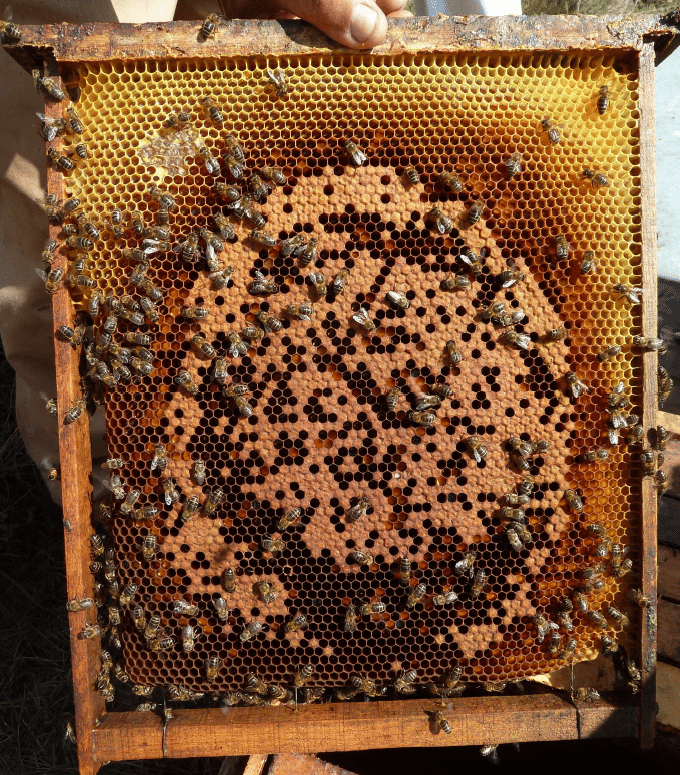
The gaps in the capped brood shown in photo 4 warrant investigation, but the photograph alone cannot identify their cause or quantify brood survival.
Good wax-management practices
Useful wax-management practices include:
- Plan gradual brood-comb renewal, often around 20–30% annually, adjusted to frame condition, disease history and the colony’s ability to build.
- Choose traceable foundation with a documented chemical history and low contamination risk, without treating a universal 100 ppb figure as a safety certificate:
- ask for relevant batch analysis and the laboratory’s interpretation;
- if buying specially processed wax, request evidence of which contaminants the process reduces;
- prefer well-managed cappings or super-wax streams where appropriate, but do not assume they always contain three times fewer residues or none at all;
- if having your own wax made into foundation, keep batches traceable and check their quality rather than assuming an own-wax loop is contamination-free;
- Maintain access to suitable pollen resources through the colony’s active needs, assessing dearths as they arise rather than relying on a fixed three-month interval.
Frequently asked questions
How much honey do bees use to produce wax?
Comb building uses food and energy, but there is no fixed honey-to-wax conversion that applies to every colony. The original article’s 4–12 kg of honey per kilogram of wax is a contextual estimate, not a feed dose. Colony strength, conditions and the amount of foundation supplied all affect the practical cost.
How do bees make wax?
Workers secrete thin wax scales from four pairs of glands on the underside of the abdomen. Wax secretion is mainly associated with younger adults and varies with age, season and colony needs. Workers use their legs and mouthparts to handle the scales and shape the wax into comb.
Do bees need 40 °C to work wax?
They do not need a universal 40 °C threshold. Bees warm and manipulate wax as they build, and direct observations have recorded comb construction below that temperature. Do not heat a hive to 40 °C in an attempt to force wax production; support a healthy, well-nourished colony and provide foundation when it is ready to build.
Does 4.9 mm small-cell foundation control Varroa?
It should not be relied upon as a Varroa-control method. Field trials with European honey bees have not consistently shown a useful reduction in mites. Cell size can affect comb characteristics, but it does not replace regular monitoring and an effective, authorised control plan.
How much newly secreted wax is in a drawn comb?
There is no fixed percentage. Bees remodel the foundation and add wax, so both contribute to the finished comb. The 100 g foundation plus 100 g added wax example for a Layens frame is illustrative, not a rule that every drawn comb contains exactly 50% new wax.
What cell sizes are available in foundation?
Many worker-cell foundations for European honey bees are around 5.3–5.4 mm, while smaller patterns around 4.8–4.9 mm are also available. Drone cells are larger, commonly around 6.2–6.4 mm. Check the manufacturer’s nominal size and measurement convention; these figures are not universal limits for every colony.
Further reading
- Working with beeswax: rendering and cleaning.
- Fitting wax foundation into a frame.
- Making wax foundation sheets.
- Varroa: identification and control (in Spanish).

Con más de 50 años dedicados exclusivamente a la apicultura, Antonio Gómez Pajuelo ha trabajado en colaboración con agrupaciones de apicultores, administraciones y empresas en América, Europa y Oceanía. Desde 1992, ofrece desde Castellón servicios de asistencia técnica en manejo de colmenas, calidad de la miel, formación y estudios para productores y empresas apícolas. Licenciado en Ciencias Biológicas por la Universidad Complutense de Madrid, ha trabajado en diversas instituciones, incluyendo la Universidad Autónoma de Barcelona y la Facultad de Veterinaria de Córdoba.
Su trayectoria incluye más de 160 publicaciones en congresos y revistas técnicas, la autoría del libro “Cata de Mieles de España y Portugal” y la participaciónen múltiples publicaciones científicas y monografías sobre sanidad apícola, polinización y calidad de la miel.


