
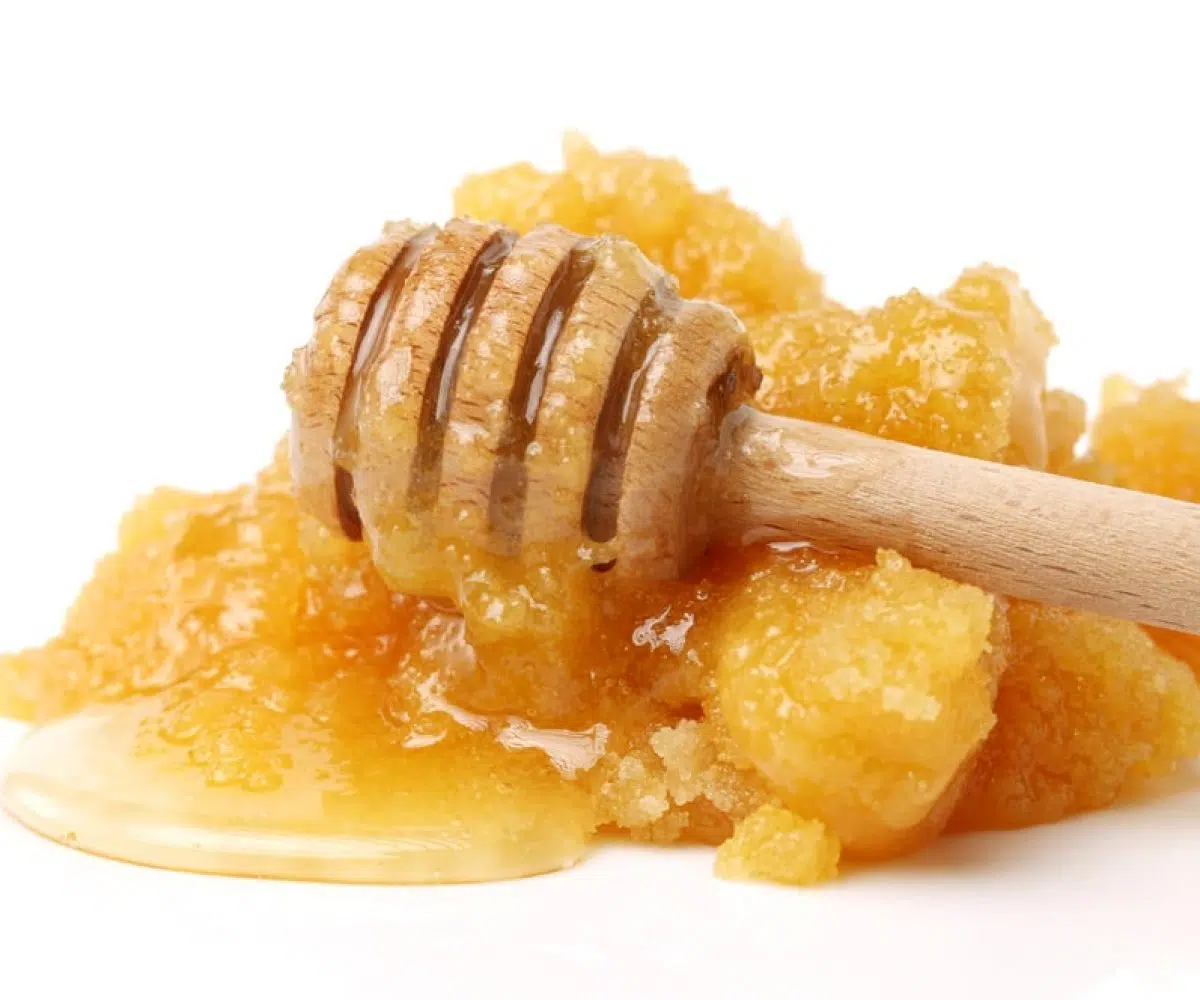
There is no exact temperature at which honey ‘loses all its properties at once’. Deterioration is progressive and depends on temperature, time, honey composition and its initial condition. Applying more heat does not always solve the problem sooner: in a jar or drum, the surface may overheat while the centre remains cold.
If honey is merely crystallised, it need not be liquefied to be suitable for use. If you need to soften, bottle or pump it, the right approach is to use indirect, uniform heat, monitor the temperature within the honey itself and keep heating time to the minimum required. This guide explains what happens in each temperature range, how to warm a jar gently and how to validate a professional process using HMF and diastase activity.
The decision in 30 seconds
1 · OBJECTIVE
Do you really need to liquefy, or just soften?
2 · MEASUREMENT
Monitor the honey, not just the thermostat.
3 · UNIFORMITY
Indirect heat, circulation and no hot spots.
4 · FINISH
Stop heating, cool and record once the honey is workable.
Key idea: 40 °C is not a boundary separating ‘intact’ honey from ‘ruined’ honey. It is more useful to consider cumulative heat exposure: how hot the product actually became, for how long and how many times.
How temperature affects honey
Temperature first alters physical properties that are easy to observe, and with sufficient time or intensity, also chemical and sensory indicators. These changes do not progress at the same rate:
Viscosity
As honey warms, it flows more easily. The change can be dramatic before all crystals have fully dissolved.
CRYSTALS
Temperature alters their rate of formation and dissolution, but the response depends on glucose, water, seed crystals and crystal size.
QUALITY
Heat and prolonged storage promote loss of aroma, increase in HMF and decline in enzymatic activity.
Honey conducts heat slowly. Therefore, air temperature in a chamber, plate temperature or bath water temperature does not equate to the temperature at the product’s core. An infrared thermometer also measures only the surface, not the temperature inside the honey.
A figure that helps put this into perspective. In a study of raw rapeseed honey, average viscosity fell from 33.6 Pa·s at 20 °C to 8.2 at 30 °C, 2.5 at 40 °C and 1.6 at 50 °C. This is an example for one particular honey, not a universal table, but it shows why gentle warming is often enough for pumping or bottling without seeking complete liquefaction.
Practical temperature map: what to expect
This map is for decision-making, not batch certification. The boundaries are not fixed because two honeys may react differently under the same treatment.
| General guidance | What usually happens | Useful decision |
|---|---|---|
| Intense cold or freezing | Viscosity increases significantly and many ageing reactions slow down. It does not sterilise honey. | Suitable for storing samples or reserves, but not necessary for a household jar. Avoid condensation when returning to ambient conditions. |
| Around 14 °C | A favourable zone for crystallisation in many honeys, although composition remains dominant. | Useful for controlled crystallisation; poor choice if the goal is to keep honey commercially liquid. |
| Cool and stable environment | Honey continues to age slowly. Light, time and thermal fluctuations also matter. | For home: airtight, dark container away from heat sources. For storage: record batch, date and conditions. |
| 32–40 °C | Honey loses much of its viscosity and may soften. Not all large crystals disappear. | A common range for gentle warming. Measure the product and stop the process when it fulfils its purpose. |
| Above 40 °C | It may dissolve crystals faster, but increases the risk of aroma loss, enzyme inactivation and HMF formation, especially with longer heating. | Do not make this routine without a validated process. Avoid hot spots and cool down when finished. |
Warm storage requires special attention. In a twelve-month trial with commercial honeys, batches stored at 35 ± 2 °C exceeded an average of 40 mg/kg of HMF from the sixth month onwards, whereas those stored at 10 ± 2 and 22 ± 2 °C did not. This does not predict the shelf life of every honey, but it shows that months of moderately warm storage can have a greater impact than brief, controlled warming.
Why honey crystallises and the role of temperature
Honey is a supersaturated solution of sugars. Glucose is less soluble than fructose and can precipitate from the liquid phase to form crystals. This is a natural physical change: it does not by itself indicate purity, adulteration, deterioration or superior quality.
Stages of crystallisation
- Nucleation: microcrystals appear, often around other crystals, pollen, wax or small bubbles.
- Growth: more glucose is incorporated into these nuclei, altering texture, opacity and firmness.
Factors explaining why two honeys crystallise differently
- Ratio between glucose, fructose and water.
- Botanical origin and mix of floral sources.
- Temperature and fluctuations during storage.
- Number of nuclei and crystal size.
- Agitation, filtration and prior treatments.
- Time and initial physical state of the batch.
An alternative to reheating: controlled crystallisation
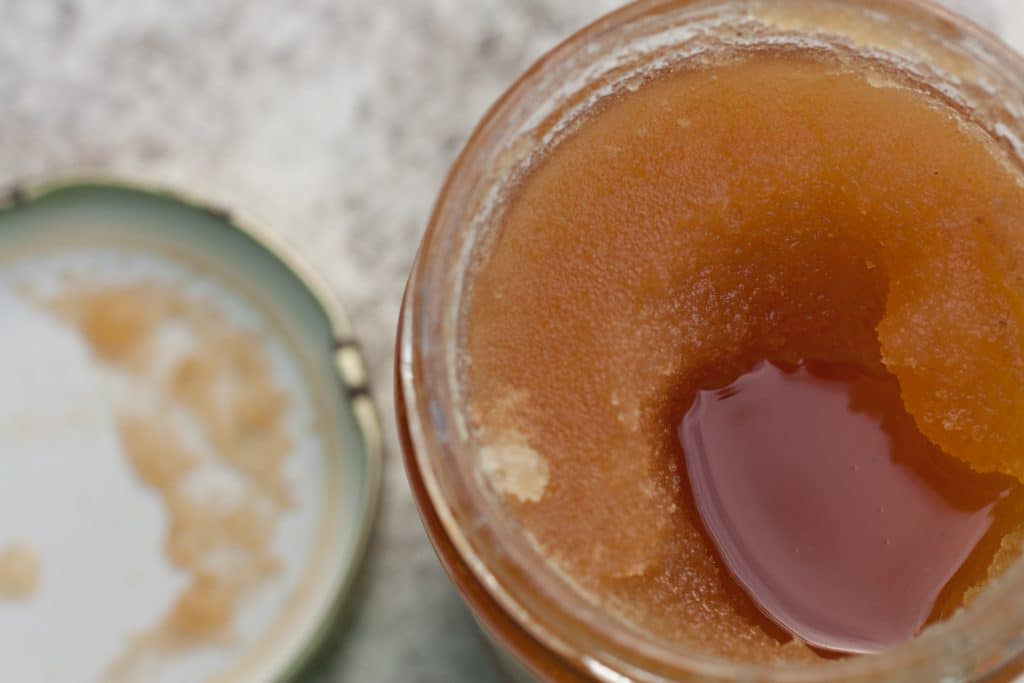
Not all crystallised honey needs to be returned to liquid form. In creamed honey, the beekeeper guides crystallisation to form many small, uniform crystals. The result is a fine, homogeneous, spreadable honey: it remains honey, with no added cream and without deliberately incorporating air.
FOR THE CONSUMER
It is easier to portion and spread, drips less and can be served without warming each jar to soften it.
FOR THE SELLER
It turns natural crystallisation into a controlled, more consistent texture, rather than allowing it to appear as coarse grains or an irregular texture that the customer might interpret as a defect.
Important: ‘creamed honey’ does not automatically mean ‘raw honey’ nor guarantee that it has never been heated. If the base contains coarse crystals, a gentle, controlled liquefaction may be required before seeding; afterwards, moisture, hygiene, the quality of the seed honey and temperature must be monitored. It does not correct immature, fermented or overheated honey. Consult the complete creamed honey process or the guide on why honey crystallises.
How to decrystallise or soften a jar at home
At home, the reasonable goal is usually to make the honey more manageable, not to eliminate every last crystal. The most controllable method is a warm water bath.
1 · Prepare
Use a heat-resistant container. Keep the water below the lid and avoid letting the glass come into direct contact with a very hot surface.
2 · Heat indirectly
Use warm water, never boiling. The FAO recommends that the water bath be no more than 5–10 °C warmer than the desired temperature of the honey.
3 · Equalise the temperature
Gently rotate the jar or stir with a clean, completely dry utensil. Do not introduce water: honey is hygroscopic.
4 · Stop heating and cool
Remove the jar as soon as the texture is suitable. Do not leave it ‘just in case’ or keep the bath hot for hours.
If you can measure the temperature with a clean, dry food-grade probe, monitor the centre of the honey. Without a thermometer, proceed more cautiously: use only warm water, work in short intervals and check frequently. Liquefaction may take time, especially with large crystals, and the honey will recrystallise when its composition and conditions favour it.
Microwaves, ovens and direct sunlight are difficult to control at home. The problem is uneven or poorly monitored heating, which makes the actual temperature difficult to reproduce. Domestic microwaves may produce hot spots; under sunlight, the process varies with the container, radiation and environment.
Precautions when heating honey: seven common mistakes
- Confusing the setpoint with the honey temperature. A thermostat reading of 40 °C does not mean that all the honey is at 40 °C; there may be hotter spots while the centre remains cold.
- Measuring only the surface. An infrared thermometer is useful for scanning, but does not replace an insertion probe when core temperature control is required.
- Applying direct heat. A flame, a very hot plate or a poorly positioned heating element may locally damage the honey before the whole mass is liquefied.
- Not circulating the air or honey. In chambers and tanks, controlled circulation reduces thermal gradients; it does not compensate for a poorly adjusted thermostat or a mispositioned probe.
- Heating to a fixed timetable. ‘Twelve hours’ does not mean the same for a jar, bucket or 300 kg drum, or for fine and coarse crystals.
- Repeating heating cycles without recording them. Several gentle heatings also accumulate thermal load. Record each intervention and avoid liquefying the entire batch if only part will be used.
- Heating honey to boiling point. Honey does not have a single operational ‘boiling point’: it is a concentrated mixture of water and solutes. Long before boiling, aromas may be lost, colour darkened and quality indicators altered.
If honey has been overheated: appearance alone cannot establish HMF, diastase activity or commercial suitability. Isolate the batch, document the incident and have it analysed if it is to be sold. At home, discard it if it smells or tastes burnt, is contaminated, has damaged packaging or raises any safety concern; do not try to ‘correct’ it by mixing it with another honey.
HMF and diastase: what they measure and their limits
The Spanish standard uses hydroxymethylfurfural (HMF) and diastase activity, determined after processing and blending, as quality parameters. They should be interpreted together and in the context of the batch’s history.
HMF
Increases with heating and storage, but also depends on acidity, composition and initial value. It does not function as a clock that alone reveals ‘how many minutes’ a honey was heated.
DIASTASE
Diastase activity is expressed on the Schade scale. It may decrease due to heat and time, but its natural level varies with the honey’s origin; it cannot reveal the heating temperature on its own.
| Legal parameter | General requirement | Specified exception |
|---|---|---|
| Diastase activity | Not less than 8 on the Schade scale, except for baker’s honey (honey for industrial use). | Honeys with naturally low enzyme content, such as some citrus varieties: not less than 3 if HMF does not exceed 15 mg/kg. |
| HMF | Not more than 40 mg/kg, except for baker’s honey. | Honey from declared tropical regions and their mixtures: not more than 80 mg/kg. |
These maximum and minimum values are compliance criteria, not process targets. Operating precisely at the limit leaves little room for subsequent shelf life. If you sell honey, agree internal acceptance limits with your laboratory, taking account of floral origin, the best-before date and expected distribution conditions.
Professional protocol for controlled heating
There is no single recipe of minutes and degrees that suits all honey producers. There is, however, a reproducible way to develop and validate a suitable process:
- Define the objective. Softening, pumping, filtering, homogenising, packaging or dissolving all crystals are different goals. Use the minimum treatment that achieves yours.
- Identify the batch. Record origin, date, mass, container, state of crystallisation, moisture and prior treatments.
- Know the starting point. For large batches or those already close to quality limits, analyse HMF and diastase beforehand. A good process cannot compensate for poor prior storage.
- Choose an indirect, controllable heat-transfer method. Use a jacket, bath, band heater, heating blanket or thermostatically controlled chamber; avoid localised high-temperature contact.
- Measure the product. Place representative probes in areas predictably hot and cold. In a chamber, combine air circulation with core measurement of test containers.
- Reduce gradients. Mix or recirculate only with suitable, clean equipment, avoiding the incorporation of air. Here, container design and viscosity matter.
- Record the actual curve. Note the time, setpoint, product temperatures and the point at which the target texture is reached—not just the total time the chamber was switched on.
- Stop, cool and validate. Avoid leaving honey hot after completing the operation. Check the result and, where appropriate, repeat HMF and diastase testing to establish a procedure by honey type, format and equipment.
Equipment should be chosen to suit the container format, not on the basis of a single catalogue specification
| Situation | Common solution | Essential checks |
|---|---|---|
| Jars or small batches | Bath or warm air cabinet | Representative temperature and frequent checks |
| Bucket or settling tank | Heated base, belt or jacket | Thermostat, even heating and a probe in the honey |
| Drum | Heating blanket, band heater, suitable heating element or warming chamber | Multiple measurement points, time and absence of local overheating |
| Batch of jars or pallet | Chamber with forced air circulation | Thermal mapping and test containers in critical zones |
How to store honey and minimise heat damage
AT HOME
- Airtight, clean and dry jar.
- Dark, cool and temperature-stable location.
- Away from ovens, radiators, direct sunlight and hot cars.
- Dry utensil to avoid introducing moisture.
IN STORAGE
- Temperature control and recording, rather than simply judging that the room feels cool.
- Stock rotation by batch and date; avoid years of unmonitored storage.
- Closed food-grade containers protected from water and odours.
- Retained sample and a record of previous heat treatments.
Refrigeration does not automatically spoil honey, but it may harden it or alter its crystallisation and is usually unnecessary for domestic use. If the real alternative is sustained exposure to temperatures above 30 °C, cold storage may reduce thermal ageing. Keep the jar tightly closed and allow it to reach room temperature without opening it to limit condensation.
Temperature and humidity interact: honey can absorb water from the air, and crystallisation can concentrate it in the liquid phase. To prevent foaming, gas or fermentation, see our guide to honey moisture content. To consider temperature, humidity, analysis and origin together, also read how to assess honey quality.
Conclusion: heat with a clear purpose and measure the result
The best temperature is the lowest that achieves the result in the shortest practical time, uniformly and verifiably. For a jar, that usually means a warm-water bath and patience. In a honey-processing facility, it means a temperature probe inserted into the honey, circulation, record-keeping, cooling and analytical validation.
And if the honey is simply crystallised, remember the gentlest option: accept its natural texture and do not heat it.
Frequently asked questions about honey and temperature
At what temperature does honey lose its properties?
There is no single point. Changes depend on temperature, time, composition, age and prior treatments. The higher the temperature and the longer or more frequent the exposure, the greater the thermal load usually is. HMF and diastase allow batch assessment, but require laboratory analysis.
Can I add honey to hot tea or coffee?
Yes, but heat may reduce some aromas and sensitive components depending on temperature and duration. To minimise this effect, wait until the drink is comfortably warm before adding honey. Heating honey does not automatically turn it into a toxic substance.
Can honey be decrystallised in a microwave?
It may liquefy, but it is not the recommended method because domestic microwaves make it difficult to control gradients and hot spots. For a jar, a warm water bath is preferable: indirect heat, frequent checks and removal as soon as the texture becomes usable.
How many times can honey be heated?
There is no universal number. Each cycle adds time and temperature to the batch’s thermal history. Heat only the amount needed, record each treatment, and if the honey is marketed, validate the process using HMF, diastase activity and sensory evaluation.
How long does it take for honey to recrystallise after heating?
It may take days, weeks or months. This depends on the glucose-water ratio, floral origin, residual crystals, filtration, agitation and storage temperature. Heating delays crystallisation but does not guarantee the honey will remain liquid.
Is crystallised honey of lower quality or adulterated?
No. Crystallisation is a natural physical process and does not by itself indicate purity or adulteration. To assess quality, consider traceability, analysis, moisture, HMF, diastase, origin and sensory evaluation.
Can honey be stored in the refrigerator?
Yes, although it is usually unnecessary. Cold increases viscosity and may alter texture or crystallisation. If refrigerated, keep it airtight and allow it to reach room temperature while still closed to reduce condensation.
Is it a good idea to heat honey in the sun?
Not as a controlled process. Radiation, container colour, wind and ambient temperature make it difficult to know what temperature each zone reaches and for how long. Use regulated indirect heat and measure the product.
What is the boiling point of honey?
Honey does not have a single boiling point like a pure substance: it contains water, sugars, acids, minerals and other compounds. Moreover, boiling is not a useful goal for decrystallisation; before that, losses in aroma, darkening and quality deterioration may already occur.
Which is better: reaching 36 °C or 46 °C?
For the same duration and conditions, a lower temperature usually means less heat exposure, but this isolated comparison is insufficient. Duration, volume, uniformity, objective and initial values of HMF and diastase matter. Stop the process when the honey is already usable.
Sources and regulation
- Spanish Royal Decree 1049/2003: honey quality standard, consolidated text.
- Council Directive 2001/110/EC on honey and consolidated text.
- International Honey Commission: harmonised methods for HMF, diastase and other parameters.
- FAO: honey handling and heating in Value-added products from beekeeping.
- FAO: controlled crystallisation and production of creamed honey.
- Kędzierska-Matysek et al.: viscosity, HMF and diastase activity of rapeseed honey at different temperatures.
- Korkmaz and Küplülü: effect of storage temperature on HMF and diastase.
- Tosi et al.: effect of thermal treatment on HMF formation.
- Tosi et al.: modification of diastase activity by heating.
- Kowalski et al.: methods of liquefaction and formation of hot spots in microwave heating.
Educational content reviewed on 23 August 2026. Operating ranges are indicative and do not replace process validation, batch analysis or current regulations. To release a batch of honey for sale, follow your food safety control plan and the advice of a competent laboratory.

Con más de 50 años dedicados exclusivamente a la apicultura, Antonio Gómez Pajuelo ha trabajado en colaboración con agrupaciones de apicultores, administraciones y empresas en América, Europa y Oceanía. Desde 1992, ofrece desde Castellón servicios de asistencia técnica en manejo de colmenas, calidad de la miel, formación y estudios para productores y empresas apícolas. Licenciado en Ciencias Biológicas por la Universidad Complutense de Madrid, ha trabajado en diversas instituciones, incluyendo la Universidad Autónoma de Barcelona y la Facultad de Veterinaria de Córdoba.
Su trayectoria incluye más de 160 publicaciones en congresos y revistas técnicas, la autoría del libro “Cata de Mieles de España y Portugal” y la participaciónen múltiples publicaciones científicas y monografías sobre sanidad apícola, polinización y calidad de la miel.


