
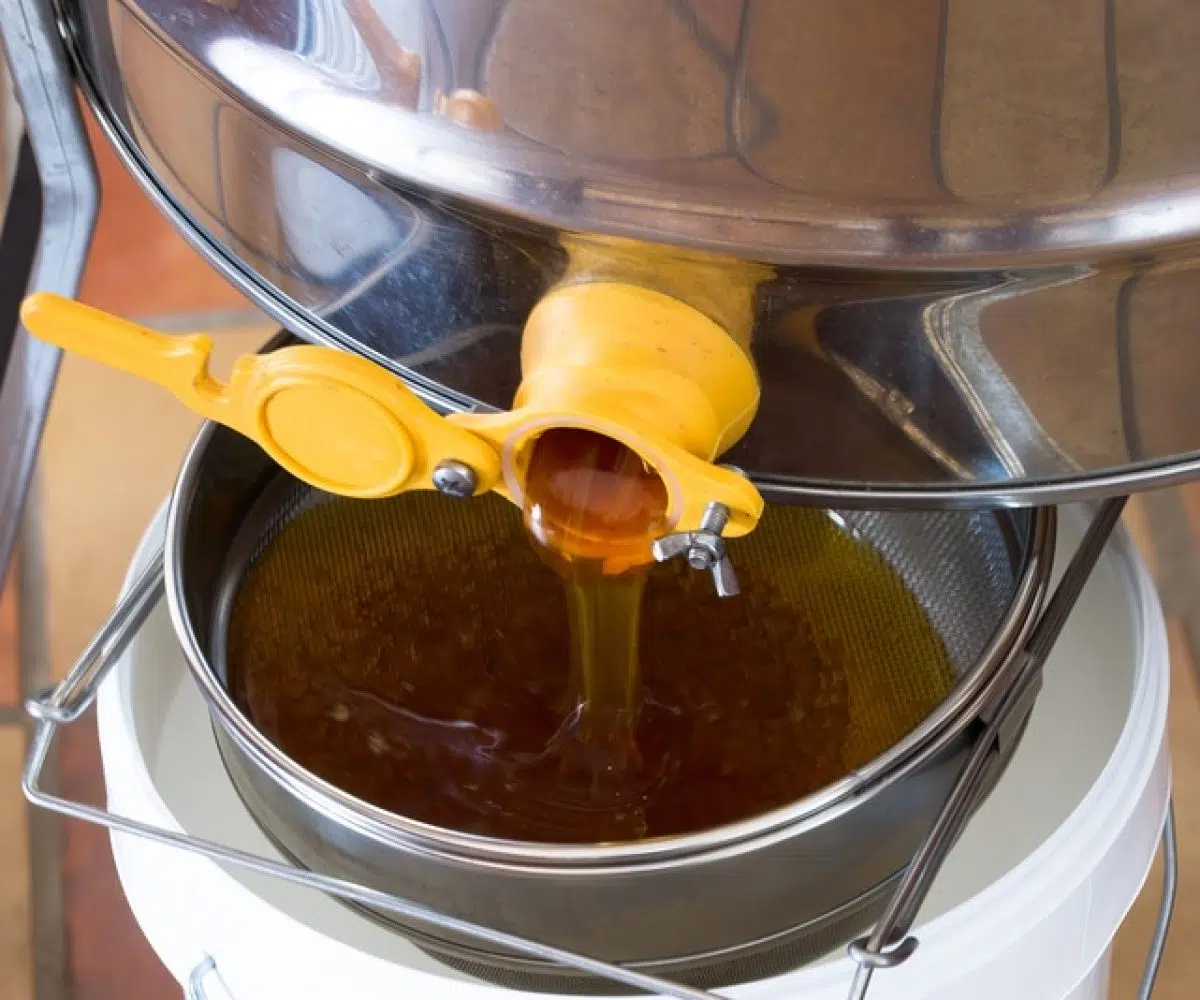
Straining honey removes wax fragments, bee debris and other unwanted solids after extraction. Fine filtration can also remove pollen, making it harder to assess floral and geographical origin. The aim is to produce clean honey without unnecessarily stripping away its natural characteristics. Pollen is an important source of evidence, but it is neither the only authenticity test nor, by itself, proof of fraud. This guide distinguishes practical processing advice from the EU and Spanish rules applying since 14 June 2026.
Mesh size and what may be removed
| Process or nominal opening | Practical effect | What it establishes about pollen |
|---|---|---|
| Settling only | Floating debris and foam are skimmed; sediment may remain below. | No sieve is used, but this is not a laboratory guarantee of an unchanged pollen count. |
| 0.20–0.15 mm (200–150 µm) | Coarse straining removes larger debris. | Many pollen grains are smaller; exact retention needs checking, not a “100%” promise. |
| 0.120 mm (120 µm) | A finer screen can retain larger particles or aggregates. | It does not establish complete retention of every Spanish pollen type. |
| 0.060 mm (60 µm) | Larger pollen units may be retained along with debris. | The effect depends on pollen dimensions, form and the real process. |
| 0.020 mm (20 µm) | Fine filtration can substantially alter the pollen spectrum. | A simple size comparison is not a measured percentage retained in honey. |
| Below 0.001 mm (1 µm) | Very fine separation can remove pollen and other suspended material. | The nominal rating alone proves neither complete removal nor sterility or removal of dissolved residues. |
In this guide
- Straining, settling and surface skimming.
- Commercial processing and temperature control.
- Current rules and authenticity checks.
- A historical comparison of processing terms.
- Preserving the character of Spanish honeys.
Straining, settling and skimming honey
Straining is one stage in preparing extracted honey for packing or bulk sale. It removes water-insoluble material introduced during uncapping and extraction and improves presentation. Spain’s quality standard sets a maximum of 0.1 g of water-insoluble solids per 100 g of honey, with a separate limit of 0.5 g/100 g for pressed honey. These limits do not mean that every particle must be removed or that all pollen should be filtered out.
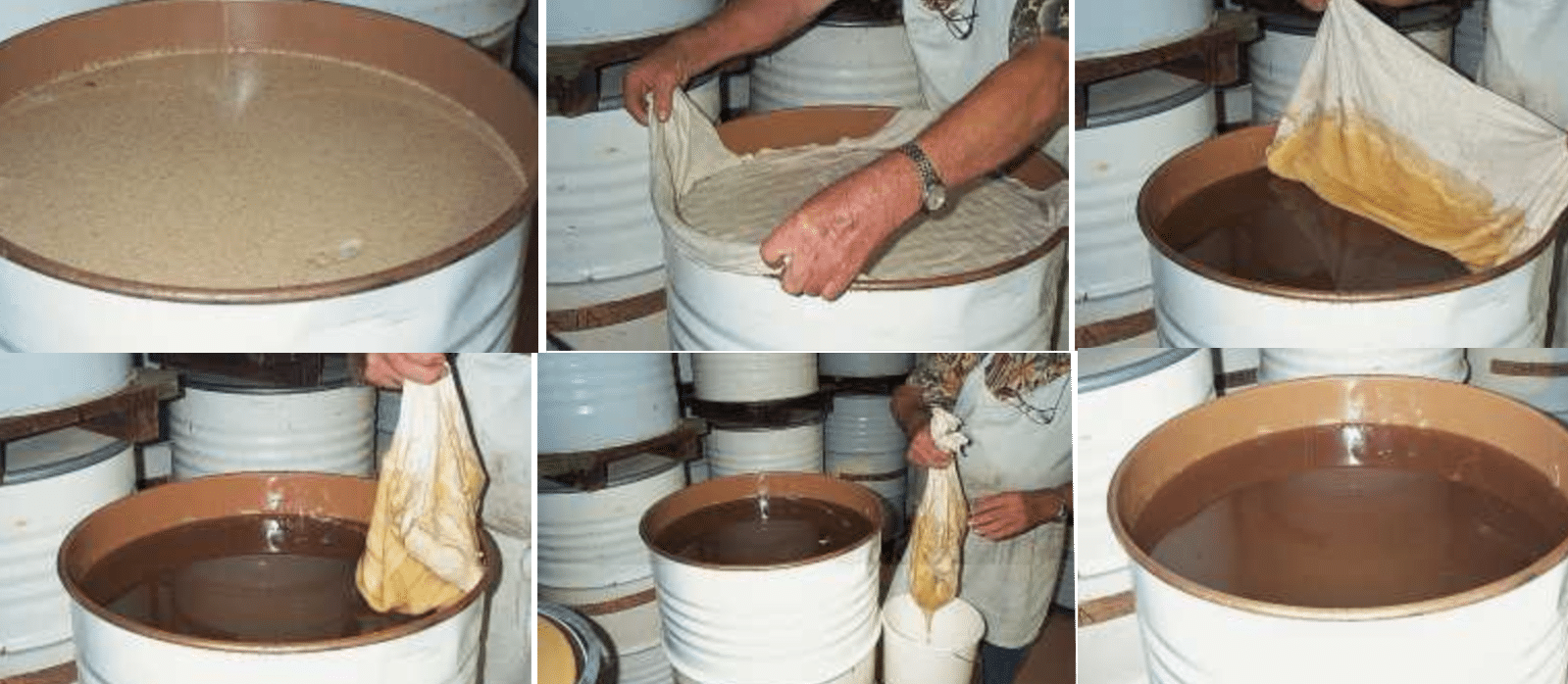
Settling can remove floating wax and foam without passing the honey through a fine filter. After an appropriate rest in a covered settling tank or drum, skim the surface using clean, dry, food-contact equipment. Heavier debris may sink, so surface skimming alone does not remove every impurity. The necessary standing time varies; “a few days to several weeks” is not a universal holding instruction. Three factors are particularly important:
- Viscosity: thick honey slows particle movement. Water content, composition and temperature influence viscosity; it is not the same property as density. See FAO’s explanation of honey’s physical properties and our honey moisture guide. Do not add water to improve flow.
- Particle size and relative density: larger buoyant particles can rise more readily, while heavier material may sink. Not every solid behaves like a floating piece of wax.
- Vessel depth: particles in a deeper vessel may need to travel farther. Assess the actual vessel and batch rather than choosing a settling time from height alone.
How commercial honey filtration works
Small-scale packers and larger honey businesses may gently warm honey when necessary to make it easier to pump and strain. Screens in the region of 0.5–0.2 mm (500–200 micrometres) are useful examples of coarse equipment, not a universal specification. Choose honey strainers for the actual honey, throughput and debris load. Around 40 °C is sometimes used in handling, but neither that temperature nor a particular mesh size guarantees quality or compliance.
Some industrial lines combine straining with a separate heat treatment. Temperature and holding time depend on the process: 78 °C for two minutes is not a general instruction for filtering honey. A flowing line, a jacketed tank and a small warming cabinet have different heat-transfer conditions. Record the honey’s actual temperature and exposure time, avoid unnecessary heating and validate any treatment intended to control yeasts. Straining is not pasteurisation, and fine filtration should not be assumed to sterilise the product.
The important distinction is coarse straining versus unnecessary pollen removal. A 200-micrometre screen is much coarser than many pollen grains, but its nominal opening alone cannot establish that every grain will pass or that the pollen spectrum will remain unchanged. Screen condition, retained debris, pollen aggregates and processing conditions also matter. Where pollen retention is part of a quality claim, check the finished honey rather than promising “100%” from the mesh rating.

Current EU rules, pollen and authenticity
The old EU category “filtered honey” is no longer the current framework. Directive (EU) 2024/1438 removed it and brought honey processed to remove foreign matter with significant pollen loss within baker’s honey. Spain implements this as miel para uso industrial. This is not a rule saying “anything finer than 0.2 mm is illegal”: the treatment and its effect matter. Read the following comparison as processing guidance, not a set of legal mesh thresholds.
Removing pollen can make an origin claim harder to investigate and may be used to obscure provenance. It does not follow that honey with little pollen is automatically adulterated, or that imports from a particular country are necessarily fraudulent. The European Commission’s coordinated honey investigations combine analytical work with traceability records and other checks. An authenticity assessment needs appropriate methods and expert interpretation; pollen analysis is one part of that evidence, not a verdict on its own.
Spain’s amendment took effect on 14 June 2026. Industrial-use honey must carry its specific name, with “sólo para cocinar” near it on the label; bulk packaging and commercial documents must also identify it appropriately. Qualifying products marketed or labelled before that date under the former rules may continue while stocks last, but in Spain only within the specified 18-month transition. Check the destination market: these are EU and Spanish requirements, not automatically the rules in every English-speaking country.
For related Spanish-language background, see honey labelling and the Spanish honey market. Older discussions may describe the previous legal category. For present-day packing decisions, consult the current rules and keep evidence for both processing and origin claims.
Raw, strained and finely filtered: a historical comparison
A historical discussion associated with a German laboratory proposal distinguished untreated honey, strained honey and progressively finer filtration. The process differences remain useful to explain, but the table below is not German law, a current Intertek policy or an official EU classification. In particular, “raw” is not a harmonised processing category defined by the EU Honey Directive, and a pore-size label cannot by itself settle a product’s legal name.
| Term in the historical discussion | Useful distinction and important limitation |
|---|---|
| Raw honey | Used in the proposal for unheated honey cleaned only by settling. Commercial usage varies; it is not a universal legal definition or a fixed temperature rule. |
| Strained honey | Honey passed through a coarse screen, such as 0.2 mm. Removing visible debris does not prove that exactly 100% of pollen remains. |
| Finely filtered honey | Finer systems, including pressure filtration or filter aids, may remove much more pollen. The former EU “filtered honey” category must not be presented as current law. |
| Very finely filtered product | A membrane rating below 1 µm does not by itself determine the legal name or demonstrate removal of dissolved HMF and residues. Assess composition, treatment and current rules; do not assume sterility. |

Our approach to preserving Spanish honey identity
Our practical recommendation is to preserve the pollen information and characteristics of Spanish honeys while removing unwanted debris. Coarse straining, including screens around 150–200 micrometres where suitable, is a starting option—not a guarantee that every pollen type is retained. Select equipment through trials, examine what is removed and use laboratory checks when making claims about the pollen spectrum. There is no sound basis here for saying that all Spanish bee-plant pollen is smaller than one fixed limit.
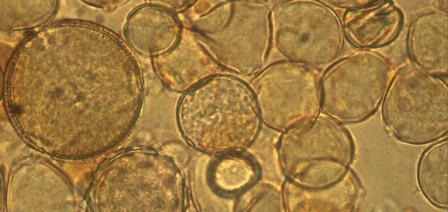
With a finer screen, such as 60 micrometres, retention of larger pollen units becomes more plausible. Rockrose (Cistus ladanifer) and strawberry tree (Arbutus unedo) illustrate why botanical identity matters, but neither should be assigned an all-or-nothing removal threshold from this guide. PalDat’s strawberry-tree record describes pollen released in groups of four grains, or tetrads. Pollen units vary in size and form: treating every type as an identical sphere gives false precision.
At 20 micrometres, substantial changes to the pollen spectrum are a serious concern. Losing botanical markers weakens an important route for checking origin; it does not prove a particular fraud or make documentary and chemical evidence irrelevant. The current EU approach to significant pollen removal is described above. Protecting the identity of a honey requires transparent sourcing and processing records as well as a suitably restrained filtration process.
An older size-based comparison discussed 73 plant types, of which 26—about 36%—were considered small enough to pass a 20-micrometre opening. That is a count of selected plant types, not a measured percentage of pollen remaining in a processed honey. Without the underlying dataset and a validated filtration experiment, it cannot establish actual retention or show that every remaining pollen type is useless for identification. Our bee-plant directory (in Spanish) introduces the botanical diversity involved.
Clean honey should still tell its own story. Preserve its natural characteristics, substantiate floral and geographical claims, and describe processing honestly. Good filtration removes unwanted material; it should not be used to substitute an attractive label for verifiable provenance.
Frequently asked questions
Why is honey strained?
To remove unwanted water-insoluble material such as wax fragments and bee debris after extraction and improve presentation. Settling and skimming can help, but neither removes every kind of impurity. The objective is clean honey without unnecessary removal of its natural components.
Does straining honey remove pollen?
Coarse straining can remove debris while allowing many pollen grains through. Finer filtration may substantially alter the pollen spectrum. A mesh rating alone cannot prove complete pollen retention, and the absence of visible pollen is not a reliable authenticity test.
What does filtered honey mean under current EU rules?
From 14 June 2026, the amended EU framework no longer uses the former filtered-honey category. Honey processed to remove foreign matter with significant pollen loss falls within baker’s honey. Spain implements this as industrial-use honey, with specific labelling and transitional provisions.
What is the difference between raw, strained and finely filtered honey?
These terms can describe different levels of processing, but they are not a universal set of legal categories. Raw is used inconsistently in commerce; straining usually means removing larger debris, while finer filtration can remove more pollen. Check the actual process and the rules in the destination market.
Can filtration conceal the origin of honey?
Removing pollen can make botanical and geographical assessment harder. However, low pollen alone does not prove fraud. Reliable investigation combines suitable analysis with traceability and other evidence, rather than relying on a single mesh size or pollen count.
At what temperature should honey be strained?
Use only as much controlled warming as the honey and equipment require for workable flow. Around 40 °C is a handling example, not a universal target or guarantee. Record actual honey temperature and exposure time; filtration and validated heat treatment are separate operations.
Further reading
- Uncapping honeycomb: the stage before extraction.
- Honey moisture: its importance for handling and stability.
- Honey labelling: names and origin information.
- Pollen analysis of honey: interpreting its botanical evidence (in Spanish).

Con más de 50 años dedicados exclusivamente a la apicultura, Antonio Gómez Pajuelo ha trabajado en colaboración con agrupaciones de apicultores, administraciones y empresas en América, Europa y Oceanía. Desde 1992, ofrece desde Castellón servicios de asistencia técnica en manejo de colmenas, calidad de la miel, formación y estudios para productores y empresas apícolas. Licenciado en Ciencias Biológicas por la Universidad Complutense de Madrid, ha trabajado en diversas instituciones, incluyendo la Universidad Autónoma de Barcelona y la Facultad de Veterinaria de Córdoba.
Su trayectoria incluye más de 160 publicaciones en congresos y revistas técnicas, la autoría del libro “Cata de Mieles de España y Portugal” y la participaciónen múltiples publicaciones científicas y monografías sobre sanidad apícola, polinización y calidad de la miel.


