
Honey moisture cannot be judged by the appearance of the comb: it must be measured with a refractometer. As a practical guide, a batch with 17 % water has a greater margin of stability than one close to 20 %. Although Spain’s general legal maximum is 20 %, compliance alone does not guarantee that the honey will not ferment.
The correct decision combines moisture content, representative sampling, hygiene, temperature, storage time, crystallisation and batch condition. In this guide you will learn when to measure, how to interpret the result, and what to do before foam, gas, or alcoholic or sour odours appear.
The method in 30 seconds
1 · SAMPLE
Representative and well homogenised.
2 · MEASURE
Two readings with a honey refractometer.
3 · DECIDE
Depending on moisture content, condition and intended use of the batch.
4 · RECORD
Batch, date, control point, and result.
The key idea: measuring helps prevent losses. If active fermentation has already occurred, reducing the water percentage afterwards does not automatically restore the batch to a condition suitable for direct sale as honey.
What honey moisture content means
Moisture content indicates what proportion of honey is water. It does not describe ‘added water’: honey naturally contains water derived from nectar or honeydew. During maturation, bees reduce this proportion to produce a highly concentrated sugar solution.
Nectar starts with a high water content
Initial concentration varies with plant, soil, rainfall, relative humidity, and temperature. Therefore, two harvests collected at different times may not arrive at the hive with the same water content. Early-season or autumn harvests, and those from humid areas, often require more attention, but floral origin alone does not predict the outcome of each batch.
From nectar to honey: concentration and maturation
Bees exchange nectar, spread it through the cells and ventilate the hive. At the same time, they add enzymes and transform some of its sugars. Once the honey reaches a suitable concentration, the cells are normally sealed with wax. The wax capping is a useful sign of ripening, but it is not a moisture meter: capped comb can still contain honey with high moisture levels, while open cells may hold sufficiently concentrated honey.
Field rule: use comb capping to decide where to sample; use the refractometer to decide whether to harvest, reduce moisture or release the batch.
Quick reference table: how to interpret the percentage
There is no single magic figure that explains all cases. Initial yeast load, actual available water, temperature, time, and liquid or crystallised state all affect risk. This scale is a conservative operational guide, not a guarantee nor a replacement for batch analysis.
≤ 17.0%
WIDE STABILITY MARGIN
Low risk under normal conditions. Keep the honey clean, sealed and stable.
17.1–18.0%
ROUTINE CONTROL
Usually manageable, but correct hygiene, sealing and monitoring are required.
18.1–20.0%
CLOSE MONITORING
Risk increases. Segregate, confirm the batch, and assess water activity or yeast levels.
> 20.0 %
HOLD THE BATCH
Above the general legal limit. Hold the batch while checking whether a specific exception applies, its permitted use and any corrective action.
The 20% limit answers a legal question, but does not establish the stability of a batch. A batch with 19.8 % may meet the general maximum but still offer little margin if it contains many yeasts, is stored warm, or begins to crystallise.
How to measure moisture with a refractometer
Use a refractometer with a scale designed for honey. Dual-scale models may show both Brix and water percentage: for this decision, read the moisture scale and do not confuse an 18% water content with a Brix value. Calibration is not identical across all instruments, so always follow the manufacturer’s specified calibration liquid, temperature and procedure.
1 · Take a representative sample
Combine samples from different locations in the batch. Do not measure only the surface, an uncapped cell or the liquid phase.
2 · Homogenise
Mix without incorporating air. If crystals or phases are present, a single drop may not represent the whole.
3 · Check the instrument
Make sure the prism is clean and dry; calibrate it and apply temperature compensation as instructed in the manual.
4 · Cover the prism
Apply an even film, close the cover plate without trapping bubbles and wait for the reading to stabilise.
5 · Read and repeat
Take at least two readings. If they do not agree within a reasonable margin, clean the instrument, resample and repeat.
6 · Clean and record
Remove the sample without scratching or submerging the equipment. Record the average reading, batch, date and sampling point.
The harmonised methods of the International Honey Commission require a representative, homogenised sample, duplicate refractometer readings and a result referenced to 20 °C using the appropriate table or temperature correction. For self-monitoring, additionally observe the specific instructions for your equipment; for an official result or a disputed batch, refer to a competent laboratory.
When to measure: four control points
COMB
Before harvesting, sample several frames and several areas of each frame.
EXTRACTION
Sample the mixed honey stream, not a single cell.
BATCH
After mixing or settling.
RELEASE
Before bottling, selling or mixing.
If you need to choose equipment, see our section on honey analysis and processing equipment. A model such as the ATAGO honey refractometer provides dedicated water and Brix scales; buying one makes sense only if it is calibrated correctly and then used with proper sampling and record-keeping.
Why honey ferments
It is not just ‘moisture + heat’
Fermentation occurs when yeasts capable of surviving in highly sugary media find sufficient available water to multiply. They consume sugars and produce alcohols, acids and carbon dioxide. The gas explains bubbles, pressure and some overflow; the metabolites explain alcoholic, sour or vinegary odours.
The risk arises from four factors
YEASTS
Present naturally or by contamination.
AVAILABLE WATER
Not all water is equally accessible.
TIME AND TEMPERATURE
Warmth can accelerate fermentation; chilling only slows it.
BATCH STATUS
Hygiene, crystallisation, phase separation and container seals.
Water activity (aw) reflects how readily water is available for chemical reactions and microbial growth. Two honeys with the same moisture percentage may have different aw due to composition, origin, temperature or crystallisation. Literature commonly identifies around 0.60 as the zone where microbiological risk begins to change, but no universal equation exists to convert any moisture level into an exact aw.
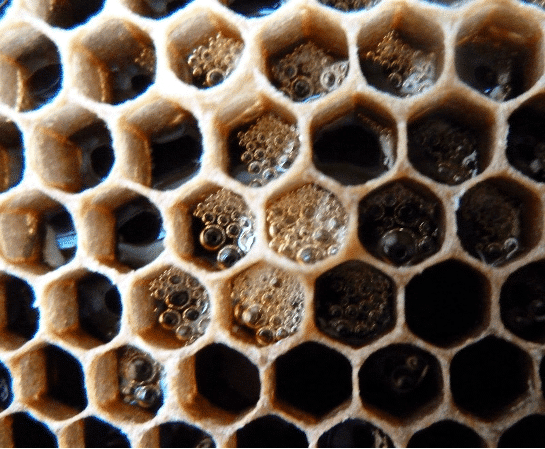
How to recognise fermented honey
No single sign replaces analysis, but several together justify putting the batch on hold. Also distinguish fermentation from bubbles of air recently incorporated or from normal crystallisation.
ALERT SIGNS
- Persistent foam and recurring bubbles: compatible with gas production.
- Pressure, bulging lid, hissing or overflow: do not open the container towards the face.
- Alcoholic, sour or vinegary odour: compatible with fermentation metabolites.
Action: hold, segregate and check the batch before any use.
NOT CONCLUSIVE ON ITS OWN
- Bubbles immediately after extraction: may simply be air entrained during extraction.
- Opaque layer, granules or solid mass: may correspond to normal crystallisation.
- Phase separation: does not confirm fermentation, although it may concentrate water in the liquid phase.
Action: leave to rest if appropriate, homogenise for measurement and assess odour, gas and changes over time.
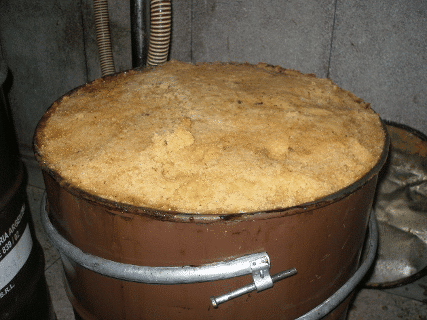
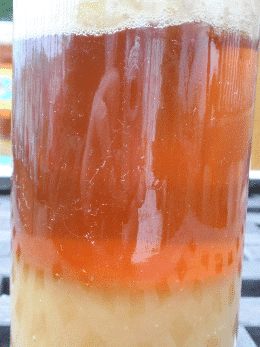
Do not scrape off the top layer to sell the remainder. If active fermentation is present, place the entire container on hold, identify the batch and assess the extent of the problem and its permitted destination. Removing foam, heating or mixing with drier honey may mask signs, but does not prove that the whole batch is once again fit for sale as table honey.
What to do if honey has too much moisture
The response depends on timing and whether signs of spoilage are already present. Do not mix the doubtful batch with a conforming one before knowing its status: you would lose traceability and risk compromising a larger quantity.
1 · STILL IN THE COMB
- Segregate the affected frames.
- Circulate dry air through a clean, closed room.
- Measure several points throughout the process.
- Extract only when representative readings meet your acceptance criteria.
2 · ALREADY EXTRACTED, NOT YET FERMENTED
- Put the batch on hold and homogenise it.
- Use professional, controlled dehydration.
- Avoid aggressive overheating.
- Record initial value, process and final result.
3 · GAS, FOAM OR ODOUR PRESENT
- Stop bottling, mixing and dispatch.
- Segregate and identify related containers.
- Review traceability and reference samples.
- Consult a laboratory and the person responsible for food safety.
Dehumidifying extracted honey works best when the surface area for exchange is increased—for example, with a thin film, discs or a cascade—and treated air and temperature are controlled. A dedicated honey dehumidifier makes batch treatment more reproducible than leaving a container open: honey is hygroscopic and may also absorb moisture from the environment.
How to prevent fermentation from harvest
IN THE HIVE AND AT HARVEST
- Sample different frames, heights and areas of the apiary.
- Do not treat ‘two-thirds capped’ as a universal guarantee.
- Protect against rain, dew and wet ground.
- Plan a clean uncapping process that introduces no water.
IN THE HONEY ROOM
- Dry equipment, pipes and containers completely after cleaning.
- Avoid placing frames or tools on dirty surfaces.
- Remove wax and impurities using a hygienic process, not as a remedy for fermentation.
- Do not mix batches before measuring and accepting each one.
IN STORAGE
- Use clean, dry and sealed food-grade containers.
- Minimise headspace and the time the honey is exposed to humid air.
- Maintain stable temperature; understand how temperature affects honey.
- Keep records and reference samples for each batch.
A minimum self-monitoring plan
- Define your internal acceptance criterion before harvesting.
- Identify apiary, bloom, date and containers.
- Measure a representative sample in duplicate.
- Segregate doubtful results; do not dilute them by mixing.
- Release the batch only after final verification.
Moisture, crystallisation and floral origin
When glucose crystallises, the remaining liquid phase may become relatively richer in water. Studies on liquid and crystallised honeys have observed an increase in water activity after crystallisation. This explains why a batch that appeared stable may become more vulnerable in its liquid fraction. For further detail, consult our guide on why honey crystallises.
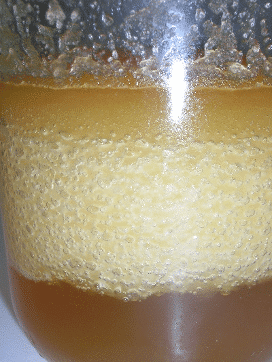
The botanical origin also alters the relationship between sugars, water and texture. The Guide to Iberian monofloral honeys describes profiles showing why honeys do not all behave alike:
AVOCADO
The guide notes frequently high moisture and slow, sometimes defective, crystallisation.
STRAWBERRY TREE
Frequently exceeds 18.5 % and may crystallise rapidly and poorly.
LOQUAT
High moisture is common and associated with rapid, coarse or irregular crystallisation.
These profiles help to characterise a monofloral honey; they do not replace batch testing nor create automatic exceptions. Consult the complete technical guide of 2023.
Legal limits and permitted uses
The Spanish standard for honey quality sets a general maximum water content of 20%. It allows a maximum of 23% for Calluna heather honey and baker’s honey (honey for industrial use) in general, and 25% for Calluna baker’s honey.
LEGAL CRITERION
- General maximum: 20 % water.
- Specific exceptions: 23 % and 25 % depending on type and destination.
- Honey sold for direct consumption must not have begun to ferment or show effervescence.
OPERATIONAL CRITERION
- Work below the legal maximum to provide a margin for storage stability.
- Adapt the criterion to origin, processing, storage and destination.
- If risk is high, supplement moisture readings with water activity (aw), yeast counts and sensory assessment.
The Calluna exception does not make fermented honey compliant for sale as table honey. Nor does it permit a batch to be reclassified without traceability: its use as baker’s honey has its own requirements and documentation trail.
Conclusion: measure, decide and document
The best prevention is not to chase an isolated figure, but to control the batch from start to finish. Take a representative sample, measure twice, segregate anything doubtful and maintain traceability. A refractometer provides a measurement; the process turns it into a safe decision.
To assess moisture alongside other indicators, also consult our guide on assessing honey quality.
Frequently asked questions on moisture and fermentation
What is the ideal moisture content for honey?
There is no universal ideal value. As a practical guideline, a value of up to 17 % provides ample margin under normal conditions; between 17.1 and 18 % is usually manageable with good control; between 18.1 and 20 % the risk increases and the batch should be assessed with greater caution.
Is honey with 20 % moisture legally compliant and safe?
20 % is the general legal maximum in Spain, with specific exceptions for Calluna honey and baker’s honey. It is not a guarantee of stability: honey close to the limit may still ferment depending on its water activity, yeast load, crystallisation, time, and temperature.
Is a fully capped comb sufficient?
No. Capping indicates maturity but does not measure water content. There may be capped frames with high moisture and uncapped cells with correct values. Several points must be sampled and checked with a refractometer.
How do you read a honey refractometer?
Ensure the equipment has a specific honey moisture scale, calibrate according to the manufacturer’s instructions, place a homogeneous sample on the prism, allow temperature to stabilise, and take at least two readings. On dual-scale models, do not confuse water percentage with Brix.
Can crystallised honey be measured?
Yes, but you must not measure only the liquid phase. The sample must represent the batch and be homogenised according to the equipment or analytical method procedure. If you need an official result or the batch is in dispute, send it to a laboratory.
How can honey moisture be reduced?
Before fermentation begins, combs may be conditioned in a clean room using dry air and repeated measurements. Extracted honey requires equipment that increases the surface area available for evaporation while controlling airflow and temperature. Always measure and document before and after treatment.
Can honey that has started to ferment be sold?
Not as table honey. Honey sold for direct consumption must not have begun to ferment or show effervescence. Isolate the batch and consult a laboratory or food safety officer about its possible lawful use as baker’s honey.
How do I know if bubbles indicate fermentation?
Air incorporated during extraction usually diminishes with resting. Fermentation is more likely if foam or bubbles reappear, there is pressure, hissing, a bulging lid, overflow, or an alcoholic, sour, or vinegary smell. When in doubt, segregate and analyse.
Sources and regulation
- Royal Decree 1049/2003: honey quality standard, consolidated text.
- Council Directive 2001/110/EC on honey.
- International Honey Commission: Harmonised Methods of the International Honey Commission.
- FAO: Value-added products from beekeeping, moisture and fermentation prevention.
- Sanz et al.: Fermentation Problem in Spanish North-Coast Honey.
- Chen: relationship between water activity and moisture content in floral honeys.
- Zamora and Chirife: change in water activity due to honey crystallisation.
- Laboratorios Apinevada and Pajuelo Consultores Apícolas: Guide to Iberian monofloral honeys, 4th edition (2023).
Educational content reviewed on 22 August 2026. Legal limits include exceptions according to type and destination. To release, reclassify or investigate a batch, consult the current text, your food safety control plan and a competent laboratory.

ISNI 0000 0005 1801 1100 | Joshua Ivars is the manager of LA TIENDA DEL APICULTOR and the author of this blog, where he shares technical and practical guidance for beekeepers. Drawing on extensive experience in the beekeeping sector, he offers advice and solutions based on beekeepers’ real needs, sharing his knowledge of equipment and essential beekeeping practices.


