
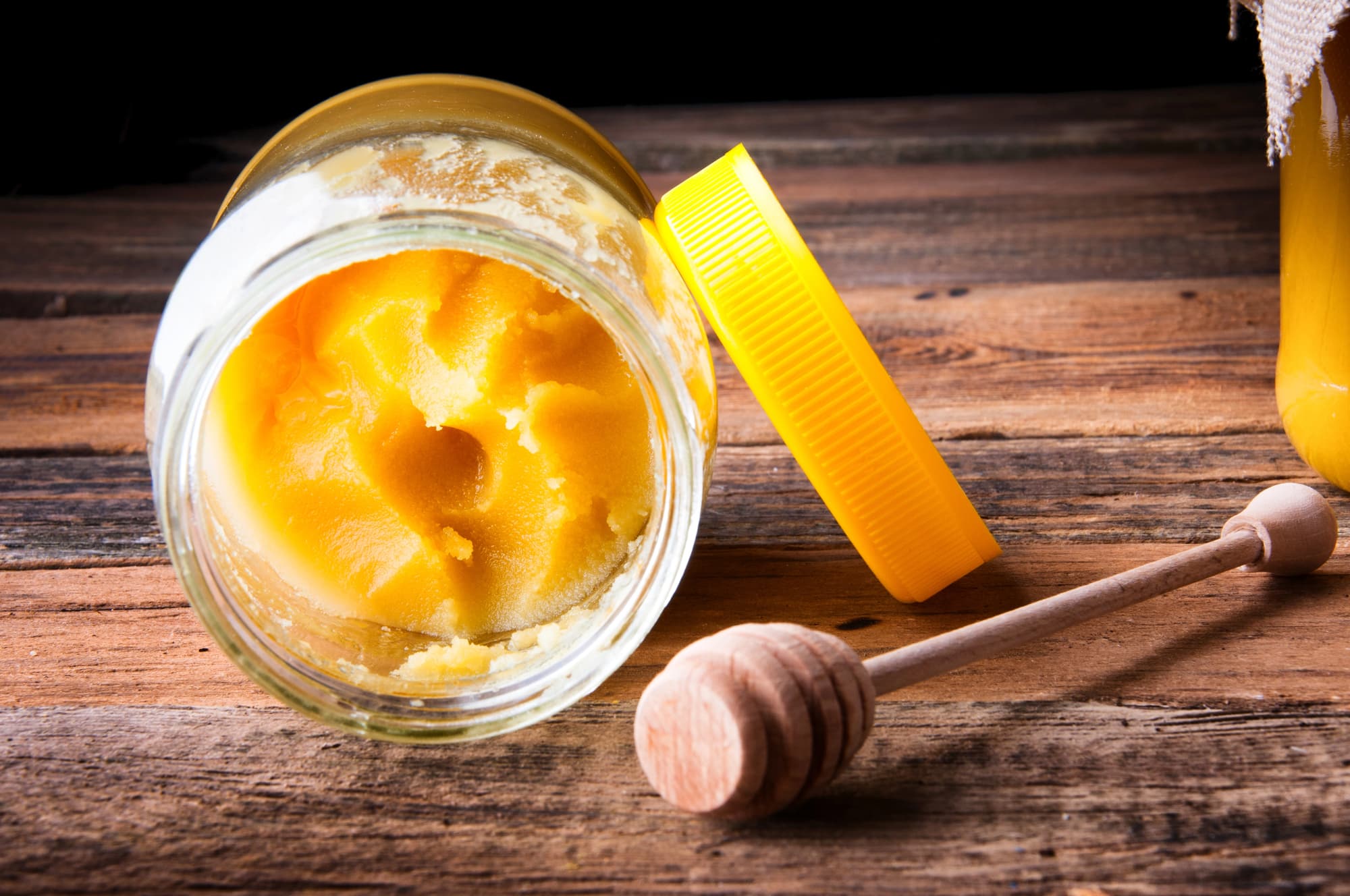
Crystallisation reflects honey’s composition and storage. Understanding it helps you choose how to store, serve and process a batch.
If you open a jar and find the honey thick, grainy or solid, that change is usually normal. Honey is a concentrated sugar solution, and glucose can leave the liquid phase and form crystals. Crystallisation is not a defect or a reliable test of authenticity. Nor does a liquid texture prove poor quality: acacia, chestnut and some honeydew honeys may remain liquid for a long time because of their composition.
Nevertheless, it is important to clarify from the start: crystallisation alone does not prove a honey is better, and not crystallising quickly does not automatically discredit it. The behaviour depends on floral origin, harvest moisture, storage temperature and handling. We will examine this in detail, with data and examples of Iberian honeys you will recognise.
Why honey crystallises and what it means
What is honey crystallisation?
Honey contains approximately 80% sugars and 17–18% water. The two main sugars are fructose (an average of 38%) and glucose (an average of 31%). The remainder comprises sucrose, maltose, oligosaccharides, organic acids, enzymes, minerals and solid particles gathered during foraging, mainly pollen.
Many honeys are supersaturated with respect to glucose: they contain more dissolved glucose than is stable under the storage conditions. Glucose is less soluble than fructose and forms glucose monohydrate crystals, incorporating one water molecule per glucose molecule. The honey’s complete sugar mixture, water content and temperature affect this behaviour; a single fixed solubility ratio does not describe every batch.
A simple analogy: imagine a glass of water to which you have added so much salt that the water can no longer dissolve it all. Eventually, part of the salt precipitates to the bottom. The same happens with honey, except the solid that precipitates is glucose.
Crystallisation does not appear suddenly. If you observe it carefully, you will see two visible stages:
- Initial cloudiness. The honey loses transparency and a haze appears, sometimes only at the bottom or on the glass walls. These are microcrystals forming on pollen grains and other suspended particles. It is barely noticeable to the touch, but the structure is already changing.
- Opacity and thickness. These nuclei grow, capture more glucose molecules and become visible crystals. The honey turns pearlescent, becomes pasty, and finally compact.
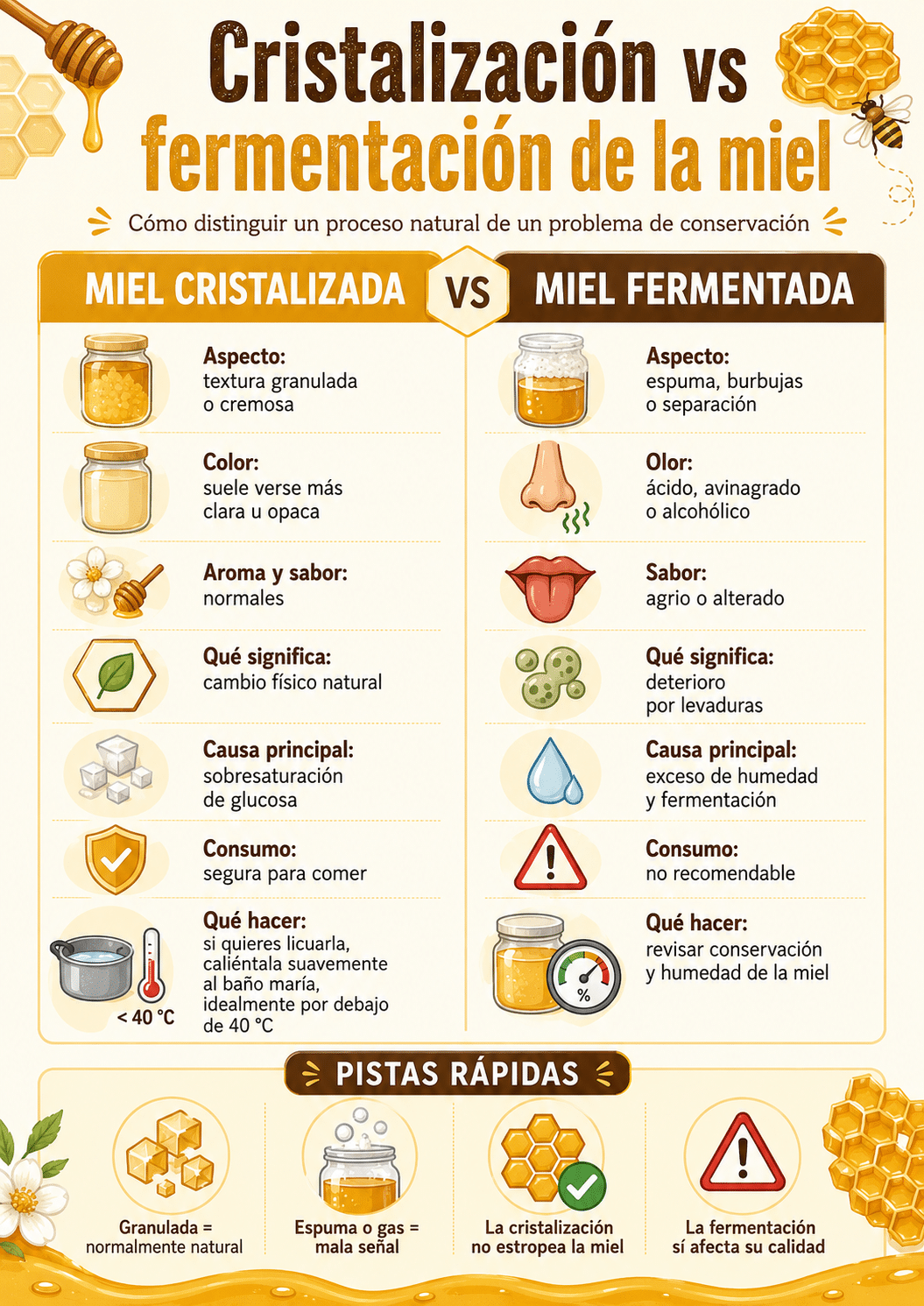
Cloudiness and a firm texture are consistent with normal crystallisation. Persistent gas production, an alcoholic or sour smell, or a bulging lid instead suggest fermentation. A few trapped air bubbles or a separated liquid layer alone do not establish the cause; assess the batch as a whole.
Why do some honeys crystallise sooner than others
The short answer: due to their sugar composition. The long answer is summarised in two ratios used by the sector to predict honey behaviour.
Glucose/water ratio (G/W): a useful predictor
The ratio of glucose to water is a useful guide to crystallisation, discussed in studies including Manikis and Thrasivoulou (2001). The ranges below are rules of thumb, not a guaranteed timetable; temperature, other sugars and existing crystals also matter:
- G/W below about 1.7: a lower tendency to crystallise rapidly.
- G/W around 1.7–2.1: intermediate behaviour, strongly affected by storage and handling.
- G/W above about 2.1: a greater tendency towards rapid crystallisation.
Fructose/Glucose ratio (F/G): the floral origin clue
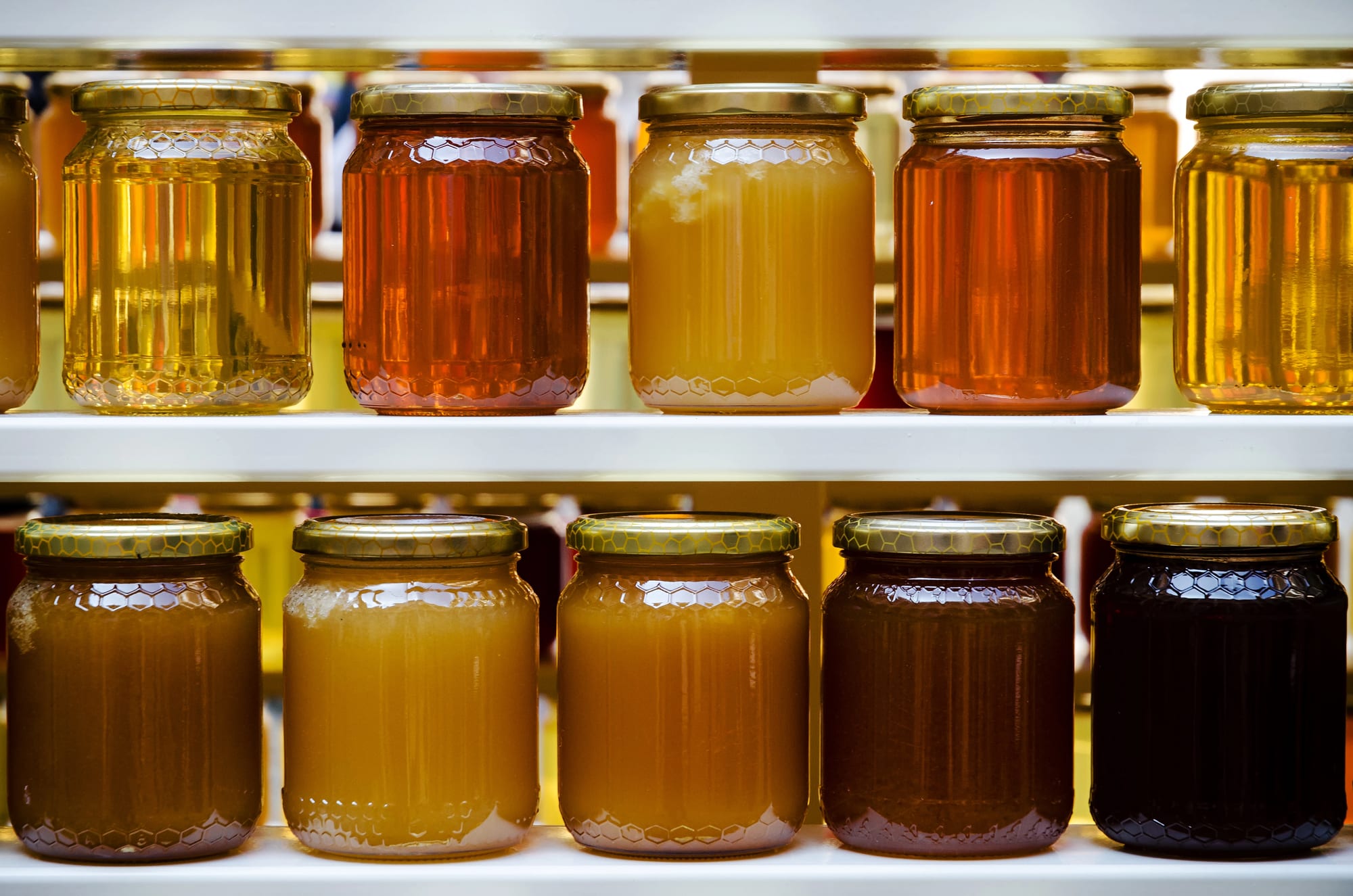
A high fructose/glucose ratio generally favours a longer liquid life. Acacia honey, for example, is often rich in fructose and can remain liquid for a long time. Glucose-rich oilseed rape honey often sets quickly. Botanical origin therefore gives a useful clue, but it does not specify the exact date or texture of crystallisation.
Iberian honeys and their crystallisation speed
The table below summarises broad crystallisation tendencies among common Iberian honeys. It is not a specification for a batch: floral mixtures, moisture, seed crystals and storage can change the result. Fixed deadlines and unmeasured F/G values would give a misleading impression of precision.
| Honey type | Broad tendency | Practical note |
|---|---|---|
| Oilseed rape (Brassica napus) | Usually rapid | Can set firmly; fine crystallisation can be managed. |
| Sunflower (Helianthus annuus) | Usually rapid | Often forms a firm set; crystal size depends on handling. |
| Cotton (Gossypium spp.) | Often rapid | Check the batch rather than assuming a fixed crystal size. |
| Almond (Prunus dulcis) | Often readily crystallising | Fine textures are possible. |
| Albaida (Anthyllis cytisoides) | Can crystallise readily | Texture varies with the accompanying nectar sources. |
| Alfalfa (Medicago sativa) | Often readily crystallising | Moisture and seed crystals affect the set. |
| Sainfoin (Onobrychis spp.) | Often readily crystallising | Texture is not fixed by the variety name. |
| Eucalyptus (Eucalyptus spp.) | Variable | Species and floral mixtures affect the result. |
| Blackberry (Rubus spp.) | Variable | Check moisture if the batch separates. |
| Heather (Erica spp.) | Variable | May develop a coarse or uneven texture. |
| Ling heather (Calluna vulgaris) | Distinctive gel-like behaviour | Thixotropy and crystallisation are different properties. |
| Rosemary (Salvia rosmarinus) | Variable | Can form fine or coarse crystals. |
| Lavender (Lavandula spp.) | Variable | Do not confuse lavender with thyme. |
| Spanish lavender (Lavandula stoechas) | Variable, sometimes slower | May develop visible clusters of crystals. |
| Thyme (Thymus spp.) | Variable, sometimes slower | Assess the actual batch. |
| Orange blossom (Citrus spp.) | Variable | A fine set is possible but not guaranteed. |
| Multifloral / wildflower | Highly variable | Depends on the blend of nectar sources. |
| Strawberry tree (Arbutus unedo) | Can be slow or uneven | An irregular set is not in itself proof of spoilage. |
| Avocado (Persea americana) | Can be slow or uneven | Watch separated liquid for fermentation signs. |
| Sweet chestnut (Castanea sativa) | Often slow | May remain liquid for an extended period. |
| Acacia / black locust (Robinia pseudoacacia) | Often very slow | Usually relatively rich in fructose. |
| Holm oak / oak honeydew (Quercus spp.) | Often slow, but variable | Honeydew honeys are not uniformly resistant to crystallisation. |
For detailed varietal profiles, see Orantes, Gonell, Torres and Gómez-Pajuelo, Guide to Iberian Monofloral Honeys, 4th edition (2023). The table above is a qualitative overview, not a reproduction of laboratory results from that guide.
Factors influencing honey crystallisation
Alongside sugar composition, five factors influence how and when a batch crystallises. Some are set at harvest; others can be managed during processing and storage.
1. Honey moisture content
Spain’s honey quality standard sets a general maximum water content of 20%, with specific exceptions for Calluna honey and baker’s honey. For good keeping quality, beekeepers commonly aim around 17–18%, but fermentation risk also depends on yeast load, temperature and the liquid phase after crystallisation. Capping is a useful field clue, not a substitute for checking representative samples with a honey refractometer. A high-moisture batch needs assessment before bottling.
2. Storage temperature
This is the most controllable factor. Remember three ranges:
- Around 10–18°C: many honeys crystallise readily, often most rapidly near 14°C. The optimum varies with composition.
- Above about 25°C: crystallisation often slows, but prolonged warm storage accelerates ageing, darkening and HMF formation. Keeping honey liquid is not the same as preserving its quality.
- Gentle warming around 35–40°C: some crystallised honey softens and crystals gradually dissolve. The required time depends on the honey and container; 40°C is not a universal melting point.
3. Suspended particles (crystallisation nuclei)
Existing microcrystals and suspended particles provide sites for crystal formation. Distributing fine seed crystals can strongly influence the final texture. Normal straining removes wax and foreign debris, but neither pollen content nor the time taken to set is, by itself, proof of authenticity.
4. Mechanical agitation
Stirring or pumping can distribute existing crystals through a batch. This principle is used for creamed honey: a small proportion of finely crystallised seed honey is mixed evenly into a suitable batch, then held under controlled conditions. Gentle mixing helps avoid incorporating excessive air. Composition and seed quality still determine the result.
5. Time
Time gives crystals an opportunity to form and grow, but there is no universal deadline. Some honeys remain liquid throughout their normal shelf life. The best-before date is set by the food business for its product and storage conditions; EU food-information rules do not impose a universal two-year shelf life for honey.
Fine, coarse and defective crystallisation are not the same. Talking about crystallisation in the singular is inadequate. There are three distinct behaviours that the beekeeper recognises at a glance:
Fine or creamy. Small, evenly distributed crystals give a smooth, spreadable texture. This is the target for creamed honey and can occur naturally in some batches. Botanical origin alone does not guarantee it.
Coarse or compact. Larger crystals produce a grainier texture, and some honey sets very firmly. The outcome depends on nucleation and handling as well as origin. Even a rapidly crystallising honey can have a fine texture if crystallisation is managed appropriately.
Phase separation. Crystals settle or form a firm layer while a more liquid layer remains above. The residual liquid can have a higher water concentration and an increased fermentation risk. This is not tied to one exact moisture threshold, and separation alone does not prove that fermentation has already occurred.
Some Iberian honeys have distinctive textures. Ling heather (Calluna vulgaris) is thixotropic: its gel-like consistency is not simply ordinary crystallisation. Spanish lavender may develop visible clusters of crystals, while rosemary honey varies with the accompanying nectar sources. Examine the actual batch rather than treating the variety name as a texture guarantee.
Can you eat crystallised honey?
The Spanish honey quality standard recognises liquid, viscous and partly or fully crystallised honey. A crystallised texture is therefore compatible with honey sold for ordinary consumption; it does not exempt the product from the remaining quality and food-safety requirements.
Crystallised honey is safe to eat
Let us dispel three common myths:
Myth 1: “Crystallised honey is fake or adulterated.” Crystallisation is a normal physical process. Both authentic and adulterated sugar-rich products can crystallise, while authentic honey can stay liquid. Neither state replaces traceability and appropriate laboratory testing.
Myth 2: “Crystallised honey has lost its nutritional value.” Crystallisation mainly changes physical structure; it does not remove the sugars or turn the honey into a different food. Storage conditions can still change enzymes, aromas and other components over time, whether the honey is liquid or solid.
Myth 3: ‘Crystallised honey must be old.’ False. Oilseed rape honey can crystallise within days of extraction, while acacia honey can remain liquid for years. Time is only one factor, and not the most important one.
Crystallised, not fermented
The distinction matters because they are two completely different phenomena. This table summarises the differences to prevent confusion:
| Characteristic | Crystallisation | Fermentation |
| Nature | Physical, reversible | Biological, undesirable |
| Odour | Retains natural aroma | Vinegary, sour, fermented |
| Taste | Characteristic flavour retained | Sour, sharp, alcoholic |
| Appearance | Opaque, whitish, granular | Persistent gas or foam; a bulging lid may occur |
| Cause | Glucose solubility | Yeasts, available water and suitable conditions |
| Suitable for consumption | Yes, if otherwise sound and compliant | Not recommended |
| Reversible | Yes, using a gentle water bath | No |
HMF and diastase activity help assess ageing and heat exposure. The general EU/Spanish limits are HMF no higher than 40 mg/kg and a diastase number of at least 8 on the Schade scale, with specified exceptions. For naturally low-enzyme honeys, the lower diastase limit of 3 is conditional on HMF not exceeding 15 mg/kg; declared tropical-origin honeys have a separate HMF allowance. Results must be interpreted together with origin and storage history. They do not reconstruct one exact heating event.
How to liquefy honey while limiting heat damage
Crystallised honey can be softened or liquefied by controlled warming. Use the lowest temperature and shortest time that achieve the texture you need, and avoid repeated warming of the whole supply.
Domestic method: gentle water bath
Step-by-step procedure:
- Use a sound, preferably glass jar in a warm water bath. Keep water below the lid and prevent it from entering the honey. Avoid sudden temperature changes that could crack the glass.
- For gentle domestic warming, keep the water around 35–40°C and check it with a thermometer. Do not use boiling water or place the jar directly on a heat source.
- Check progress periodically. If you stir, remove the jar from the bath, dry around the lid and use a clean, completely dry spoon. Close it again before returning it to the water.
- Stop when the honey is soft enough for your intended use. A large jar or firmly crystallised honey can take considerably longer than 30–60 minutes; do not assume that one fixed duration suits every batch.
- Dry the jar, close it securely and return it to cool, dry storage away from sunlight.
The point of gentle warming is to limit cumulative heat exposure. There is no temperature below which time ceases to matter, and no fixed HMF increase for a “correct” liquefaction. Monitor the honey as well as the bath and keep moisture out. FAO’s honey-handling guidance explains why indirect, even heating is preferable.
Why a water bath is preferable to a microwave
Three technical reasons to avoid it:
- Uneven heating: microwave heating can create local hot spots before the rest of the jar has softened.
- Enzyme damage: high temperatures can reduce diastase, invertase and glucose oxidase activity. The effect depends on both temperature and exposure time.
- Aroma changes: excessive heating can drive off volatile aromas and promote darkening. A controlled water bath makes gradual warming easier to monitor.
Professional equipment for beekeepers and packers
As batch size increases, purpose-built equipment gives better temperature control and handling than improvising with domestic utensils. The available equipment includes:
- Heating blankets and drum-heater bands wrap around the container and typically operate between 30 and 40 °C under thermostatic control.
- Flexible heating cables to fit drums and settling tanks of any shape.
- Immersion and spiral liquefiers, which transfer heat within the container. The heating surface and surrounding honey still need control to prevent local overheating.
- Warming cabinets and rooms with thermostatic control and suitable air circulation. Probe position should follow the equipment design, and the honey temperature should be checked; an air reading at one height is not enough.
- Decrystallisers for 1,000 L IBCs used by large-scale honey packers.
Match the equipment to the batch and follow its instructions. Warm only what you need, avoid prolonged holding at elevated temperatures and record the product’s temperature and time where quality control requires it.
One final technical detail, rarely mentioned by science communicators: the Codex Alimentarius explicitly states that chemical or biochemical treatments must not be used to influence honey crystallisation. The correct approach is not to force the product’s behaviour artificially, but to work with three variables: composition, moisture content and temperature.
How to store honey to delay crystallisation
If you wish to keep honey liquid for as long as possible, there are four variables you can control: temperature, light, ambient humidity and container.
Temperature
Delaying crystallisation and protecting quality are different aims. Temperature involves a trade-off:
- Warm storage around 25–28°C may delay crystallisation, but it also accelerates ageing compared with cooler storage. It should not be presented as a quality-neutral long-term solution.
- Cold storage, especially below about 5°C, slows crystal growth because the honey becomes very viscous. Freezer storage is another option for suitable sealed containers, but the honey’s behaviour depends on composition. Let a sealed container warm before opening it to minimise condensation.
Choose a stable storage arrangement appropriate to the batch and its intended sale or use. Repeated warming and cooling can change texture. For everyday household storage, a tightly closed jar in a cool, dry cupboard is usually more practical than trying to keep every honey permanently liquid.
Light, ambient humidity and odours
Keep honey in a dark, dry place away from strong odours. Honey is hygroscopic and can absorb moisture from humid air when the container is open or poorly sealed. The balance depends on both the honey and ambient humidity; one relative-humidity figure is not a universal safe threshold.
Container
Glass is the reference material for consumers due to its impermeability to oxygen and moisture, inert nature and transparency. For the professional beekeeper, stainless steel AISI 304 is the standard for honey settling tanks and large drums. The lid, in any case, must be airtight and in perfect condition.
Filtration: the balance between stability and respect for the product
Settling and straining remove unwanted debris while retaining honey’s characteristic components. Under Spain’s rules applying from 14 June 2026, honey processed so that significant pollen is removed is covered by the baker’s honey / honey for industrial use category, rather than the former “filtered honey” category. The 2025 amendment includes transitional provisions for earlier stock. Routine straining and intensive pollen removal should not be confused.
Pollen analysis can help investigate botanical and geographical origin, but crystallisation does not reveal a product’s complete filtration history. Judge honey using its provenance, labelling and appropriate analytical results, rather than the place where it is sold or whether it remains liquid.
What if you want to encourage a smooth set?
Creamed honey uses controlled crystallisation to produce an even, spreadable texture. The approach associated with Dyce commonly uses a small proportion of fine seed honey—often around 5–10%—and controlled mixing and temperature, frequently near 14°C. Fine seed, good distribution and an appropriate base honey matter more than treating those figures as a universal recipe. The goal is a smooth texture with crystals too small to feel gritty.
In summary
Crystallisation offers useful clues about honey, but it is not a laboratory test or a complete history of the jar. For beekeepers and packers, the practical task is to combine batch measurements, controlled handling and suitable storage to obtain a stable texture with minimal quality loss.
Frequently asked questions
Is crystallised honey bad?
Not simply because it has crystallised. A grainy or solid texture is normal for many honeys. Persistent gas production, a sour or alcoholic smell, or a bulging lid need separate assessment; appearance alone is not a complete safety test.
At what temperature does honey crystallise?
Many honeys crystallise fastest around 10–18°C, often near 14°C. Colder temperatures increase viscosity, while warmer temperatures can delay crystal formation. Composition matters, and prolonged warm storage can reduce quality.
Why does some supermarket honey remain liquid?
Botanical origin, water content, storage and processing all affect liquid life. Some genuine honey remains liquid naturally. The retail channel and the speed of crystallisation do not establish authenticity or prove overheating.
Which honeys crystallise slowly?
Acacia, chestnut and some honeydew honeys often crystallise slowly and may remain liquid for a long time. No variety name provides a universal guarantee that honey will never crystallise.
How can I liquefy honey gently?
Use a controlled warm water bath, typically around 35–40°C for a domestic jar, keeping water out and checking progress. Use a clean, dry spoon if stirring. The time required varies; stop when the desired texture is reached and minimise repeated heating.
Does crystallised honey have a best-before date?
Yes. Crystallisation does not replace the best-before date or storage instructions. The producer sets shelf life for the product; there is no universal EU rule making it exactly two years. Good storage helps preserve quality, but suspected fermentation should not be dismissed because the date has not passed.
Bibliography
- Royal Decree 1049/2003: Spanish honey quality standard, consolidated text.
- Codex Alimentarius CXS 12-1981.
- Royal Decree 68/2025, implementing changes to the EU Honey Directive.
- Orantes, Gonell, Torres and Gómez-Pajuelo. Guide to Iberian monofloral honeys, 4th edition, 2023.
- Manikis & Thrasivoulou, 2001.
- FAO, Value-added products from beekeeping: liquid and controlled-crystallisation honey.

ISNI 0000 0005 1801 1100 | Joshua Ivars is the manager of LA TIENDA DEL APICULTOR and the author of this blog, where he shares technical and practical guidance for beekeepers. Drawing on extensive experience in the beekeeping sector, he offers advice and solutions based on beekeepers’ real needs, sharing his knowledge of equipment and essential beekeeping practices.


