
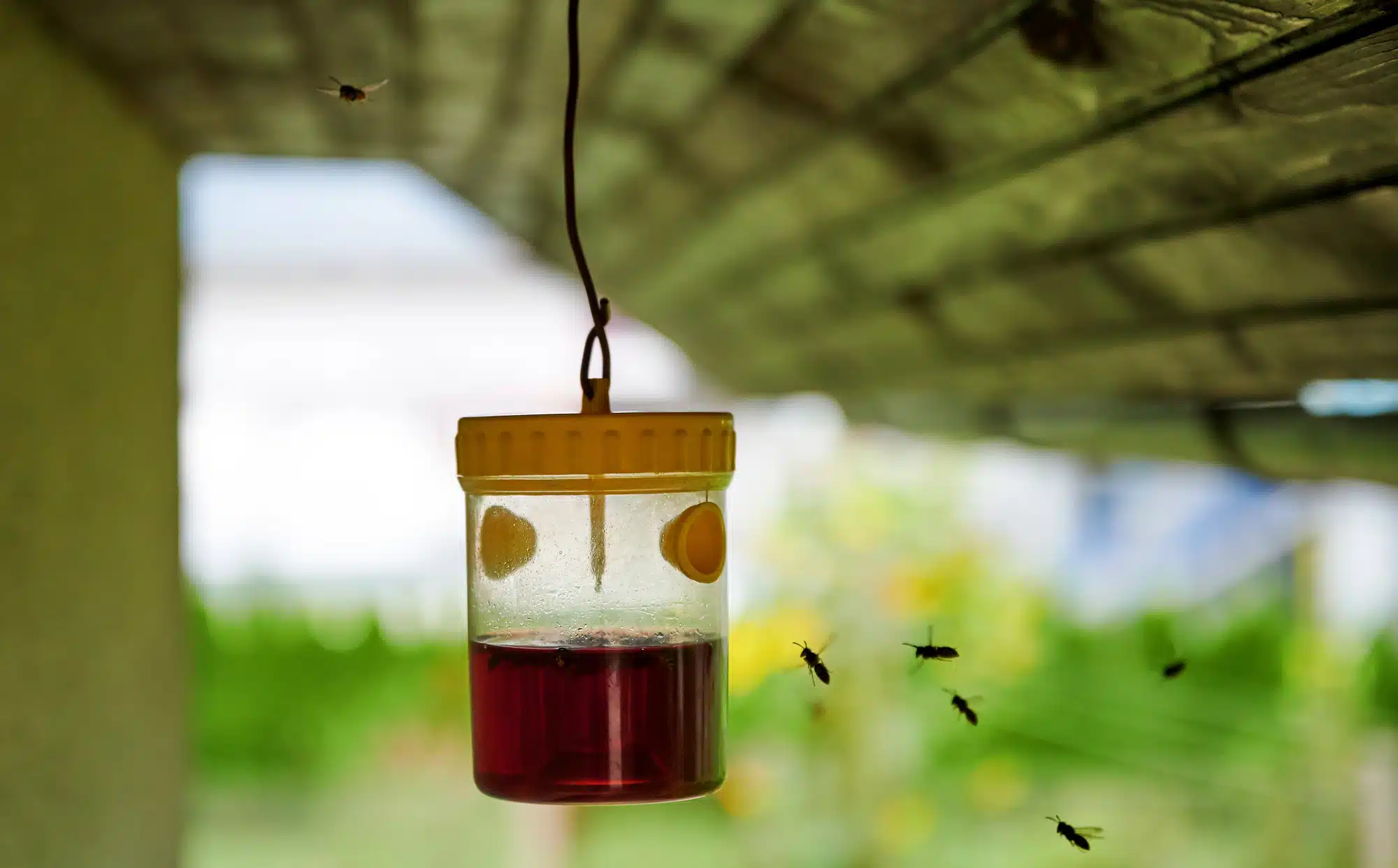
Can you trap Asian hornets with a plastic bottle and a fermented attractant? Yes. A PET bottle of 1.5 L with entrance holes of 8-9 mm, escape holes of 5 mm and an attractant made from yeast + sugar + water or from stout beer + white wine + syrup captures Vespa velutina, particularly in spring when foundress queens seek sugars. The issue is not whether it captures Asian hornets: it is what else it captures. For every Asian hornet caught, dozens of bees, moths and other pollinators may also be caught. Here we explain how to make it properly, when it makes sense to use it and when it is better to switch to truly selective methods.
How to make a homemade Asian hornet trap, step by step
You need a transparent 1.5- or 2-litre bottle, a craft knife or scissors, an awl or nail for making the holes, string or wire for hanging it, and the attractant. Nothing else. What separates a decent trap from an insect graveyard is the holes: trapping programmes recommend entrance holes measuring 8–9 mm (large enough for an Asian hornet) and 5 mm exit holes so that small insects caught accidentally can escape. This does not make the bottle ‘selective’, but it makes it far less harmful than the traditional open funnel.
Assembly
- Cut the bottle at about 2/3 of its height, where the body begins to narrow towards the neck.
- Invert the top part (the neck) and fit it upside down into the base, acting as a funnel: the hornet enters easily but finds it hard to exit.
- Make 4–6 8–9 mm holes near the top. To reduce catches of beneficial insects, add 2–3 smaller 5 mm escape holes in the sides near the base; they allow bees and small flies to escape.
- Punch two holes in the base to thread the string.
- Add the bait, filling the base to a depth of 3-4 cm. No more is needed: a thin film of liquid that generates scent is sufficient.
- Hang the trap 1–1.5 m above the ground, somewhere accessible so that it can be checked frequently and, if possible, under a small cover that protects it from rain.
The yellow trick
Use yellow paint on the outside of the bottle or on the cord. Vespa velutina is particularly attracted to this colour, and this free detail improves the visit rate. It is a common recommendation in beekeeping associations’ trapping campaigns.
Recipe 1 — Yeast, sugar and water (the fermented one)
The cheapest option, with the strongest scent attraction. The key is fermentation: the CO₂ produced by yeast acts as a partial deterrent to honeybees once the mixture is fermenting actively. The most widely cited ratio in municipal campaigns is 5 L of water + 2 kg of sugar + 50 g of baker’s yeast, which can be scaled up as needed:
| Water | Sugar | Fresh yeast |
|---|---|---|
| 1 litre | 400 g | 10 g |
| 2.5 litres | 1 kg | 25 g |
| 5 litres | 2 kg | 50 g |
Preparation: dissolve the sugar in warm water (no hotter than 35 °C, or the yeast will be killed). Crumble in the baker’s yeast and mix. Allow it to ferment at room temperature for 48 hours before use—this is the step most people skip, yet it activates the gas production that helps deter honeybees. Replace the attractant every 7–10 days, or when it stops bubbling.
Recipe 2 — Dark beer + white wine + syrup (the quick one)
No waiting time: use immediately. The most well-documented classic mix in action plans is 40-45% dark beer + 40-45% white wine + 10-15% syrup or fruit juice. Or, to remember it easily: 2 parts dark beer, 2 parts white wine, and 1 parts syrup. White wine is the key ingredient: it repels honeybees but not the Asian hornet.
A note on fruit. This recipe is often cited using cranberry juice, but it is important to know that this is the least significant part of the mixture: it is the alcohol and acidity, not the sugar, that do the work with queen wasps. Among experienced beekeepers who actively set traps, cranberry is increasingly questioned — it was widely recommended at first, when less was known, and its sugar concentration is low. If you are using fruit, a very sweet syrup or grape juice will perform equally or better. And if your aim is to reduce worker wasp numbers in summer, it is the sugar concentration that matters most: the sweeter the mixture, the more attractive it becomes.
| Ingredient | Approximate quantity |
|---|---|
| Black beer | 150 ml |
| White wine | 100 ml |
| Cranberry syrup or juice | 50 ml |
| Sugar (optional, strengthens) | ≈30 g |
Preparation: combine the ingredients, stir until the sugar dissolves and use immediately. Replace every 5–7 days, or sooner in very hot weather. Sweet baits such as beer or soft drinks can be improved by adding a small quantity of yeast to increase fermentation.
Regarding blueberry (an important caveat). Blueberry became popular as a star bait at the start of the invasion, but its effectiveness is disputed. Beekeepers with years of field-trapping experience point out that its low sugar concentration makes it one of the least attractive baits for worker hornets—interestingly, traps do catch large numbers of hornets in vineyards, but because of the grapes rather than the blueberry. In a fermented mixture aimed at queens, blueberry may contribute, but do not expect miracles from it in summer. If your target is worker hornets, prioritise concentrated sugar; if it is queens, prioritise fermentation over the type of fruit.
Recipe 3 — Fermented must with white wine (queen bait, almost free)
This is the recipe for those aiming to catch queens in spring while maximising selectivity for minimal cost. The idea, advocated by professional beekeepers, is simple: a sugary ingredient mixed with water forms must, and the only addition needed for fermentation is yeast. The common mistake is using bread yeast: this works well for cereal starches, but for a sugar-rich must it makes more sense to use wine yeast. And where can you get it for free? From a pour of cheap white wine, which carries thousands of yeasts ready to reactivate as soon as they encounter fresh sugar.
How to prepare it:
- Use a jerry can with a capacity of approximately 8 litres to prepare a must with water and a sugar feed—glucose, fructose, or the Apipasta or Apifonda already used to feed colonies.
- Add one cup (≈250 ml) of cheap white wine. Optional: a few dead bees from those falling into the trap, which contribute some protein.
- Seal with a small gas outlet hole (or a balloon with a pinprick, as in mead-making: it inflates when CO₂ escapes and deflates when pressure drops). Leave in a cool place indoors.
- Forget about it for several weeks (1-2 months). When you return, you will have 4–7% alcohol by volume: a poor wine but an excellent queen attractant. And if it turns sour, it becomes vinegar, which also works. You cannot go wrong.
One 8 L container supplies approximately 20–24 traps. The mixture can be prepared without urgency in January and kept ready for March. No temperature control or winemaking equipment is needed: the method is deliberately simple.
Sweet bait without alcohol means a trap for honey bees. If you use a sugar-only bait with neither alcohol nor active fermentation, the risk of catching honey bees soars. Alcohol and CO₂ partially deter Apis mellifera. Without them, you are not setting up an Asian hornet trap; you are setting a trap for your own bees.
The detail almost no one tells you: queen bait is not worker bait
Here lies the difference between blind trapping and informed trapping. The palatability —how appealing a bait seems— is not the same for a founding queen as for a worker. As explained by beekeepers with years of experience in coordinated trapping networks across the Cantabrian ridge, confusing the two baits is a waste of time:
| Founding queens (spring) | Workers (summer-autumn) | |
|---|---|---|
| What attracts them | Alcoholic, acetic and vinegary aromas. Partially or fully fermented solutions. | Pure sugar with fruity aromas. The more concentrated in sugar, the better. |
| Ideal bait | Fermented must, poor wine, vinegary sugar solution. | Glucose, fructose, syrups, very sweet fruit (plums). |
| Selectivity | High. The alcoholic and vinegary notes attract few other species. | Low. The sugar attracts everyone: bees included. |
The practical consequence is significant: when setting up a spring queen-trapping network—one of the best ways to control the population—fermented or vinegary substances are preferable. They are cheap, easy to prepare and, above all, far more selective. Combined with an 8 mm entrance, the trap catches almost exclusively Asian hornets. A sugar-only attractant is reserved for reducing the pressure from workers in summer, when selectivity will inevitably be minimal.
When to trap: the calendar makes all the difference
Here is one of the most overlooked keys. It is not the same to trap in spring as in autumn. The Asian hornet life cycle dictates timing: in spring, founding queens emerge from diapause and establish the primary nest; later, the first workers appear; and by late summer and autumn, activity peaks, pressure on apiaries intensifies, and future queens disperse. The MITECO itself summarises this cycle: first workers in April–May, transfer to secondary nest from May–June, and emergence of females and males with dispersal of future queens between late August and October.
Spring (mid-February – mid-June): the window for founding queens
Queens that have survived the winter emerge from diapause with one purpose: to feed on sugars so that they can establish a nest. The National Strategy identifies this as the window for queen trapping. Below 10 °C, activity is almost nil, so it is not worth setting up traps. However, for trapping, the useful threshold is higher: beekeepers who trap continuously observe that while the daily maximum remains below 15 °C, the dispersal phase is almost completely suppressed and traps catch almost nothing—not because Asian hornets do not fly (they fly at 10 °C and below), but because queens do not set out to claim territory. From 15 °C they begin to be caught, and as temperatures approach 20 °C catches become substantial. If you set up traps during a cold March and catch nothing, check the thermometer before concluding that the trap is ineffective. Priority locations are within 100–150 m of the previous year’s nests, near flowering plants (camellias, loquats, fruit trees and acacias), and around composting areas. But note the caveat—read on, because the actual value of this trapping is disputed.
The most common mistake is not starting late, but removing traps too early. Almost everyone starts on time (as soon as days approach 20 °C, February–March), but they remove them too soon. In higher-altitude areas, with later emergence, queens are still being caught into late June. Rule: let the weather and your test traps determine when to stop, not the calendar.
Summer and autumn (August – October): sweet bait is superfluous
During this period, worker hornets put apiaries under intense pressure. Bottle traps baited with sugar syrup are not recommended here: selectivity drops sharply and the ratio of non-target insects to Asian hornets increases dramatically. This is the time for physical protection—electric harp and hive entrance barrier—combined, if necessary, with selective cup traps. Placing a sweet attractant in front of hives in August kills biodiversity while barely affecting Asian hornet numbers.
The controversy worth knowing
That spring is the period of foundress queens does not mean that spring trapping is the best solution. The MITECO Strategy itself acknowledges there is controversy over its effectiveness: French authorities even recommended avoiding it, as natural mortality due to competition among foundress queens is already high at that time. Several studies point in the same direction: spring trapping of queens does not clearly reduce the number of nests in a given area, because trap capture capacity is lower than the production of new queens. Translation: if trapping in spring, do it in a targeted way and only at points of real pressure, not filling the field with bottles ‘just in case’.
Foraging radius: why trap density matters
A useful concept when deciding how many traps to set is the foraging range. A foundress queen travels only a short distance from her primary nest to find food: about 300 m in diameter, and even less where resources are abundant, such as around livestock buildings and in heavily urbanised areas. A worker hornet, by contrast, belongs to a populous colony and may forage up to 2.8–3 km from the nest, as confirmed by marking workers in the same way as queens.
What does this mean? In highly urbanised areas under heavy pressure, you need a dense trapping network: in a 1 km² grid, the queen’s range may require 10–20 traps, whereas fewer may provide adequate coverage in less urbanised areas. The real problem is often not the number of nests per square kilometre, but the enormous foraging range of worker hornets putting pressure on your apiary.
The major flaw of homemade traps: selectivity
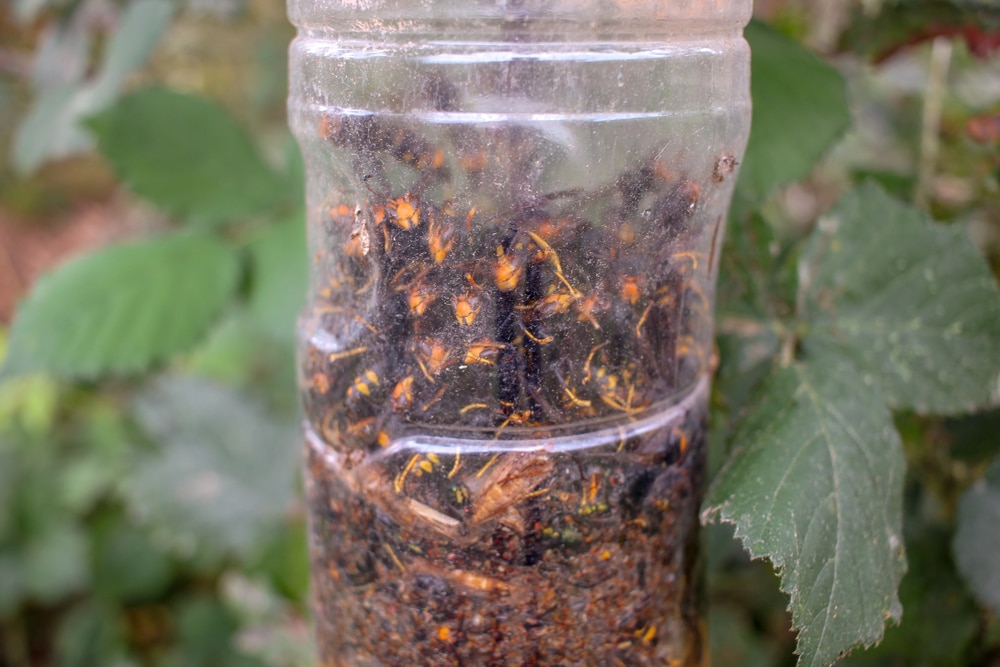
The serious limitation of a homemade trap is not that it fails to catch hornets—it does—but what else it catches. In several studies of baited traps for Vespa velutina, Asian hornets made up a very small proportion of the total catch; most specimens were Diptera, native Hymenoptera and Lepidoptera. The recurring conclusion is that poorly designed food-baited trapping can itself become an additional threat to native insects.
And the studies comparing trap models agree on one point: some designs with good capture capacity have very poor selectivity and also trap native insects, including the European hornet (Vespa crabro, one of the few natural predators of the Asian hornet). With current tools, baited trapping remains environmentally unsustainable if trap design is not carefully managed.
The other side is the variable efficacy. In spring, beer-based traps can be as effective and selective as some commercial baits; in autumn, the situation changes and the combination of a specific trap + appropriate bait usually prevails. The most decisive factor is almost never the bait itself: it is the trap design.
There is a field explanation for this variability that goes beyond the bait, known as «environmental trap»: what truly decimates a Vespa velutina population is not a cold winter —for which the species has diapause, a survival mechanism involving metabolic shutdown— but a cold and rainy spring that arrives immediately after an early emergence from diapause. If a mild winter causes queens to emerge early and hungry, and then a spring with no resources follows (little flowering, few days above 15-20 °C, continuous rain), natural mortality rises sharply. That is why the same bait, in the same area, can yield excellent captures one year and almost nothing the next: spring weather carries as much weight as the trap itself. A good bioindicator is autumn-flowering ivy: if you see it heavily visited by bees, hoverflies and butterflies, Asian hornet pressure in that valley is low; if you see only Asian hornets, the pressure is high.
In short: yeast or beer baits work, but they are not a silver bullet. Sometimes they are effective, sometimes not, and their selectivity is almost always their weak point. It is dishonest to sell you on the idea that a bottle trap solves the problem. It is better to tell you that it may help a little, at specific times, and that in many contexts the balance between useful captures and collateral damage is poor.
Homemade bait vs professional attractant
What really makes the difference is not ‘homemade vs bought’, but ‘ad hoc improvisation vs proven system’.
| Criterion | Homemade bait in DIY bottle | Professional attractant + selective trap |
|---|---|---|
| Selectivity | Low and irregular. Highly dependent on the bottle, entry size, and environment. | Better when the attractant is paired with a trap designed specifically for Asian hornets. Not perfect, but operating at a different level. |
| Effectiveness | Can work well, but varies greatly depending on season and location. | More consistent when the attractant is designed for a specific device. |
| Bait durability | Ferments quickly. The liquid must be monitored and renewed every 5–10 days. | More stable and standardised formulation. Fewer renewals. |
| Convenience | Requires preparing mixture, adjusting quantities, fermenting 48 h, and checking more often. | Ready to use. Simple dosing, less trial and error. |
| Cost | Minimal in ingredients. High in time and maintenance if managing many. | Higher initial cost, usually offset by time and consistency savings. |
| Ideal for | Targeted spring trapping, private individuals with sporadic presence, areas without nearby hives. | Beekeepers, high Asian hornet density, hives and gardens with pollinators to protect. |
It cannot honestly be said that ‘professional always catches more’ in any context. Three things can be affirmed: that the specific trap matters enormously, that the selectivity of DIY is often worse, and that proven systems greatly reduce improvisation. If you wish to move from makeshift solutions to something more serious, the starting point is the Asian hornet control category.
More effective and selective alternatives
1. Selective glass trap with professional attractant
The Véto-pharma VespaCatch Select selective trap has adjustable entrances from 7 to 11 mm: use 9 mm to catch Asian hornets generally (foundresses and workers), 8 mm to target workers only, or 10 mm where Vespa orientalis is attacking. It also includes an anti-drowning grid and a filter cone that allows small insects to escape. These details provide the selectivity that a bottle trap lacks. Use it with an attractant that does not draw bees, such as Avispa’clac, whose maker states that it contains a pollinator repellent.
The trap’s selectivity is supported by scientific trials, not just marketing. A study conducted in Asturias and Catalonia in September 2024 and presented at the XII National Beekeeping Congress in Zamora (2025) identified every catch taxonomically. In one area, 93% of the catch was Vespa velutina, far above the selectivity of a homemade bottle trap. A multicentre field evaluation carried out in France by the manufacturer in spring 2025 also recorded averages of up to 9–10 Asian hornets per trap in the areas under greatest pressure.
2. Electric harp: the queen of selectivity
For apiaries under intense attack in summer and autumn, the stainless steel electric harp Tártago is one of the most scientifically supported systems. Its separate wires allow bees to pass through but electrocute the Asian hornet on contact, which then falls into a container. It is not a bait, so it does not attract anything not already hunting in your hive entrance. Field studies attribute it a very high selectivity (the vast majority of captured insects are Asian hornets) and a notable reduction in predation pressure on colonies. It does not replace springtime trapping: it acts when worker hornets are already attacking the hives.
3. Hive entrance barrier: passive protection without killing anything
The hive entrance barrier against Asian and Oriental hornets provides mechanical protection through entrances calibrated to 5 mm: an Asian hornet’s thorax cannot pass through, but bees can. It does not catch hornets, but it removes the main source of stress in the apiary: hawking, the hovering flight of hornets waiting in front of the entrance. To be clear, barriers alone neither reduce hornet numbers nor prevent all predation, but they do drastically reduce foraging paralysis: guard bees are no longer overwhelmed and foragers resume normal activity. This low-cost measure has no environmental impact and works best when combined with a nearby cup trap.
Koldo’s trap (for stationary apiaries)
To reduce the number of worker hornets in summer and autumn in a fixed apiary, the Koldo trap is highly effective and is based on the Asian hornet’s escape behaviour: when it feels trapped, it escapes upwards and sideways. The device (mesh of 6 mm with side exits leading into a capture chamber) lets hornets enter and captures them as they try to escape, while bees pass through. It has an additional advantage: by continuous capture, it gradually depletes the surrounding nests. Its drawback is that it requires the front of the hives to be clear of grass, so it suits stationary apiaries better than large-scale operations.
Common (and costly) mistakes when trapping
- Sugar bait in summer without selectivity. This is the most common and most damaging mistake. Selectivity falls to a minimum, and more native insects than Asian hornets are killed. Use physical defences in summer and autumn.
- Failing to ferment yeast bait for long enough. Without 48 h of fermentation, the mixture produces no active CO₂ and bees enter, attracted by the sugar. The result is a trap for bees, not Asian hornets.
- Setting a trap and forgetting it. An unattended trap becomes a sink for non-target insects. Inspect it every 5–7 days, renew the bait and release any live by-catch.
- Placing it right beside the hive entrance. Baited traps attract Asian hornets; place them next to the hive and you direct the hornets towards your bees. Keep them at least 10–20 m from the apiary; in spring, the farther away, the better.
- Leaving the bottle wide open. Without controlled entry points or escape holes, you capture everything except what you want. Limit access to 8-9 mm and add exit holes of 5 mm.
- Believing that a bottle protects an apiary. It does not. The biology of the Asian hornet demands different strategies by season: targeted queen trapping in spring, and electric harp plus entrance barrier in summer and autumn.
Frequently asked questions
Does yeast attract the Asian hornet?
Yes. The fermentation of sugar and yeast produces CO₂ and volatiles (alcohols, esters) highly attractive to the Asian hornet. The most commonly used ratio in affected areas is 5 L of water + 2 kg of sugar + 50 g of yeast. The key is to let it ferment for 48 hours before use, to maximise attraction and to ensure gases deter bees.
Does beer work as bait for the Asian hornet?
Yes, with nuances. In spring, traps using beer are often effective and reasonably selective, especially dark beer with white wine and syrup. The nuance: selectivity declines in autumn. It is not a poor bait, but its optimal window is spring.
Do homemade traps kill bees and pollinators?
They can, and the impact can be substantial. In several studies, Asian hornets made up only a very small fraction of the catch; the remainder comprised Diptera, Lepidoptera, native Hymenoptera and other groups. To minimise by-catch, use fermented bait rather than fresh sugar, provide 5 mm exit holes, place traps away from flowers and hives, trap only in spring and inspect frequently so that non-target insects can be released.
When should I set Asian hornet traps?
Avoid winter. According to the National Strategy, the queen window runs from mid-February to mid-June, but its practical utility is controversial: implement it selectively, not en masse. Do not place sugary bait in full summer near apiaries — minimal selectivity, maximum damage. In autumn, if trapping, use selective traps or ‘dry’ traps to allow release of non-target insects.
How do you truly eliminate the Asian hornet?
With a single bottle, no. A realistic approach is multi-layered: detection and destruction of nests, very targeted trapping when appropriate, and physical protection of the apiary using a hive-entrance barrier and/or electric harp if pressure is high. Evidence does not show that trapping alone controls populations in invaded areas; physical defences, however, do demonstrate direct benefits to the colony.
Is a homemade trap enough to protect my apiary?
No. It is useful for spring queen trapping and as a supplement, but insufficient as the primary protection for an active apiary. For summer and autumn, the combination of electric harp + hive-entrance barrier + selective cup trap with professional attractant offers significantly better results.
Does professional attractant work better than yeast?
It depends on the time of year and the objective. In spring, yeast or beer bait can match certain commercial attractants in number of captures. However, professional attractant wins in durability (weeks versus days), consistency, and especially in selectivity when used with a glass jar trap. For those managing multiple apiaries, the time savings and reduced risk to bees make it the more rational choice in the medium term.
Don’t know which system fits your case?
La Tienda del Apicultor has been helping beekeepers in Spain and France tackle the Asian hornet for years. If your colonies are under genuine pressure, contact us, and we will help you choose a practical combination of measures to protect them.
Sources and evidence
This article combines peer-reviewed scientific evidence with the field experience of professional beekeepers. Its main sources are the Strategy for the management, control and possible eradication of the Asian hornet (MITECO) and regional action plans; Rojas-Nossa, S. V., Novoa, N., Serrano, A. and Calviño-Cancela, M. (2018), “Performance of baited traps used as control tools for the invasive hornet Vespa velutina and their impact on non-target insects”, Apidologie 49:872–885 (DOI: 10.1007/s13592-018-0612-0); Lioy et al. (Insects, 2020) on bait efficacy and selectivity; Requier et al. (Journal of Pest Science, 2020) on hive entrance barriers; and research on electric harps. Field-trial data for the VespaCatch Select trap by Véto-pharma include the Spanish study by Doblas Bajo, Armengol Coll, Celenza and Méjica Pérez, “Preliminary results from the new Véto-pharma trap for Vespa velutina” (XII National Beekeeping Congress, Zamora, 2025), with trials in Asturias and Catalonia in September 2024, and a French multicentre field evaluation conducted by the manufacturer in spring 2025. Practical knowledge about separate attractants for queens and workers, foraging range and the ‘environmental trap’ comes from talks by professional beekeepers on the Cantabrian coast with years of experience running coordinated trapping networks.

ISNI 0000 0005 1801 1100 | Joshua Ivars is the manager of LA TIENDA DEL APICULTOR and the author of this blog, where he shares technical and practical guidance for beekeepers. Drawing on extensive experience in the beekeeping sector, he offers advice and solutions based on beekeepers’ real needs, sharing his knowledge of equipment and essential beekeeping practices.


