
Introduction

Nosemosis, also called Nosema disease in older beekeeping literature, has been studied for more than a century. It affects honey-bee health, but a positive test and a visibly failing colony are not the same thing.
Early descriptions of intestinal disease in bees predate the diagnostic tools available today. They are valuable historical records, but should not be read as modern guidance on disease severity or treatment.
In 1909, Enoch Zander described the organism known as Nosema apis. Later research identified another important species, Nosema ceranae, in western honey bees.
G. F. White of the United States Department of Agriculture also contributed extensively to the early study of Nosema disease. His work forms part of the history of bee pathology, not a substitute for current bee-health advice.
The microscope image accompanying this section is credited in the source article to the COLOSS BEEBOOK. It illustrates spores; it is not a visual key that lets a beekeeper identify the species or judge the severity of an infection from a photograph.
What is nosemosis?
Nosemosis concerns infection by microscopic, spore-forming parasites associated with the adult honey bee’s gut. N. apis and N. ceranae are now also referred to in research as Vairimorpha apis and Vairimorpha ceranae. The familiar Nosema names remain widely used by beekeepers.
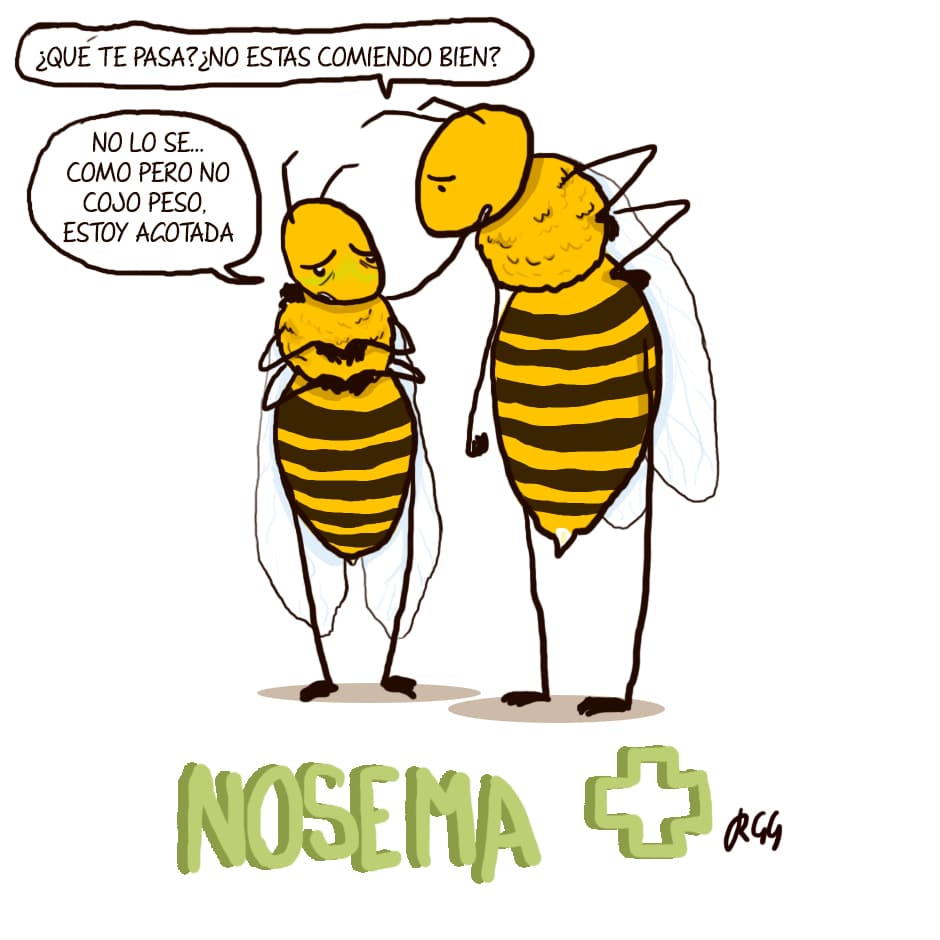
The Spanish cartoon asks, ‘What’s wrong? Aren’t you eating properly?’ The smaller bee replies, ‘I eat, but I don’t gain weight; I’m exhausted.’ This is an illustration of weakness, not a diagnostic checklist: those signs cannot establish nosemosis.
Historical accounts sometimes described limited losses, but it is misleading to conclude that nosemosis is always minor or harmless. The consequences depend on the bees, parasite, environment and other stresses affecting the colony.
Research has linked Nosema infections with impaired individual bee performance and, in some settings, colony decline. However, neither the presence of spores nor a weak colony proves that Nosema is the sole cause of the problem.
The term Colony Collapse Disorder (CCD) came to prominence following reports in the United States in 2006. It describes a particular pattern of colony loss, not every instance of depopulation or winter mortality.

Nosemosis and Colony Collapse Disorder
Concern about CCD brought renewed attention to honey-bee diseases, nutrition, pesticides and other stresses. Researchers investigated both newly recognised agents and organisms that had been known for many years.
Nosema was one of those organisms. A careful distinction is needed between finding an infection, demonstrating an effect on bees and explaining an entire colony-loss event.
The Spanish team led by Mariano Higes at the bee-pathology laboratory in Marchamalo, Guadalajara, made an important contribution. Their 2006 report identified N. ceranae in samples of Apis mellifera from Spain.
This changed the earlier assumption that Nosema disease in western honey bees could be attributed only to N. apis. It did not mean that every affected colony had the same parasite or that N. apis ceased to exist.
N. ceranae had first been described in the Asian honey bee, Apis cerana, in the 1990s. Subsequent work documented its presence in western honey bees in several parts of the world.
The Marchamalo findings were important for understanding Spanish colony losses, but results from one region should not be applied uncritically to every country. A USDA account of a US CCD investigation reported no single cause and did not find a close association between Nosema and CCD in that study.
The original article referred to an almost complete predominance of N. ceranae in a laboratory’s own cases. That is a local observation, not a current global prevalence estimate or proof that N. apis has disappeared. Species identity must be established by appropriate testing.
What does type C nosemosis mean?
‘Type C nosemosis’ is the term used for disease associated with N. ceranae. The word ‘new’ in older articles reflects when it was recognised in western honey bees; it is not a newly discovered condition today.
The name distinguishes it from nosemosis associated with N. apis, sometimes called type A. More recent papers may use the genus name Vairimorpha for the same organisms.
The two infections can differ in their patterns, but a beekeeper cannot reliably distinguish them by looking at the hive. Clinical signs, when present, are not specific enough to identify the species.
Diarrhoea or faecal staining is often mentioned in older descriptions. Two points are particularly important:
- Faecal staining is not specific to Nosema. Several conditions can cause it, so a stained hive does not establish the diagnosis.
- The absence of diarrhoea does not exclude infection. It is also too absolute to say that a colony with N. ceranae can never have diarrhoea, particularly when other problems may coexist.
Do not use the presence or absence of staining as a yes-or-no test. Interpretation requires the colony’s history, an assessment of its condition and, when appropriate, laboratory evidence.
Infection can be present without obvious external signs. That does not mean every apparently healthy, positive-testing colony is destined to collapse, nor that every declining colony has nosemosis.
A falling adult population is a reason to investigate, not a diagnosis in itself. Queen problems, Varroa and associated viruses, inadequate nutrition, pesticide exposure and other causes may need consideration.
Regular inspection records can help reveal changes in colony strength before losses become severe. The useful question is how the colony is changing over time, rather than whether it matches a single photograph or symptom description.
How do the seasonal patterns differ?
N. apis has often been associated with seasonal patterns in temperate regions. This does not make it invariably mild, and diarrhoea is not a reliable species-specific sign.
Weakness, reduced productivity and other changes have many possible explanations. They should prompt assessment rather than an assumption that a particular Nosema species is responsible.

Winter confinement, spring brood rearing and the availability of flying weather can influence what is observed. The timing and scale of infection are affected by local conditions, so a rigid calendar cannot describe every apiary.
A seasonal fall in measured infection does not guarantee that a colony has recovered or will overwinter successfully. Colony strength, stores, queen status and the wider health picture still matter.
Equally, N. ceranae should not be described as increasing continuously through every summer regardless of climate. Research across five Canadian provinces found strong regional and yearly differences in Vairimorpha detections, with spore counts generally falling over the summer in that dataset.
The practical lesson is to use local advice and comparable records. Neither warm weather alone nor a date on the calendar proves that the problem has ended, or that inevitable depopulation will continue until autumn.
How can infection contribute to colony decline?
Nosema affects adult bees, not just foragers. Research has found effects on energy use, longevity and behaviour; their expression depends on the conditions studied and should not be assumed identical in every colony.
When adult workers are lost faster than they are replaced, the colony’s division of labour can be disrupted. Some studies have reported earlier foraging by infected workers, but this is a possible consequence, not an inevitable sequence with a fixed timetable.
Flight performance is another research topic. A 2026 study found reduced flight performance in infected workers and queens under experimental conditions. That finding does not allow the cause of a missing forager to be diagnosed at the hive entrance.
During inspection, two population imbalances deserve attention, without treating either as specific to nosemosis:
- Too few foragers for the colony’s needs. Compare flight activity with weather, forage and the normal pattern for that colony.
- Too few workers covering and tending the brood. Assess this alongside brood area, queen status and available stores.
Brood combs with little bee coverage can indicate that the colony is struggling, but similar appearances can have different causes. Swarming, recent management, weather and other health problems must be considered before attributing the picture to Nosema.
Severe or prolonged decline can reduce production and threaten survival. Recovery is not guaranteed, but neither is failure inevitable: decisions should be based on an assessment of the whole colony.

What about queens and drones?
Most routine discussion of nosemosis focuses on workers because they make up most of the colony. Queens and drones can also be infected, and their health matters to reproduction and colony continuity.
Experimental findings should be distinguished from a field diagnosis. A problem with egg laying or mating success does not, on its own, demonstrate that Nosema is responsible.
Research on queen physiology has reported changes in physiological measures and pheromone production. For practical assessment, record the following observations rather than assuming an inevitable list of effects:
- Queen age and any known history of replacement.
- Changes in the amount and pattern of brood.
- Signs that the colony may be preparing to replace its queen.
- The wider condition of the adult bees and the colony’s nutritional resources.
- The timing of mating and the onset of laying, interpreted with weather and management history.
- Any veterinary or laboratory findings relevant to the queen or the colony, rather than diagnosing infertility from appearance alone.
In drones, studies have found physiological and behavioural costs, but reproductive outcomes are not uniform. A 2018 study, for example, found energetic effects without a reduction in sperm numbers. Keep three distinctions in mind:
- A change in one fertility measure is not proof that all infected drones are sterile.
- Survival and flight effects can vary with the study conditions and other stresses.
- Evidence from one Nosema species, life stage or experimental setting should not be presented as a universal explanation for failed mating in an apiary.
What can you do as a beekeeper?
Do not wait for one supposedly unmistakable sign. Keep routine records of colony strength, brood, stores, queen condition and relevant health checks.
If a colony’s population or performance falls unexpectedly, investigate promptly. Describe the timing and extent of the change to your veterinarian, bee-health adviser or diagnostic laboratory.
A badly weakened colony, especially approaching winter, may be difficult to recover. However, an inspection or test result should guide the prognosis; the date or the presence of spores alone cannot establish that recovery is impossible.
Do not apply routine medication or supplements simply because they are marketed as preventive. Unnecessary products can waste money, complicate the assessment and create avoidable risks.
Early assessment matters. The aim is to understand the cause of decline and act appropriately, not to make a treatment decision from a single number.
Diagnosis and interpretation
Discuss a proportionate monitoring and investigation plan with a qualified bee-health professional. Testing may be useful where history or colony condition warrants it; there is no single schedule that suits every beekeeping operation.
Varroa monitoring is important, but its methods and decision thresholds cannot simply be transferred to Nosema. The two problems require different interpretations.
Continue to assess Varroa and other likely causes of poor performance as part of the wider health picture. Finding Nosema should not end the investigation if the colony’s condition suggests additional problems.
A spore count is not a direct measure of colony health. Primary research on Nosema spore loads shows why counts alone are insufficient as a general health indicator. Results must be interpreted with sampling context, colony condition and other findings; this article provides no universal treatment threshold.

Comparable observations and appropriate testing can support decisions before losses become extreme. They cannot promise that disease will always be detected before any damage occurs.
Microscopy can show compatible spores, but the two species are difficult to distinguish reliably by conventional appearance alone. A specialist laboratory can advise whether a molecular test is needed for species identification.
Contact the laboratory before submitting material and follow its own sampling and transport instructions. A beekeeper or association should use trained personnel and appropriate facilities; a cheap microscope by itself is not a complete diagnostic service.
Treatment: professional advice and current authorisation
A positive result does not automatically require medication. Decisions depend on the overall assessment, not just the number of spores or an old internet threshold.
Fumagillin appears in historical literature and research from countries with different regulatory arrangements. That history does not provide permission to obtain or use it in Spain today, and this article gives no dose or treatment protocol.
In Spain, consult the AEMPS veterinary-medicines information and CIMA Vet for current product authorisation and official instructions. Spanish veterinary-medicine rules require use in accordance with authorised conditions, with any legally permitted exceptional use governed by veterinary requirements. Follow the applicable prescription, record-keeping and withdrawal instructions.
Availability, efficacy and legal use are separate questions. If there is no suitable authorised option for the situation, the next step is professional advice, not a homemade remedy or an imported product chosen from a foreign recommendation.
What about ‘natural’ products and supplements?
‘Natural’ is not evidence that a product treats nosemosis, is harmless, or is legally authorised as a veterinary medicine. Feed supplements and medicinal products must not be treated as interchangeable categories.
When assessing a claim, ask whether the research measured colony health and survival, not merely a short-term change in a laboratory measurement. Results may depend on study design, population, season and other conditions.
The original article cited a preliminary 2014 study of Nozevit by Higes and colleagues, listed below. A preliminary study is not by itself proof of reliable prevention, cure or improved colony survival, nor a current authorisation to make medicinal claims.
A fall in spore counts does not guarantee that a colony has been saved. Even research involving fumagillin and overwintered colonies has reported a more complex relationship between infection measures, treatment and colony outcomes. Do not replace appropriate diagnosis and management with a promise that a supplement will prevent collapse.
Conclusion
Nosemosis is an important part of bee-health management, but its effects must be understood in context. Both the organism involved and the wider condition of the colony matter.
No diarrhoea does not mean no infection; a positive test does not mean inevitable collapse. A declining colony needs a proper assessment of possible causes rather than a diagnosis from photographs or a single spore count.
Use inspection records, local bee-health advice and appropriately interpreted testing to decide what is needed. Keep nutrition, Varroa management, queen status and other factors in view.
Any treatment decision should follow the veterinary assessment and current legal requirements. Timely, appropriate action can improve the chances of recovery, but no feed supplement or treatment should be presented as a guaranteed rescue.
Historical reference
Higes, M., et al. (2014). Preliminary effect of an experimental treatment with Nozevit® (a phytopharmacological preparation) for Nosema ceranae control. Journal of Apicultural Research, 53(4), 472–474. DOI: 10.3896/IBRA.1.53.4.03. Retained as the reference cited in the original article, not as a treatment recommendation.

Soy veterinario especializado en apicultura. Trabajo como “veterinario de abejas” diagnosticando sus enfermedades, y también soy apicultor.
"Me embeleso, casi medito, viendo el ir y venir de las abejas por la piquera y escuchando el zumbido del colmenar."
Mi blog: desdelapiquera.com


