
At a glance
Almond blossom honey
Prunus dulcis
Colour
Very pale, whitishguide reference: up to 30 mm Pfund
Aroma
Noticeably floral and fruitysometimes with bitter-almond notes
Taste
Sweetoccasional bitterness, depending on variety
Crystallisation
Not particularly rapid; very fine crystalsan almost creamy texture
Season
Early springone of the early nectar flows
Growing areas
Several regions of Spainharvest depends on weather and frost
Pollen reference
At least 20%not a percentage of nectar purity
Conductivity
Up to 0.25 mS/cmthe guide’s almond-honey reference
A very pale early-season honey that often never reaches a jar: the colony uses the incoming forage to raise its next generation of bees.
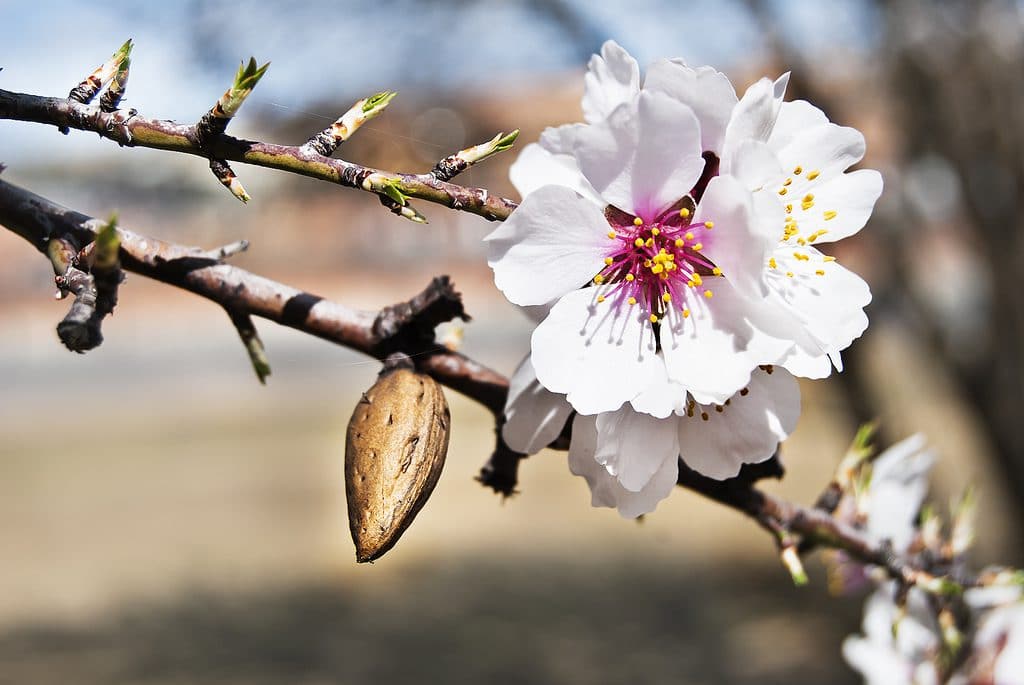
Almond trees can flower while it is still winter. They provide one of the first major nectar and pollen flows in the Iberian beekeeping calendar. For many beekeepers, the aim is spring build-up rather than a honey crop. That distinction explains why almond blossom honey can be difficult to find.
The blossom that feeds spring build-up
Migratory beekeeping is an important part of the Spanish sector. Many beekeepers move colonies into almond-growing areas to support early brood rearing: nectar and pollen help the colony replace winter bees and build a workforce for the coming season. Where colony strength and local conditions allow, this period may also be used to establish the first nucleus colonies.
A nectar flow does not necessarily mean a harvestable surplus. Much of the incoming forage may be consumed in brood rearing. Earlier or overlapping forage, such as white wall-rocket (Diplotaxis erucoides, known as rabaniza in Spain), can support build-up and improve the chance of a surplus. It is not an essential condition or a guarantee of an almond-honey crop.
Weather matters too. The technical guide associates production with adequate rainfall and areas that escape frost during flowering. Frost in February or March can damage blossom, while unsuitable flying weather can restrict nectar collection.
Low conductivity: what it does and does not tell you
The guide gives an electrical-conductivity reference of no more than 0.25 mS/cm for almond honey, lower than its 0.30 mS/cm references for rosemary, acacia, albaida and oilseed rape. Conductivity reflects dissolved substances, including mineral salts and organic acids. It is not a direct mineral assay, a purity test or evidence that one honey is “cleaner” or healthier than another. A reference ceiling also cannot rank the mineral content of every individual jar.
Colour
Almond blossom honey is characteristically very pale or whitish. The guide sets a reference maximum of 30 mm Pfund, within the white colour range. Colour must be interpreted alongside aroma, pollen and other analytical results, not used as proof of botanical origin on its own.
The Pfund scale · almond honey
The three palest bands show the part of the scale associated with this honey; the guide’s maximum is 30 mm, not the upper edge of the whole white band. Screen colours are illustrative, not laboratory measurements.
Aroma, flavour and texture
Sensory profile
Our qualitative illustration of the guide’s sensory descriptions. The dots are editorial aids, not measured scores or a laboratory scale. A pale colour does not mean an absence of aroma.
Aroma
A clearly noticeable floral aroma with a fruity character and some persistence is typical. Almond belongs to the rose family, as do apples and brambles, but botanical kinship does not make all their honeys taste alike. Some batches also have a recognisable bitter-almond note.
Taste
The main taste is sweet, sometimes with a bitter note. The guide describes variation between almond varieties. The flavour of a particular batch also reflects the other flowers visited by the bees.
Crystallisation
The guide describes crystallisation as not particularly rapid, with very fine crystals, producing an almost creamy texture. Mixed nectar sources can change that behaviour. White wall-rocket is one possible companion during the early flow, but crystal size alone cannot identify it: storage conditions and the honey’s composition also matter. Comparable mixed-flow effects are discussed in our Spanish articles on rosemary honey, orange blossom honey and lemon blossom honey.
Composition: understanding the analytical profile
| Parameter | Reference | How to interpret it |
|---|---|---|
| Colour | Up to 30 mm Pfund | A very pale profile; colour alone does not establish authenticity. |
| Moisture | Up to 18% | The guide’s quality reference, stricter than the general legal maximum of 20%. Fermentation risk also depends on yeasts and storage; 18% is not an automatic fermentation threshold. |
| Fructose + glucose | At least 60 g/100 g | The general composition requirement for blossom honey. Passing it does not rule out adulteration. |
| Sucrose | Up to 5 g/100 g | A composition requirement interpreted with botanical origin and the rest of the analysis. |
| Electrical conductivity | Up to 0.25 mS/cm | A characteristic low-conductivity profile, not a stand-alone mineral or purity test. |
| Free acidity | Up to 50 meq/kg | Part of the quality assessment. An unusual result requires interpretation; it does not by itself diagnose fermentation. |
| HMF | Up to 40 mg/kg | An indicator affected by heating and storage time. |
| Diastase activity | At least 8 Schade units | An enzyme-activity indicator used alongside HMF and the applicable legal provisions. |
| Prunus dulcis pollen | At least 20% | The guide’s botanical reference. It is not “20% almond nectar” and is not a general statutory threshold. |
The almond profile comes from the Guía de mieles monoflorales ibéricas, fourth edition (2023). Its quality and botanical reference values must be distinguished from the general composition requirements in Spain’s Royal Decree 1049/2003, as amended, which implements the EU Honey Directive. The guide’s current almond pollen reference is 20%; do not confuse it with a nectar percentage or an older classification criterion.
Other pollen that may accompany almond
- White wall-rocket
- Rosemary
- Other mint-family plants
- Legumes
- Carry-over from autumn forage, including heathers
Where it is produced and when it is harvested
The guide lists Aragon, the Balearic Islands, Catalonia, central, eastern and southern Spain, with production in early spring when conditions are favourable. Flowering dates vary with variety, location and weather. Modern orchards include later-flowering and self-compatible varieties. Research on the self-compatible Independence variety has found benefits from bee pollination; self-compatibility does not mean that all varieties perform independently of pollinators.
An illustrative almond season
Possible flowering periodLater flowering or a possible surplus
This is an illustration, not a fixed flowering or harvesting calendar. The guide describes early spring production with adequate rainfall and no damaging frost during bloom. Variety, altitude, weather and colony strength can shift the dates or leave no harvestable surplus.
Recognising a credible almond-honey profile
- 1A very pale colour. The guide’s reference is up to 30 mm Pfund.
- 2A noticeable fruity-floral aroma. Some batches also suggest bitter almond.
- 3Occasional bitterness. A bitter note can fit the profile, but is not proof of origin.
- 4Fine crystals. A creamy texture is characteristic; coarser crystals alone do not prove a particular accompanying flower.
- 5A coherent analysis and traceable origin. Conductivity, pollen, sensory assessment and composition should agree. No single easy measurement proves purity.
For the wider picture, see our guides to honey purity and quality and honey labelling requirements.
Properties: useful descriptions, not health promises
Almond blossom honey is a food, not a treatment. Its colour, aroma, texture and composition can be described without promising medical benefits. In the EU, commercial nutrition and health claims must comply with the nutrition and health claims framework and the applicable authorisations. This article makes no claim that almond honey prevents or treats disease.
The useful points for a buyer are:
- A pale, low-conductivity profile, without implying nutritional superiority.
- An early-season origin, with harvestable quantities depending on the year and locality.
- Very fine crystals that can give an almost creamy texture, making it pleasant to spread.
- A connection with orchard pollination. Honey bees visiting almond blossom can contribute to crop production, including in some self-compatible varieties.
Practical precautions
No honey for children under 12 months. Honey can contain spores associated with infant botulism. This warning applies to all honey, including monofloral and raw honey; see the NHS infant-feeding guidance.
Diabetes and sugar intake: honey is a concentrated source of sugars. Its natural origin does not remove it from carbohydrate or sugar planning. Follow your own healthcare team’s advice; honey sugars count as free sugars.
Allergy: if you have a diagnosed allergy to honey or a previous reaction to it, seek individual medical advice. Pollen allergy, bee-venom allergy and food allergy are not interchangeable diagnoses, and the name “almond honey” is not a personal allergy safety assessment.
Frequently asked questions
Why is almond blossom honey difficult to find?
The early nectar and pollen flow often supports brood rearing rather than a harvestable surplus. Earlier forage can help colonies build up, but it does not guarantee a crop. Weather, frost, variety and colony strength all affect whether honey is available to harvest.
Does almond blossom honey taste of almonds?
Its typical profile is sweet, floral and fruity. Some batches have a bitter-almond aroma or a bitter note, but the flavour varies and should not be equated with eating an almond.
Does its low conductivity mean it has the fewest minerals?
Not necessarily. The guide gives almond honey a low conductivity reference of up to 0.25 mS/cm. Conductivity is influenced by several dissolved substances; it does not directly rank mineral content or prove that a honey is healthier or purer.
Why can the crystals be fine in one batch and coarser in another?
The guide describes fine crystals and not particularly rapid crystallisation. Other nectar sources, including white wall-rocket, can influence the result, as can composition and storage. Crystal size alone cannot identify the flowers involved.
Who needs to take precautions?
Do not give honey to children under 12 months. People managing diabetes need to account for its sugars according to their own care plan. Anyone with a known honey allergy or a previous reaction should seek medical advice.
Where to look for almond blossom honey
Ask beekeepers in almond-growing areas about the harvest year, origin and availability: a crop should never be assumed. Stock changes, so check current product information before ordering. If you are looking for another pale honey, raw rosemary honey is a related early-season option, although its flavour and composition are not identical.
Sources and further reading
The technical profile is based on the Guía de mieles monoflorales ibéricas, fourth edition (June 2023), by Orantes, J.; Gonell, F.; Torres, C.; and Gómez-Pajuelo, A., published by Laboratorios Apinevada and Pajuelo Consultores Apícolas. The publishers’ introduction describes a programme of analyses dating back to 1980 and more than 3,600 analyses a year at the time of publication. Read the publishers’ guide or consult the printed Spanish-language edition. The quality discussion also draws on the European Commission’s honey authenticity work: passing simple composition checks is not enough to exclude added sugars.
This profile belongs to our series on Iberian honeys, currently available in Spanish. Almond often flowers alongside rosemary. For other rose-family honeys, see the Spanish profiles of apple blossom and blackberry blossom; shared botany does not make their individual profiles identical.

ISNI 0000 0005 1801 1100 | Joshua Ivars is the manager of LA TIENDA DEL APICULTOR and the author of this blog, where he shares technical and practical guidance for beekeepers. Drawing on extensive experience in the beekeeping sector, he offers advice and solutions based on beekeepers’ real needs, sharing his knowledge of equipment and essential beekeeping practices.


