
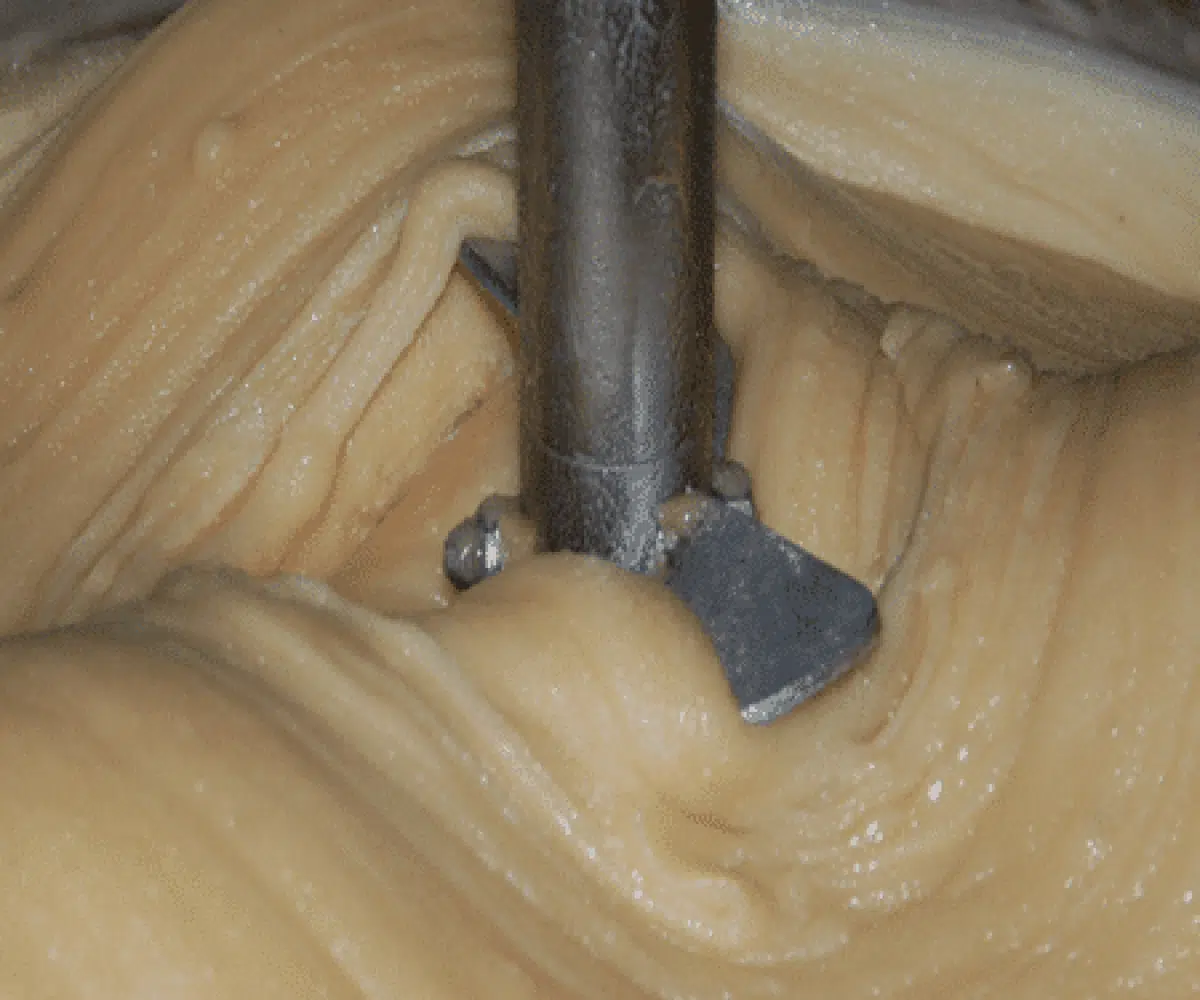
Creamed honey—also sold as soft-set honey or whipped honey—is honey whose crystallisation is controlled to produce a fine, smooth texture. The aim is a uniform spread that holds its consistency well. Pure creamed honey contains no cream or butter: the texture comes from fine crystals, not from adding dairy ingredients or deliberately whipping in air.
The seeding method at a glance
- Weigh out 90% liquid base honey and 10% fine seed honey, calculated as percentages of the final batch.
- Add the seed when the base is fluid enough to mix but cool enough to preserve its fine crystals.
- Mix slowly until evenly blended, avoiding unnecessary aeration, then fill the jars.
- Keep the jars at a steady temperature close to 14 °C and monitor the texture over the following days.
A practical starting point: with suitable seed honey and good temperature control, many batches develop the desired texture in roughly 7–14 days. That is an observation window, not a guaranteed deadline. Sugar composition, moisture, previous heating and crystal size all affect the result.
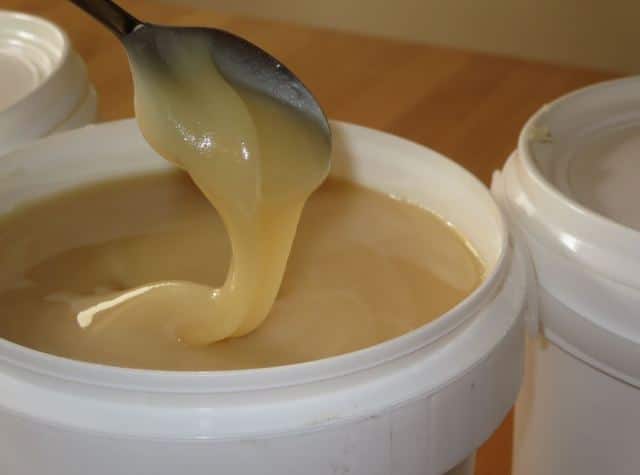
What is creamed honey, and why make it?
Honey naturally tends to crystallise. Instead of trying to prevent this, creaming guides the process towards numerous fine crystals rather than coarse ones. A fine crystal structure gives a smooth mouthfeel and can produce an even, spreadable consistency.
“Whipped honey” is a familiar sales name, but it can be misleading: the goal here is not to whip honey like cream or turn it into an aerated foam. Its paler appearance comes largely from light scattering by the crystals, not from a white ingredient being added.
For the customer
It drips less readily, is easy to portion and spreads well on bread and baked goods while remaining honey.
For the producer
It offers a way to make texture more consistent and manage crystallisation that might otherwise be uneven or coarse.
What creaming cannot fix
Creaming does not put right unripe, fermented, overheated or unhygienically handled honey. The quality of the starting material remains essential.
The science behind honey crystallisation
Honey is a concentrated sugar solution. Glucose is less soluble than fructose and can leave the liquid phase to form crystals. The rate of crystallisation and final texture depend on interacting factors: sugar composition, the glucose-to-water ratio, temperature, viscosity, existing crystal nuclei and the batch’s processing history.
- Floral composition: some honeys crystallise rapidly while others remain liquid longer. A single programme will not suit every honey.
- Temperature: conditions around 14 °C are widely used to encourage fine crystallisation. Fluctuating temperatures make results less repeatable.
- Crystal nuclei: fine seed honey supplies many starting points for crystal growth and helps guide the texture.
- Water content: moisture affects concentration and viscosity; it is not as simple as “more water means more crystallisation”. Excess moisture also increases fermentation risk.
Before designing your process, see our guides to why honey crystallises and honey moisture and fermentation.
How to make creamed honey: the seeding method
Seeding is a useful, controllable starting method for small and medium-sized honey businesses. Liquid honey is mixed with a measured amount of honey that already has very fine crystals. This “seed honey”, also called a starter, provides nuclei for the new batch to crystallise around.
1. Check the base honey
Use ripe, clean honey with no signs of fermentation. Measure and record its moisture with a calibrated honey refractometer: creaming does not replace incoming-batch checks, hygiene or traceability. If coarse crystals are already present, dissolve them with carefully controlled, even warming before seeding. Do not add water to make mixing easier.
Do not heat a batch unnecessarily or hold it warm longer than needed. The aim is to remove coarse crystals without avoidable heat damage. Record the actual honey temperature and treatment time so the process can be repeated or adjusted. This gentle preparation is not a validated pasteurisation treatment and should not be used to rescue fermented honey.
2. Choose genuinely fine seed honey
Choose excellent creamed honey from a known batch, with no perceptible grittiness. Coarse seed can reproduce the defect you are trying to avoid. Its flavour, colour and provenance must also suit the intended product: adding it blends two honeys, so include both in your batch records and any relevant origin or floral claim.
Technical methods use different seed proportions. For a first reproducible trial, 10% of the final batch weight is a useful, documented starting point, not a universal optimum. A 2025 study compared 5%, 10% and 15% additions under its own test conditions. Adjust your process through small trials with your actual honey rather than assuming that more seed always gives a better product.
| Final batch | Base honey (90%) | Fine seed honey (10%) |
|---|---|---|
| 5 kg | 4.5 kg | 0.5 kg |
| 10 kg | 9 kg | 1 kg |
| 25 kg | 22.5 kg | 2.5 kg |
| 100 kg | 90 kg | 10 kg |
3. Check temperatures and add the seed
Allow the base honey to cool while it is still mixable, so the added seed crystals do not dissolve. For the simple seeded method, FAO’s technical guide describes mixing at about 24–28 °C. Check the temperature of the honey itself, not just the room or heating jacket. If the seed is much colder, let it temper gradually without dissolving its fine crystals.
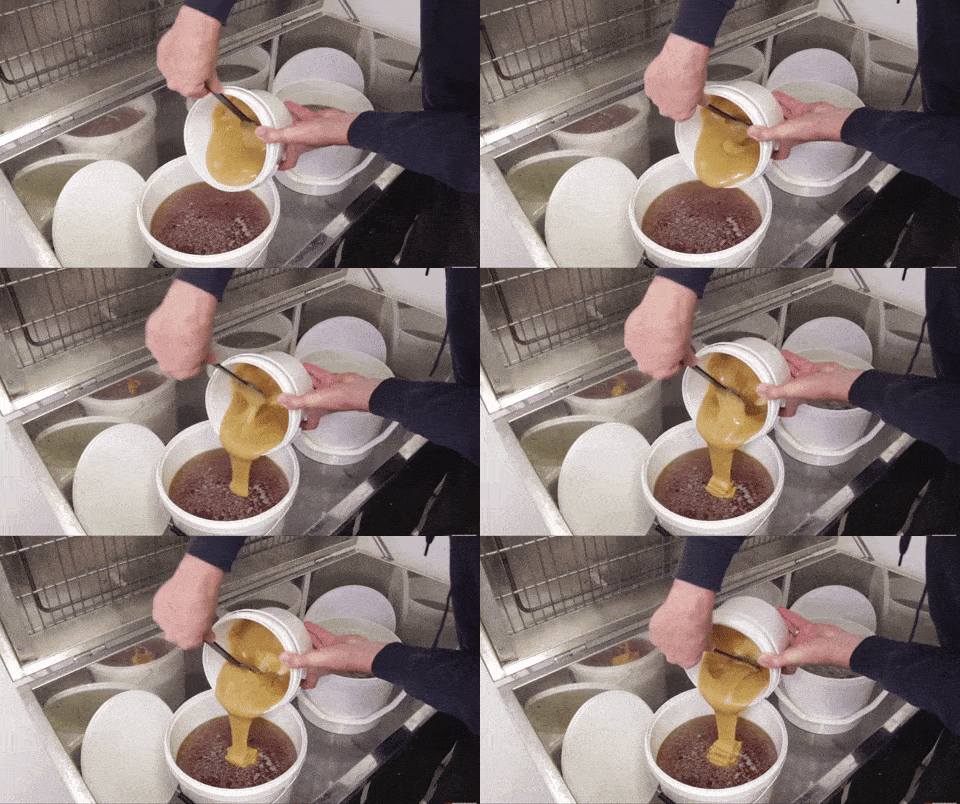
4. Mix slowly with minimal aeration
Mix slowly with the paddle or propeller submerged. Distribute the seed through the sides and bottom as well as the centre. Stop and isolate powered equipment before scraping or putting any utensil into the vessel, following its instructions. There is no universal “20-minute” mixing time: the endpoint is an even blend without streaks or unmixed pockets. Vessel shape, viscosity, batch size and mixer design determine how long that takes.
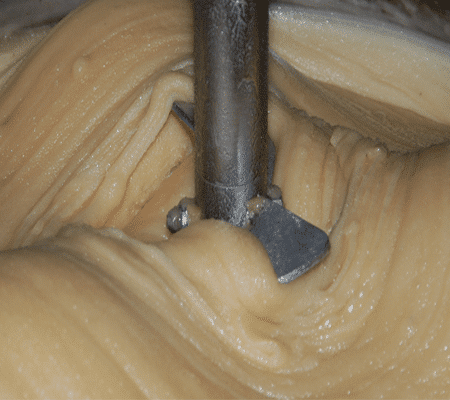
5. Fill the jars and allow the honey to set
Allow bubbles to rise if necessary, skim off surface foam and fill the jars before the blend becomes too thick. Hold them at a steady temperature close to 14 °C. Start checking a retained sample after several days and record when it reaches the intended consistency; allow roughly one to two weeks for planning, while recognising that individual batches differ.
Judge the batch by more than the calendar. Check for an imperceptible or very fine grain, an even texture and no liquid separation, excessive foam, fermentation or unusual smell. Keep several sample jars to observe stability over the intended selling period. Sensory checks support, but do not replace, your food-safety and quality controls.
Minimum trial record
Record the origins and batch numbers of both honeys, moisture, seed percentage, temperatures, equipment, mixing speed and duration, filling date, setting conditions and sensory assessment. Without those records, a successful batch can be difficult to reproduce.
The Dyce method and modern seeding
Elton J. Dyce’s work laid the foundations for modern creamed honey. His US patent application was filed in 1931 and the patent was granted in 1935. It described heating, cooling, introducing fine seed crystals and controlling crystallisation temperature. The simplified gentle-warming method above is not a reproduction of every step of that historical process. The shared principle is well-distributed fine nuclei and controlled temperature; historical heating instructions are not a substitute for a validated present-day food-processing protocol.
Stirring and other production methods
In honey processing, “whipping” sometimes means periodically stirring the honey as it crystallises. Slow agitation distributes crystals and can break up crystal aggregates; excessive aeration produces foam and an uneven presentation. Unseeded stirring is also possible, but its behaviour depends on the nuclei and composition of the honey. Research on glucose-rich spring blossom honey found temperature particularly important, with seeding having little effect under some 14 °C test conditions. That result should not be treated as a rule for every floral type.
Seeding
A practical starting point for repeatable trials. It requires fine seed honey, accurate weighing and thorough distribution.
Timed stirring
Useful with a honey creamer and temperature control. Set cycles to suit viscosity and avoid drawing in air or warming the batch through excessive agitation.
Mechanical refining or Helimel
A suitable refining machine can work already-crystallised honey to improve smoothness. It does not remove the need to check temperature, starting crystal structure and storage stability.
Common problems and what to check
| Problem | Possible causes | What to review for the next batch |
|---|---|---|
| Grainy texture | Coarse seed, too few nuclei or unstable temperature. | Seed quality and proportion; even mixing; temperature record. |
| Honey stays runny | Dissolved seed, insufficient seeding, slow-crystallising honey or conditions that are too warm. | Temperature at seeding; weighing; honey composition; setting conditions. |
| Too firm to spread | Batch composition, extensive crystallisation or very cold storage. | Small trials with a different base or blend; storage and serving temperature. |
| Foam or bubbles | High speed, a vortex or a mixing tool partly above the honey. | Vessel and tool design, immersion, speed and settling before filling. |
| Liquid layer forms | Prolonged warmth, incomplete crystallisation or an unstable batch. | Setting conditions, temperature stability and shelf-life trials. |
| Fermentation | Excess moisture and yeasts, potentially compounded by poor hygiene or unsuitable storage. | Starting honey, refractometer calibration, cleaning and the food-safety control plan. |
If a trial fails, do not try to fix it blindly with more mixing or heat. Use small test batches, change one variable at a time and compare with a control. Quarantine any suspect fermented or otherwise non-conforming batch for proper assessment; do not simply reblend it into saleable honey.
Honey creaming equipment for different batch sizes
For small trials, use clean, dry food-contact equipment, a suitable vessel, scales, temperature control and a mixer capable of working slowly. As output increases, pay attention to unmixed pockets, cleanability, repeatable cycles and discharge without excessive aeration. Check the manufacturer’s minimum working fill as well as maximum capacity.
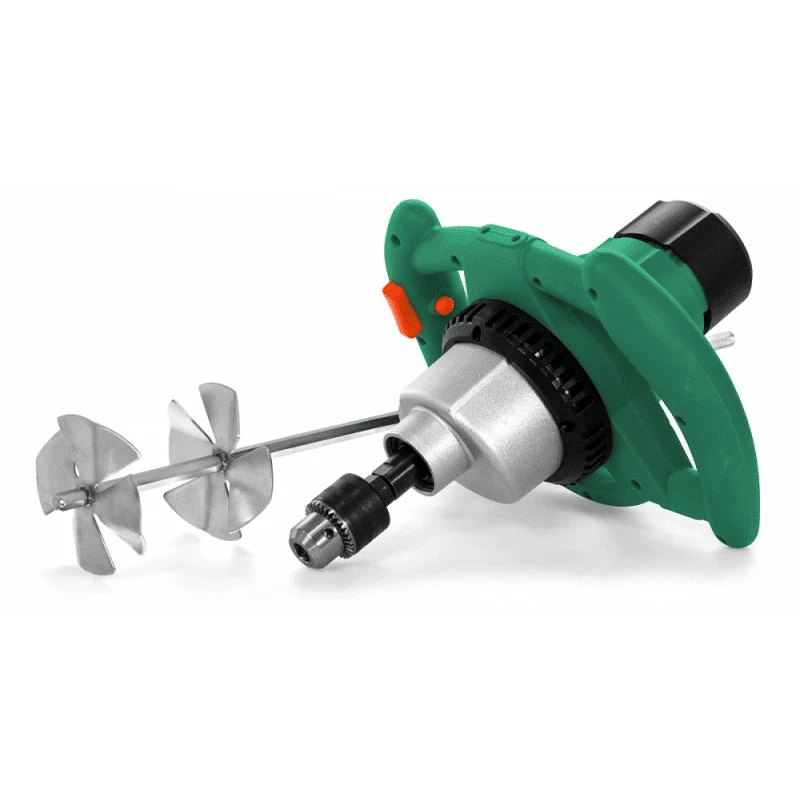
- Small trials: a propeller honey mixer can be a simple way to test the process with suitable speed control.
- Already-crystallised honey: a Helimel-type refining machine mechanically works the honey towards a more uniform texture.
- Repeated batches: a 100 kg honey creamer provides timed stirring without a heated jacket; room temperature still needs separate control.
- Larger output: a 300 kg homogeniser-creamer combines a larger vessel, mixing and controlled discharge.
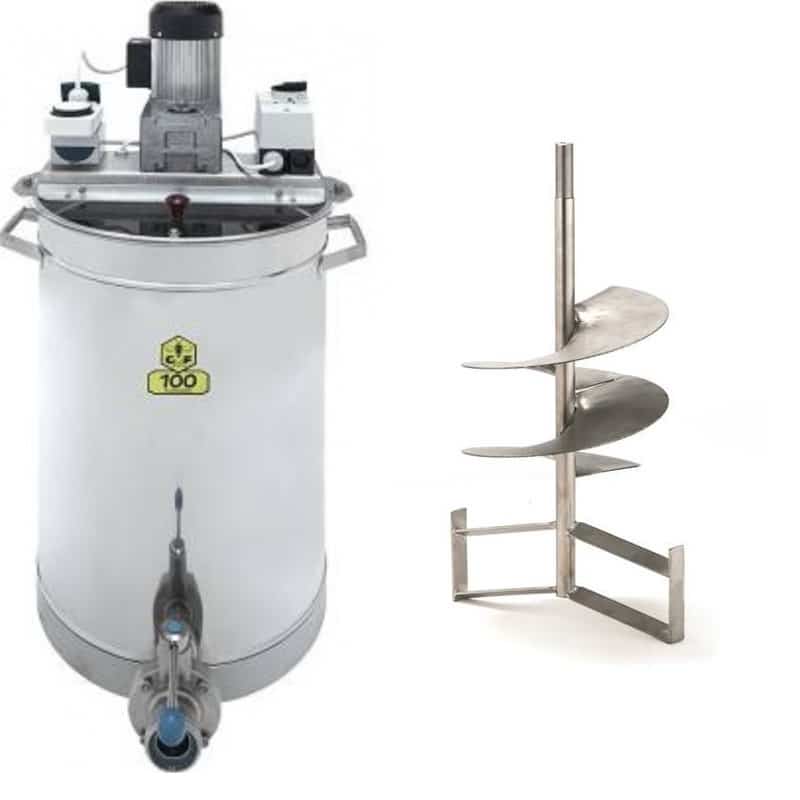
Compare capacities and designs in our honey mixers range. Choose equipment for your process, cleaning requirements and usable batch size—not nominal capacity alone. A mixer without heating does not automatically provide refrigeration or hold the honey at 14 °C.
 ▶ Watch video
Storage, stability and labelling
Creamed honey needs stable conditions while setting, and its performance must also be tested under realistic distribution conditions. Prolonged warmth can soften its structure and encourage a liquid layer to form. FAO describes separation after extended storage above about 20 °C, becoming more rapid near or above 25 °C in susceptible honeys. These are practical warning ranges, not a sharp universal failure temperature.
There is no single shelf life that applies to all creamed honey. Validate the batch with retained samples, realistic temperature changes and appropriate quality checks. Keep jars tightly closed in a dry place, away from direct heat and sunlight. Very cold storage does not necessarily damage the honey, but may make it difficult to spread.
Selling it as honey: check the destination market
Spain’s honey quality standard allows honey to be partly or fully crystallised, but honey sold as such must not contain added food ingredients, additives or other substances. Seed honey is still honey and belongs in the blend’s traceability and origin assessment. Adding cocoa, nuts, flavourings or other ingredients creates a different type of food product requiring the appropriate name and labelling. This is a Spanish regulatory example, not a complete rulebook for every English-speaking market. Check current requirements wherever you sell; Spain’s revised origin-labelling provisions took effect on 14 June 2026, with transitional arrangements for qualifying older stock.
Frequently asked questions about creamed honey
Are whipped honey, soft-set honey and creamed honey the same?
Commercially, these names often describe honey with a fine crystal structure and a spreadable texture. “Whipped” should not be taken as an instruction to make a foam: the method described here aims for an even blend with minimal aeration.
Does creamed honey contain cream, milk or butter?
No. Pure creamed honey is just honey. Its texture comes from small crystals, and their interaction with light helps give it a paler appearance.
Can any honey be made into creamed honey?
Different honeys can be tried, but setting rate, firmness and stability vary greatly with composition. Test a small batch of the actual honey you intend to sell and keep reference samples before scaling up.
How long does creamed honey take to set?
With suitable seed honey and stable conditions close to 14 °C, roughly 7–14 days is a useful initial observation period. It is not a fixed completion time: assess texture and stability rather than relying on the date alone.
Why is my creamed honey grainy?
Possible causes include coarse seed crystals, uneven mixing, unsuitable temperatures or coarse crystals remaining in the base honey. Check the starting materials and temperature record before changing the recipe.
What can creamed honey be used for?
Use it wherever you would use honey, especially when a less runny texture is helpful: toast, sandwiches, yoghurt, cheese or fillings. Warming it makes it more fluid and may undo part of its fine-set structure.
Conclusion: control the process, not just the recipe
A blend of 90% liquid honey and 10% fine seed is a useful starting recipe, but quality depends on the whole process: good honey, fine crystals, thorough mixing with minimal air, steady temperature and batch validation. Start small, record the variables and scale up only when you can repeat the result.
Technical references and regulatory background
- Elton J. Dyce, Honey process and product, US1987893A. Application filed in 1931; US patent granted in 1935. Historical background, not a current food-safety standard.
- FAO, Value-added products from beekeeping, section 2.12.2: Creamed honey. Technical background on seeded crystallisation and storage.
- Meixner and colleagues, study of stirring conditions and spring blossom honey creaminess, Foods 12(1), 48 (2023; published online in December 2022).
- Ozmen and colleagues, study of seed concentration, storage time and honey crystallisation, Food Chemistry: X 28, 102634 (2025).
- Spain: consolidated honey quality standard and 2025 amendment, effective from 14 June 2026.
These processing parameters are starting references, not guaranteed outcomes. Each producer must validate the process, storage conditions and labelling for the finished product and its intended market.

ISNI 0000 0005 1801 1100 | Joshua Ivars is the manager of LA TIENDA DEL APICULTOR and the author of this blog, where he shares technical and practical guidance for beekeepers. Drawing on extensive experience in the beekeeping sector, he offers advice and solutions based on beekeepers’ real needs, sharing his knowledge of equipment and essential beekeeping practices.


