
Primary production
A batch code is useful only if it leads back to reliable records. For a beekeeper, it should connect the honey in a drum or jar with its harvest and handling history. This guide explains a practical approach to honey batch coding in Spain, within the EU food-law framework; it is not a complete retail-labelling checklist or a statement of the rules in every English-speaking country.
Beekeeping businesses have food-safety responsibilities whether they sell in bulk, supply retailers or sell directly to consumers. Under the EU General Food Law traceability requirements, operators must be able to identify their suppliers and the businesses they supply. This does not mean recording the identity of every individual retail customer. Batch coding supports that traceability, but cannot replace the records behind it.
For hygiene purposes, European Commission guidance on Regulation (EC) No 852/2004 includes beekeeping, honey harvesting, extraction and packing at the beekeeper’s premises within primary production. Storage and handling at the place of production can also fall within the associated operations where the product’s nature is not substantially altered. Extraction or packing elsewhere, including at a cooperative acting for beekeepers, is not covered by that same classification. Do not assume that every honey-packing business is a primary producer; confirm the requirements for your actual activity with the competent authority.
Keep records that make the system usable in practice: apiary and harvest references, extraction dates, quantities, container identifiers, movements, relevant colony-treatment records and analytical results. Check that labels match the register, that quantities can be reconciled and that records can be retrieved promptly. The code format alone does not establish that a batch is safe or of a particular botanical origin.
Quality must be traceable
Whether you use a 300 kg drum, a 100 kg tank or a 200 g jar, you need a dependable way to identify its contents. Internal identification and the legally required information on a marketed package are related, but they are not the same thing. A simple drum code is not a complete retail label.
In Spain, Royal Decree 1808/1991 generally requires marketed food to carry a lot identifier. It contains specific exceptions, including certain deliveries of primary products leaving the holding and some forms of direct retail sale; these are not a blanket exemption for honey. A date showing at least the day and month, in that order, can satisfy the decree’s provision for omitting a separate lot mark. Check which case actually applies. Regardless of an exception, identify drums at source, preferably on the body rather than only on a removable lid.
A lot groups units produced, manufactured or packed under substantially the same conditions. The responsible operator defines it. Depending on your extraction facilities and handling, a lot might correspond to one extraction or to a properly documented combined batch. Sharing the same honey variety is not, by itself, enough to show that all the honey belongs to one lot.
For an operation that does not blend or homogenise different harvests, a practical starting point is a separate batch for each apiary’s extraction. Give it a unique identifier and keep that reference throughout storage and packing. Where honey from the same extraction is divided among containers, record the link between each container and the common batch.
Which numbering system should you use? Choose one that staff can apply consistently. Options include the year followed by the extraction month and day, honey variety, apiary number or location. Management software can also generate unique codes. Document every abbreviation and date convention, and avoid reusing a code for unrelated honey. Prefix the lot with L unless it is clearly distinguishable from other label information, as the Spanish decree provides.
For example, the original Spanish system uses AZ for azahar, meaning orange blossom honey:
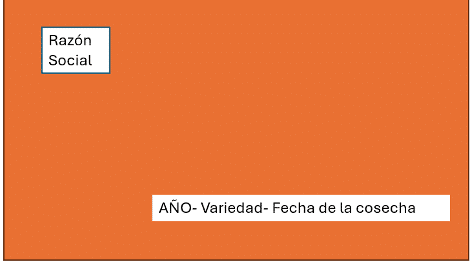
BATCH: 24 AZ 0501 — year, variety and extraction date in month–day order. In this illustrative convention, 24 means 2024 and 0501 means 1 May, not 5 January. The code does not prove the honey’s floral origin; that claim needs its own supporting evidence.
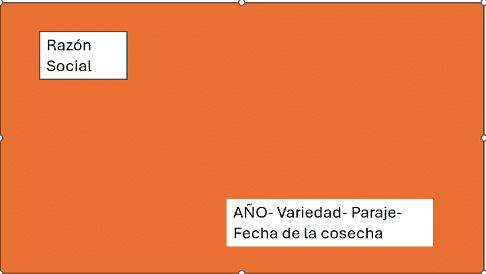
Another possibility is 24 AZ Apiary X, corresponding to 24 AZ Colmenar X in the Spanish example. If that apiary produces more than one separate orange-blossom batch in the year, add an extraction reference so the code remains unique.
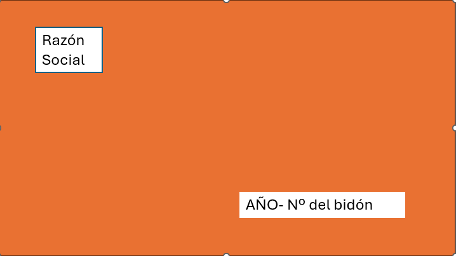
Number the individual drums and link them to a batch sheet or digital record. Following the example above, container references could be 24 AZ 0501/1, 24 AZ 0501/2 and so on. Here, /1 and /2 identify drums within the batch; they do not necessarily mean different production lots. Record each drum’s contents and quantity, and retain the link when honey is transferred to a tank or packed into jars.
The three original Spanish diagrams illustrate possible identification layouts. Their English equivalents appear in the captions below. They are examples of an internal identification system, not complete, ready-to-use statutory labels.
Keeping apiary and extraction batches separate has several practical advantages:
- Even nearby apiaries harvested close together can produce honey with different botanical characteristics. Appropriate analysis and sensory assessment can help establish those differences, which may affect how the batch is described, marketed or valued.
- Colonies may have different veterinary-treatment histories, so the relevant records and risk assessment may differ too. Keep questionable honey separate while it is assessed. Never use blending to dilute residues or make unsafe honey saleable.
- Where appropriate, several compliant batches can be combined and homogenised into a larger sale batch. Keep the identifiers and quantities of every contributing batch linked to the new one. Grouping may suit a buyer’s required volume or an appropriate sampling plan, but merely changing a code does not homogenise honey or automatically justify fewer tests.
Traceability is a food-business obligation; documenting the apiary, harvest and handling history also helps substantiate a product’s identity. That information can support differentiation from competitors, but a code alone is not proof of origin, purity or quality.
Distinctive honeys: an opportunity for some businesses
Spanish beekeeping produces a wide range of honeys, including distinctive batches that can broaden a product range or attract buyers looking for particular origins and sensory characteristics. A higher selling price is possible, not guaranteed.
Whether it pays to investigate and preserve those differences depends on the business: bulk or direct sales, separate batches or a combined harvest, analysis costs and customer demand. Decide what information is commercially useful while maintaining the traceability and safety controls required for every batch.
When batches are clearly identified and their characteristics are documented, you can make better-informed decisions about storage, testing and sale. The aim is a simple system that reliably answers: what honey is this, where did it come from, what happened to it and where did it go?

ISNI 0000 0005 1801 1100 | Joshua Ivars is the manager of LA TIENDA DEL APICULTOR and the author of this blog, where he shares technical and practical guidance for beekeepers. Drawing on extensive experience in the beekeeping sector, he offers advice and solutions based on beekeepers’ real needs, sharing his knowledge of equipment and essential beekeeping practices.


