
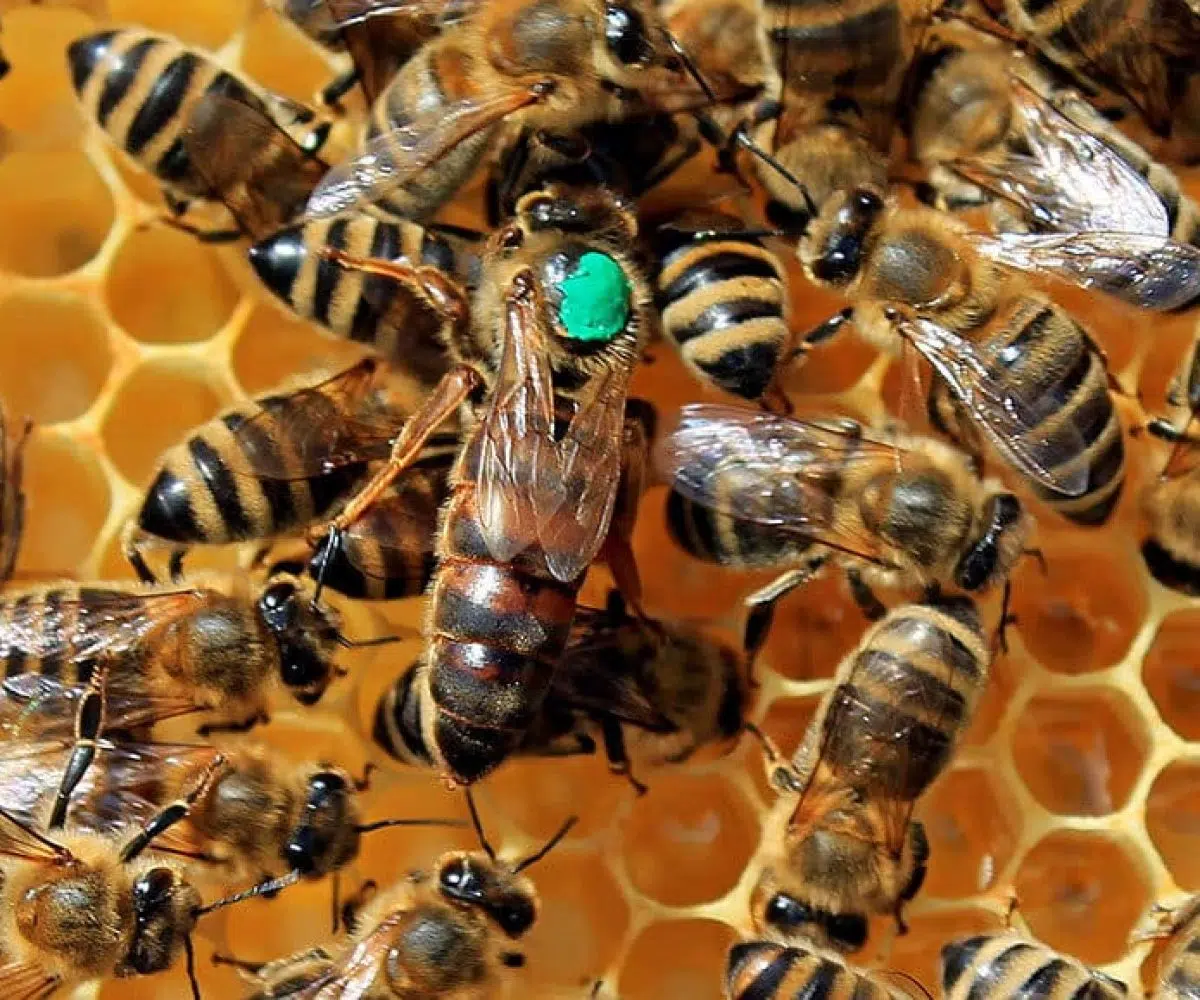
Reproduction and development
Sex determination
Honey bees have a haplodiploid system of reproduction: ordinary drones develop from unfertilised eggs and have one chromosome set, while females normally develop from fertilised eggs and have two. This is a useful starting point, but chromosome number alone is not the whole mechanism. Research on the complementary sex determiner gene, csd, explains why fertilised eggs can occasionally produce diploid males when they carry two matching versions at that locus.
Workers and queens are both female. They inherit genetic material from the mother queen and a father drone. Because a queen mates with several drones, workers in the same colony can also have different fathers.
Queen and worker are two different female developmental forms, with distinct anatomy and behaviour. They share the capacity for these alternative developmental pathways, but the individual bees are not genetically identical copies of one another. Early larval nutrition strongly influences which form develops.
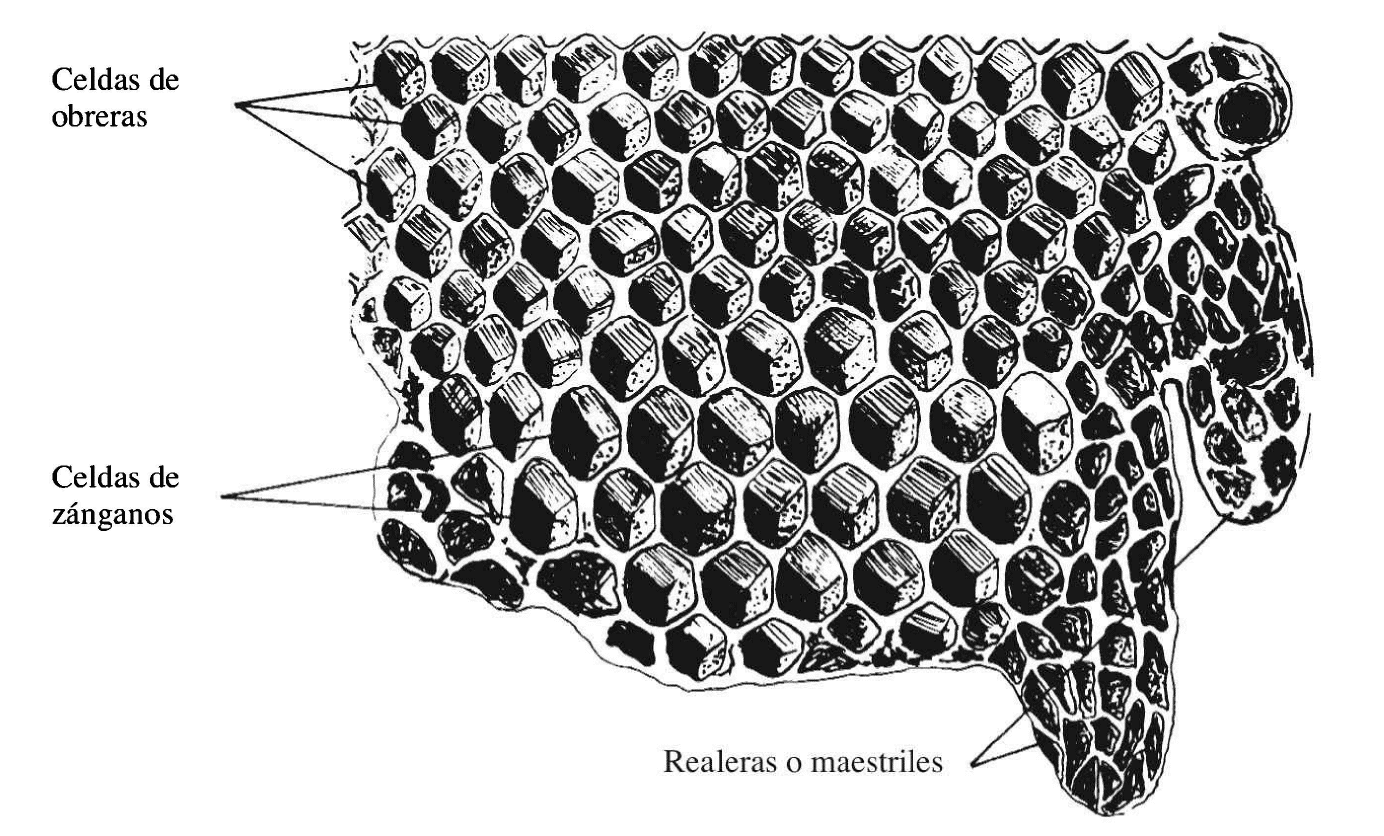
An ordinary drone develops without fertilisation and inherits his chromosome set from his mother. A mated queen stores sperm in her spermatheca and regulates its release as eggs are laid, normally producing fertilised eggs in worker cells and unfertilised eggs in the larger drone cells. Experiments comparing eggs in the two cell types confirmed precise control of fertilisation. It is not adequately explained as the queen’s abdomen simply being squeezed by a narrow cell.
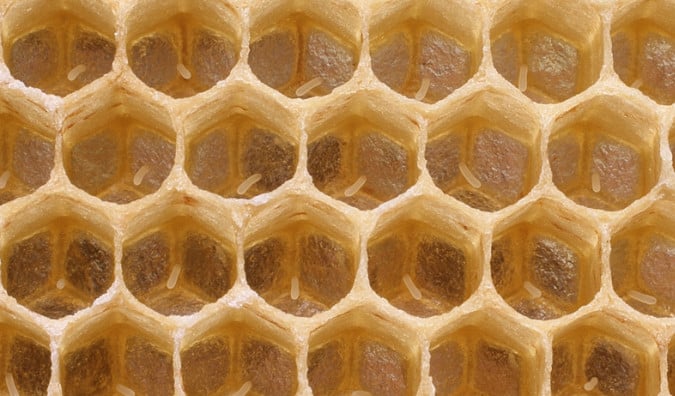
The role of nutrition
A very young female larva can be reared as a queen under appropriate conditions. Nurse bees supply queen-destined larvae with abundant royal jelly throughout larval development. The amount and composition of food, and the age at which queen rearing begins, affect development. An adult worker cannot turn into a queen by being fed royal jelly.
Worker-destined larvae also receive glandular brood food; they are not fed only pollen and honey from the moment they hatch. Their later feeding differs from that of queen larvae. Nutrition interacts with gene regulation, hormones and developmental pathways, rather than acting as a simple all-or-nothing ingredient. Research on nutrition-mediated caste development demonstrates the contribution of genetic regulation as well as food supply.
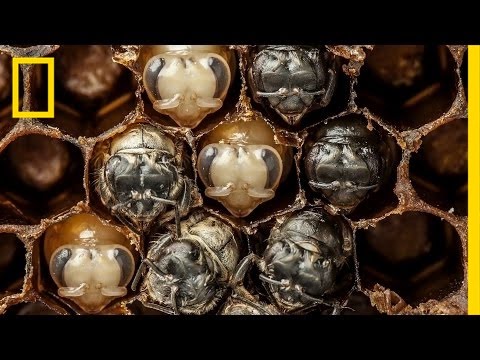
The three types of honey bee: queen, worker and drone
The queen
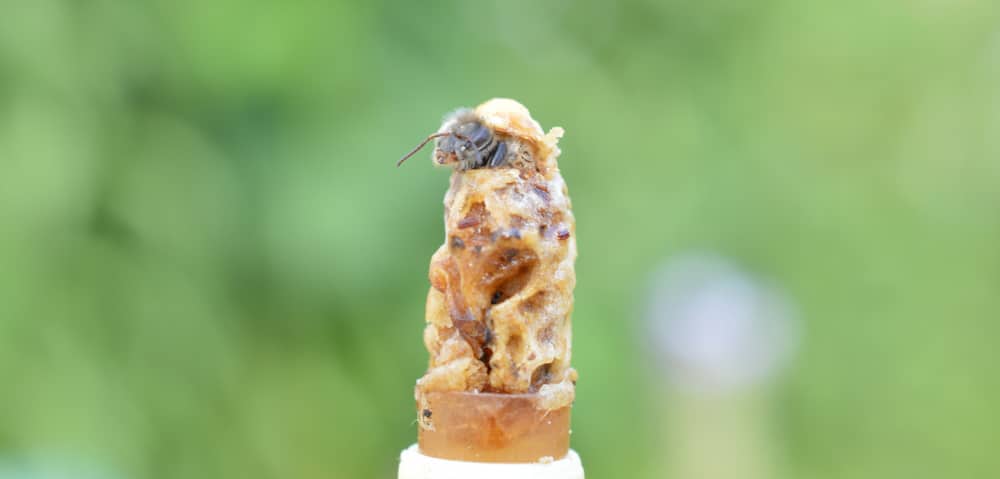
Queen’s function
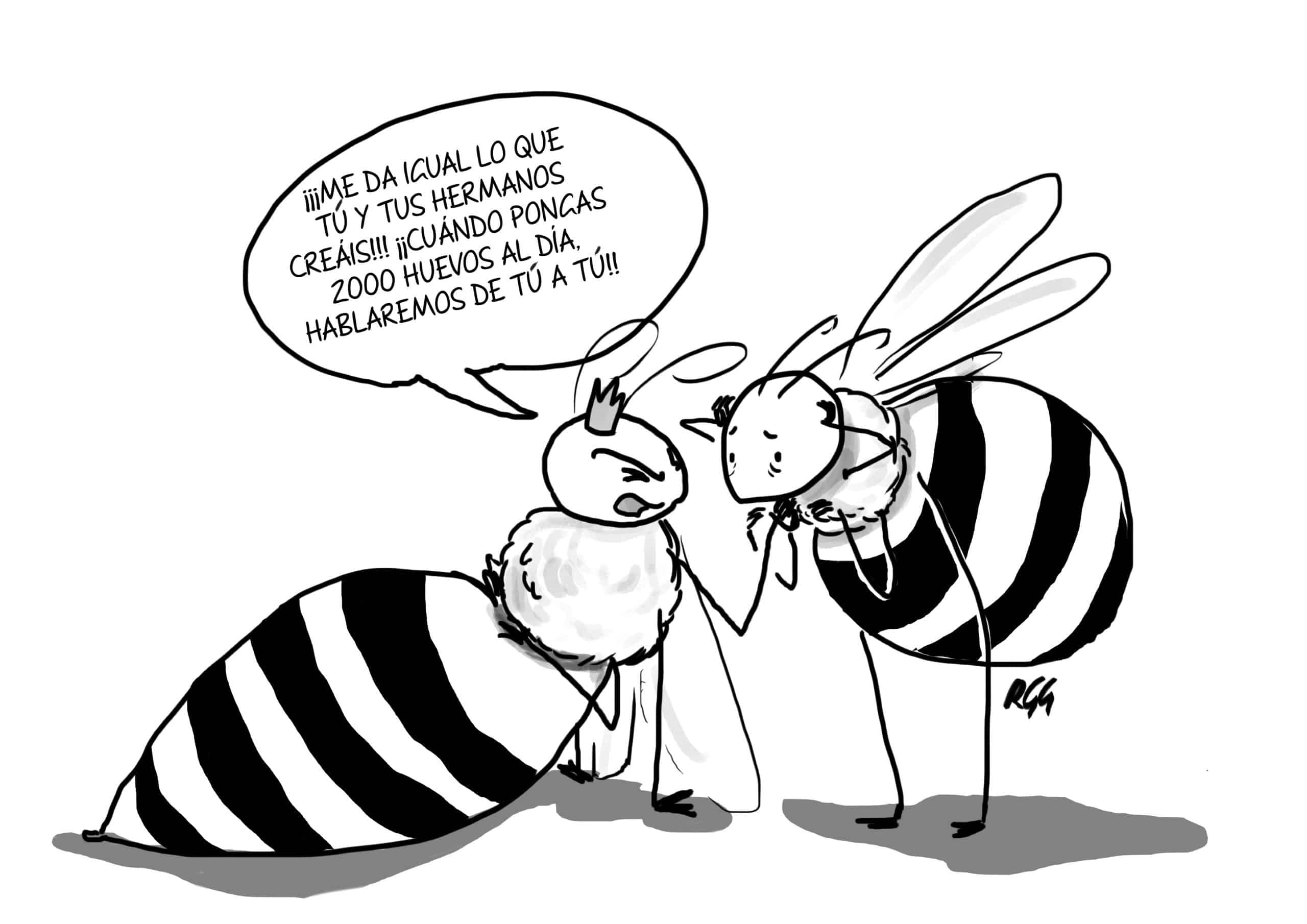
The queen is the colony’s principal egg layer. Her pheromones contribute to reproductive and social regulation, but she does not direct each worker’s task like a human manager.
A queen emerges as a virgin. She must mate to lay fertilised eggs that produce workers; an unmated queen may still lay unfertilised, drone-producing eggs. Her mating period normally occurs early in adult life, often beginning around a week after emergence, with timing affected by weather and other conditions.
Mating occurs in flight, often in drone congregation areas. A queen can mate with several drones on one flight and make further flights on the same or subsequent days. Warm, suitable flying weather matters: mating is one early-life period, not necessarily one flight or one mating.
After mating, the queen stores sperm for later egg fertilisation and normally remains in the colony, apart from events such as swarming. Workers attend and clean her, but it is too simplistic to say they force her out until a fixed quota is reached. Age and weather affect mating opportunities; there is no universal 20-day cut-off at which every queen suddenly loses all attraction to drones. See the RFID study of queen mating flights.
Queens mate with multiple drones, and the number varies. The original Spanish article gives 15–20 as an estimate for the authors’ area; this is a local observation, not a guaranteed count for every queen or breeding population.
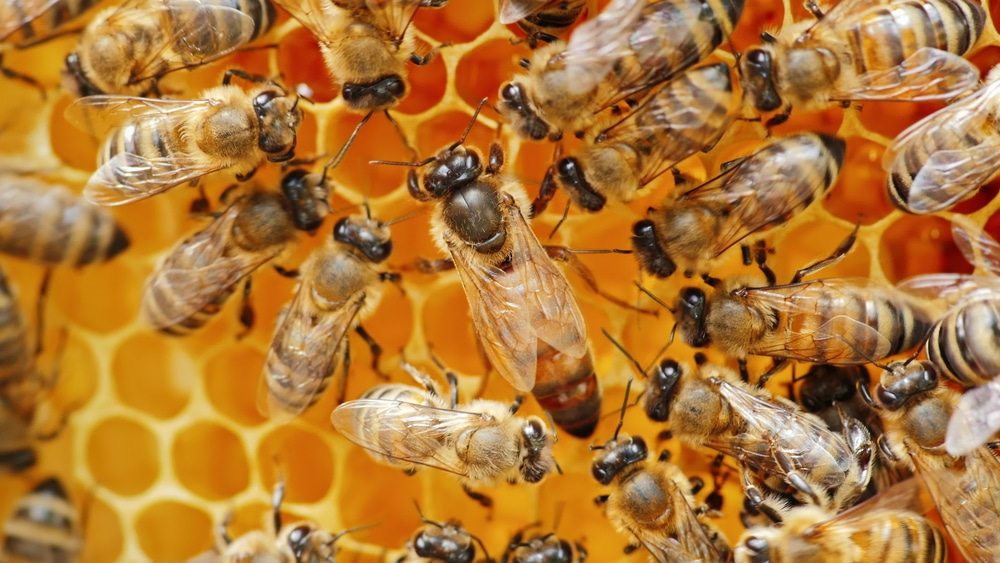
Queen morphology
A laying queen usually has a noticeably elongated abdomen, extending beyond her wing tips, and a larger body than a worker. She lacks the workers’ pollen baskets and is not equipped for routine nectar and pollen collection. A virgin queen can be much slimmer and less conspicuous than a well-established laying queen.
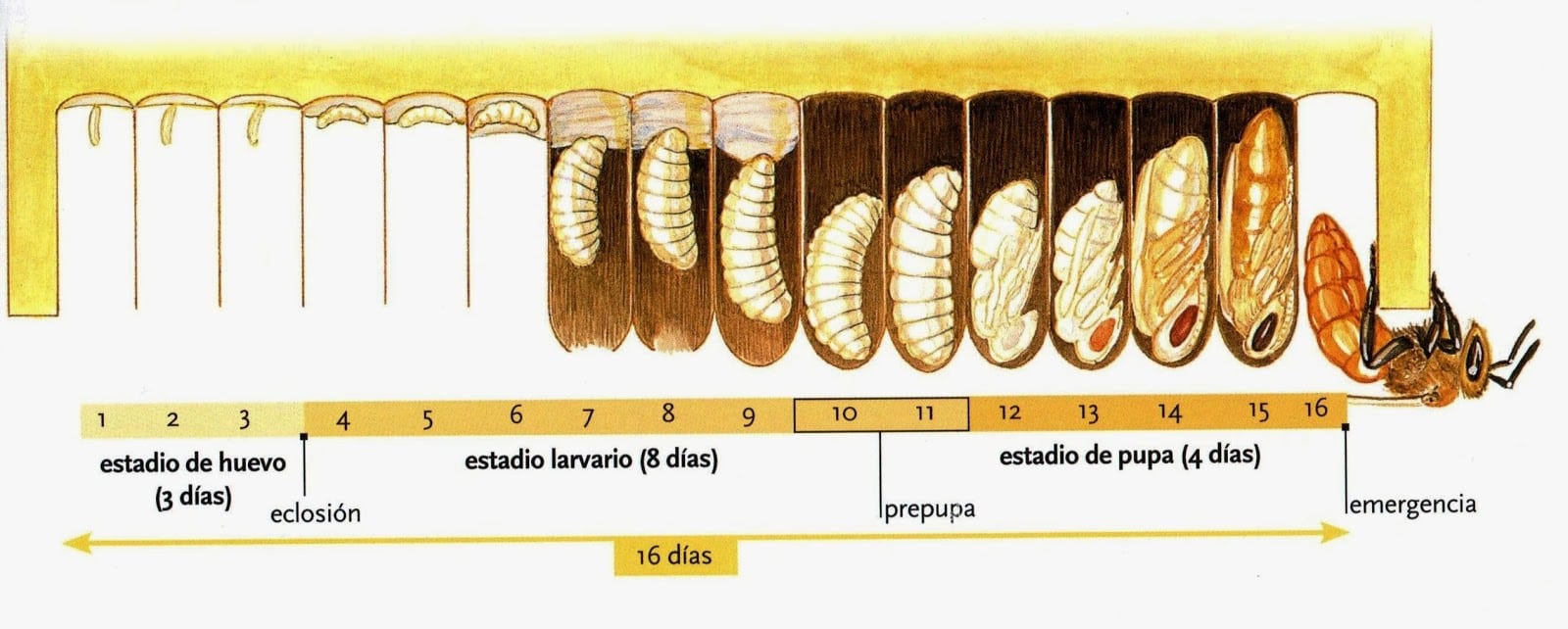
Development: about 16 days from egg to queen
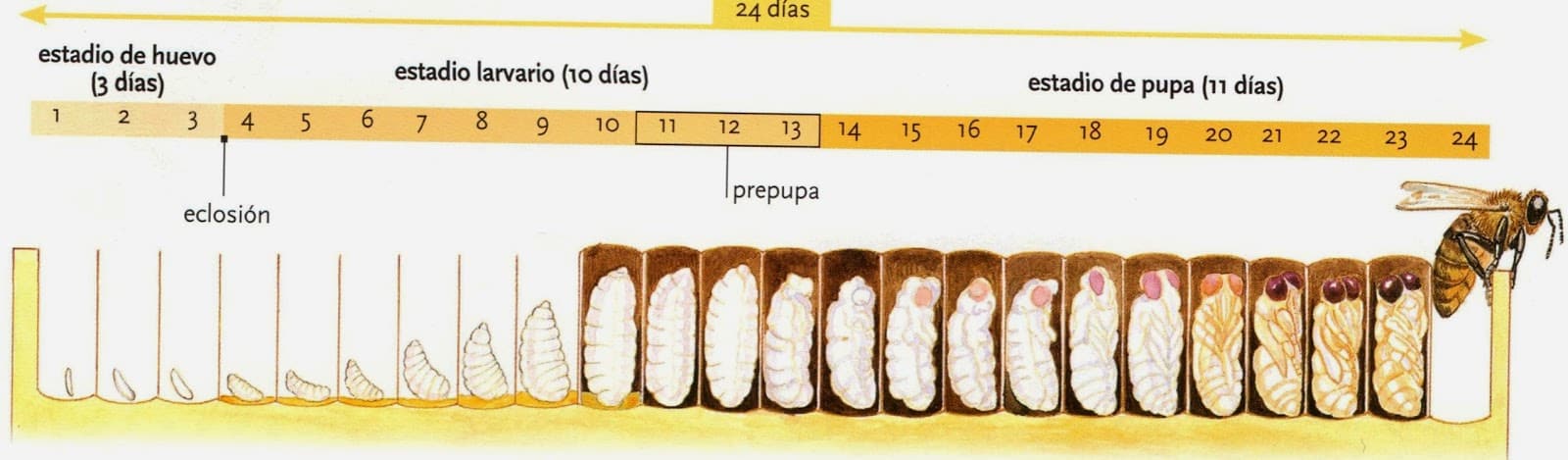
Queen-destined larvae grow rapidly on abundant royal jelly. Development from egg to adult emergence normally takes about 16 days, shorter than the worker or drone schedule. This includes the egg, larval and pupal stages; it is not 16 days spent feeding as a larva.
The large, downward-projecting queen cells differ from the horizontal worker and drone cells. Their position and context help interpretation, but shape alone does not reliably establish why they were built. See our guide to emergency, supersedure and swarm cells.
Larval feeding, hormonal signalling and changes in gene activity interact during caste development. This should not be reduced to the claim that hormones contained in royal jelly alone explain the queen’s shorter development. The familiar 16-, 21- and 24-day schedules are practical approximations; temperature, nutrition and other conditions introduce variation.
The worker
Worker morphology
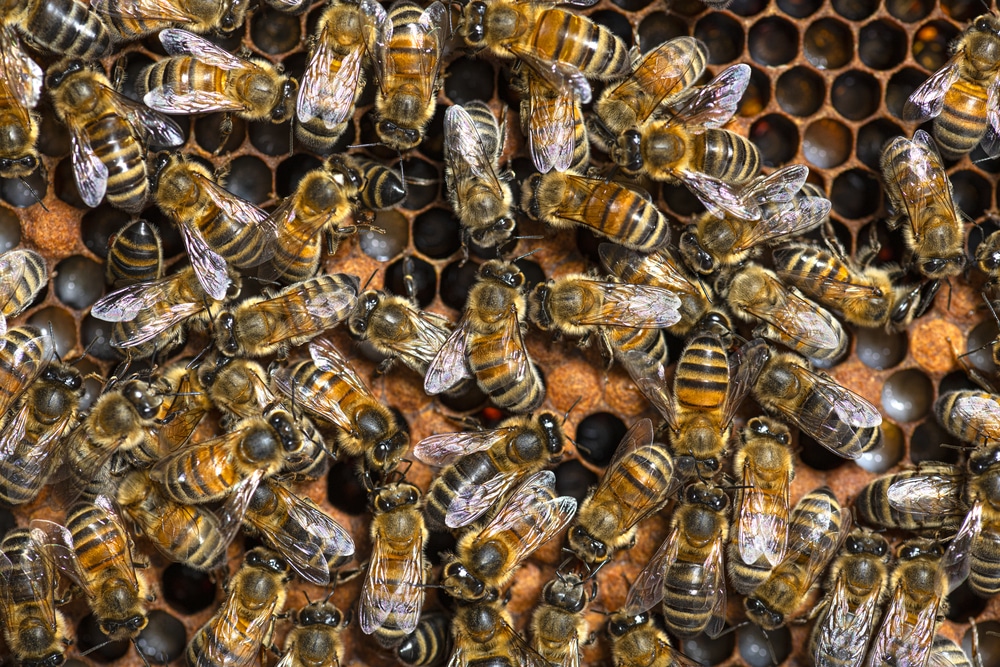
A worker is a female with much smaller ovaries than a queen and does not normally mate. Her mouthparts are adapted for collecting and handling liquid food, while her hind legs carry the pollen baskets used to transport pollen and plant resins for propolis. Workers are physiologically and behaviourally flexible, with specialised glands and structures:
- Hypopharyngeal glands: important contributors to the glandular food produced by nurse bees for larvae and other colony members. Their activity changes with the worker’s role.
- Wax glands: produce the wax scales workers use to build and repair comb. The mandibles manipulate this wax into cells.
- Labial (salivary) and mandibular glands: distinct head-gland systems involved in secretions used in food handling and other functions. They should not be treated as a single alarm gland. Important alarm signals also come from glands associated with the sting apparatus.
- Nasonov gland: releases an orientation and aggregation scent. Workers expose the gland near the tip of the abdomen and fan to spread the scent, for example at a nest entrance or a settling swarm.
- Venom apparatus: produces and stores venom for defence. Workers defending the colony are not a separate anatomical “soldier” caste.
Worker functions
Workers tend to move from jobs within the nest to foraging as they mature, a pattern called age-related division of labour. However, the timetable is flexible: nursing, comb work, food processing and defence overlap, and colony needs can alter the age at which foraging starts. It is misleading to assign every bee fixed blocks of days 1–15, 15–30 and 30–45. Experiments with same-age workers show that young bees can perform different roles, including early foraging.
- Cleaners: newly emerged workers commonly begin by cleaning cells for fresh eggs. Other workers remove waste and dead bees, helping maintain nest hygiene. These activities do not all occur at one fixed age.
- Nurse bees: usually relatively young adults, often in the first two weeks of adult life, tending the brood and producing larval food. Feeding is adjusted to the larvae’s age and developmental needs.
- Comb builders and wax producers: build and repair comb, and cap brood or ripened honey when appropriate. Activity depends on colony conditions, available food and the need for new comb, not simply a worker reaching her fifteenth day.
- Nectar receivers and food processors: accept nectar from returning foragers and handle it inside the hive, allowing the foragers to leave again. Pollen is handled differently: pollen foragers unload pellets into cells, where workers pack and store them. Nectar transfer is not the route by which intact pollen loads are passed around.
- Fanning workers: move air to help regulate the nest environment and remove moisture during honey ripening. Fanning can also disperse Nasonov scent during orientation or aggregation; the meaning depends on the bee’s posture and context.
- Guards: check arrivals at the entrance and help defend stores against robbing. Alarm signals can recruit other workers to a threat, but recognition is not infallible and not every incoming foreign bee is rejected.
- Foragers: collect nectar, pollen, water and plant resins. They are commonly older workers, often starting around the third week, but can begin earlier or later. Trip frequency varies with distance, weather and the resource being collected; neither ten nor one hundred trips is a dependable daily rule. Long-lived winter workers may forage during suitable weather, so their greater lifespan is not simply proof that they never fly.
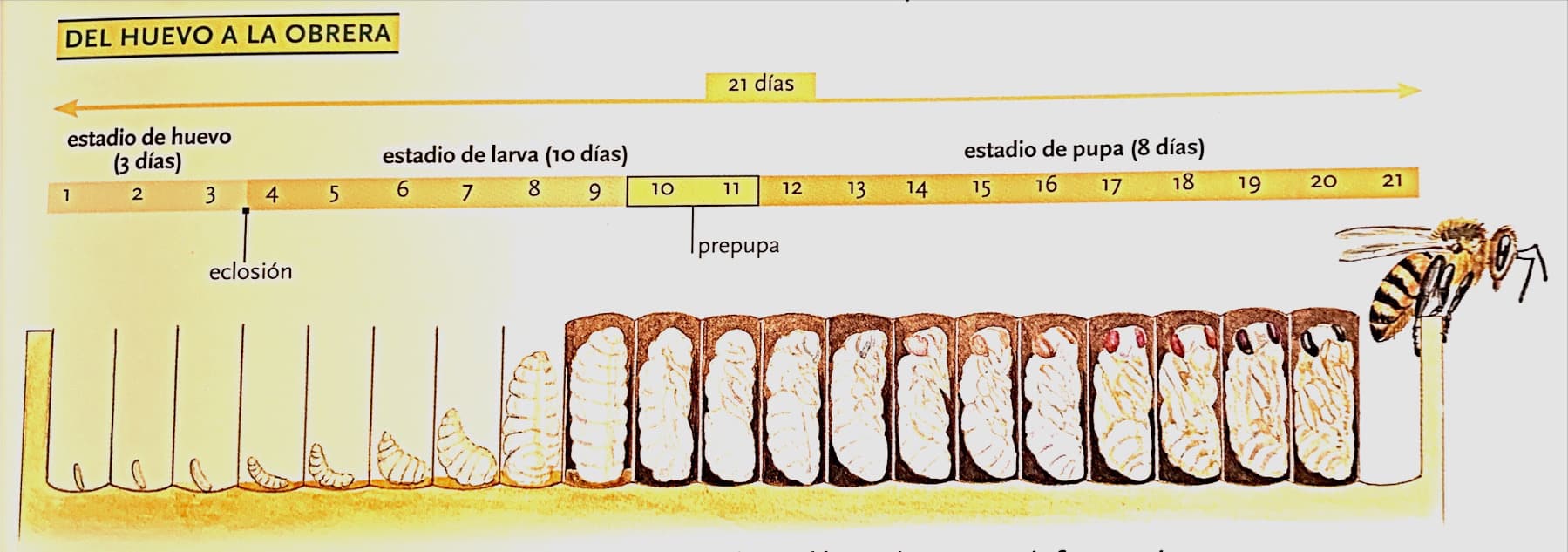
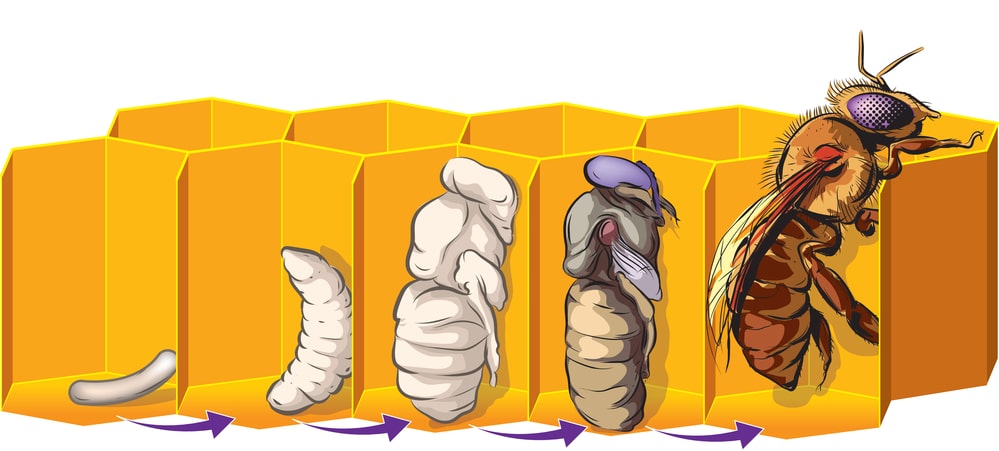
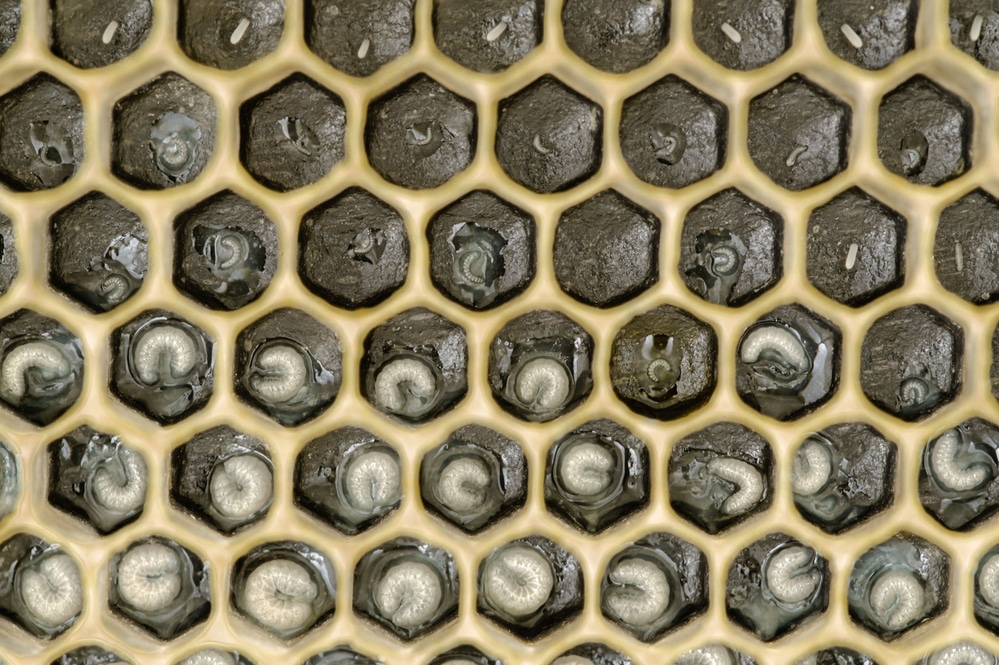
Development: about 21 days from egg to worker
The drone
Morphology of the drone
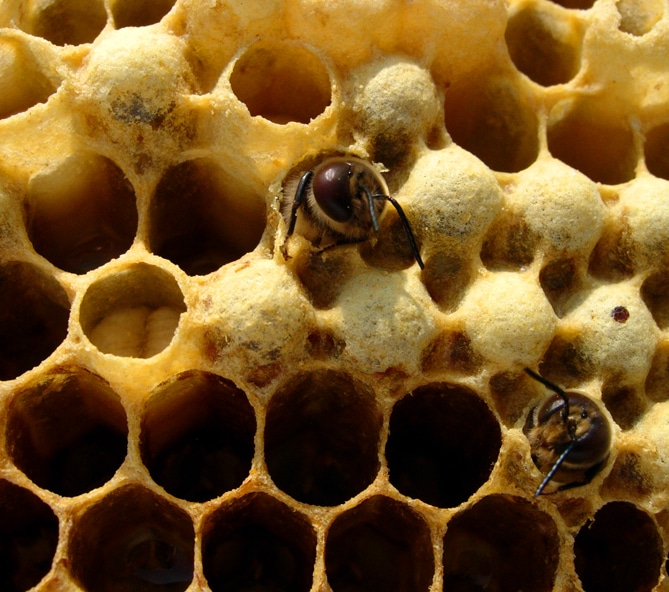
Drones are male bees with a broad body, very large compound eyes and longer antennae than workers. They have no sting. Sexual maturity is usually reached around two weeks after emergence, with individual variation. Their adult lifespan depends on season and colony conditions, rather than ending automatically three weeks later.
Function of the drone
The drone’s principal reproductive role is to mate with a virgin queen. Mature drones fly to congregation areas where mating encounters can occur. They do not collect pollen or nectar for the colony.
A drone that successfully mates is fatally injured as his reproductive apparatus everts; part can remain as a mating sign in the queen. Not every drone succeeds in mating, and many die without doing so.
Development: about 24 days from egg to drone
Drone development from egg to adult normally takes about 24 days. Nurse bees provision the growing larvae with brood food. The original description of a switch to nothing but “bee bread” is an oversimplification: larval diets include nurse-gland secretions, and vary with age. Bee bread is stored pollen and is especially important in the nutrition of the adult nurses that produce brood food.
Drone rearing follows local resources and the reproductive season, commonly increasing in spring and continuing while conditions allow. An autumn flush can occur in some climates. Colonies may reduce or expel drones during a dearth or before winter; their presence is not restricted to a universal spring-and-autumn calendar.
Understanding the social behaviour of the hive
Honey bees are social insects. The queen, workers, drones and brood depend on one another, so the colony can usefully be viewed as a superorganism. This describes their interdependence, rather than claiming that a hive box is literally an individual animal.
Monarchy or republic?
The word “queen” can suggest a human hierarchy, while older writers sometimes imagined a male ruler or “king” bee. The female-monarch idea predates the Industrial Revolution: Charles Butler’s The Feminine Monarchie appeared in 1609. Modern colony biology is better explained by reproductive roles and interactions than by royal titles.
Workers rear replacement queens, provision larvae and contribute to colony reproduction and swarm decisions. The queen’s egg laying is also essential. Neither role makes sense in isolation, and calling one “more important” conceals that dependence.
The original Spanish article attributes a political comparison to Argentine queen breeder Martin Braunstein: workers, rather than the queen, are portrayed as the dominant collective. This is a colourful metaphor, not evidence that colonies operate a human political system or that the queen is literally a slave. Collective outcomes arise from the interactions of many bees.
How long do a queen and a worker bee live?
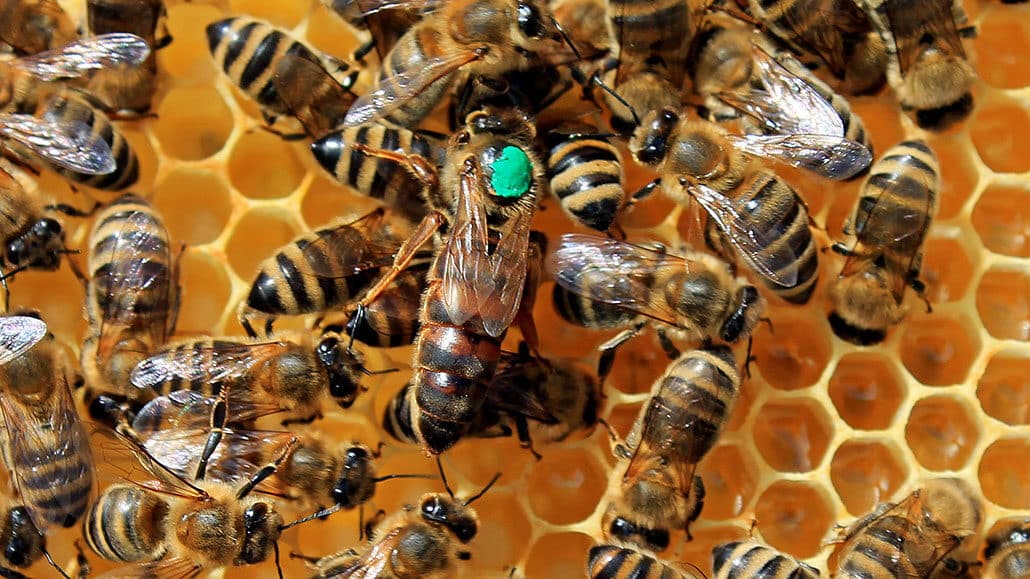
Adult worker lifespan changes with season and workload. During active spring or summer conditions it is often measured in weeks; roughly 40–45 days is one familiar estimate, not a fixed lifespan. Winter workers can survive for several months, including three or four months and sometimes longer, but 120 days is not a guaranteed minimum. Nutrition, health and the timing of foraging all matter.
Queens can live for several years, including three to five years in some cases, although many are lost or replaced much sooner. Egg-laying performance often declines after the first year or two, but there is no exact expiry at eighteen months. Penn State’s queen-development guide distinguishes potential longevity from practical productivity.
The contrast between a short-lived summer worker and a long-lived queen illustrates how developmental form, physiology, diet and activity interact. Epigenetic regulation is one part of that biology, not a guarantee of longevity, and these bee comparisons do not justify advice about human health or diet.
How many queens does a hive have?
A typical colony has one laying queen, but exceptions occur. A mother and daughter can coexist during supersedure, and several virgin queens may be present temporarily around swarming. “One queen” is the usual condition, not an absolute physical limit.
Replacement is not risk-free. A queen may be lost before a successor is laying, and the new queen may fail to mate or return. Workers cannot always ensure a perfect handover. This is why observing brood and the colony’s development matters more than assuming that the bees have necessarily solved the problem.
How many bees are in a hive?
A full colony commonly contains tens of thousands of bees, and 20,000–60,000 is a useful illustrative range for established colonies across different seasonal conditions—not a universal minimum and maximum. Nucs, weak colonies and some winter colonies can contain fewer. The original field estimate of about 10,000 bees per four fully covered Langstroth frames, or three larger Dadant or Layens frames, is only a rough guide. Frame dimensions, coverage on both faces and packing density change the count. Likewise, about 1 kg per 10,000 bees is an approximate conversion, not a precise measurement.
How do bees communicate?
Communication helps coordinate work and responses to changes inside and outside the nest. Honey bees combine several forms of information:
Pheromones and scents
Chemical signals are central to colony behaviour, but not every scent is a pheromone. A floral odour, for example, can provide information about forage without being a signal produced by a bee.
Pheromones are chemical signals between members of the same species. Depending on the compound and context, they can trigger an immediate response or influence physiology and behaviour over a longer period. They are not simple commands that every recipient must obey identically.
Queen signals help workers detect her presence and contribute to the regulation of reproduction and worker activity. Queen, brood and worker signals act together; no single “queen substance” is a complete explanation for colony stability or every wax-building and clustering response.
Different brood signals help coordinate nursing, pollen collection and the care of larvae approaching pupation. Older workers also influence the transition of younger bees to foraging: experiments with ethyl oleate showed a delaying effect, not a universal signal to make all young bees age faster. Nasonov scent helps orientation and aggregation, while alarm signals associated with the sting apparatus recruit defence. These are distinct functions, not one colony-wide perfume.
Returning foragers carry floral scents on themselves and in their nectar loads. Nestmates can learn food odours through close contact and food sampling, helping them recognise a useful resource on a later trip. Scent information complements dance communication; it does not itself provide a distance-and-direction map.
A beekeeper should keep the colony’s recognition cues in mind during management, especially when mixing bees from different colonies. Sharing a smell does not guarantee acceptance of unfamiliar bees or queens.
The antennae carry important olfactory receptors, as well as sensors for other kinds of information.
Tactile signals
Antennal contact helps bees detect and interact with nearby nestmates. Touch also accompanies trophallaxis, the exchange of liquid food, which can distribute food and information about its scent.
Honey bee dances
A successful forager may advertise a worthwhile source by dancing after returning to the hive; not every trip triggers a dance. In a waggle dance, the orientation of the waggle run conveys direction relative to the sun and its duration conveys information about distance. Recruits combine this with odours and their own searching experience.
Dances also contribute to nest-site selection during swarming. Scouts advertise candidate cavities, and the swarm’s choice emerges from their interactions. This is another example of collective decision-making, rather than the queen issuing a destination.
How the colony works as a whole
Chemical, tactile, vibrational and other sensory information can interact during communication. Experiments have also shown that honey bees detect and learn electric-field stimuli, supporting a possible role in social communication. That does not establish that every channel is active in every encounter. The colony functions through many overlapping local interactions.
Would you like to know more about beekeeping?
See our online beginner beekeeping course, taught in Spanish.
The course page provides the syllabus and current enrolment details. The promotional video below is also in Spanish. The original illustrations throughout this article are retained; where their embedded labels are Spanish, the surrounding English text and captions explain them.
![Introducción al Curso de Apicultura [SÚPER COMPLETO]](https://www.latiendadelapicultor.com/blog/wp-content/plugins/wp-youtube-lyte/lyteCache.php?origThumbUrl=https%3A%2F%2Fi.ytimg.com%2Fvi%2FuJomNRA0UP8%2F0.jpg)

ISNI 0000 0005 1801 1100 | Joshua Ivars is the manager of LA TIENDA DEL APICULTOR and the author of this blog, where he shares technical and practical guidance for beekeepers. Drawing on extensive experience in the beekeeping sector, he offers advice and solutions based on beekeepers’ real needs, sharing his knowledge of equipment and essential beekeeping practices.


