
Natural swarming
The hive is a superorganism composed of different parts that function together: the queen, worker bees, drones (mainly during the reproductive season), and brood combs and stores for reserves.
The relationship between the queen and the workers is governed by instinctive responses. As in other living organisms, external stimuli such as day length and temperature and internal signals such as hormones can trigger specific behaviours. When a stimulus reaches a perceptible threshold and the receiver is sensitive enough, the corresponding response follows. Swarming is a natural expression of the colony’s reproductive drive, regulated by several interacting mechanisms.
A young, mated queen releases pheromones—chemical signals transmitted through the colony—that regulate various worker behaviours, including suppressing queen rearing, stimulating comb building and maintaining colony cohesion. This regulation weakens as the queen ages or if any condition reduces her pheromone output.
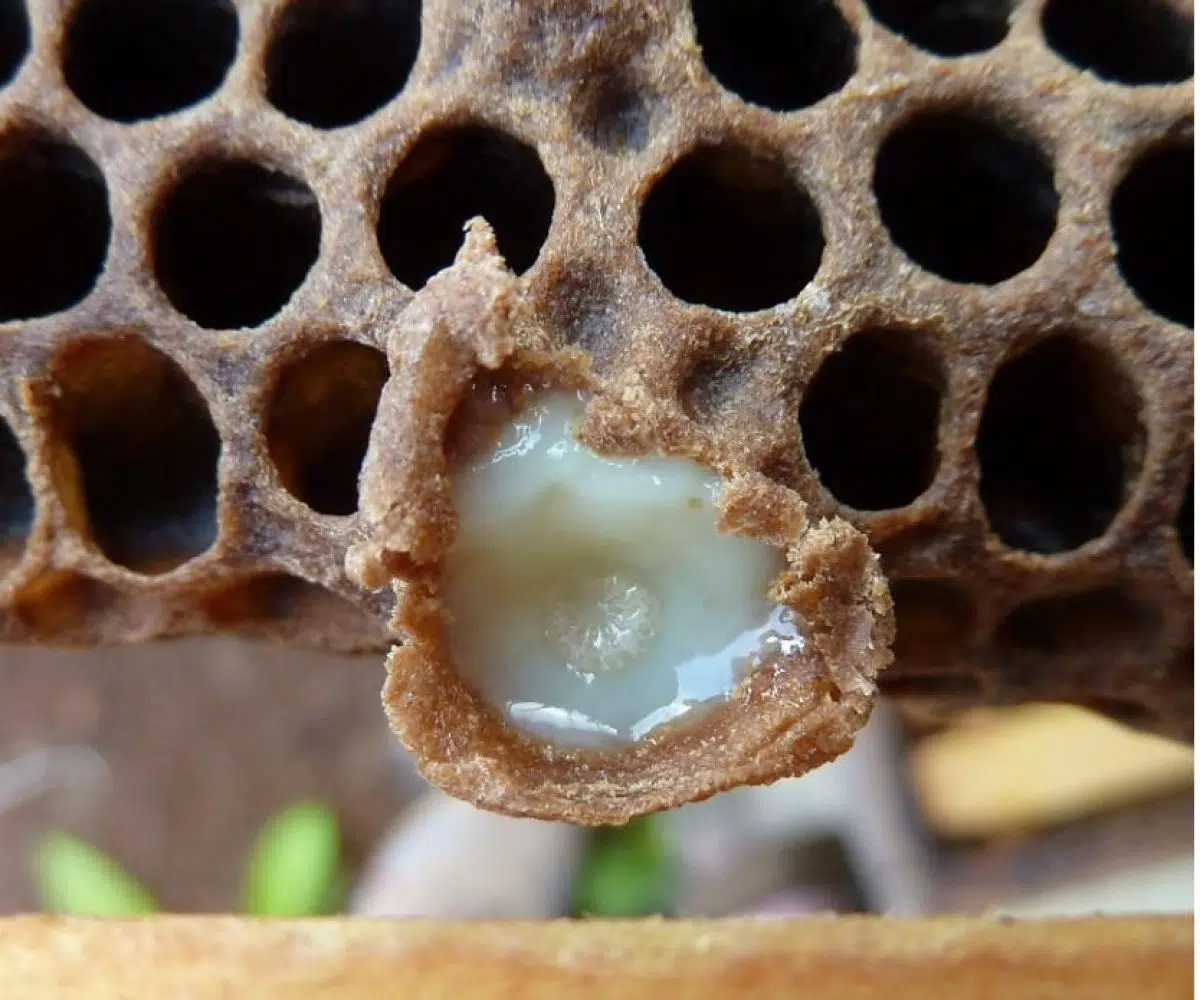
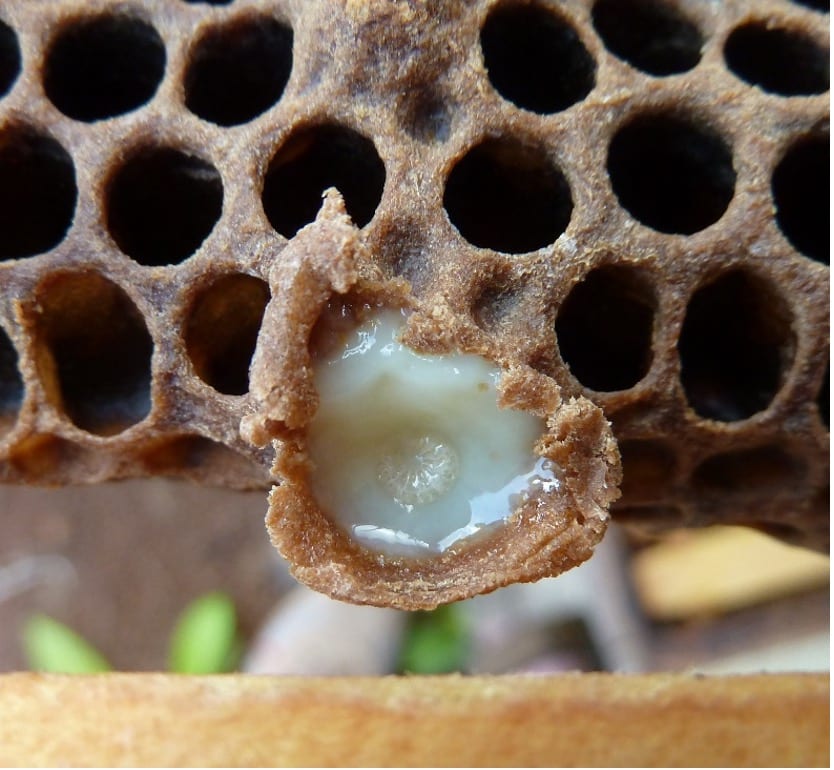
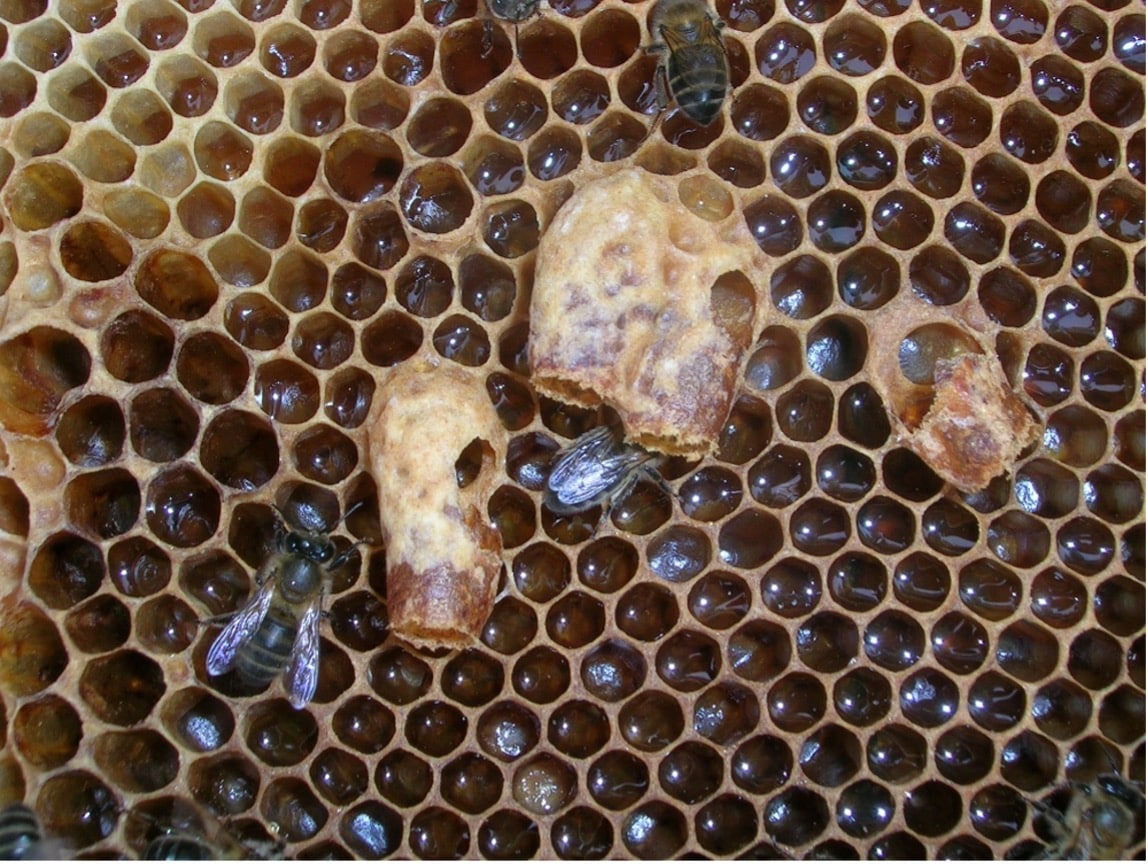
The same occurs if the colony’s population grows excessively, and the quantity of pheromones produced by the queen no longer reaches an adequate level in all bees. Then some worker bees will begin to rear queens in the peripheral area of the brood nest. To do so, they construct several queen cells on the surface of the comb, transfer freshly laid eggs from the queen into them, and feed the larvae exclusively with royal jelly throughout their larval stage (Photos 1 and 2).
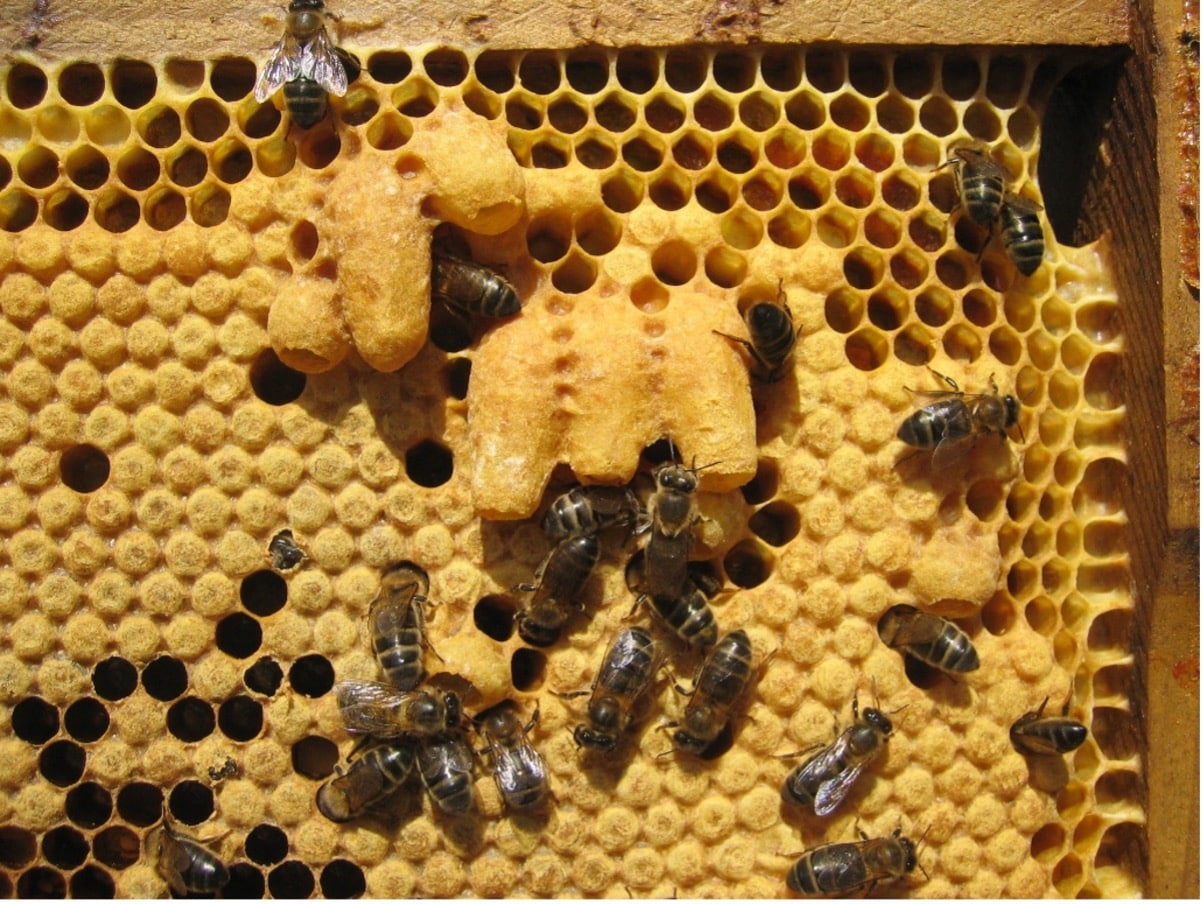
If weather conditions remain favourable, the process continues to completion. If conditions deteriorate, the colony removes the contents of the started queen cells and narrows their openings to worker-cell diameter—what some beekeepers call ‘vicio’ (Photo 3)—then waits for a better opportunity to reproduce.
If swarming proceeds, the larva fed exclusively on royal jelly will “activate” (via epigenetics) its reproductive tissue development genes (ovaries, vagina, etc.), and the final result will be a fertile female.
Shortly before emerging, or just after emergence, these queens will ‘pipe’ (see video), threatening the old queen or sisters that emerged earlier and prompting them to leave the hive. At this stage, the old queen may back down and leave with a group of workers and whatever stores they can carry in their honey crops, settling in another nearby cavity. Scout bees will already have inspected the available cavities and communicated their locations to the others through the figure-8 dance, which they repeat on the clustered swarm during rest stops. Finally, the swarm will settle at the site most insistently indicated in the scouts’ dances (presumably because they found a better cavity).
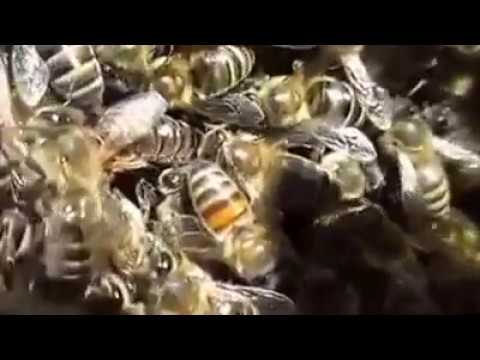
The first newly emerged queens may coexist in the hive and ignore one another while still unmated, until they reach sexual maturity at around 4–5 days. They may even swarm during this period, with several queens leaving in the same swarm until the first mates. These smaller secondary swarms are known as afterswarms.
Once sexually mature, they begin to emit pheromones to attract drones (for about 20 days). Then they will begin mating flights, usually mating with 15–20 drones within a few days, provided weather conditions are suitable (low wind, good temperature, and no rain). The queen will store the semen from these drones in her spermatheca, keeping it viable for about 2–3 years, using it to fertilise her eggs and thus produce new females for her colony. Males develop from unfertilised eggs.
If weather conditions are unfavourable, the queen may mate with only a few drones during her 20 days of receptivity, store little sperm, and subsequently begin laying only drone eggs within a few months. This is why, in years with poor weather for queen mating, a significantly higher proportion of queens are replaced during the season.
Normally, if the beekeeper does not intervene by replacing old queens, around one third of colonies replace their queen naturally during a season. This causes egg laying to stop for about 5 weeks and sometimes goes unnoticed.
It may also happen that a queen produces poor pheromone levels and is not very attractive to drones, or fails to mate. In such cases, she will be a “drone-layer” and must be discarded.
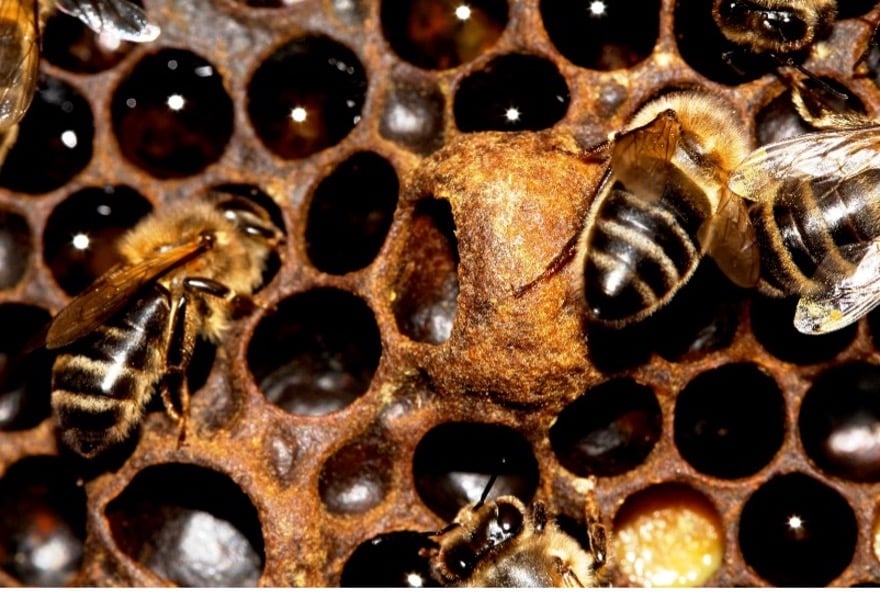
The mated queen takes another couple of days to complete her physiological transition and begin laying. She then produces pheromones that attract workers, stimulate comb building and suppress further queen rearing, and the workers accept her as the swarm’s queen. The workers destroy any surplus queen cells still containing developing queens by chewing through their bases (Photo 4).
In total, a new queen begins laying eggs approximately 5 weeks after the start of her rearing.
In exceptional circumstances, an entire colony may abscond and leave its brood behind. This is generally associated with severe American foulbrood, heavy Varroa pressure or starvation (in Spanish), and is sometimes described as ‘sanitary absconding’ in search of a more viable site.
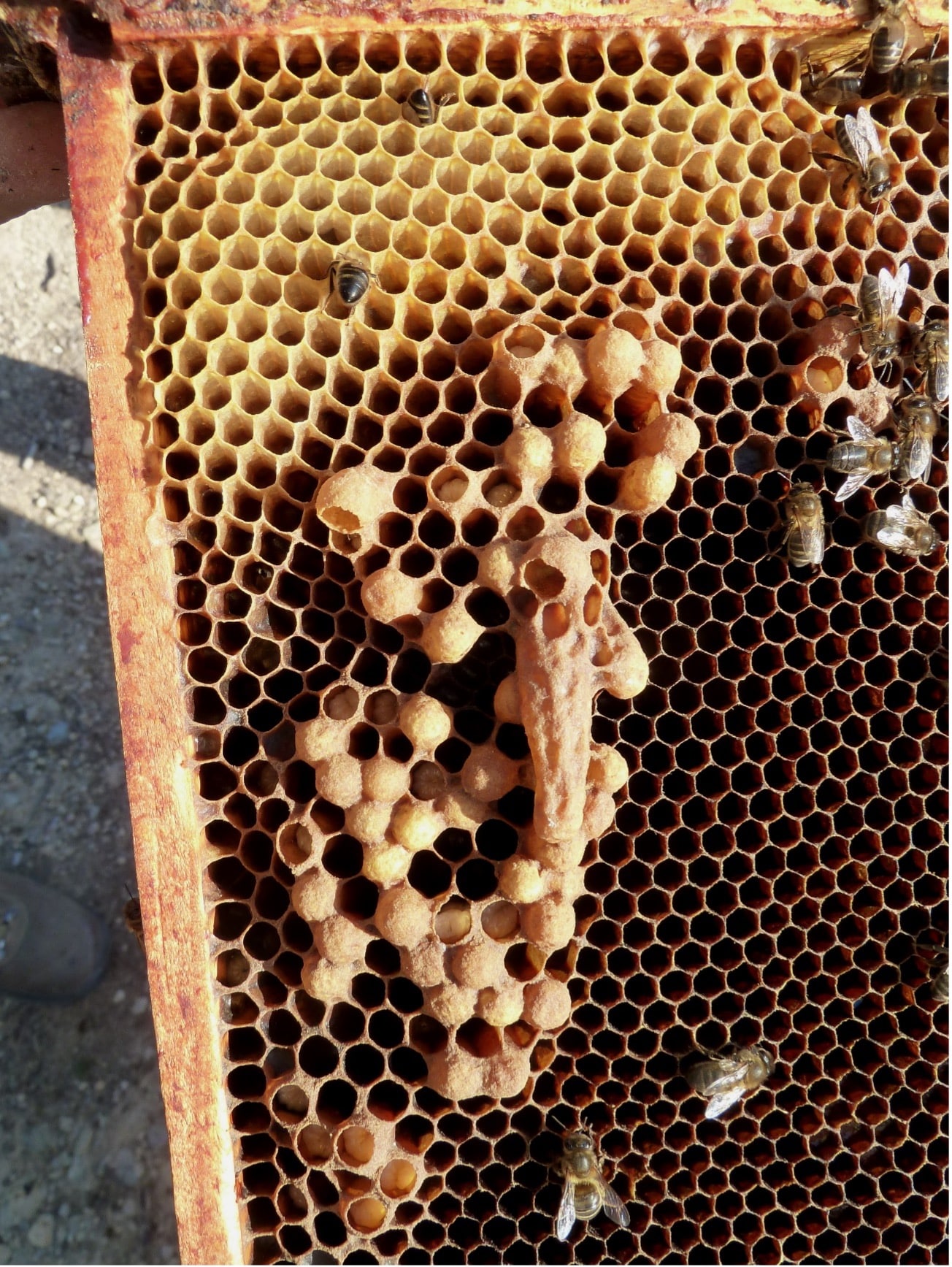
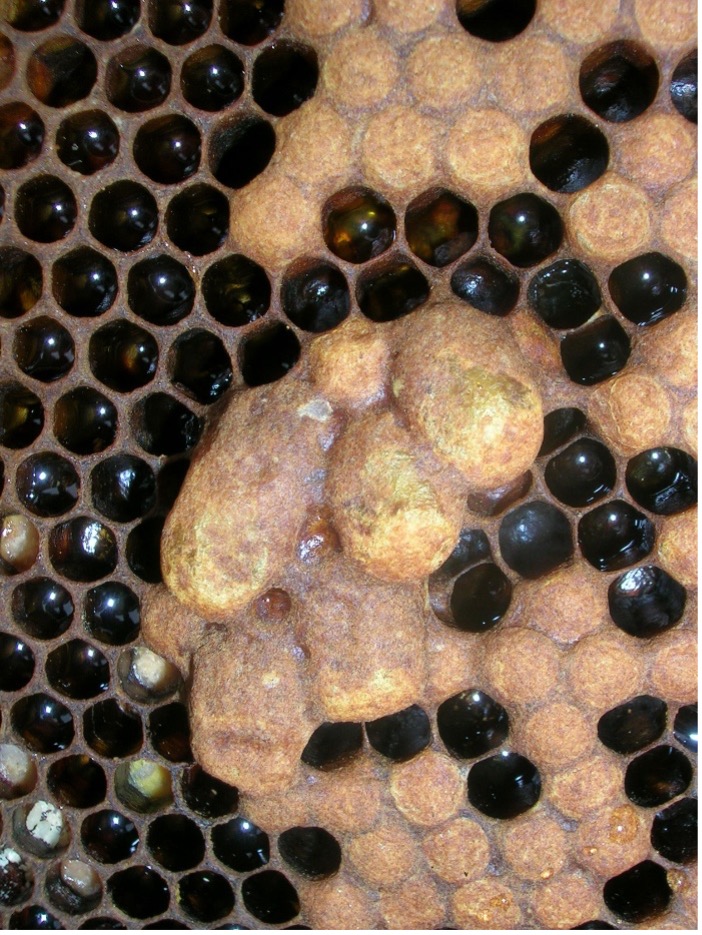
Workers in a drone-layer colony, where only unfertilised drone eggs are being laid, may instinctively build queen cells around those eggs in an attempt to replace the queen. These cells occur in drone comb, contain drone brood, and are abnormally long and constricted in the middle; they can never produce a queen (Photo 5).
Artificial swarming
Swarming is a natural process that cannot be eliminated entirely, but commercial beekeepers can manage it to reduce the loss of bees and production.
To this end, one should try to prevent it, as far as possible. Several factors must be considered:
- Queen age: young one-year-old queens are less likely to swarm, at around 30%. Two-year-old queens are about twice as likely to swarm, while almost all three-year-old queens do so. This is why a year with little swarming is often followed by one with heavy swarming.
- Nectar flow: colonies that have built up strongly, reared drones and become congested for comb space are more likely to swarm in favourable weather. A slow flow allows colonies to rear more workers while leaving many bees underemployed, increasing swarm pressure. During a fast flow, newly vacated brood cells may be filled with nectar and honey, restricting the queen’s laying space; this brood-nest congestion and resulting worker inactivity can also accelerate swarming.
- Inheritance?: bees with low olfactory sensitivity (dependent on maternal and paternal inheritance) may not detect queen pheromones well, and thus have a higher tendency to swarm earlier. The heritability of this trait has not been quantified.
Preventing swarming
Therefore, actions to prevent swarming should focus on replacing old queens and on controlling excessive worker bee populations and comb space saturation, taking into account genetic inheritance.
The usual approach is to make nucleus colonies from the strongest hives in early spring. Work with the most advanced colonies once they have at least 7 brood frames, removing at least 3 frames and replacing them with empty drawn comb or foundation as appropriate. The removed frames should carry bees, open and sealed brood, and honey and pollen stores. Each nuc should have around 3 brood frames well covered with bees, plus one frame of honey and pollen and one sheet of wax foundation.
Before frames are permanently removed from the colony being decongested, inspect them to ensure the queen is not present. The nucleus colony receiving them can be made up with brood frames and bees from one or several colonies. If it is still short of bees, shake in bees from one or more additional frames from any colony, again checking first that the queen is not among them.
Newly made nucs can be moved to another apiary at least 4 km away. If they remain in the same apiary, older field bees may return to their original hive, leaving the nuc short of bees. An alternative is to keep the nucs closed in a cool place for about 24 hours and release them at dusk.
If they are to remain in the same apiary, the entrance of the nucleus should be positioned roughly equidistant from that of another hive with a good number of foraging bees, older ones (‘flight’ or ‘trio’). If we wait a few minutes, we will see whether the ‘flight’ is distributed evenly. If not, we will move one of the two hives closer or further away until an even distribution is achieved. It is important that the fronts of the hive and the nucleus are as similar as possible, and to remove any reference points for the original hive entrance: nearby shrubs, adjacent stones…
The frame containing freshly laid eggs or very young larvae, from which the nuc will rear its queen, should come from a colony selected for desirable traits: high honey production, Varroa tolerance, resistance to other diseases and gentle behaviour. This increases the proportion of next-generation colonies expressing the same qualities.
The foundation sheet acts as a practical indicator: if the bees are drawing it well, this suggests that the nuc has a successfully mated queen.
If the nucleus lacks a queen, the worker bees will initiate rearing a new one, ’emergency’ queen rearing, from a worker cell containing a newly hatched larva, by enlarging and extending the cell walls outward. These queen cells will appear smaller, but only because part of them is embedded within the comb (Photo 6). The new queen will emerge after 13 days, and will begin laying eggs approximately 5 weeks after the nucleus was formed. During this time, it is not advisable to disturb the hive. At most, feed it with syrup, and, if necessary, with protein paste.
These nuclei are used in the operation to maintain the number of hives, replace losses, and replace hives with queens that have failed due to age, disease, or poor characteristics. For this purpose, many operations keep a certain number of such nuclei in each apiary.
Nuclei may also be used to increase the number of hives, or to sell them as an additional product of the operation.
These operations must be initiated before the hive begins mass rearing of queen cells. Otherwise, the bees will continue to respond to their instinct to reproduce.
Placing a super at the right time may also be a good practice to divert the bees towards other activities instead of swarming.
WOULD YOU LIKE TO KNOW MORE ABOUT BEEKEEPING?
Discover our online introductory beekeeping course.
An excellent opportunity for anyone wishing to learn beekeeping: comprehensive, high-quality training with industry experts and a thorough syllabus.
![Introducción al Curso de Apicultura [SÚPER COMPLETO]](https://www.latiendadelapicultor.com/blog/wp-content/plugins/wp-youtube-lyte/lyteCache.php?origThumbUrl=https%3A%2F%2Fi.ytimg.com%2Fvi%2FuJomNRA0UP8%2F0.jpg)

ISNI 0000 0005 1801 1100 | Joshua Ivars is the manager of LA TIENDA DEL APICULTOR and the author of this blog, where he shares technical and practical guidance for beekeepers. Drawing on extensive experience in the beekeeping sector, he offers advice and solutions based on beekeepers’ real needs, sharing his knowledge of equipment and essential beekeeping practices.


