
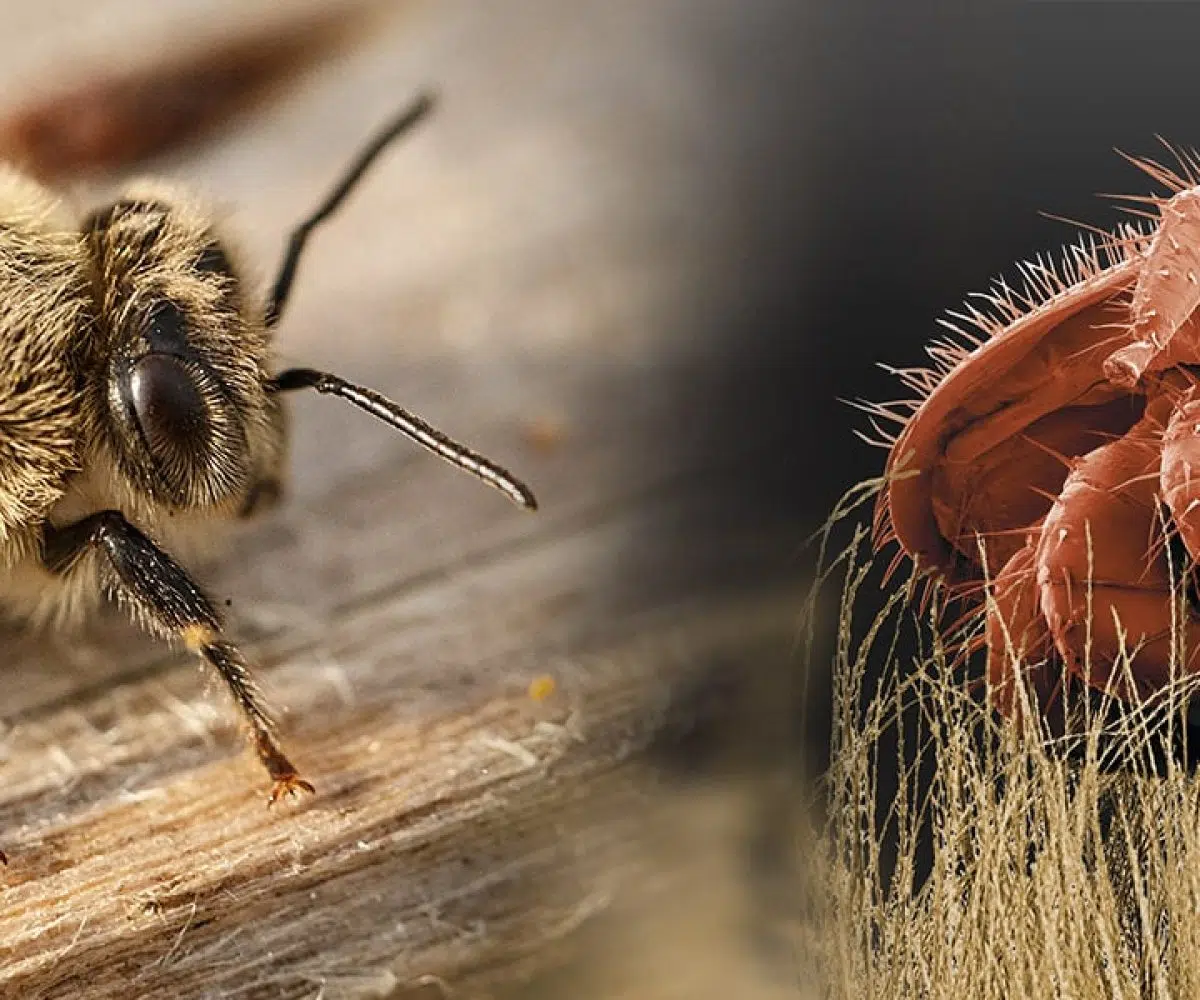
Varroa life cycle
It must be understood in order to plan the fight against it effectively:
- Phoretic stage, on adult bees: a Varroa mite remains on an adult bee for between 2 and 10 days. During this stage, the mite is exposed and susceptible to treatment.
- Reproductive phase, inside a capped brood cell: when mature, the female mite enters a cell shortly before capping. Between 60 and 70 hours after capping, she lays a male egg and then one female egg every 30 hours. After approximately 6 to 7 days, the male develops into a sexually mature adult; the females mature one day sooner. They mate inside the cell. When the cell is opened as the parasitised bee emerges, or by workers cleaning it out if the pupa dies, several already-mated daughter mites leave the cell.

Increase in Varroa population
We may have more or less Varroa depending on a series of factors. It will depend on:
- The Varroa strain (which cannot be controlled):
- Not all mites reproduce; a proportion live on adult bees without producing offspring. For example, in South America, 60% remain ‘single and unattached’, compared with 25% in Europe.
- Not all reproducing mites lay the same number of eggs. In theory, a foundress mite has time to lay up to 5 eggs in a worker cell and up to 7 eggs in a drone cell; however, some Varroa strains are less fecund than others. Of the eggs laid in worker cells, at most two daughters will emerge mature and mated; in drone cells, up to four.
- Not all Varroa mites reproduce the same number of times. Some do not reproduce (25% in Europe), some reproduce only 1 time, some reproduce 2 times (20%), and a few (5%) even 3 times.
- The colony’s genetic stock (which we can influence):
- When bees show a high level of Varroa Sensitive Hygiene (VSH), they can detect infested cells, sense that something is wrong beneath the capping, uncap those cells and clean them out completely. Colonies with a high level of VSH maintain very low Varroa populations or very slow Varroa population growth.
- External conditions (we can also intervene):
- If there is “robbing” from other colonies with Varroa, there may be a significant external influx of Varroa.
- If drone brood is present, Varroa reproductive efficiency is higher.
- If there is no flowering, bees will forage further away, increasing the likelihood of encountering colonies with Varroa and of “robbing” them.
Varroa mites are distributed unevenly within a colony, but as a general rule, 1/4 are on adult bees and 3/4 are beneath the brood-cell cappings.
As long as brood is present, new Varroa mites emerge every day and new foundress mites enter brood cells beneath the cappings every day.
Varroa will produce a new generation every 14 to 22 days. Normally, Varroa populations can double or triple within a month.
This means that when more than 20–30% of a colony’s brood is infested with Varroa, it may have less than one month of active life left: it is entering a ‘terminal’ phase from which it will not recover. In that situation, some form of immediate treatment is needed to prevent the combined effects of Varroa, diseases spread via mite feeding wounds, and the weakening of adult bees and parasitised brood from killing the colony.
Only when the percentages of infested brood cells are low can we act calmly and delay treatments until a more favourable moment, but never neglect the evolution of Varroa populations within the colonies.
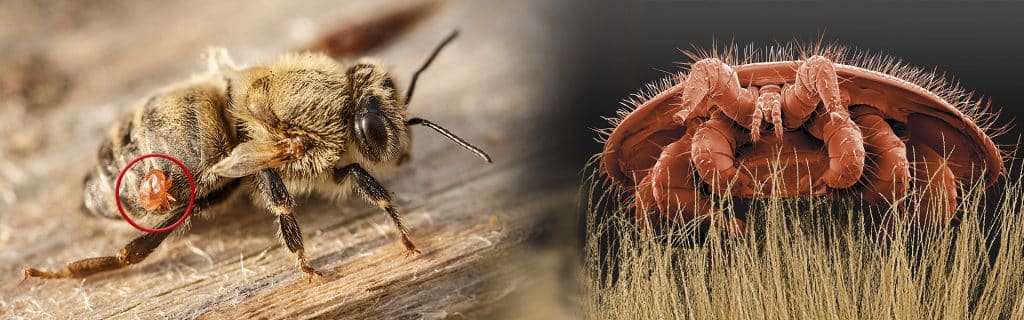
Detection of Varroa levels in the apiary
In an apiary, we will never have the same Varroa level in all hives. Since Varroa distribution will never be homogeneous, we cannot randomly sample hives; we must select a biased sample towards those with higher detection probability.
Colonies that find another honey-laden colony dying or dead from Varroa (Varroa can survive for up to 10 days without bees to feed on), and which rob the honey, will also pick up Varroa mites. A portion of these bees will return to their original hive, carrying both honey and Varroa. Other bees will drift into the hives at the end of the apiary where foragers approach, or into the nearest hives.
Therefore, to determine an apiary’s Varroa status, sample part of its colonies, selecting about 10 hives per apiary, regardless of its size.
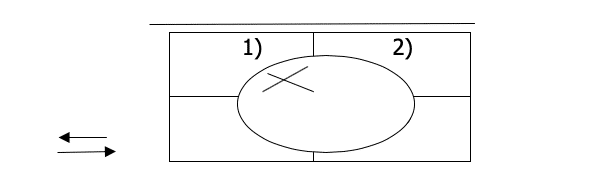
To select them, half of the hives sampled should be those located at the edge of the apiary on the bees’ approach side. The other half should be selected from colonies showing signs of distress at the hive entrance, such as bees with underdeveloped wings (DWV), robbing, dead pupae and/or bees with shortened abdomens…
Detection of Varroa level in the hive
Once the hives for inspection have been selected, they will be opened, and the following steps will be followed:
- A frame of capped brood from those facing the hive entrance will be removed, and if possible, one with wax not very new, little open brood, and little open honey.
- The selected frame will be shaken by tapping it inside the hive.
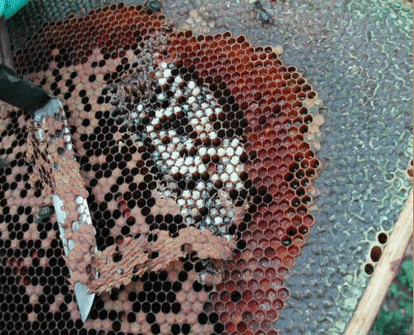
- In the 1/4 upper front section, uncap approximately 100–200 cells using a very sharp knife or utility knife:

- The contents will be removed by tapping the frame on the lid of a neighbouring hive.
- Count the pale amber and mahogany-coloured Varroa mites and record the number:


- The number of extracted pupae will be counted, or, if they have been destroyed, the number of uncapped cells.
- Calculate the number of Varroa mites per 100 cells, expressed as a percentage.
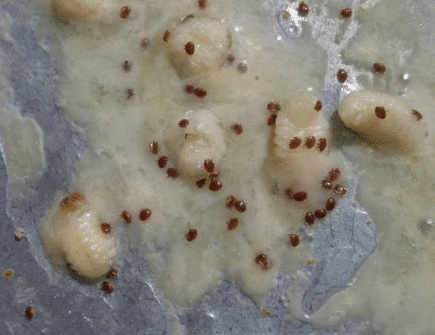
It is highly advisable to mark some of these hives and record their Varroa level before carrying out a treatment. Then, after approximately 45 days, repeat a full Varroa count in order to check the treatment’s level of effectiveness.
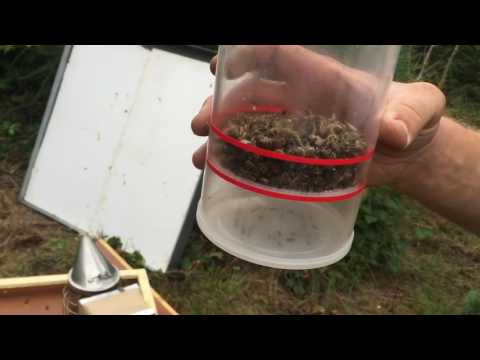
Two other practical options for quick, convenient Varroa diagnosis are the Varroa Tester and the Varroa EasyCheck. Both are available from La Tienda del Apicultor.
Decision-making
It is often stated that a colony begins to collapse at around 4,000 Varroa mites, although there are no firm data for our conditions. The Varroa population can double or even triple in one month when worker brood is present, more rapidly when there is drone brood or robbing from nearby apiaries with heavy Varroa infestations.
The inspection results may call for three types of action, depending on the number of Varroa mites found in 100 worker brood cells:
- around 5%: recheck before two months, treatment will probably be needed soon
- 10%: treat within one month
- more than 15-20%: immediate treatment
Decision thresholds should be raised or lowered according to factors such as the amount of drone brood present and the presence of nearby apiaries with heavy Varroa infestations…
If Varroa is assessed using adult bees, the action thresholds should be reduced to 1/3 of those values, as follows:
- around 1%: recheck before two months, treatment will probably be needed soon
- 3 %: treat before one month
- more than 5%: immediate treatment
Treatments will be carried out at temperatures above 12 °C, so that bees remain active and move, distributing the treatment from the point of application throughout the rest of the colony. The greater the colony activity, the more effective the treatment will be.
Read the directions for each treatment carefully and follow them. Improvised disease-control measures can seriously harm colonies, hive products and the person applying them, and may also fail to control Varroa.
WOULD YOU LIKE TO LEARN MORE ABOUT VARROA?
Discover the specialised online course on Varroa delivered by Antonio Gómez Pajuelo for Bees.Academy.

ISNI 0000 0005 1801 1100 | Joshua Ivars is the manager of LA TIENDA DEL APICULTOR and the author of this blog, where he shares technical and practical guidance for beekeepers. Drawing on extensive experience in the beekeeping sector, he offers advice and solutions based on beekeepers’ real needs, sharing his knowledge of equipment and essential beekeeping practices.


