
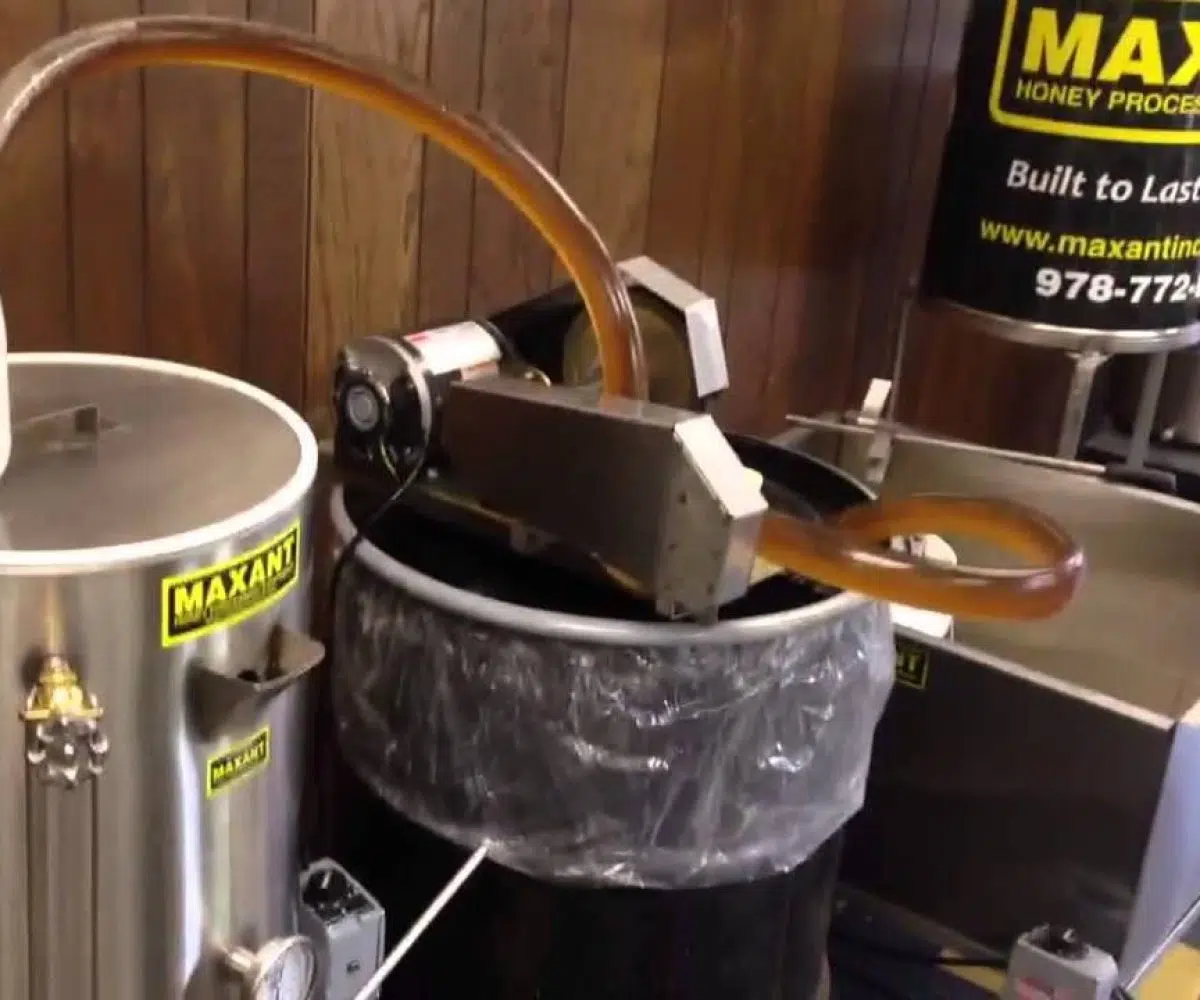
A honey transfer pump moves honey where gravity cannot—and its suitability depends on much more than the headline flow rate. Progressing cavity, rotary lobe, gear, peristaltic and flexible impeller pumps work differently. Compare how they handle your honey, the required throughput, priming, wax fragments, cleaning and speed control before deciding what to buy.
How to use this guide
- Go straight to a pump family: progressing cavity, rotary lobe, gear, peristaltic or flexible impeller.
- Use the comparison table to shortlist designs.
- See which pump suits your work for workload examples, special applications and a decision checklist.
Start with the selection factors. They apply to all five families. This guide explains the choices; the exact pump manual and the design of your installation determine operating limits.
After honey leaves the extractor, it normally goes through straining and settling. It may move between settling tanks, in-line filters, drums and clarifiers. Gravity transfer is useful where the layout permits it. Otherwise, a suitable honey pump can do the job.
A poor match can mean slow transfer, excessive air in the honey, unnecessary heat, difficult cleaning or equipment damage. Choose for the product and the complete route through the honey house, not simply the motor power or price.
What to consider before choosing a pump
Honey condition and viscosity
Honey is viscous, and its behaviour changes with temperature and crystallisation. The same pump can deliver differently with warm liquid honey, cold honey or a partly crystallised batch. State the actual conditions when asking for a recommendation. Do not assume that a water-rated capacity is also a honey-rated capacity.
Food-grade positive-displacement pumps are common in honey processing because they can move viscous products at controlled speeds. Avoid unnecessary agitation and air entrainment: suitable speed, a sound inlet connection and an adequate supply of honey all matter. A claim that a pump “does not emulsify” is not a guarantee that an installation can never introduce bubbles.
Required throughput and pipework
Work out the kilograms to be moved, the available pumping time and the rate the next machine can accept. Include the suction and discharge heights, hose bore and length, bends, valves and filters. A blocked or overly restrictive filter changes the operating conditions; a larger motor is not the remedy for unsuitable pipework.
For example, moving 200 kg in 30 minutes requires an effective transfer rate of 400 kg/h. Allow for preparation and cleaning when planning the working day, and select the pump within its manufacturer’s permitted operating range. An undersized pump may struggle; an oversized one can add cost and be awkward to regulate at the flow you actually need.
Variable-speed control
A variable-frequency drive, or inverter, controls the speed of a compatible motor. Mechanical speed controls and other drive arrangements also exist. Specify a complete, compatible pump-and-drive system rather than adding an arbitrary inverter.
- Match the flow: adjust delivery to the honey and the receiving tank, filler or separator.
- Reduce unnecessary agitation: use a suitable operating speed instead of running at maximum by default.
- Control starts: follow the permitted starting procedure and avoid forcing a loaded or obstructed pump.
- Integrate the line: provide the level, flow and pressure controls required by the connected machinery. An inverter alone does not guarantee a constant measured mass flow.
Include controls in the quotation. They can be particularly valuable for automated work, but neither a universal inverter price nor one speed setting applies to every pump.
Progressing cavity pumps
Also called progressive cavity or eccentric screw pumps, these are the pumps commonly described as helicoidales in Spanish honey houses. Suitable versions can handle viscous honey and mixtures containing cappings. The term “screw pump” also covers other designs, so confirm the actual rotor-and-stator arrangement.
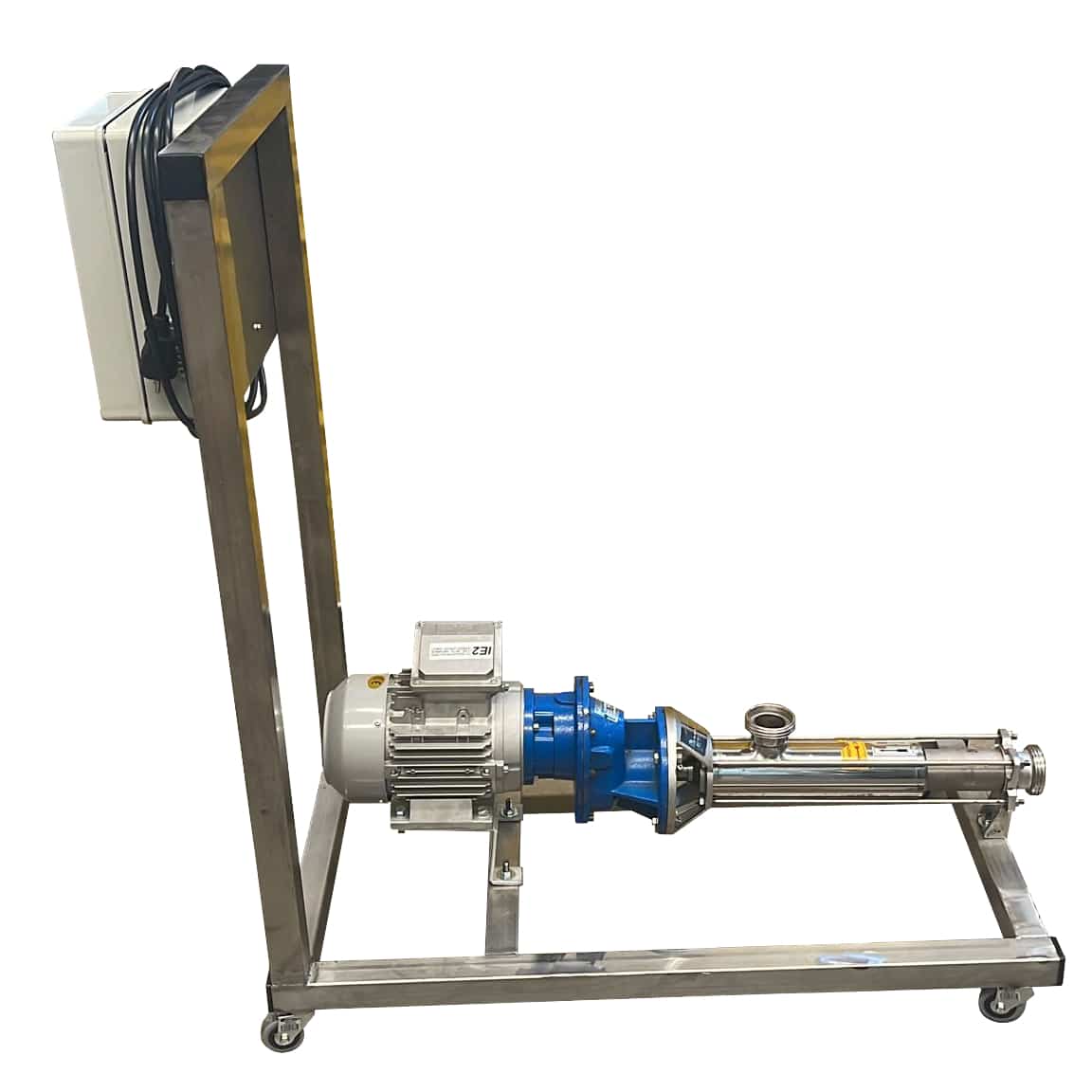
How they work
A screw-shaped rotor turns eccentrically inside a matching stator. Cavities carry product from the inlet towards the outlet. This is displacement, not the honey being compressed between the parts: NETZSCH describes moving cavities of constant volume.
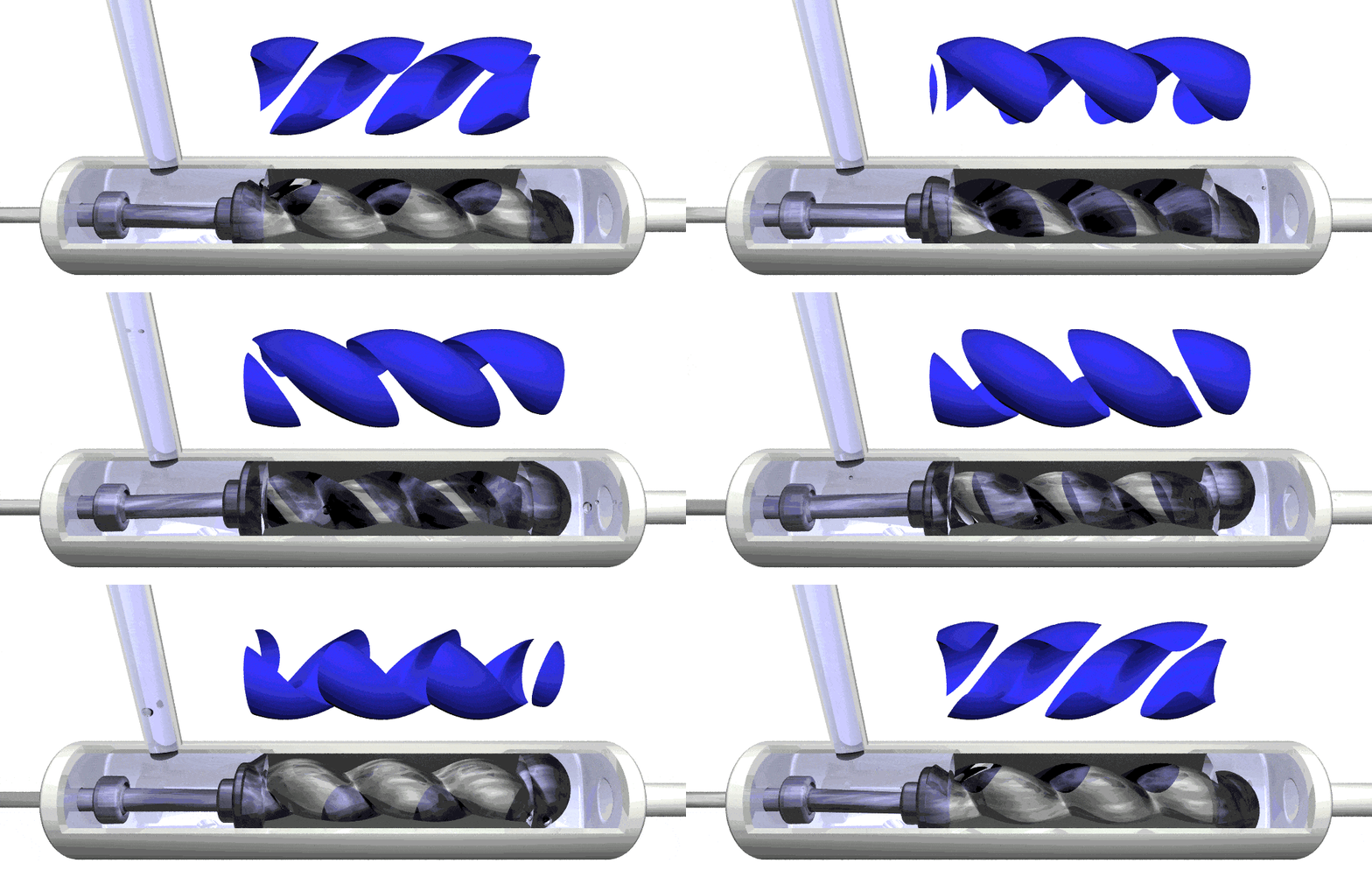
The design can provide low-pulsation, gentle transfer. Pressure capability depends on the selected pump and its stages. Actual delivery also depends on speed, inlet supply and operating conditions; it is not guaranteed to stay identical at every viscosity or temperature.
Priming and cappings
These pumps commonly offer self-priming capability, but self-priming does not mean safe dry running. Follow the initial wetting, filling and start-up instructions. Keep the suction route practical: self-priming does not let you put the pump anywhere or ignore a restrictive inlet.
For honey mixed with cappings, specify the wax content and the size and consistency of the pieces. Choose a pump and inlet designed for that mixture. Do not assume that every model will pass a 5–6cm lump or accept any quantity of solids.
Avoiding dry-running damage
Without adequate product at the rotor/stator interface, friction can overheat and damage an elastomer stator. Watch the source tank level and use the manufacturer’s recommended protection. Stop if the supply fails; do not leave the machine turning while it waits for the next batch.
Overpressure protection
A positive-displacement pump must not be allowed to build unsafe pressure against a closed or obstructed outlet. The installation needs the protection specified for the pump and connected equipment. Manufacturer options include pressure monitoring and shutdown; a correctly designed relief or bypass arrangement may also form part of the system.
There is no universal 3–4bar relief setting for honey pumps. Select and set protection against the permissible pressure of the complete installation, including its lowest-rated hose, fitting, filter or machine. Do not replace engineered protection with a promise to keep an eye on the valve.
Crystallised honey and stator wear
Partly crystallised honey can increase the load and affect wear. The amount and character of the crystals, speed, pressure and materials all matter. Do not promise a stator lifetime of a fixed number of hours, or force solid honey through a pump that is not designed for it.
If warming is needed, use a controlled process suitable for the honey and equipment. A blanket instruction to heat every batch to 45–50°C is not appropriate: time and temperature affect honey quality, and the necessary treatment depends on the batch. Soft-set honey is not the same duty as a drum of hard-set honey.
Cost, examples and trade-offs
Price depends on capacity, stator material, drive, controls and installation. Ask for a current complete quotation, including replacement stators and protection; an old price band does not tell you the cost of the system you need.
Strengths: a useful option for demanding viscous-product duties, controlled transfer and suitable cappings mixtures. An in-line pressure filter can be included only where its rating and the system protection are compatible.
Trade-offs: stator care, dry-run protection, access for cleaning and replacement-part costs. High discharge pressure is not the same as unlimited suction lift. Choose it because the duty justifies it, not because it is automatically the “best” honey pump.
Rotary lobe and Monolobi pumps
Rotary lobe designs can provide gentle, relatively low-pulsation transfer of viscous products. They are worth considering for honey handling and some filling or soft-set-honey processes. However, the broad sales label covers different constructions; compare the actual pump, not just the family name.
Operation, suction and solids
In a conventional twin-rotor lobe pump, synchronised rotors turn in opposite directions and carry product around the pump chamber. Alfa Laval explains the partial vacuum created at the inlet. Clearances between the rotors do not mean that the whole family is incapable of suction.
Some designs can handle soft suspended solids; allowable particle size and concentration remain model-specific. Whether the pump will prime in your installation depends on its design, seals and inlet conditions. Check the instructions rather than assuming either “always self-priming” or “never self-priming”.
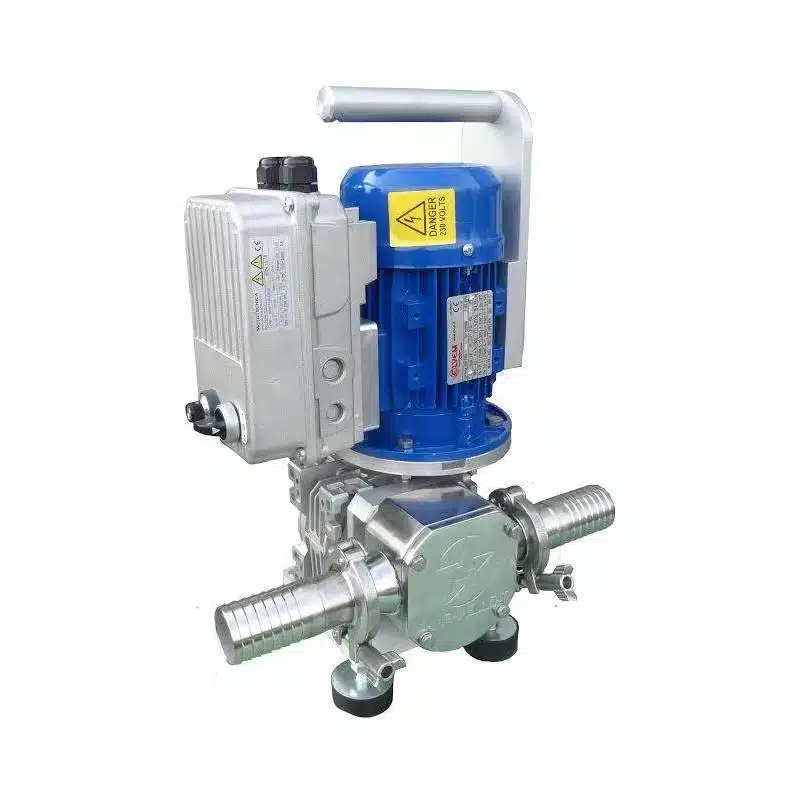
The illustrated Chiaramello Monolobi 60 uses a food-grade rotor and scraper. Its declared maximum is 700 l/h, with 60–330 rpm adjustment and 40 mm ports. The model’s manual requires filling the chamber with honey before starting and excludes fluids containing solid bodies. The current manufacturer specification for Monolobi 100 lists 1,800 l/h maximum, 40–330 rpm and 50 mm ports. These are different configurations; check the exact supplied unit and its fittings.
Cost and examples
Compare the complete pump, seals, controls and hose connections. Port dimensions, access for cleaning and parts availability matter alongside purchase price. Compact models may be easy to move, but transport weight and trolley needs increase with size.
Strengths: controlled handling of viscous products and useful variable-speed options. Trade-offs: model-specific priming and seal care, permissible solids and installation requirements. Neither completely pulse-free dosing nor longer life than every gear pump is guaranteed by the name “lobe”.
Gear pumps
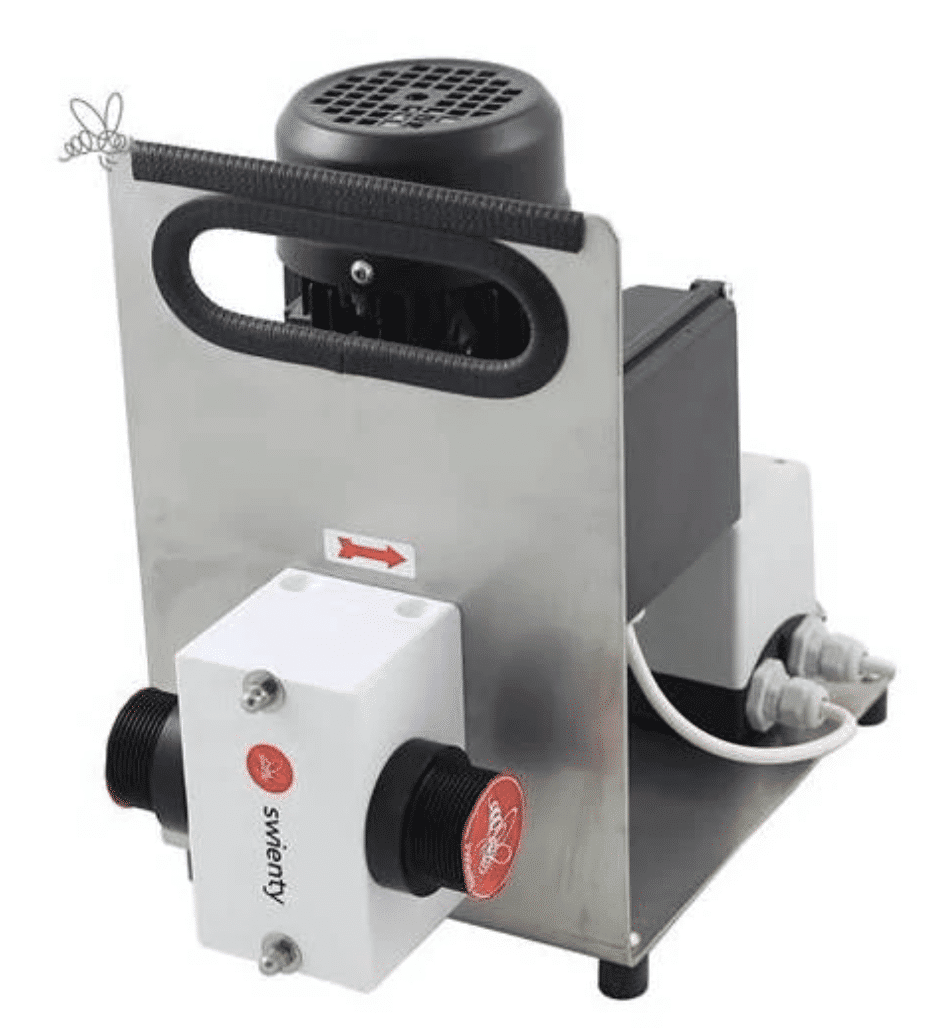
Gear pumps are common in honey filling equipment and compact transfer units. The selected gear profile, clearances and controls determine which honey and filling duties the machine can handle.
How they work
In an external gear pump, one gear drives the other. Product enters where the teeth separate, travels in the spaces between the teeth and casing, and is displaced at the outlet as the gears mesh. It does not flow straight through the meshing teeth in the centre.
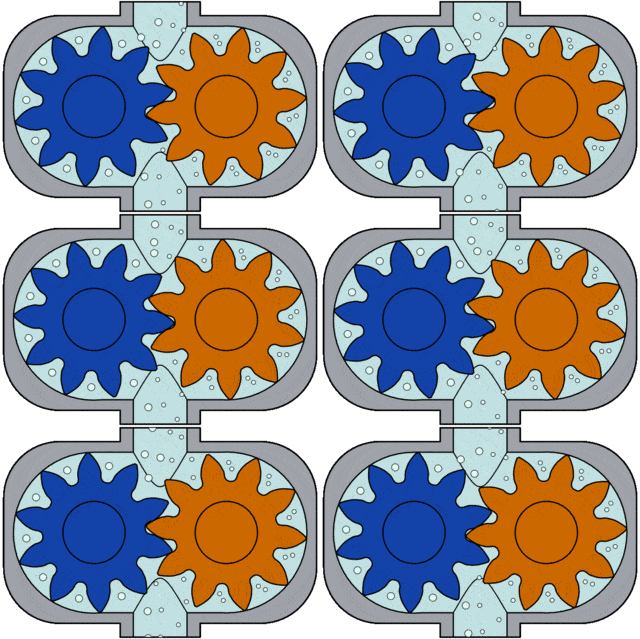
Changing speed changes the theoretical displacement rate; actual delivery also reflects operating conditions. Reverse transfer is possible only where the complete model and its controls permit it. Do not assume that reversing a pump is a safe way to clear an obstruction.
Priming, crystals and wax
Priming performance varies with clearances, seals, viscosity and the installation. Some honey units require the head to be filled before starting. Follow their instructions, including dry-running restrictions, instead of making one rule for all gear pumps.
Close clearances make coarse wax and foreign objects a concern. Prepare the honey as the manufacturer requires. A controlled fine-crystal soft-set honey duty is different from pumping loose cappings or hard-set lumps: neither “all crystals are forbidden” nor “all creamed honey is suitable” is a reliable general rule.
Cost, examples and trade-offs
Strengths: compact equipment and controlled transfer or dosing when matched to the product. Trade-offs: clearances, feed preparation, priming and wear. Obtain a current quotation and a stated honey duty; do not assume that an advertised flow or smooth-running description guarantees the accuracy of every filling setup.
The Swienty 110333 mini pump is rated at approximately 350 kg/h depending on viscosity, with a 200 W motor at 89 rpm. Swienty gives hose-route guidance of up to 6 m straight or 2–3 m upwards; these are not additive guarantees. Its 1½-inch hose quick couplings and hoses are supplied separately. The compact SAF NATURA SN_HP1 has a declared maximum of 100 l/h with adjustable speed and reversible rotation. Compare like units rather than assuming a fixed kilograms-to-litres conversion.
Peristaltic pumps
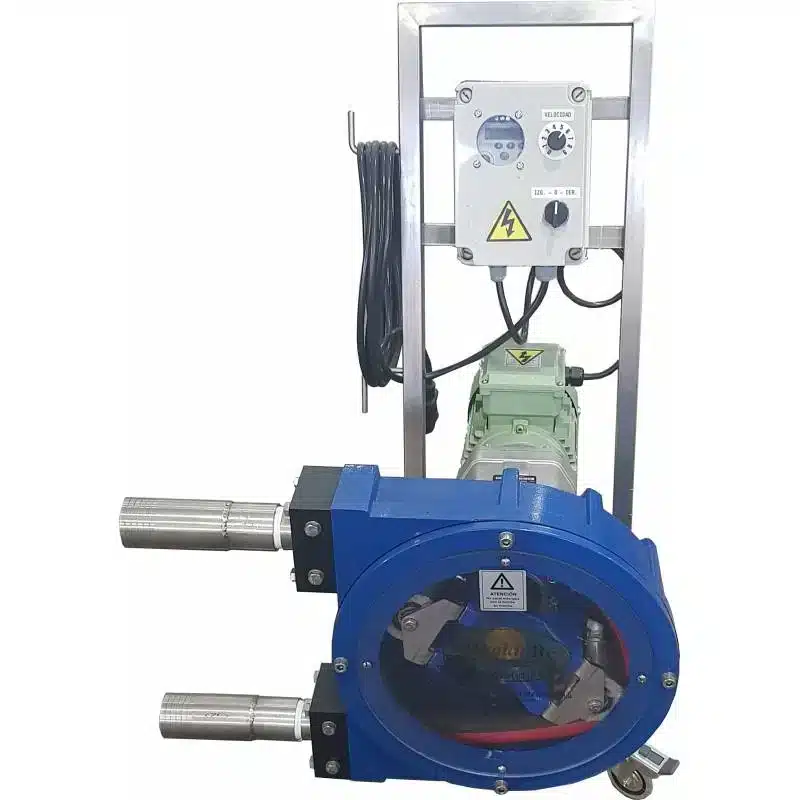
A peristaltic pump moves product inside a flexible tube or hose. Designs range from small dosing heads to larger transfer pumps, so the family is not limited to miniature containers or 10–50kg/h. Select the tubing and drive for the actual duty.
How they work
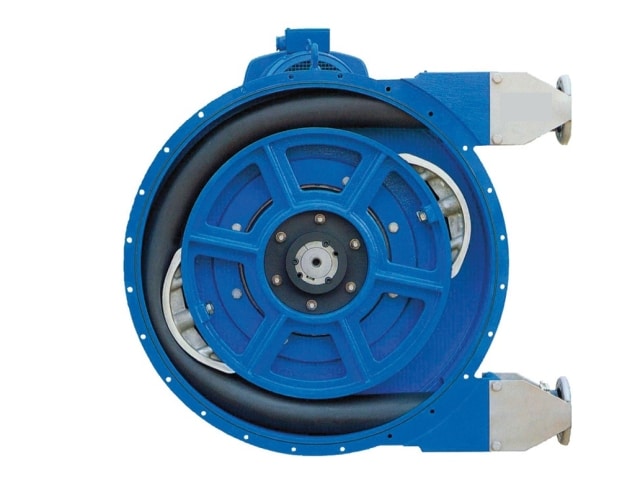
Rollers or shoes squeeze the hose as the rotor turns. The advancing squeeze displaces product towards the outlet; behind it, the hose recovers its shape and draws more liquid in. Verder describes this compression-and-recovery principle.
Think of pushing material along a flexible tube, rather than stirring it with an exposed impeller. The product path through the pumping head is the hose interior, but the hose, connectors and handling procedure must still be suitable and hygienic.
Priming and maintenance
Peristaltic designs are generally self-priming and many permit dry running. Follow the model’s stated limits: that feature does not mean indefinite unattended operation or freedom from temperature and wear constraints.
The hose is a principal consumable. Inspect and replace it as specified, and check fittings, rollers, bearings, drive and controls too. Do not describe the entire machine as maintenance-free or the hose as necessarily disposable after every batch. Product compatibility and the cleaning method determine the suitable hose material.
Capacity, cost and trade-offs
Our PERS001 peristaltic honey pump is listed at approximately 550kg/h. That is an indicative product figure, not a guarantee for cold honey or any pipework. It also shows why a universal 50kg/h ceiling for peristaltic pumps would be misleading.
Strengths: an isolated hose product path, self-priming and suitability for carefully controlled transfer or dosing. Trade-offs: hose replacement, compatibility, pulsation and the chosen model’s pressure and flow limits. Precise dispensing requires the appropriate head and calibration; “zero contamination” is not a hygiene guarantee.
Flexible impeller pumps
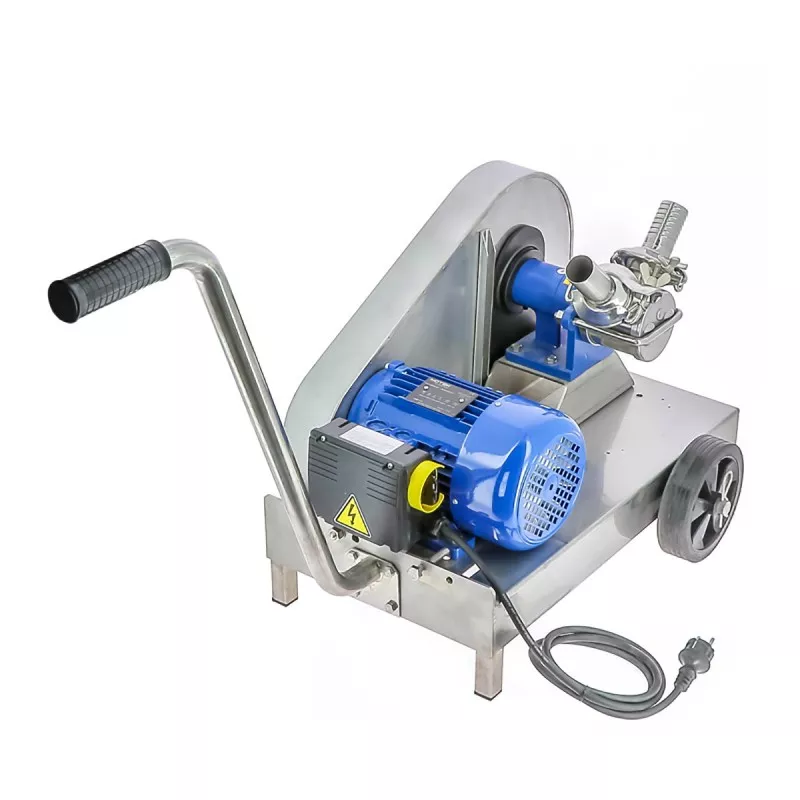
These pumps use flexible vanes on an impeller. They are often called bombas de paletas in Spanish honey equipment descriptions, but should not be confused with every other vane-pump design. Suitable low-speed versions can be practical for honey transfer.
How they work
As the vanes straighten on the inlet side, the space between them increases and draws in product. They carry it around the housing, then bend on the discharge side as the space decreases. Liverani describes self-priming, reversible low-speed designs for viscous products, including honey.

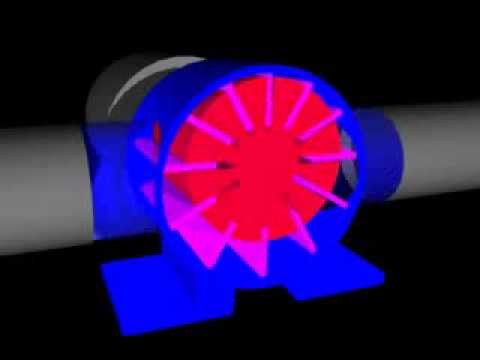
The original demonstration video is retained, starting at 20 seconds. Its displayed title is Spanish. Follow the instructions for your own equipment; the illustration is not a substitute for its operating manual.
Priming, speed and wear
Self-priming capability has defined limits. Follow the manufacturer’s start-up procedure and do not treat a permitted dry start as permission to continue running without product. Keep the inlet airtight and the pump supplied.
Use a speed suitable for viscous honey and the fitted impeller. Some models can handle suspended soft material, but large cappings clumps, hard crystals or foreign objects need a specific compatibility check. Impeller material, speed, product and pressure affect wear; a universal 200–500-hour life or five-metre limit is not useful sizing advice.
Cost and maintenance
Keep the correct spare impeller and seals available. Check access, food-contact compatibility and the approved cleaning procedure before buying. A compact unit may be straightforward to service, but cleaning time and spare-part prices vary.
For the Minor 40 transfer pump, the family table gives 6,900 l/h with water at 20 °C, 900 rpm and 0 m discharge head. The manual says flow and achievable head fall as viscosity increases. This does not establish a honey output of 2,400 l/h by applying a fixed percentage. Ask for the operating point with your honey and pipework, including the required controls and protection.
Strengths: practical self-priming options and relatively simple construction. Trade-offs: impeller wear and performance changes with the duty. Neither suitability for every small honey house nor damage-free pumping at maximum speed should be assumed.
Quick comparison
Use this table to shortlist technologies, then compare specific models. The budget column identifies cost items rather than publishing conflicting historical price bands. Pressure and capacity must be checked at the required operating point.
| Type | Budget considerations | Priming | Wax or solids | Pressure check | Potential use |
|---|---|---|---|---|---|
| Flexible impeller | Impeller, seals, controls | Usually self-priming; follow limits | Only within model limits | Check complete duty | Local transfer and adaptable honey-house work |
| Progressing cavity | Stator, drive, protection | Commonly self-priming; avoid dry running | Suitable designs accept cappings | Pump stages and system ratings | Viscous honey, demanding transfer, approved cappings duty |
| Gear | Pump head, controls, feed preparation | Model-dependent | Coarse wax is a concern | Pump and connected equipment | Clean-honey transfer and compatible filling |
| Rotary lobe / Monolobi | Seals, rotor parts, connections | Model-dependent | Some designs accept soft solids | Exact construction and duty | Controlled viscous-product handling |
| Peristaltic | Hose, drive, replacement schedule | Generally self-priming | Hose and particle limits apply | Model-specific | Transfer or dosing with a hose product path |
Which honey pump do you actually need?
Workload profiles are examples, not rules based on hive count. Yield per colony varies, and annual production alone does not tell you the peak hourly pumping requirement. First identify what must move, where it must go and how fast the rest of the line works.
Smaller honey house: short, straightforward transfers
For a workload such as 50–200kg on a processing day, moving honey between nearby tanks or filling drums, a suitably specified flexible impeller pump may be worth comparing with compact gear or other transfer units. This could describe an operation producing around 500–2,000kg a year, but colony numbers are not a reliable sizing shortcut.
Prioritise easy handling, suitable low-speed operation, practical cleaning and available spares. If gravity already handles part of the route, include that in the layout. A pump selected for a much more demanding cappings or pressure duty may add cost without solving your bottleneck.
A hand-operated filling gun closes the outlet when released. Confirm that the pump and controls are designed for that arrangement; do not attach a shut-off gun to an unprotected pump. Ask for the complete installed price rather than treating the bare unit as the whole investment.
Medium-scale work: controlled transfer and filling
For example, a business handling 200–500kg on busy days may need to feed a filler, change between batches with different viscosities or move honey farther through the building. A rotary lobe or gear model can be a useful candidate, but compare its actual flow range, priming procedure and cleaning access.
- Lobe or Monolobi: check the precise construction, permitted product and seals; do not assume it is always stronger or longer-lived than a gear pump.
- Gear: check feed preparation and compatibility with fine-crystal honey if that is part of your process; do not infer suitability from the word “creamed” alone.
A flooded inlet may simplify operation where the layout permits it. Longer pipework, greater elevation and cold honey need an actual duty calculation, not a promise that every model covers 5–8m of lift or 20–30m of hose. A progressing cavity pump is not automatically excluded at this scale: it must justify its cost through the required duty.
Larger workloads or honey mixed with cappings
For 500–1,000kg on peak days, frequent transfers, long shifts or a honey-and-cappings feed, consider a purpose-specified progressing cavity system alongside any alternatives approved for that process. Operations exceeding 8,000kg a year may value dependable integration and fast access to service, but no technology offers absolute reliability.
- State the mixture: wax proportion, lump size and whether feed arrives steadily or in surges.
- State the route: elevations, pipe lengths, bores and every filter or receiving machine.
- Check control: required delivery range, level sensing and safe stops when a tank empties or fills.
- Check maintenance: cleaning access, spare parts and support during the extraction season.
- Handle blockages safely: stop and investigate using the approved isolation procedure; do not routinely reverse against an unknown obstruction.
The complete investment may include the pump, compatible drive, protective controls, relief arrangement where specified, hoses and professional installation. Compare that total with the cost of downtime in your own operation. Avoid fixed claims about money lost per day or guaranteed savings from one technology.
Special case: feeding a Spinfloat or other separator
A continuous honey-and-wax separator needs a compatible, controlled feed. Obtain the exact machine’s approved pump arrangement, flow range, wax-loading limits and interlocks. A progressing cavity system can be a candidate, but this guide does not establish one compulsory pump family or a universal 200–270g/s feed rate for all Spinfloat models.
Agree the pump and separator as one system with the supplier. A general pump description is not enough to confirm particle passage, suction conditions or the effect of feed variation on separation.
Special case: creamed or soft-set honey
Soft-set honey is produced by controlled crystallisation, not by treating any long recirculation cycle as a universal recipe. Match the pump to the texture and the production method, minimise unnecessary air, and verify results with the actual honey.
Suitable gear, lobe or other low-shear designs may be used where the manufacturer approves the duty. Progressing cavity pumps are not inherently too aggressive, and all flexible impeller pumps should not be dismissed as inevitably beating air into honey. Avoid prescribing 48–72 hours of pumping at 14°C for every batch.
Special case: royal jelly, cosmetics and small fills
A correctly specified peristaltic dosing system can be useful for small containers and products where an isolated hose path is valuable. Specify the formulation, container size, required filling accuracy and cleaning process. It is not the only possible technology for royal jelly or cosmetics.
Food or cosmetic compatibility, hose condition and hygienic handling still need validation. A 20–100g filling application and bulk honey transfer require different sizing; neither drop-by-drop precision nor a low maximum flow follows automatically from the word “peristaltic”.
A quick decision checklist
- Honey with cappings or a separator feed? Start with the machine-approved mixture and pump specification.
- Long shifts or high daily throughput? Compare the complete duty, service access and controls, not annual kilograms alone.
- Soft-set honey or sensitive dosing? Check product compatibility and measured performance at the intended texture.
- Clean-honey transfer with a favourable inlet? Compare compact lobe and gear models as well as other suitable designs.
- Short, simple transfers? Assess a flexible impeller unit and whether gravity can do part of the work.
- Small fills or a hose-only pumping path? Assess a peristaltic model with the right tubing and calibrated controls.
Three expensive mistakes to avoid
1. Buying capacity you do not need. A more expensive pump is not automatically a better investment for a modest transfer duty. Compare like-for-like complete quotations and put the difference where it solves a real processing constraint. Equally, do not buy too small simply to minimise the initial price.
2. Omitting overpressure protection. A closed valve, blocked filter or obstruction can expose hoses, connections and receiving equipment to excessive pressure. The resulting failure can injure an operator as well as damage equipment. Provide the manufacturer-approved protective arrangement; there is no dependable universal time-to-failure or repair bill.
3. Leaving cleaning until later, then forcing a blocked pump to start. Residual honey can crystallise or leave parts stuck. The time varies with the honey and conditions; it is not always 48–72 hours. Do not repeatedly energise a stalled pump. Isolate it and follow the approved inspection and cleaning procedure.
Plan cleaning after use, including the hoses and fittings. Use water, detergents, temperatures and dismantling steps compatible with the manufacturer’s instructions and your hygiene procedure. Keep electrical parts protected and remove residual rinse water before the next honey batch. Five minutes of hot water is not a universal validated cleaning programme.
Ask for a quotation based on your actual work
We can help compare equipment for your honey house. To make the recommendation useful, tell us:
- Your annual production and, more importantly, the amount to transfer during the busiest working period.
- The operations: transfer, filling, cappings handling, soft-set honey or another product.
- Honey temperature and condition, including crystals or wax fragments.
- Distances, elevations, hose dimensions, connected machines and available electrical supply.
- Your budget and the level of automation you need.
Ask the quotation to distinguish the pump, controls, necessary protective equipment, hoses, fittings and installation. Include spare-part availability and an estimated maintenance budget with its assumptions. The aim is a suitable, serviceable system—not a promise of a fixed lifespan or the most expensive pump by default.
For tanks without a bottom outlet, the LYSON W20210S vertical pump requires a 400 V supply and its pumping section must be immersed before starting. The manual gives a reference of 1,500 l/h with honey at 30 °C. Its curve for honey at 40 °C shows approximately 2,900 l/h at 1 m lift, 2,400 l/h at 3 m and 1,400 l/h at 5 m. The same manual specifies about 40 litres of water at 50–60 °C for rinsing; this is a wash-water temperature, not a honey-heating instruction.
Frequently asked questions
Which honey pump do I need?
Choose from the actual honey condition, peak throughput, inlet and outlet layout, and whether cappings or a connected machine are involved. Hive count and annual production are only context. Compare complete models and installed costs, not just pump families.
What does self-priming mean?
It means a pump can draw product into the inlet under its specified conditions rather than relying entirely on a flooded feed. It does not imply unlimited suction lift or safe continuous dry running. Follow the model’s start-up and dry-running instructions.
Why use a variable-speed drive?
It lets a compatible pump operate at a speed suited to the product and receiving equipment. It can help control flow and unnecessary agitation, but it does not replace level sensing, pressure protection or measurement where a process needs them.
Can a pump move honey mixed with cappings?
Some models can, provided the wax concentration, particle size and inlet arrangement are within their limits. Do not assume every progressing cavity pump accepts any lump, or every other pump family rejects all soft solids. Specify the actual mixture.
Why do positive-displacement pumps need overpressure protection?
If the outlet is closed or obstructed, pressure can rise to an unsafe level. The system needs protection appropriate to the pump and the lowest-rated connected component. A relief or bypass arrangement may be required; there is no universal setting for every honey installation.
Can I pump crystallised honey?
Only if the pump and process are suitable for its actual texture. Fine-crystal soft-set honey is different from hard-set lumps. Do not force a stalled pump or assume one warming temperature solves every batch; follow equipment limits and control heat exposure to protect honey quality.
Further reading
- Honey extraction lines: where pumping fits into the process.
- Straining honey: planning filtration and settling.
- Uncapping tools and technique: where the cappings come from.
- Honey moisture: checking the product before bottling.

ISNI 0000 0005 1801 1100 | Joshua Ivars is the manager of LA TIENDA DEL APICULTOR and the author of this blog, where he shares technical and practical guidance for beekeepers. Drawing on extensive experience in the beekeeping sector, he offers advice and solutions based on beekeepers’ real needs, sharing his knowledge of equipment and essential beekeeping practices.


