
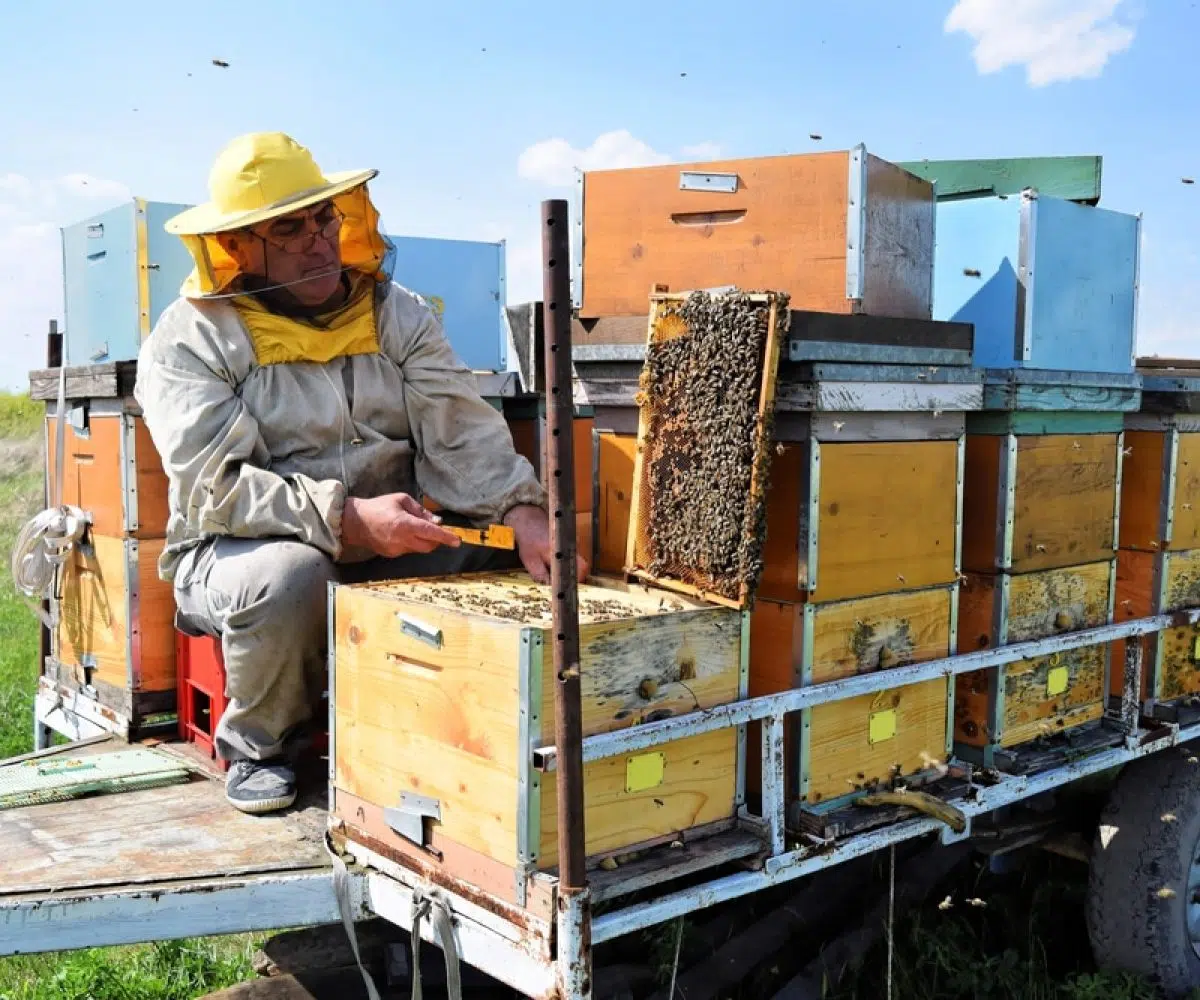
Moving beehives involves more than lifting boxes onto a vehicle. Distance, weather, colony strength, ventilation and handling all affect the bees’ survival and their ability to find the new entrance. Plan the destination and the entire journey before disturbing the colonies.
This guide covers short moves within an apiary, moves of a few kilometres and longer journeys for migratory beekeeping. Distance examples are practical guides, not guarantees that no foragers will return to the old stand. Road transport also requires suitable equipment, experienced help and compliance with the rules that apply where you operate.
Short moves within the same apiary
During orientation flights, workers learn the position of their hive in relation to surrounding landmarks such as vegetation, posts and stones. These local cues help returning foragers locate the entrance. Moving the hive while those cues remain familiar can send them back to its former position.
For a move of only a few metres within the same apiary, one option is to shift the hive gradually in small stages. Give the bees time to find the entrance after each stage. Do not combine a large change of position with an automatic daily schedule simply because the boxes are easy to move.
Choose each step according to the site and the bees’ response. The space between neighbouring hives, entrance direction and visible landmarks matter as well as the measured distance.
Watch returning foragers after a move. They may hesitate at the old position or drift into nearby colonies. After a small displacement—sometimes less than a metre—they may locate their hive again, enter, or fan at the landing board to help other workers orient. This observation does not establish one safe distance for every apiary.
Wait until returning bees are finding their own entrance consistently before making another small move. Confusion may persist for several days. If bees continue gathering at the old stand or entering neighbouring hives, pause and reassess instead of increasing the distance.
An isolated hive has fewer neighbouring colonies into which its bees can drift, but this does not remove the risk of losing foragers. Moving beehives forwards or backwards can preserve the entrance’s alignment better than a sideways move across a row. Treat that as a site-dependent consideration, not permission to make a much larger step.
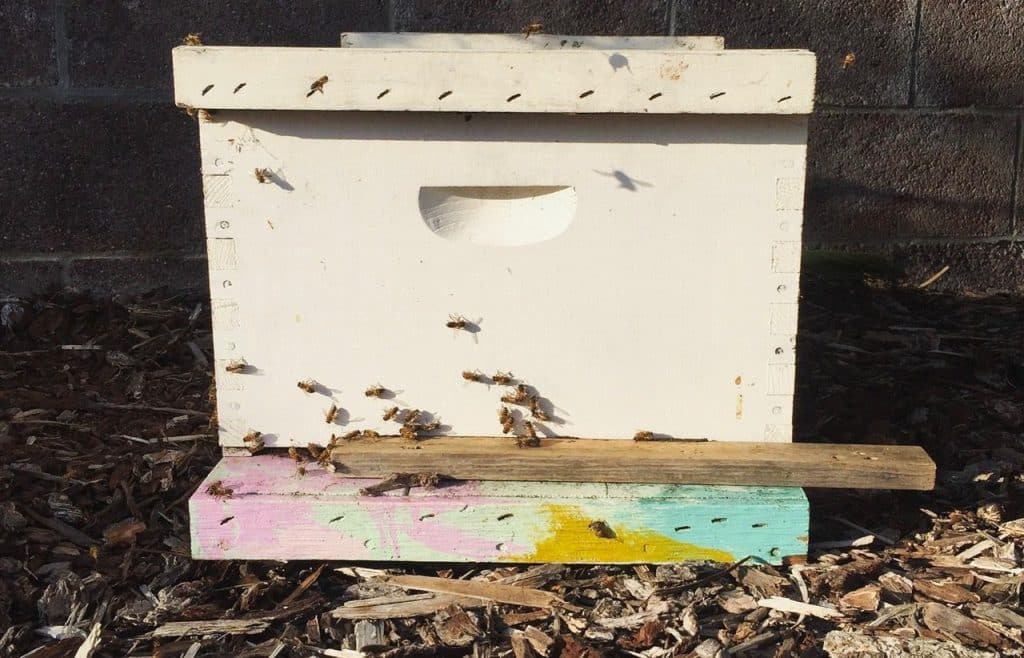
Late evening, once flight activity has largely stopped, is often a suitable time for a short move. Handle the hive gently and keep its boxes securely together. A changed entrance landmark, such as the board illustrated above, must not seal the bees in or obstruct ventilation.
Recovering returning foragers: a box with suitable frames at the old position can collect displaced bees. An experienced beekeeper can reunite those bees with their healthy original colony after flight has stopped, using an appropriate uniting method; a newspaper barrier is one traditional option. Check health and queen status before any union. Alternatively, removing an unused old stand can reduce the cues drawing bees back, as discussed by Jamie Ellis in American Bee Journal.
Editorial paraphrase of a traditional recovery method; the Spanish article cites The Hive and the Honey Bee, Dadant & Sons. Not a verified verbatim quotation.

Short-move summary: conservative steps of around 30–50 cm, with several days between them, are one practical approach. The original Spanish diagram above illustrates 0.5–1 m stages every 4–8 days. These are examples of gradual relocation, not equivalent fixed prescriptions or a promise to retain every forager; observe the colony and adjust the pace.
Intermediate moves: a few metres to several kilometres
A move that leaves the colony within familiar foraging country can bring workers back to the old stand. This is a particular concern over a few metres to a few kilometres. The familiar short-move/long-move rule of thumb highlights that risk, but 3 km, 5 km and 6 km are not precise biological cut-offs. Landscape, forage and the bees’ previous flight range all affect the result.
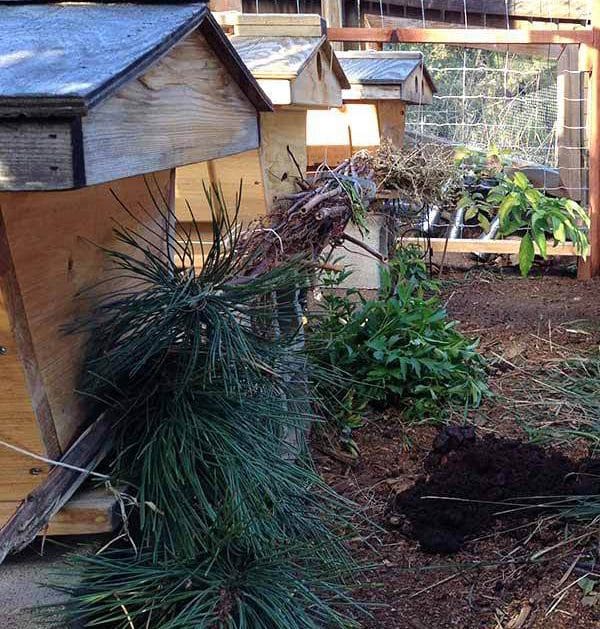
A few metres to 3 km: the temporary-apiary option
For a final move of, for example, 2 km, one traditional option is a two-stage relocation via a more distant temporary apiary. It requires a suitable second site and two properly planned journeys; it is not compulsory for every short move and does not guarantee zero losses.
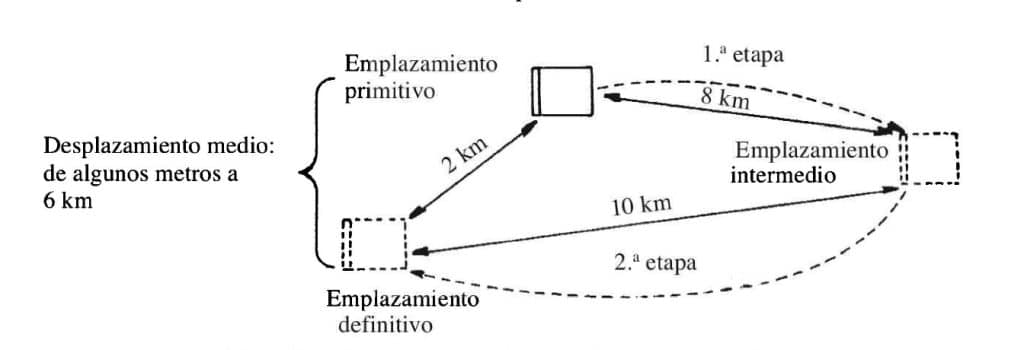
First move the colony to a temporary site outside its familiar foraging area. The original Spanish diagram illustrates an 8 km first journey. Traditional advice often allows several weeks there—around a month in summer and longer in winter—before bringing it back towards its original area. A calendar interval does not prove that every worker familiar with the old site has died; worker longevity and colony turnover vary.
Then move the colony from the temporary apiary to its final position. In the illustration, that final position is 2 km from the original stand and 10 km from the temporary one. The Spanish labels mean original, intermediate and final location; the arrows show the first and second journeys. The distances illustrate the arrangement rather than define universal minimums.
The purpose is to encourage orientation to each new site while reducing the chance that foragers recognise the original area on their return. Check activity, bee coverage and stores after each move. If suitable distant accommodation is unavailable, seek experienced local advice on a direct move and a plan for returning foragers rather than assuming that branches alone will prevent losses.
Direct moves of 3–5 km
A direct move of 3–5 km measured in a straight line may work well in some circumstances, but it is not a reliable boundary beyond which only a few bees return. Consider whether the new and old foraging areas overlap. A longer road journey does not necessarily mean a longer flight distance between the two apiaries.
Arrange loading for when most foragers are home, commonly after flight has ceased in the evening or before it starts in the morning. Choose a cool weather window and allow enough time for safe handling. Darkness helps retain flying bees; it does not replace containment or ventilation.
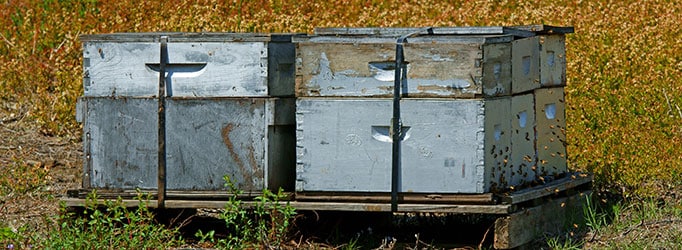
Strap the hive components securely and check joints, cracks and other unintended exits. For closed-entrance transport, use suitable bee-tight ventilated closures and keep the intended ventilation paths clear. Closed to escaping bees must never mean airtight. Secure the hives to the vehicle as well as securing each hive’s boxes together.
Have the new stands ready before arrival. For closed-entrance moves, place the hives securely in their final positions before reopening them, with people clear of the flight paths. Work promptly enough to avoid heat build-up. Shade and ventilation take priority over leaving a loaded vehicle waiting. A fine water mist can be useful in specific handling situations, but soaking bees is not a substitute for airflow or a guarantee against disorientation.
Long-distance moves: migratory beekeeping
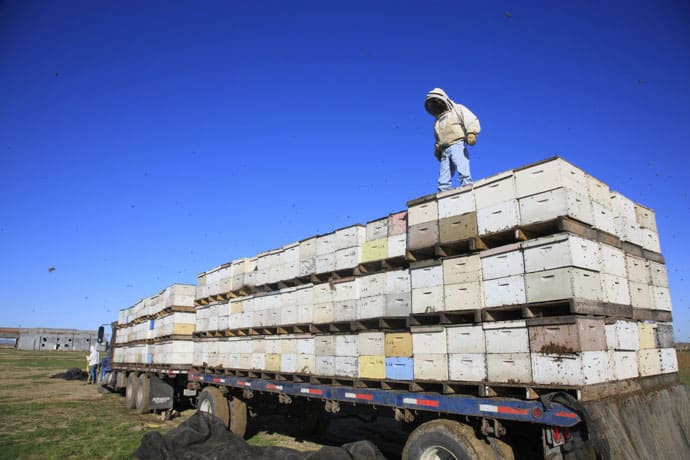
Migratory beekeeping means moving colonies between sites to follow forage or provide pollination. Both closed-entrance transport and specialist open-entrance transport are used. The latter means bees are contained within a properly secured transport system; it does not mean allowing them to fly freely from a vehicle on public roads.
Closed entrances and open-entrance transport
With closed-entrance transport, mesh screens or purpose-designed ventilated covers provide airflow while the entrances are secured. Suitability depends on colony strength, equipment, temperature and journey duration. Even a short trip in cool conditions needs ventilation; never seal an occupied hive completely.
Strong colonies can overheat or suffer inadequate gas exchange when confined. A mesh top alone may be insufficient if the load blocks airflow or the vehicle is delayed. Do not explain transport losses by assuming that stressed bees inevitably consume all their larvae for water. Assess the real risks—heat, ventilation, confinement and handling—and postpone a move if they cannot be controlled.
Open-entrance systems are used by some professional operators for strong colonies and longer journeys, including summer moves. Their design must maintain air movement and prevent escape throughout the trip. Adequate ventilation is needed to remove heat, moisture and carbon dioxide, not merely to leave an entrance open.
A system that saves loading time is only an advantage if containment, welfare and human safety remain satisfactory. Open entrances do not guarantee calmer bees, and the method is not a default recommendation for beginners. Use a transporter or experienced beekeeping team with equipment suited to the load.
Open-entrance transport: a specialist operation
Planning an open-entrance move with an experienced team:
1. Check colony health, weather, destination, equipment and any required documents; use smoke sparingly where needed for handling.
2. Load and secure the hives while maintaining ventilation and keeping bystanders clear.
3. Enclose the load with an effective bee-escape prevention system before travel; ordinary shade cloth is not automatically suitable.
4. Follow the planned route, with a contingency for delay or breakdown.
5. Unload promptly and safely at the prepared apiary. Do not rely on engine noise or vibration to control the bees.
Loading the hives
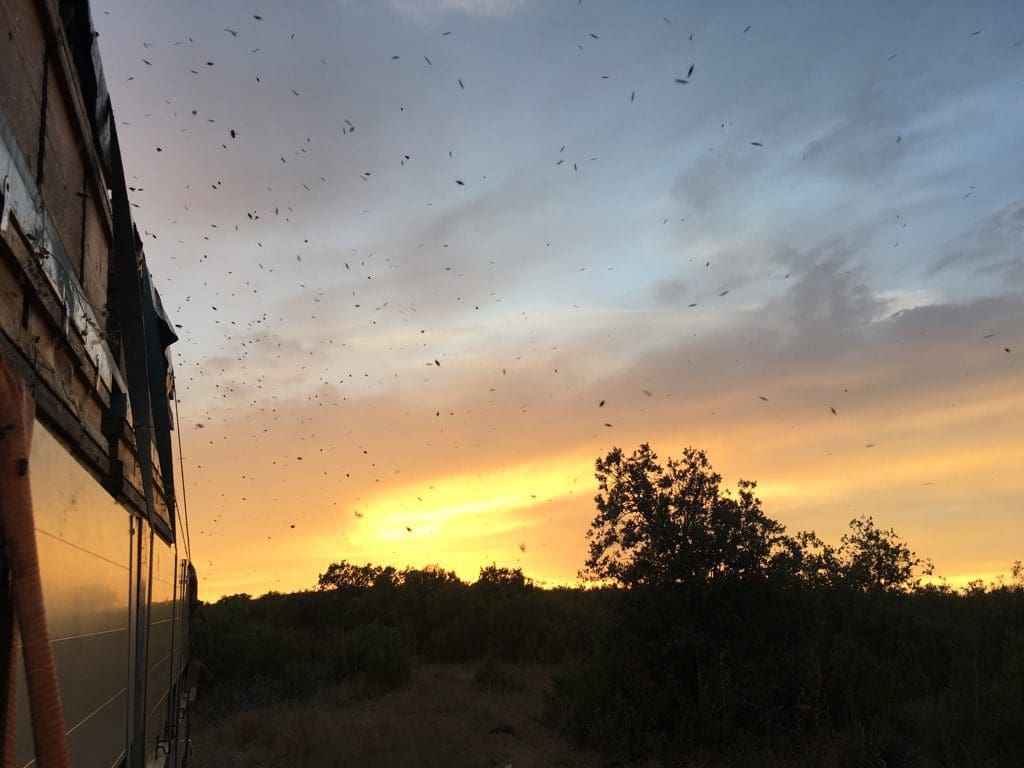
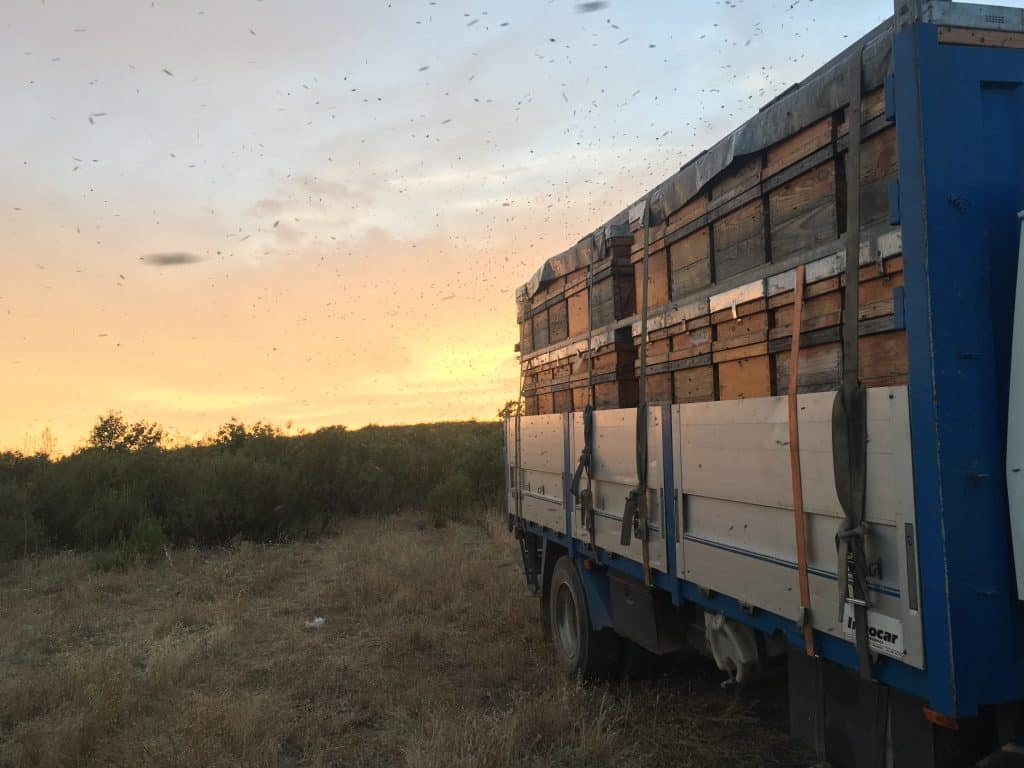
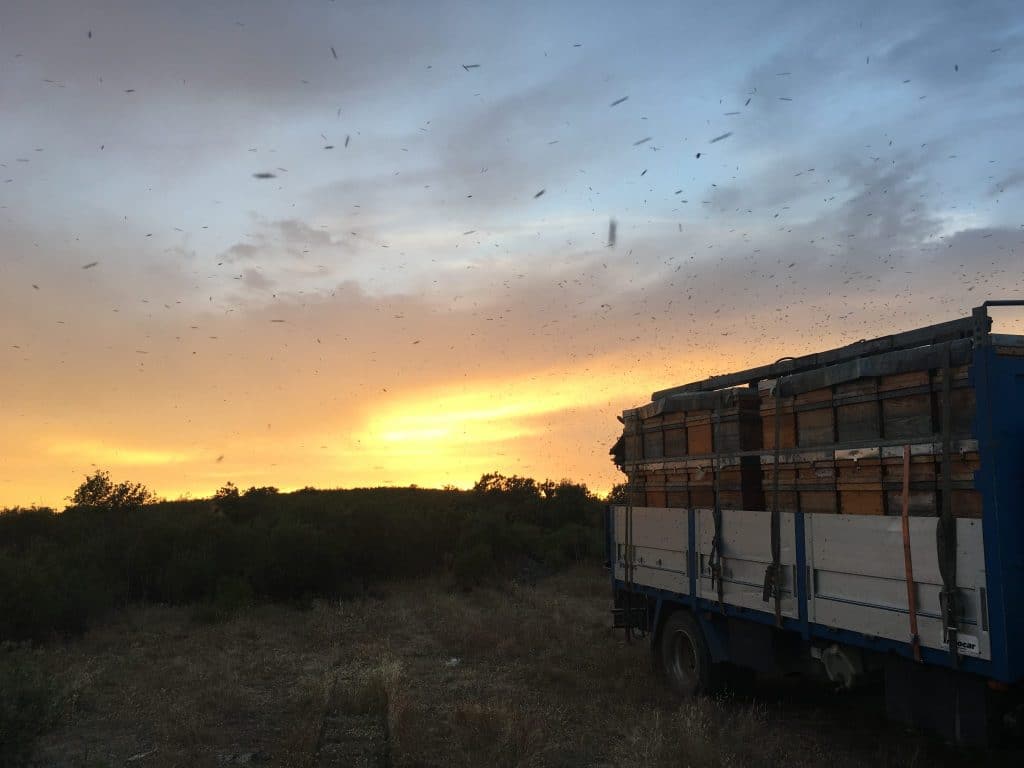
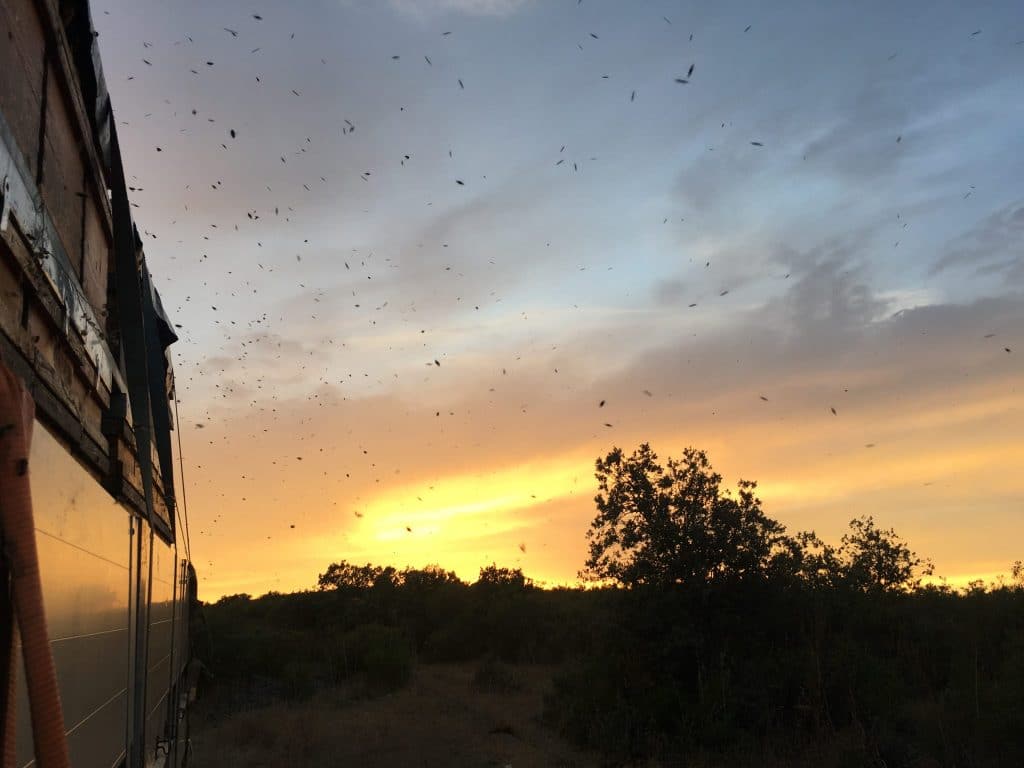
Plan loading near the end of the flying day where conditions permit, while there is still enough visibility to work safely. Finishing before full darkness can help the team, but bees may still be flying: account for stragglers and do not assume that sunset brings every worker home.
Use appropriate lifting aids, a trolley or sufficient trained help. Apply only the smoke needed for controlled handling and observe local fire restrictions. Arrange entrances and ventilation gaps to suit the particular vehicle and hive system, and secure the load within its rated capacity. There is no universally safe two-metre stacking height. Hives remaining at the old apiary may receive returning foragers, but uncontrolled drifting is not a complete recovery plan.
Spanish transport rule: Article 11.6 of Royal Decree 209/2002 requires hive entrances to be closed during transport or, if open, the hives to be covered with a net or another system that prevents bees escaping. This is a Spanish requirement, not a statement of the law everywhere. Check the applicable movement, health and registration requirements with the competent authority before departure.
Royal Decree 209/2002, Article 11 — BOE, Spain (Spanish text). Summary, not a verbatim quotation.
An evening departure or a pre-dawn journey can help avoid the hottest period and fit the intended unloading time. Choose the schedule around actual weather, traffic, access and driver safety, rather than treating night travel as sufficient protection on its own.
Inspect the containment system around the whole load, including its edges and fastening points. The important requirement is effective escape prevention, not a particular nylon material or the fact that few bees are visible. In Spain, Article 11 also addresses movement documents and provides for an advance health certificate when a stationary holding needs to move colonies; confirm the procedure for your particular movement.
During the journey
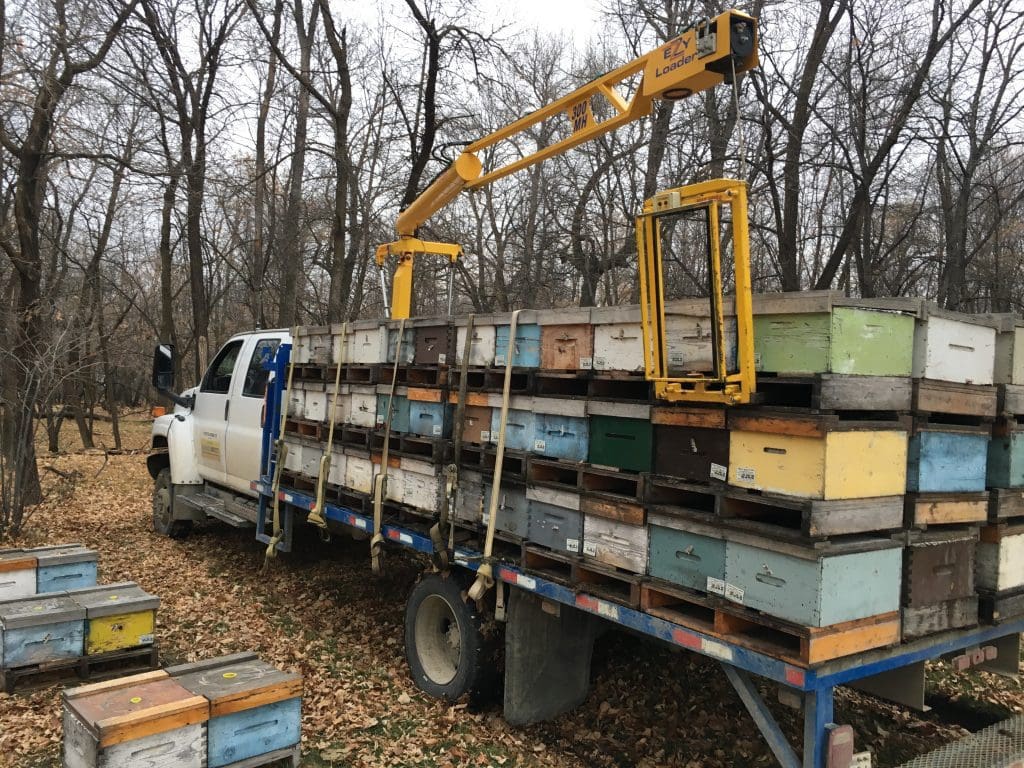
Bees may crawl outside their hive boxes in an open-entrance system, making secure containment especially important. Movement and vibration can injure bees and do not guarantee that they will remain inside. Avoid rough handling and inspect the securing system safely at appropriate points; never open the load among unprotected members of the public.
Arrange spacing and ventilation channels according to the hive and transport system; suitable spacers can help maintain airflow between layers where the load design allows them. No preparation makes transport safe in any heat. Avoid unnecessary delays and exposed sunny stops, but recognise that traffic or a breakdown can interrupt airflow. Penn State’s honey bee transport emergency guidance highlights rapid overheating in stationary loads and the need for coordinated specialist help.
Plan stops before leaving: refuel in advance, check the route and arrange a safe contingency location away from bystanders. Do not improvise fuel carriage or bypass necessary rest stops to keep the bees moving. If the vehicle breaks down or bees escape, prioritise people’s safety and contact appropriate emergency services and experienced beekeeping assistance.
Editorial transport-planning guidance, replacing the original book-attributed advice about carrying spare fuel. Not a quotation from The Hive and the Honey Bee.
Unloading at the destination
Unloading around dawn or dusk can reduce flight activity compared with a hot, bright part of the day. Balance that advantage against visibility, ground conditions and the team’s ability to handle heavy hives safely. Have the stands, vehicle access and unloading order ready.
Bees can become defensive during unloading and can crawl into gaps in clothing, especially when visibility is poor. Wear suitable, properly closed protective equipment and keep unprotected people away. Use lighting that allows safe work while minimising attraction of bees where possible. Do not leave an engine idling on the assumption that vibration calms them. Follow the vehicle and lifting equipment’s safe operating procedures, place each hive securely, and confirm that entrances and ventilation are unobstructed before leaving.
Learn more about beekeeping
Explore our online introductory beekeeping course, taught in Spanish.
The course covers a broad introduction to beekeeping with experienced instructors. The original presentation video below is also in Spanish; it is not an English transport-safety tutorial.
![Introducción al Curso de Apicultura [SÚPER COMPLETO]](https://www.latiendadelapicultor.com/blog/wp-content/plugins/wp-youtube-lyte/lyteCache.php?origThumbUrl=https%3A%2F%2Fi.ytimg.com%2Fvi%2FuJomNRA0UP8%2F0.jpg)

ISNI 0000 0005 1801 1100 | Joshua Ivars is the manager of LA TIENDA DEL APICULTOR and the author of this blog, where he shares technical and practical guidance for beekeepers. Drawing on extensive experience in the beekeeping sector, he offers advice and solutions based on beekeepers’ real needs, sharing his knowledge of equipment and essential beekeeping practices.


