
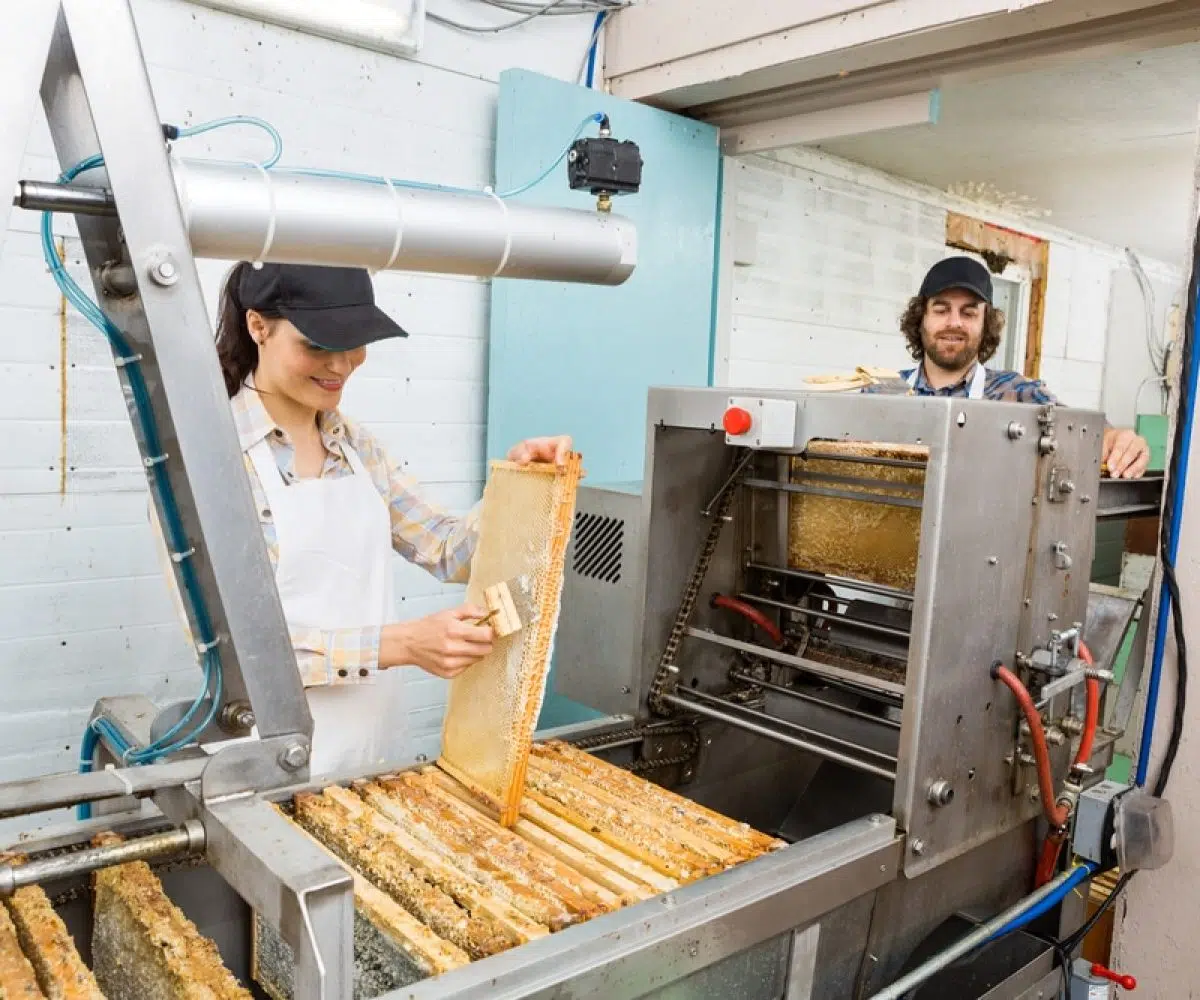
A honey extraction line links uncapping machine, cappings processing and extractor so that honey flows out without manual handling between machines. The fundamental decision is not the brand: it is whether you work cold or hot. And the most common trap is installing a complete line without sufficient volume to amortise it.
Cold or hot: the fundamental decision
| Cold | Hot | |
|---|---|---|
| Uncapping | Horizontal chain type | Heated vertical |
| Cappings processing | Centrifuge or press | Melter |
| Effect on honey | No direct heat is applied at this stage; HMF still depends on the honey’s history and storage | Heat exposure needs control; excessive heating raises HMF risk |
| Frame sizes accepted | Depends on the machine; mixed Layens and Dadant frames only if it is designed for them | Often limited to one frame size |
| Cleanliness of cut | Less clean: more filtration required afterwards | Cleaner |
| Labour | At least 2 operators for continuous flow | Less |
In this guide
- what a line is and when it is worthwhile;
- the types available on the market;
- cold extraction lines;
- hot extraction lines;
- horizontal extractors and portable lines.
Extraction and processing are two of the most time- and labour-intensive tasks during the season. Honey extraction lines automate much of the process: they reduce labour, shorten times and free the beekeeper to focus on urgent priorities, such as capitalising on a new nectar flow with migratory beekeeping or advancing health treatments.
What is a honey extraction line?
What components does it consist of?
A complete honey extraction line consists of several machines working together to automate the entire process. The main components include an automatic uncapping machine, which removes the wax cappings sealing the comb; a cappings-processing system (whether a centrifuge, press or wax melter); and a horizontal extractor, where centrifugal force removes the honey from the frames.
Other key elements include settling tanks or pressure filters, which clean the honey before storage; guide rails that connect the machines and keep frames moving through the line; and transfer pumps for honey, cappings or both.
When the entire system is properly integrated, a continuous production line is achieved that allows uncapping, extracting, processing cappings and filtering honey continuously and without manual intervention, saving time and avoiding bottlenecks.
Summary:
- Automatic uncapping machine
- Cappings processing (press, wax melter or centrifuge)
- Horizontal frame extractor
- Honey decanter / Pressure filter
- Connecting rails between the uncapping machine and extractor
- Transfer pumps for honey and/or cappings
When is it worthwhile for me?
Before installing a line, carefully consider these factors:
- Production volume: Do you extract enough honey to justify the investment?
- Overlapping nectar flows: Do you have short extraction windows?
- Staff availability: Do you have teams split between field and storage?
- Physical space: Do you have a fixed workshop or do you need a transportable solution?
- Budget and subsidies: Do you have access to grants that make it viable?
⚠️ Important tip: Many beekeepers rush to install complete lines without processing enough honey to justify them. In such cases, it may be better to start with a partial setup (for example, an uncapping machine plus 2 extractors), which already allows continuous operation without additional handling.
What types of lines are available on the market?
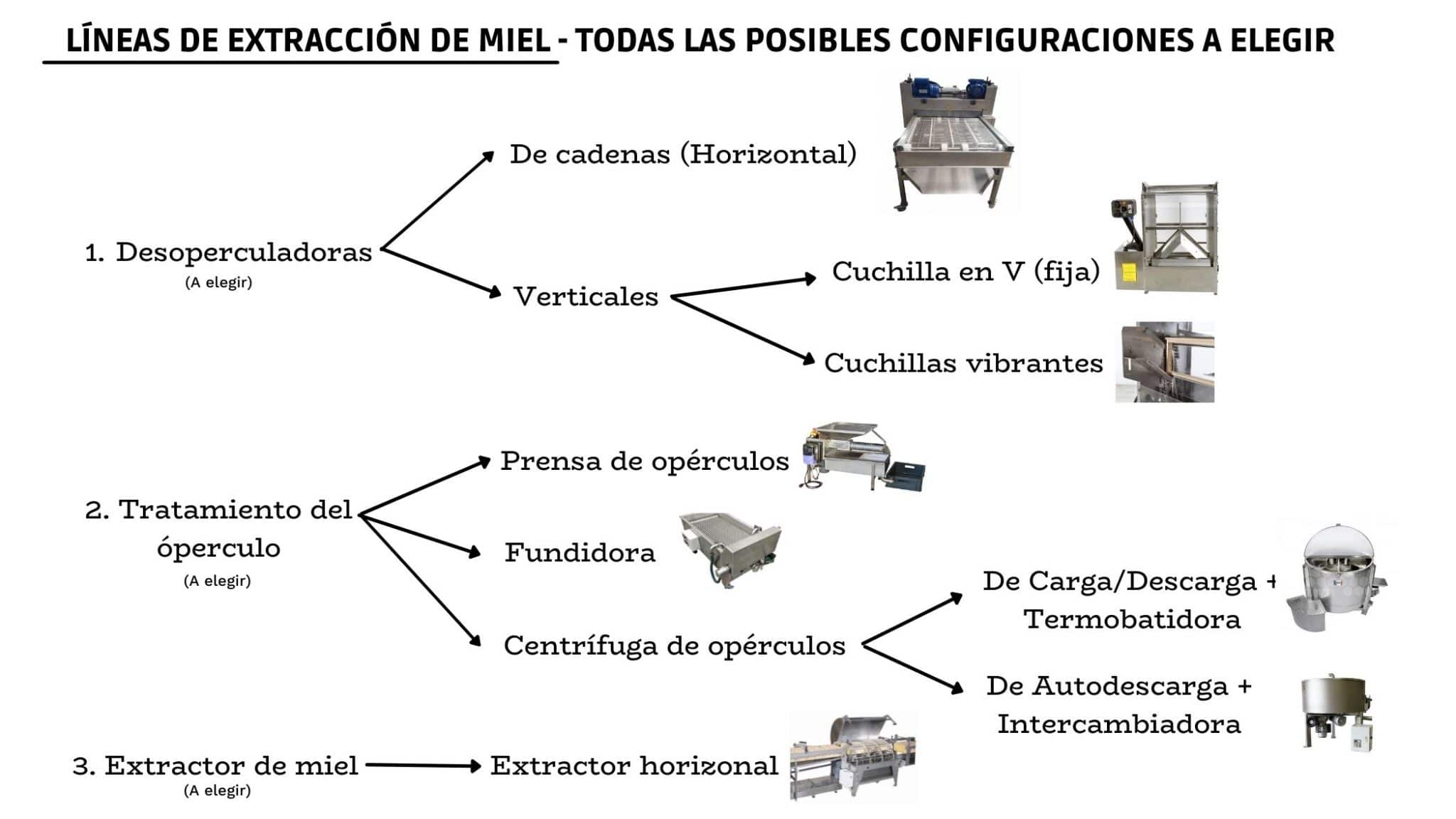
Today, the market offers a wide variety of possible configurations for setting up a honey extraction line. The ideal choice will depend on multiple factors: production volume, type of hive used, space available in your extraction workshop, your budget, or even your personal preferences as a beekeeper.
Although each line can be supplemented with additional elements such as transfer pumps, decanters or connection guides, the core operational components usually consist of three main machines:
- The uncapping machine, which removes the wax sealing the combs.
- The cappings-processing system, which separates the wax from the honey.
- The frame extractor, which releases honey from inside the combs by centrifugal force.
From this base, simpler or more sophisticated lines can be built. Below, we review the main available configurations and their most relevant features.
Types of honey extraction lines
Cold extraction lines
These lines avoid direct heat at this stage. They can help preserve the honey’s sensory properties, but HMF also depends on previous heat exposure, storage and the starting honey.
a) Horizontal chain-driven uncapping machine
- Invented by Donald Gunnness (Dakota brand).
- Suitable for all frame types, including mixed configurations such as Layens + Dadant.
- Use chains instead of blades, so they do not generate heat.
- Require at least 2 operators for continuous flow.
b) Cappings centrifuge (with or without self-unloading)
- Separate honey and wax; some models need temperature management because honey viscosity affects feeding.
- Process honey from the extractor and cappings simultaneously.
- Need a viscosity suitable for the model; follow the manufacturer’s instructions rather than a universal temperature.
- Models:
- Charge/discharge (‘cheese’ cages): more economical, but less practical.
- Self-discharge: ideal for continuous operation, but require a constant and homogeneous feed.
➡️ To feed the centrifuges correctly, the following are used:
- Thermostatic heaters → for loading and unloading centrifuges.
- Heat exchangers → for self-unloading centrifuges.
A cappings centrifuge can remove coarse solids, but the need for further filtration or settling depends on the product and equipment. Check the honey before storage.
c) Cappings press
- Operate using a screw and perforated cylinder.
- Do not require heat.
- Compact units that pair well with vertical uncapping machines.
- Disadvantage: the extracted honey may have a more acidic flavour.
Hot extraction lines
These lines apply controlled heat at certain stages, mainly during uncapping or cappings processing. They are the most common in Europe.
a) Heated vertical uncapping machines
- Types: vibrating blade or V-blade (Delta).
- Use heating elements or steam to heat the blades.
- Produce cleaner cuts.
- Highly productive and compatible with other automated components.
- Important: the first year may be problematic if frames are damaged (buckles, broken heads, etc.).
The thermal impact and any HMF change depend on contact time, temperature and the starting honey. A few seconds is not a universal safety guarantee.
| Condition | What to consider |
|---|---|
| Cool, stable storage | Slows quality changes; use clean, dry, covered containers. |
| Warm storage | Accelerates changes; avoid unnecessary heat and long holding times. |
| Repeated heating | Can alter colour, aroma and composition; follow the equipment process. |
| HMF assessment | Use a suitable analysis when a specification matters; do not infer a limit from a single temperature. |
b) Cappings melters
- Economical and compact.
- Their temperature is model-specific and should be set according to the manufacturer’s instructions; excessive heat can affect honey quality.
- Separate liquid wax and honey. Keep the streams identifiable and decide their use under the applicable food-safety requirements; do not blend them automatically.
- Require constant supervision to avoid overheating.
c) Alternative: presses or centrifuges
- The presses can be installed directly beneath vertical uncapping machines.
- The centrifuges, if used, will need a thermostatic heater or heat exchanger depending on the model.
Horizontal extractors
- Standard in all automated lines.
- Greater capacity than conventional radial or tangential extractors.
- Uncapped frames are loaded into rectangular steel cages that slide directly into the drum.
- Maximise workflow efficiency.
Portable extraction lines
- A solution mounted on a trailer or trolley.
- Ideal for horizontal hives (Layens), migratory beekeeping or operations without a fixed workshop.
- Avoid transporting frames and allow harvesting directly in the apiary.
In summary
Choosing an appropriate honey extraction line is not merely a matter of budget, but of strategy, volume and logistical needs. Automating this process can be a significant medium-term investment if properly designed. Sometimes less is more: starting with an intermediate solution and scaling up as your operation grows may be the best decision.


Frequently asked questions
What is a honey extraction line?
It is a coordinated set of machines—uncapping machine, cappings-processing system and extractor—that moves frames and honey through several stages with less manual handling.
What components does a honey extraction line need?
At its core, it needs an uncapping machine, a cappings-processing system such as a press, melter or centrifuge, and an extractor. Filters, decanters, rails and transfer pumps depend on the layout and product.
When is it worthwhile to install a honey extraction line?
When the production volume, extraction windows, staff and available space justify the investment. A partial configuration can be a sensible first stage while the operation grows.
What is the difference between a cold and a hot extraction line?
A cold line avoids direct heat in the line; a hot line uses controlled heat for some operations. Heat can improve cutting but needs control, and frame compatibility depends on the equipment.
At what temperature do cappings centrifuges operate?
There is no single setting for every model. Honey must have a viscosity the machine can handle; follow the manufacturer’s instructions and monitor the product rather than copying a universal figure.
Is it necessary to settle honey after a cappings centrifuge?
Not always, but a centrifuge does not make every batch automatically ready for storage. Inspect the result and use the filtration or settling steps required by the equipment and honey.
Continue reading
- Uncapping, the stage that opens the line.
- Honey filtration, and why the sieve matters.
- Honey pumps, for transfer.
- Honey moisture, prior to bottling.

ISNI 0000 0005 1801 1100 | Joshua Ivars is the manager of LA TIENDA DEL APICULTOR and the author of this blog, where he shares technical and practical guidance for beekeepers. Drawing on extensive experience in the beekeeping sector, he offers advice and solutions based on beekeepers’ real needs, sharing his knowledge of equipment and essential beekeeping practices.


