
How chemical signals coordinate the colony
Honey bee pheromones are chemical signals that help coordinate colony life. Some prompt rapid actions, such as joining a defensive response; others influence physiology and the development of tasks over time. They work alongside touch, movement, food availability and learning—not as commands that force every bee to react identically.
A pheromone is a substance, or blend of substances, released by an individual that affects the behaviour or physiology of another member of the same species. Not all pheromones are airborne smells: some are relatively non-volatile and are exchanged through close contact.
Queens, workers and brood all contribute chemical signals. Queen-to-drone attraction, queen-to-worker communication, worker recruitment and the regulation of brood care are different parts of this system. Their effects depend on the signal, its concentration and the condition of the receiving bees.
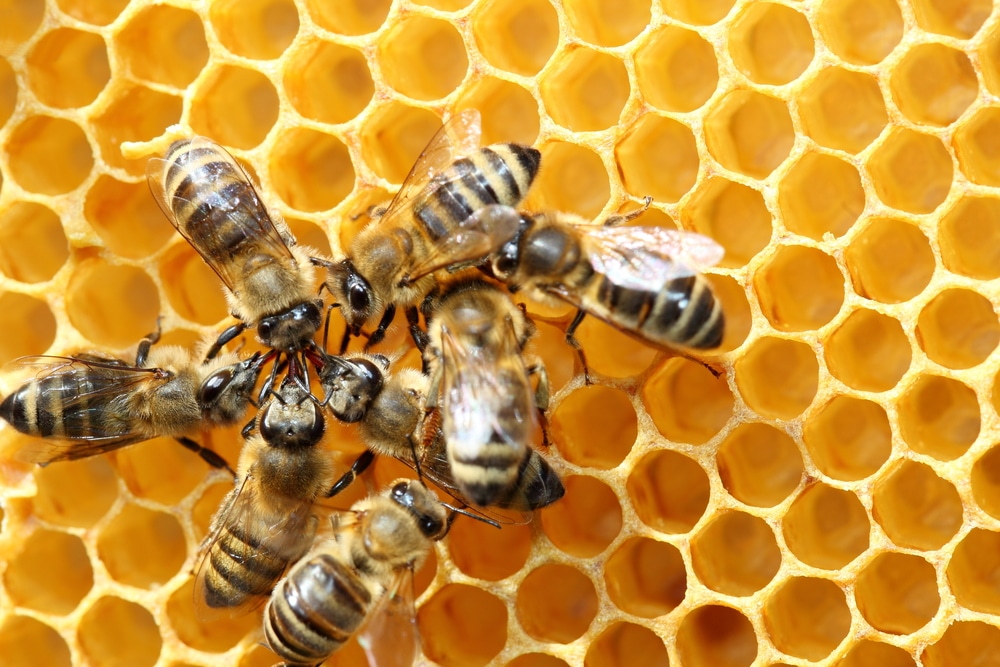
Queen pheromones
Queens produce several types of pheromones:
- Sex pheromones: virgin queens attract drones during mating flights. One important compound is 9-ODA, which also forms part of queen mandibular pheromone; these are overlapping functions, not wholly separate chemical systems. Research on a honey bee odour receptor demonstrated a specific response to 9-ODA. Queens mature after emergence and normally mate with several drones, sometimes over several flights. Age, weather and opportunities to fly affect mating success; there is no universal north–south quota of mates or rigid timetable that guarantees success. RFID tracking of queen mating flights illustrates this variability. Failure to acquire or retain sufficient viable sperm can ultimately result in a drone-laying queen, but this is not an automatic immediate consequence of a weak scent.
- Queen mandibular pheromone (QMP): produced by the mandibular glands, not by the jaws themselves. Its composition changes with the queen’s reproductive state, and it is only part of the wider queen pheromone system. It is misleading to reduce queen quality to “young queens produce more, old queens produce less”. Attendant workers contact the queen and relay her signals through further contacts. Tracking and modelling of this relay network show the importance of both queen movement and worker-to-worker encounters. Trophallaxis is another important interaction, but queen signalling is not simply a scent distributed uniformly through the hive air or through food alone.
Queen signals contribute to several related responses. QMP alone does not reproduce every effect of a living queen: Keeling and colleagues identified additional compounds involved in retinue attraction.
- Retinue response: workers gather around the queen, touching, licking and feeding her. This contact also helps them acquire and pass on her chemical signals.
- Inhibition of worker ovary development: queen and brood signals both contribute to keeping worker reproduction limited. After queen loss, some workers may develop their ovaries and lay unfertilised eggs, especially if brood signals are also missing. The outcome depends on colony conditions; introducing a queen does not guarantee that all laying-worker activity will reverse, or that a replacement will be laying exactly one month after the previous queen was lost.
- Regulation of queen rearing: changes in queen signals and their distribution can contribute to emergency queen rearing, supersedure or swarming, depending on the situation. These are distinct processes. Queen condition, brood, colony population and congestion also matter: a single pheromone threshold is not a complete explanation of why a colony swarms.
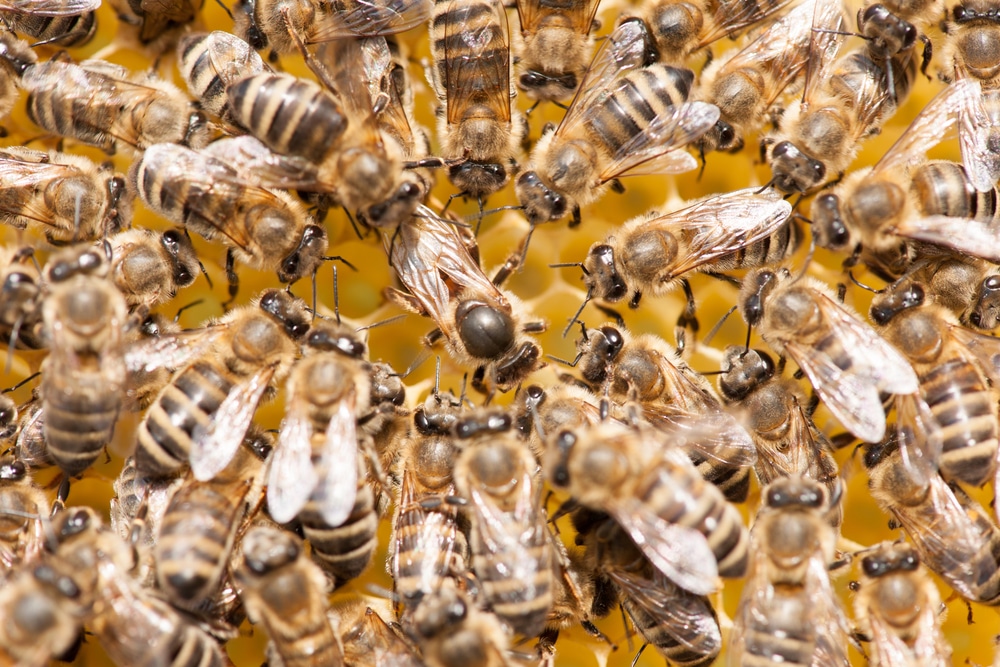
Worker pheromones
Workers also produce several types of pheromones:
- Nasonov gland pheromone: an orientation and aggregation signal released from a gland near the tip of the worker’s abdomen. Scenting workers raise the abdomen and fan their wings, for example at a hive entrance or around a swarm. This helps guide and gather other bees; it should not be confused with the chemical cues used to distinguish nestmates from intruders. The commonly described blend contains seven components, including geraniol and citral. Experiments with synthetic Nasonov blends demonstrated their role in clustering. Related compounds are used in swarm lures, but commercial formulations differ; they are not all the same mixture.
- Footprint signals and the Arnhart glands: bees leave chemical traces on surfaces they walk over, which have been discussed in relation to orientation at entrances and other visited sites. However, it is too definite to describe these as a proven colony-identification secretion from the Arnhart glands. An anatomical study of the honey bee pretarsus found no evidence that these tarsal glands release the proposed footprint pheromone. Footprint effects, their glandular origin and any interaction with Nasonov signalling should therefore not be treated as one fully resolved mechanism.
- Alarm pheromone: the sting-associated blend helps recruit defensive bees and focus their response around a disturbance or a sting site. A major component is isopentyl acetate, also called isoamyl acetate. Experiments with this compound found both immediate and longer-lasting effects on responsiveness. The blend contains many compounds; “15 components” and “only after 28 days” are not reliable universal rules. The scent noticed while opening hives should not simply be called the smell of venom. Defensive behaviour varies with the bees and conditions, so an absence of noticeable scent does not establish that handling is safe.
- Signals that delay the start of foraging: foragers produce ethyl oleate, which helps delay younger workers’ transition to field work. Leoncini and colleagues demonstrated this primer-pheromone effect. It contributes to the balance between in-hive workers and foragers, alongside brood signals and colony needs. A young worker taking up foraging early has changed task; she has not instantly become an old bee because nectar stopped arriving.
- Dance-associated scent: waggle dancers release a blend of four hydrocarbons: tricosane, pentacosane, (Z)-9-tricosene and (Z)-9-pentacosene. In Thom and colleagues’ experiments, introducing the blend increased the number of bees leaving the hive. This can stimulate foraging activity, but the scent alone does not encode the food source’s coordinates. The directional and distance information belongs to the waggle-dance communication system.
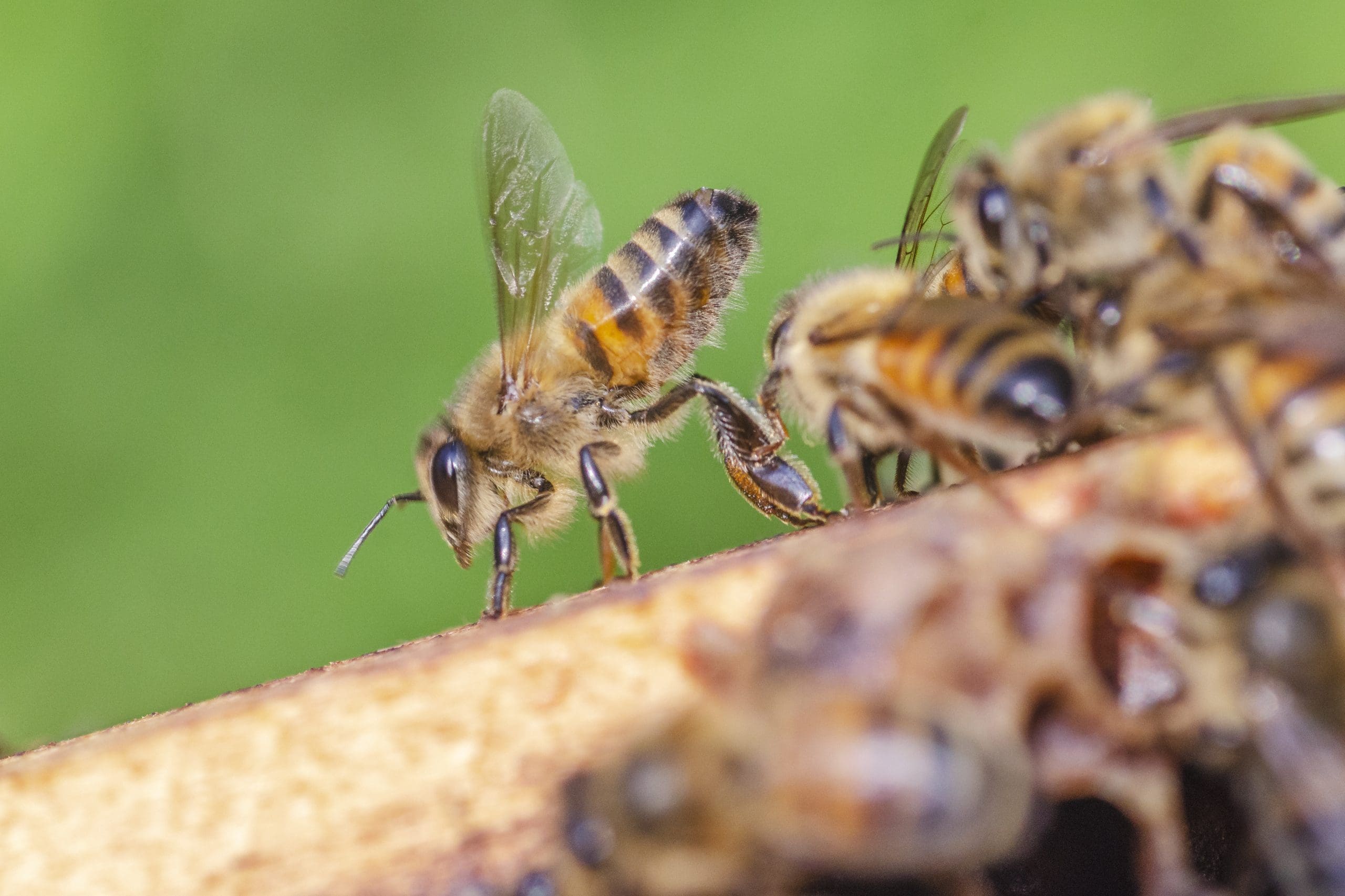
Brood pheromones
- Signals from developing larvae: brood chemistry changes with age and caste. Brood ester pheromone (BEP) is a blend of ten methyl and ethyl esters of fatty acids—not ten free fatty acids—and is particularly associated with older larvae. Young larvae also emit the volatile signal E-β-ocimene. Research comparing these signals shows that they have different effects on workers’ transition to foraging. Brood communication also influences:
- Nurse-bee physiology: brood signals help regulate the hypopharyngeal glands involved in producing larval food. Pheromones do not replace the protein and other nutrients needed for effective nursing.
- Brood feeding: chemical cues contribute to workers’ visits and food allocation. Observation-hive experiments with brood pheromone examined changes in brood-rearing behaviour and colony growth; the response depends on more than the presence of a single compound.
- Brood removal and cannibalism: signals from unhealthy or dead brood can contribute to hygienic removal, which should be distinguished from consuming brood during nutritional stress. These are not simply two effects of one “young-brood pheromone”. In a study of summer-dearth colonies, synthetic E-β-ocimene increased retention of eggs and first-stage larvae over four days. The authors did not establish the same protection throughout larval development, and the result is not a feeding or disease-control prescription.
- Signals close to capping: the larval ester profile changes as larvae approach the stage when workers seal their cells. Chemical analyses of worker and drone larvae documented these developmental differences. Varroa mites enter brood cells before capping and can exploit host-related chemical cues, but it is inaccurate to say one capping pheromone alone guides every invasion. Bioassays with larval food also demonstrated responses by mites. Understanding these cues is a research topic, not in itself a validated Varroa treatment.
These examples show why pheromones are so important to the colony’s organisation, while also illustrating how much remains to be understood. Signals overlap, several glands may contribute, and the same compound can have different effects according to context. This is a working overview, not a complete chemical inventory of the honey bee.
Research has led to commercial preparations of synthetic queen mandibular pheromone. For example, the manufacturer of TempQueen lists temporary use in queenless packages, splits and nuclei. These products imitate some queen signals; they do not lay eggs or permanently replace a queen. A queenless unit used for transport or a short pollination task still needs a plan for its subsequent management. Follow the current product instructions rather than extrapolating a research result into a dose or a guaranteed outcome.
Synthetic brood pheromone has also been investigated to stimulate pollen collection and improve crop pollination. In a field experiment with twelve colonies pollinating a market garden in Texas, treated colonies showed increased pollen-foraging effort and heavier pollen loads. Such findings are specific to the trial, crop and conditions; they do not establish a fixed percentage increase in rockrose pollen harvest or guarantee the same benefit in a greenhouse. Product availability, formulation and suitability must be checked separately from the experimental evidence.
For the beekeeper, the practical value is a better understanding of queen status, swarming, defence, foraging and brood care. Pheromones help explain the behaviour seen at the entrance and on the comb, but they should be interpreted alongside the colony’s condition rather than used as a substitute for inspection.
WOULD YOU LIKE TO KNOW MORE ABOUT BEEKEEPING?
See our online beginner beekeeping course, taught in Spanish.
The course page provides the syllabus and current enrolment details. The promotional video below is also in Spanish.
![Introducción al Curso de Apicultura [SÚPER COMPLETO]](https://www.latiendadelapicultor.com/blog/wp-content/plugins/wp-youtube-lyte/lyteCache.php?origThumbUrl=https%3A%2F%2Fi.ytimg.com%2Fvi%2FuJomNRA0UP8%2F0.jpg)

ISNI 0000 0005 1801 1100 | Joshua Ivars is the manager of LA TIENDA DEL APICULTOR and the author of this blog, where he shares technical and practical guidance for beekeepers. Drawing on extensive experience in the beekeeping sector, he offers advice and solutions based on beekeepers’ real needs, sharing his knowledge of equipment and essential beekeeping practices.


