
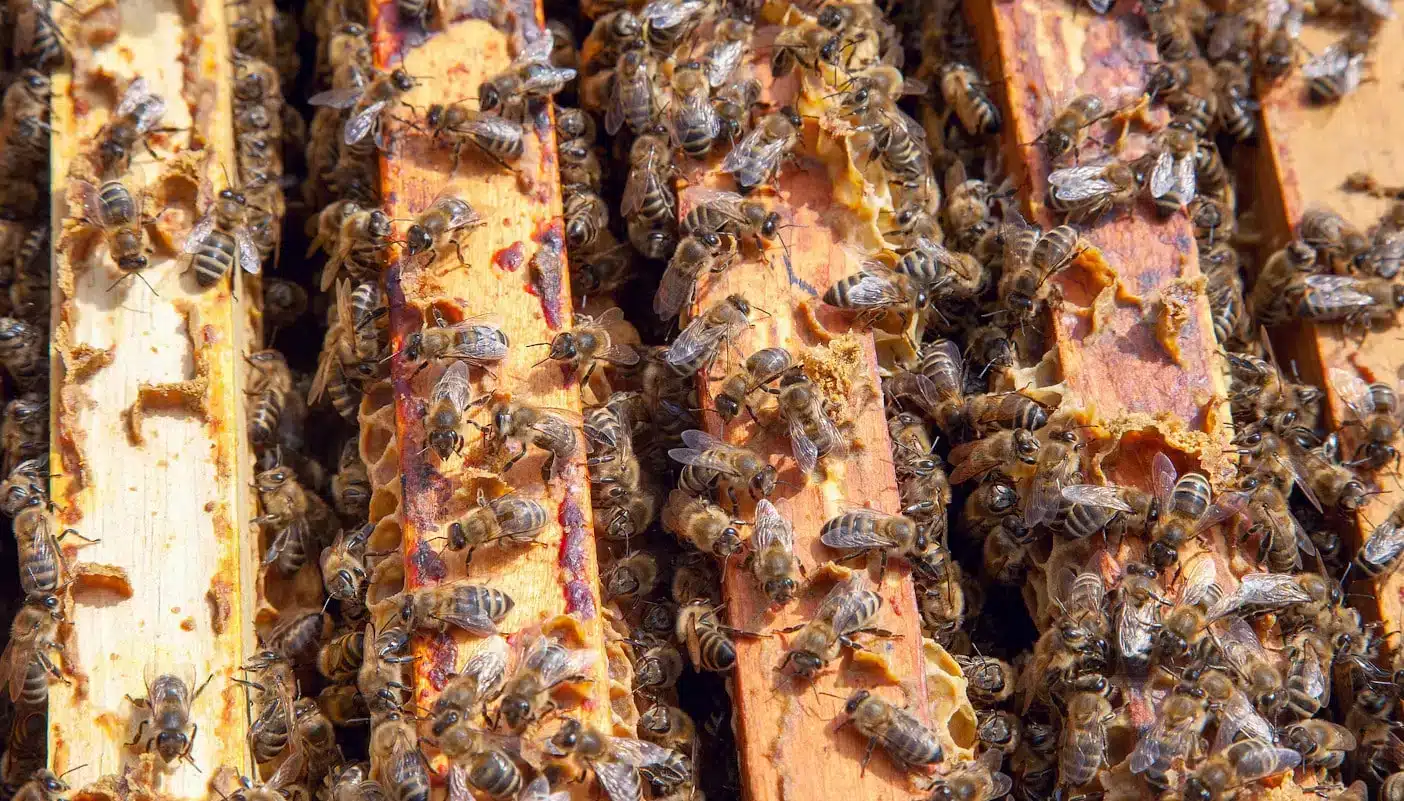
One of the pleasures of beekeeping is discovering how closely the structure of a nest fits the bees’ needs. A few millimetres can determine whether a gap remains a passageway, becomes sealed with propolis or fills with unwanted comb.
What is bee space?
Bee space is the clearance bees tend to keep open for movement around the nest, rather than filling it with propolis or comb. You can see passageways between combs in an established wild colony, as well as in a managed hive. In hive design, the same principle applies to gaps between frames, box walls and other components. It describes a useful range, not one exact measurement that every colony follows in every situation.
A little history
Langstroth is often credited with discovering bee space in 1851. That shorthand can be misleading: the bees’ behaviour was not an invention, and earlier beekeepers had already observed and used spacing between combs.
Langstroth’s major contribution was applying suitable clearances to a practical top-opening, movable-frame hive. This reduced the attachments that made earlier designs difficult to inspect. The principle remains fundamental to modern beehives with removable frames.
Understanding hive dimensions
Beekeeping guides quote different ranges. A common practical description is ¼–⅜ inch, approximately 6–9.5 mm. More detailed accounts distinguish narrower and wider working passages: figures such as 5.3 ± 0.5 mm and 8–9 mm appear in discussions of single and double bee space. These are useful ways to describe different situations, not universal manufacturing tolerances or proof that all other gaps are wrong.
The distinction reflects how bees occupy the space. Sometimes there is one layer of bees; elsewhere, bees working on the facing surfaces of two combs need room for two layers, roughly back to back. Do not confuse the gap between comb faces with the centre-to-centre spacing of the frames that hold them.
As a rule of thumb, bees tend to seal very small gaps with propolis and build comb in oversized gaps. Between those extremes they can leave a usable passage. Treat thresholds around 4–5 mm and 9–10 mm as guidance, not abrupt biological cut-offs: position, equipment and the colony’s comb-building activity matter.
The examples below explain why millimetres matter. Clearances inside a hive, openings in an excluder and holes in a pollen trap serve different purposes; they are not interchangeable specifications for building equipment.
Gaps smaller than about 4 mm
A gap this narrow generally does not provide a useful worker passage. Bees tend to seal such crevices with propolis, sometimes mixed with wax. Avoid treating 4 mm as a precise pass-or-fail boundary: the shape and depth of the opening matter too.
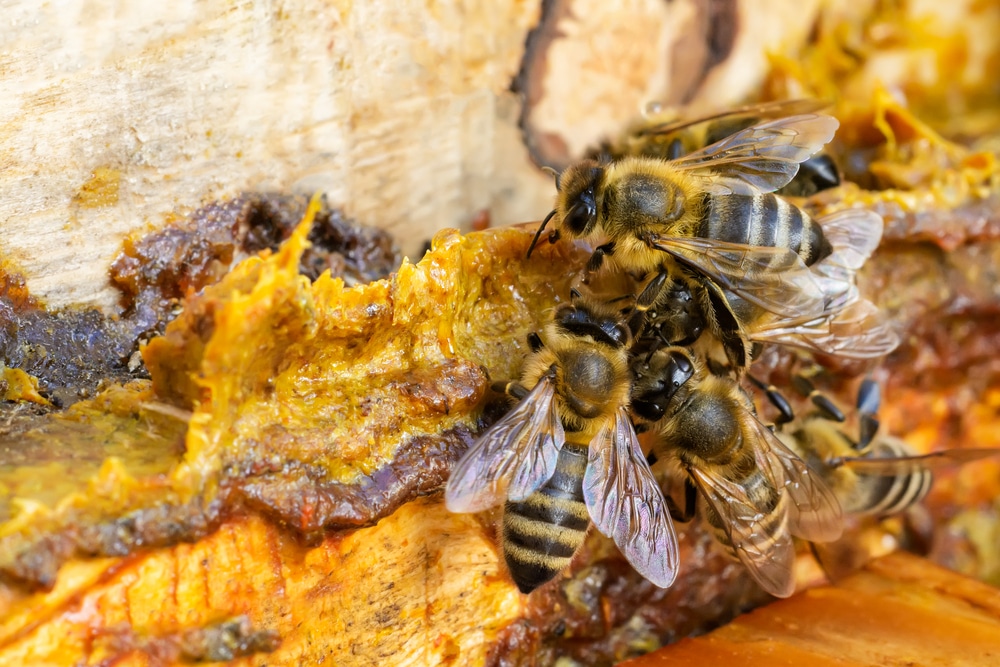
Around 4.3 mm: queen excluders
Openings around this size are associated with queen excluders, designed to let workers through while restricting the queen. Use a correctly manufactured, undamaged excluder; 4.3 mm should not be presented as a single European standard for every design. Gaps around its edges can defeat its purpose even when the grille itself is correct.
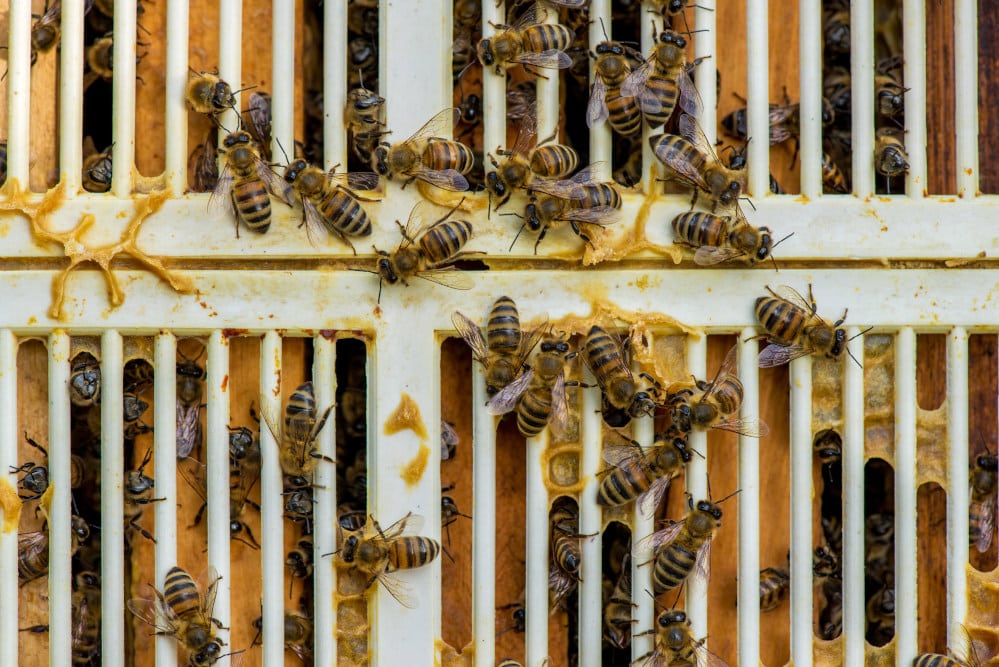
Around 5 mm: pollen traps
Some pollen traps use openings around this size. Returning workers squeeze through the collecting screen, which removes some of the pollen pellets carried in their hind-leg pollen baskets. Hole shape and trap design affect the result, so a nominal diameter alone is not a complete specification.
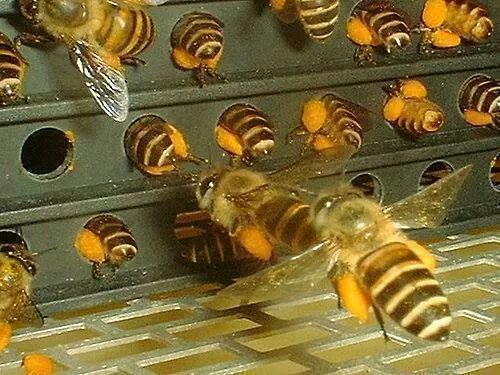
Around 5.2–5.4 mm: drone screening
Openings in this range are sometimes described for screening drones from smaller bees. That is a specialised use, not ordinary bee space and not a guarantee that every worker or queen will pass freely. Use equipment designed for the task rather than assuming that a homemade opening of this size will reliably separate all three castes.
Around 6 mm: a narrow passage
A clearance around 6 mm illustrates a narrow passage that can accommodate one layer of bees. It is near the lower end of common practical bee-space guidance, not a fixed minimum found between every pair of combs.
The arrangement of passages at the edge of the nest also affects air movement. However, a 6 mm gap alone does not establish the correct ventilation or humidity for a colony; those depend on the whole hive and its conditions.
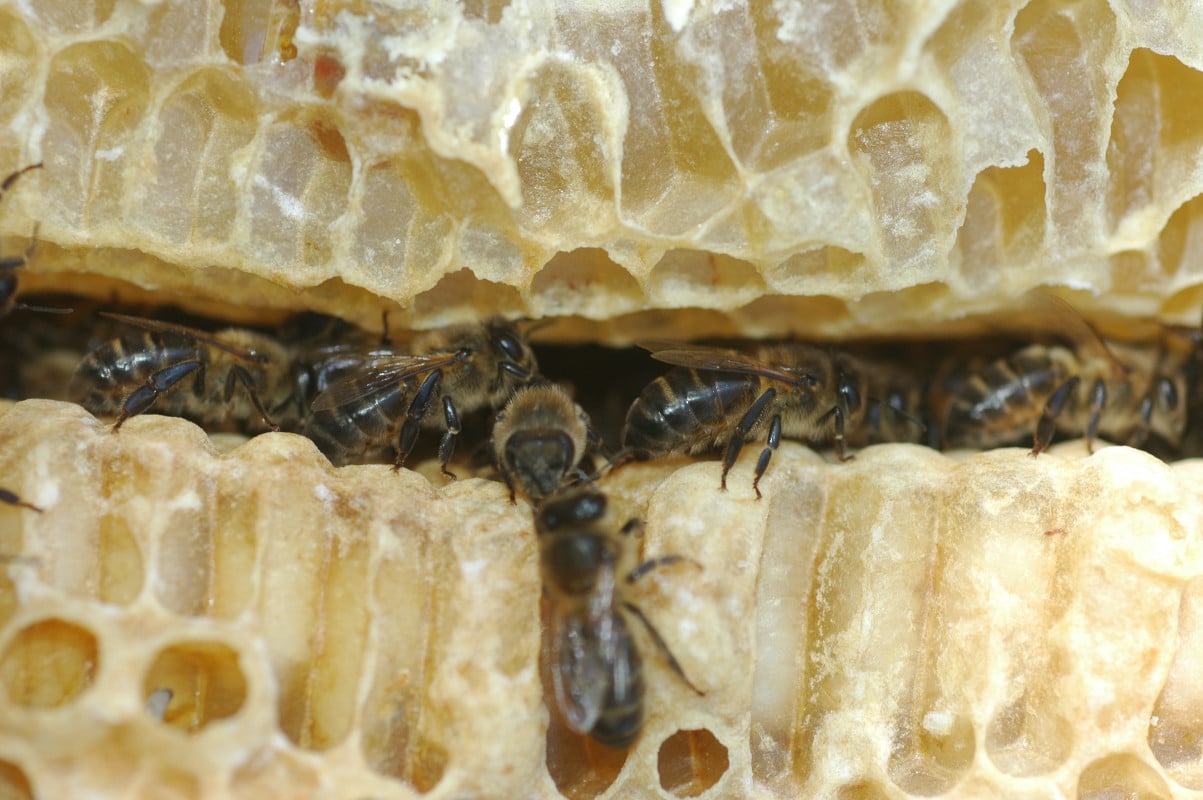
Around 7 mm: equipment clearances
A clearance around 7 mm can be useful when designing the space between frame parts and the hive body. It is not a size that bees somehow refuse to use. The aim is to preserve a working passage while limiting the incentive to add bridging comb.
Take Hoffman-style frames set at 35 mm centres. If their top bars are 25–28 mm wide, the gap between top bars is 7–10 mm, not always 7 mm: 35 − 28 = 7, while 35 − 25 = 10. This calculation concerns the top bars, not the gap between comb faces. Measure the actual equipment, because frame dimensions vary.
Around 8 mm: a practical design clearance
About 8 mm is a convenient clearance in some hive designs, lying roughly midway between 6 and 9.5 mm. Use the dimensions of the complete design rather than choosing a gap in isolation: mixing incompatible top and bottom bee-space arrangements can leave too much or too little space between stacked boxes.
Around 9 mm: working between brood combs
A gap around 9 mm between facing areas of capped brood is often used to illustrate double bee space. It allows bees on both comb faces to work in the intervening space. The principle is useful, but brood-comb surfaces are not perfectly flat and their spacing is not an invariant measurement.
Beyond bee space: unwanted comb
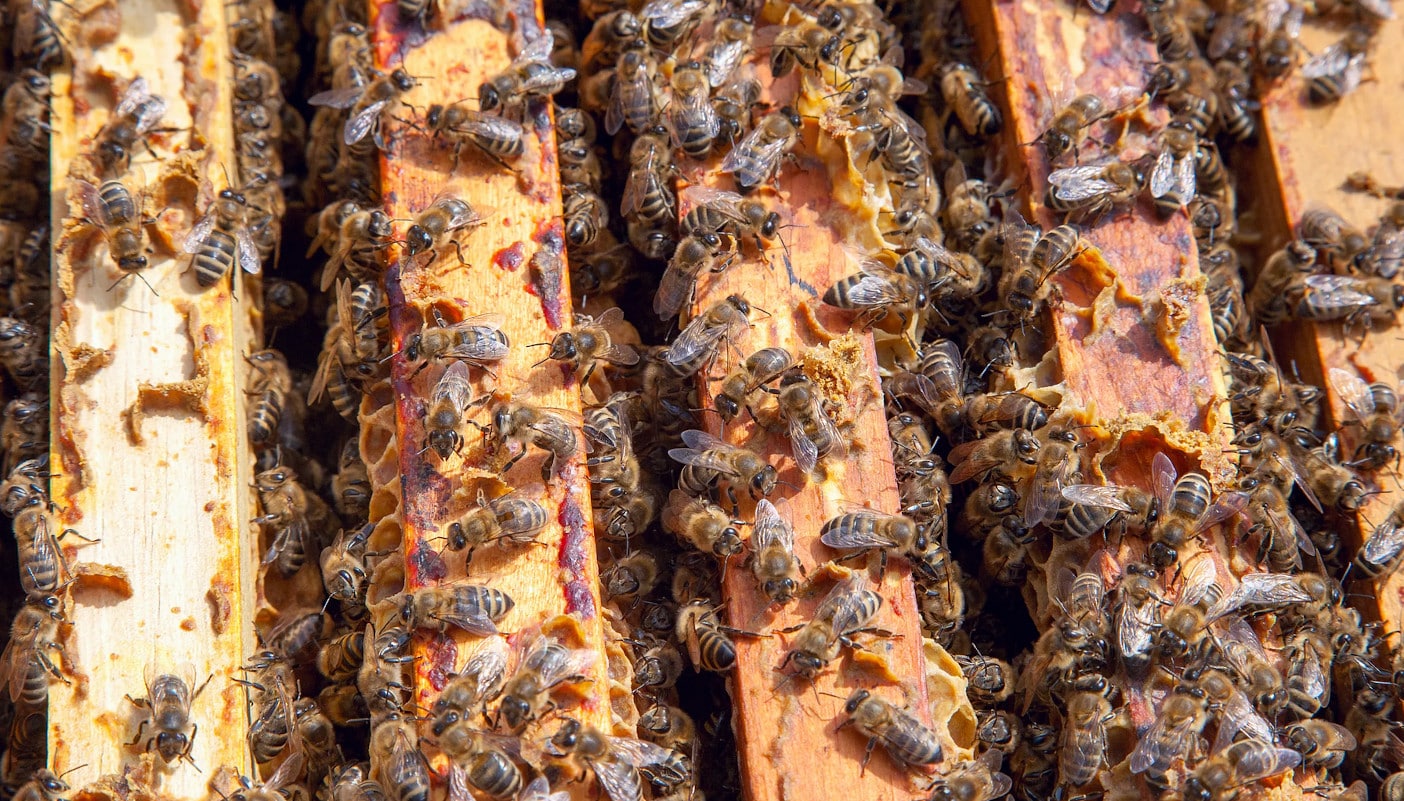
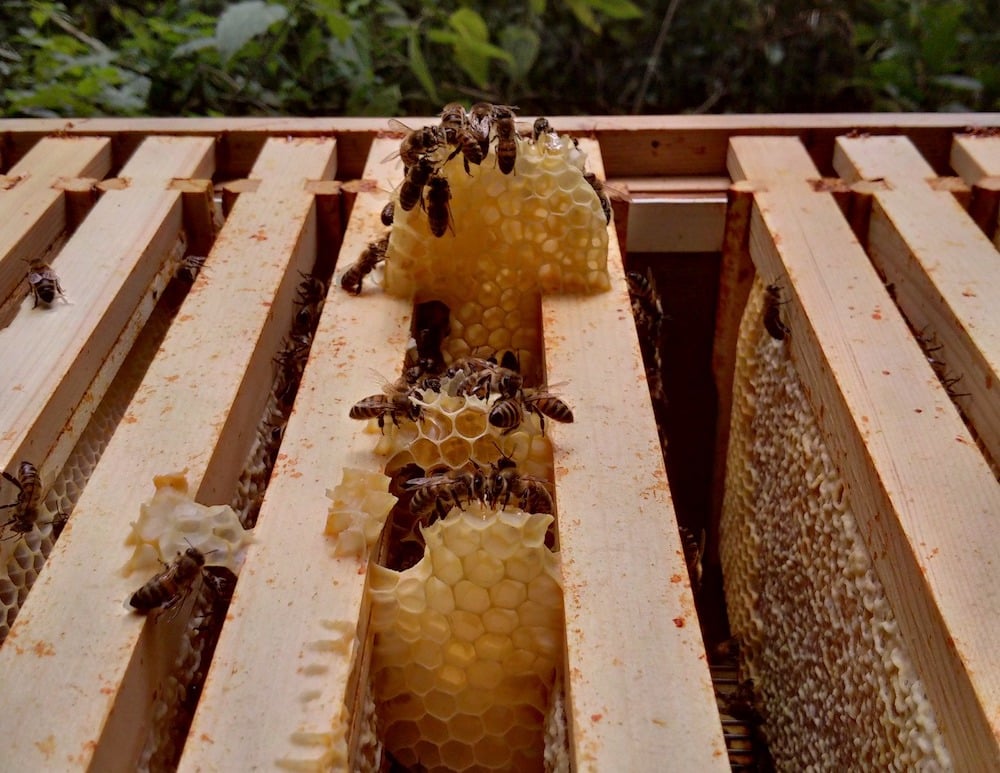
When a gap becomes too large to function as bee space, bees are more likely to build burr comb or brace comb in it. This is a tendency, not a switch that flips at exactly 9 mm: that figure still falls within some commonly quoted bee-space ranges. Check frame spacing and the fit between boxes if unwanted comb keeps returning.
Brood nest spacing versus honey super spacing
In the brood nest, suitable spacing lets bees move between combs, tend larvae and help regulate nest conditions. Keep frames correctly assembled and positioned for their design; do not spread brood frames apart simply to copy the arrangement of a honey super.
In honey supers, beekeepers sometimes space fewer frames evenly within a box—for example, nine drawn frames in a ten-frame super, or eight in an arrangement designed for that purpose. Bees can extend the honey cells and make thicker combs while retaining passageways. The key distinction is drawn comb versus foundation: start foundation at the normal frame spacing, and only consider wider spacing once suitable comb has been drawn. Wide gaps beside bare foundation invite irregular or cross-comb. The remaining gap between thickened combs need not be exactly 6 mm.
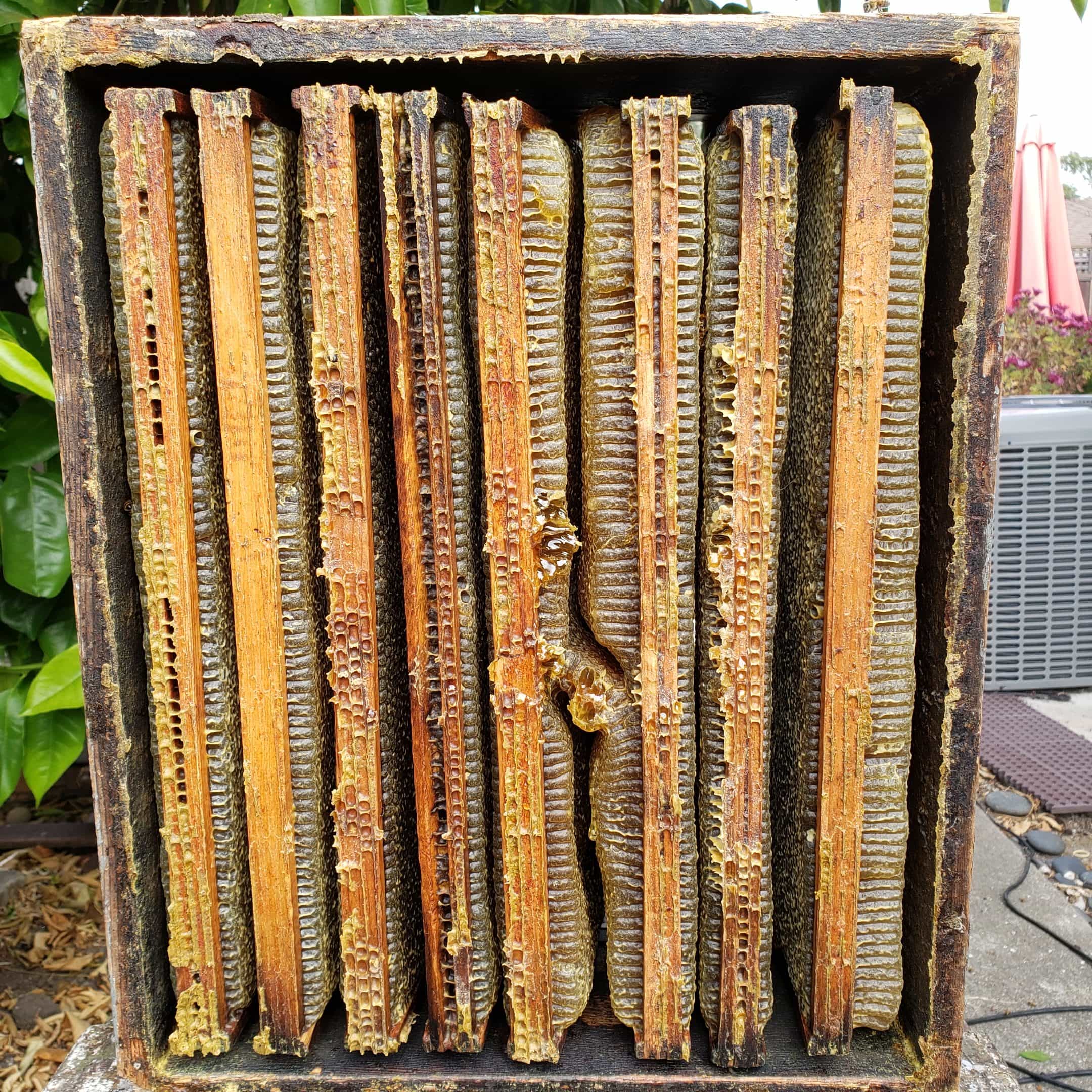
A narrower passage between mature honey combs can accommodate a single layer of bees. Stored, ripened honey does not need the same continual feeding work as brood. That does not mean the super needs no attention: bees still have to process incoming nectar and move freely through the box.
With suitable drawn comb, wider spacing means fewer frames to handle and can produce comb that projects beyond the wood, making uncapping easier. It does not guarantee a larger crop or a fixed saving in wax. Keep the combs evenly spaced and judge the results in your own equipment.
The practical lesson
Langstroth’s achievement shows the value of turning careful observation into workable equipment. The lesson is not to memorise a list of millimetres without context, but to understand what each clearance does and how the parts of the hive fit together.
Distinguish bee space, comb spacing and equipment openings, keep frames in their intended positions and inspect the actual gaps. That practical understanding makes hive inspections easier and helps avoid unnecessary comb damage.
Would you like to learn more about beekeeping?
Explore our online introductory beekeeping course.
The course page provides the syllabus and training details. Check the language and format before enrolling; translating this article does not mean that the linked course or introductory video is available in English.
![Introducción al Curso de Apicultura [SÚPER COMPLETO]](https://www.latiendadelapicultor.com/blog/wp-content/plugins/wp-youtube-lyte/lyteCache.php?origThumbUrl=https%3A%2F%2Fi.ytimg.com%2Fvi%2FuJomNRA0UP8%2F0.jpg)
Sources
Taking Measure of Bee Space, American Bee Journal.
Dave Cushman’s article on bee space.
The Spanish source also credits an article by Fernando Calatayud, beekeeper and PhD in Biological Sciences.

ISNI 0000 0005 1801 1100 | Joshua Ivars is the manager of LA TIENDA DEL APICULTOR and the author of this blog, where he shares technical and practical guidance for beekeepers. Drawing on extensive experience in the beekeeping sector, he offers advice and solutions based on beekeepers’ real needs, sharing his knowledge of equipment and essential beekeeping practices.


