
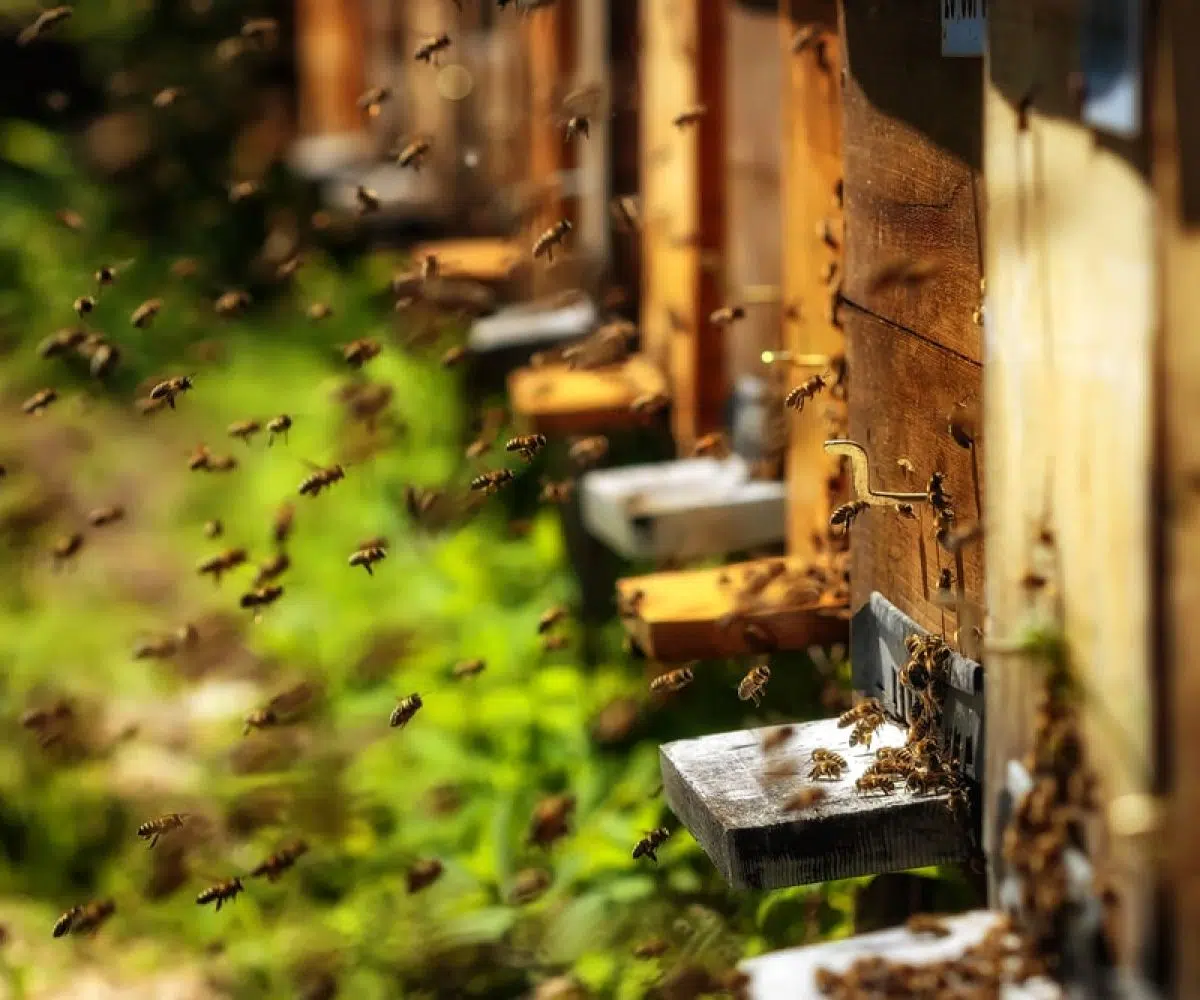
What is bee drift?
Drifting is when a honey bee enters a colony other than its own. In an apiary, this often happens when a returning bee mistakes a neighbouring entrance for home. It is different from robbing, in which bees enter another colony to take its food stores.
Which colonies are affected?
Drift can redistribute bees unevenly between hives. Pay attention to colonies at the ends of rows and to entrances that are easy to confuse, but do not assume that every end hive will gain bees or produce more honey.
In a straight east–west row, for example, hives at either end may be prominent to bees approaching from that direction. This is an illustration of how layout may matter, not a rule that returning foragers always enter the first hive they encounter.
Situations worth checking include:
- Parallel rows of similar hives, with all entrances facing the same way. Repetitive entrance cues can make it harder to distinguish one colony from another; a higher yield in the front row does not, by itself, prove drift.
- Hives at the ends of rows. Compare their population and entrance traffic with neighbouring colonies, while checking other explanations for differences.
- A strong colony beside weaker ones. Unequal populations may raise a suspicion of drift, but colony strength alone does not establish which bees moved where.
- A queenright colony beside a queenless one. Queen status can affect guard behaviour and acceptance, but it is not a reliable rule that workers leave the queenless hive for the queenright one. Free and Spencer-Booth’s experiments actually recorded more drift from queenright colonies into queenless than into queenright colonies under their study conditions.
Why does bee drift occur?
Similar-looking entrances, close spacing and repetitive landmarks can contribute to orientation errors. Consider wind exposure and poor flying conditions as well; fatigue or low light may make a return more difficult, but neither is a diagnosis of drift.
Managed Apis mellifera colonies are often much more closely packed than free-living colonies. That can increase opportunities for drift. It is too absolute to say that drifting never occurs naturally or that wild bee colonies can never occur close together.
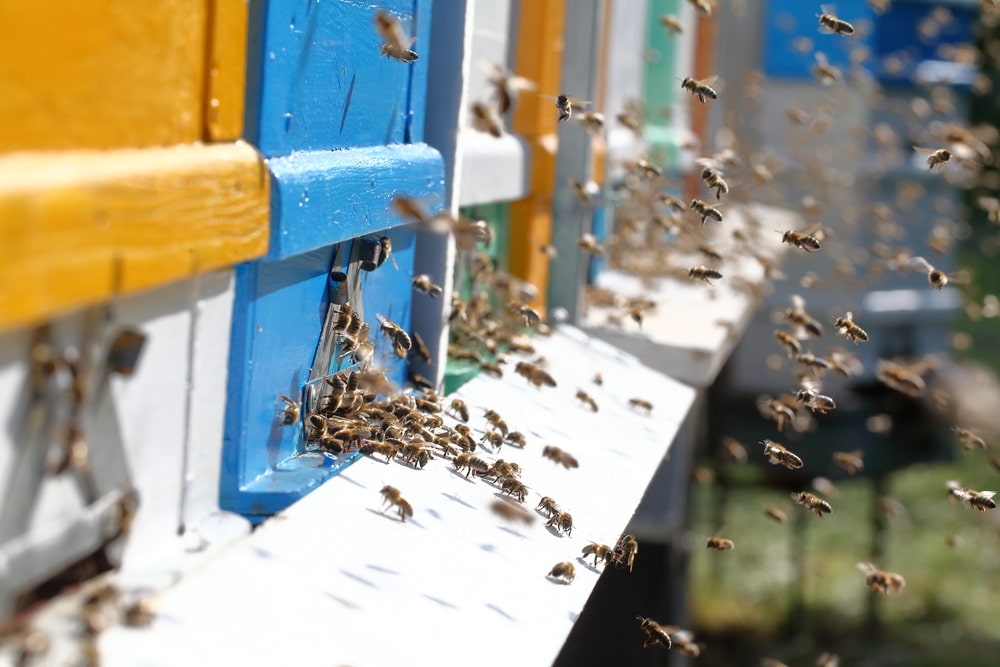
What are the consequences?
Drift mixes workers from different colonies. Differences in bee colour or stock can make this noticeable, but appearance alone cannot reliably identify a worker’s home colony.
Losing workers can matter particularly to a weak colony, and changes in the foraging population can complicate comparisons of honey yield. Avoid assigning a fixed productivity loss to drift without measuring the colonies and considering their health, queen performance and food supply.
A bee that reaches a neighbouring hive still has to pass its guards. Acceptance varies with colony conditions and the behaviour of the arriving bee; carrying nectar is not a guaranteed entry pass.
Practical reminder: guard bees may reject an unfamiliar bee. Do not treat a nectar flow as permission to mix colonies, or assume that a bee admitted at the entrance is necessarily healthy.
Drifting is one possible route for parasites and pathogens to move between colonies, alongside robbing and the transfer of contaminated material. It can contribute to Varroa spread; USDA guidance also identifies drifting bees as a possible route for American foulbrood. Reducing drift does not replace colony inspections, mite monitoring or appropriate disease control.
Drones drift too, but they do not enter every colony indiscriminately: acceptance varies with circumstances. Consider their movement as part of the apiary’s health picture, not as a reason to assume all drones are infected or to remove them without a management purpose.
How to reduce drifting
Make each entrance easier to recognise. Where the site permits, break up long uniform lines, vary spacing and use different entrance orientations while keeping the apiary practical and safe to work.
Useful measures include:
- Avoid long, repetitive rows where practical. Staggered or outward-facing groups can offer more distinctive approaches than identical entrances on a single line.
- Use stable landmarks, such as shrubs or rocks, and clear markers near entrances. Do not obstruct the flight path or create trip hazards for the beekeeper.
- Provide more separation where space allows. The original guide suggests groups of six to ten hives separated by several tens of metres. Treat that as an example to adapt to the site, not a proven universal minimum or an optimum group size.
- Give nearby entrances distinct visual cues, using contrasting shapes and colours such as blue and yellow rather than relying on the roof colour alone. Free and Spencer-Booth found that cues close to the entrance were important; colours high above it attracted little attention.
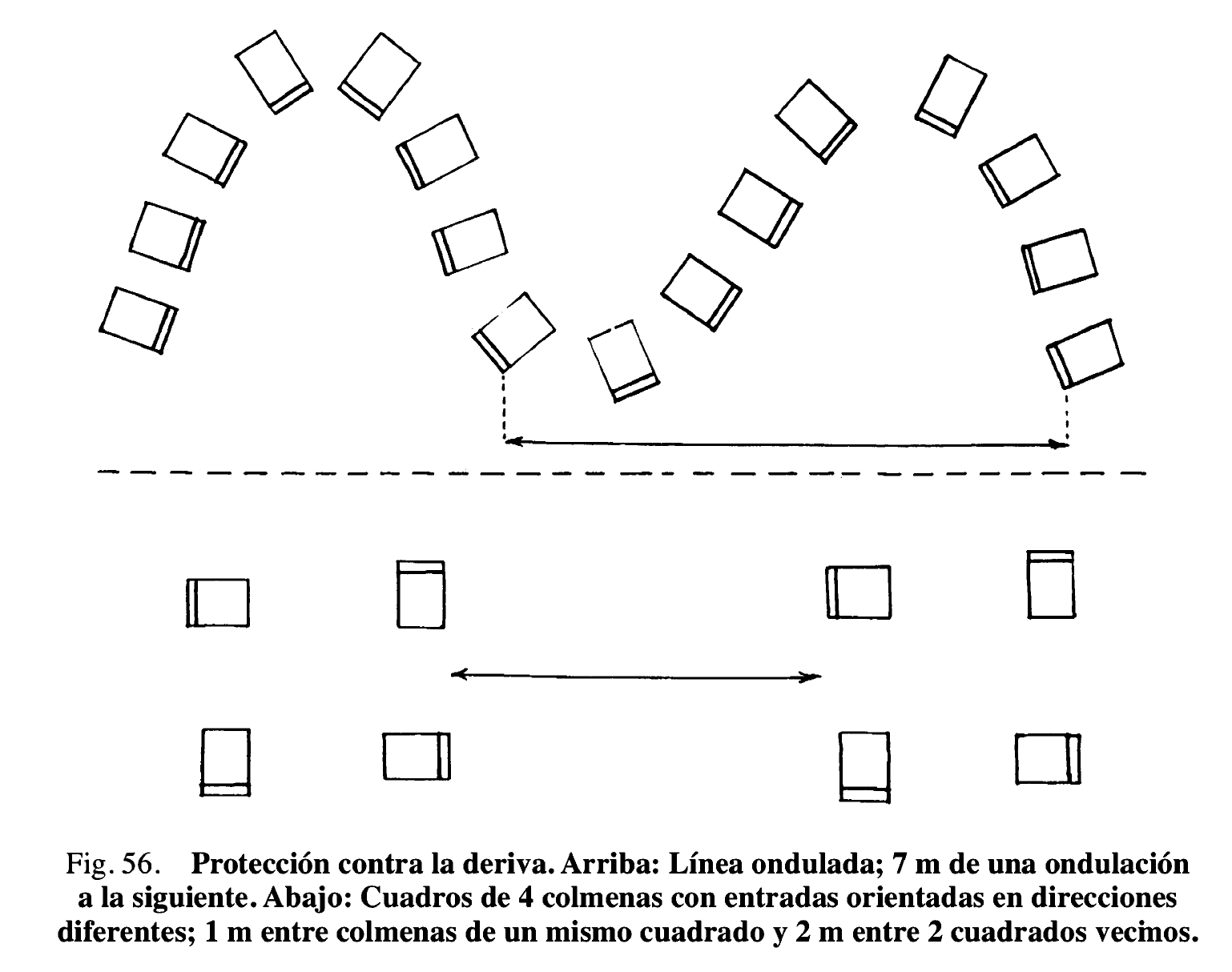
What the research supports: a two-year experiment by Dynes and colleagues compared crowded, uniform rows with more widely spaced, visually distinct colonies arranged in a circle. The latter configuration had less worker drift, greater honey production and better winter survival. Several layout features changed together, so the study does not isolate a single ideal spacing, colour or pattern.
A separate study by Forfert and colleagues found a strong relationship between hive position and drifting. After accounting for position, highly Varroa-infested colonies accepted more drifters; the tested viruses and Nosema were not associated with higher drifting frequency. This supports checking layout and colony health together, not assuming that every drifting bee is diseased.
Would you like to learn more about beekeeping?
See our online beginner beekeeping course, taught in Spanish.
The course page gives the syllabus and current enrolment details. The promotional video below is also in Spanish.
![Introducción al Curso de Apicultura [SÚPER COMPLETO]](https://www.latiendadelapicultor.com/blog/wp-content/plugins/wp-youtube-lyte/lyteCache.php?origThumbUrl=https%3A%2F%2Fi.ytimg.com%2Fvi%2FuJomNRA0UP8%2F0.jpg)

ISNI 0000 0005 1801 1100 | Joshua Ivars is the manager of LA TIENDA DEL APICULTOR and the author of this blog, where he shares technical and practical guidance for beekeepers. Drawing on extensive experience in the beekeeping sector, he offers advice and solutions based on beekeepers’ real needs, sharing his knowledge of equipment and essential beekeeping practices.


