
Before collecting your first nucleus colonies, packages or established colonies, find out how to register the holding and secure a suitable apiary site. Keep the purchase invoices and movement documents. The paperwork is manageable, but there is no single procedure or fixed price for all of Spain. This guide explains the main distinctions and points you to the competent authorities; it is general information, not individual legal or tax advice.
What is a beekeeping holding, and how is it classified?
National rules provide the framework, while the autonomous communities administer registration and may impose additional requirements. Begin with the agricultural or livestock office responsible for your proposed holding rather than assuming the procedure is identical everywhere.
A beekeeping holding may comprise hives at one or more apiaries. Under Royal Decree 209/2002, the size and own-consumption categories are:
- Professional: 150 hives or more.
- Non-professional: fewer than 150 hives. This is not a tax exemption and does not mean that sales are prohibited.
- Own consumption (autoconsumo): no more than 15 hives, with products intended exclusively for family consumption. Hive count alone does not qualify a holding for this category.
Even two hives can constitute a holding that must be registered. A small family-consumption apiary is not outside livestock and animal-health rules simply because it is a hobby.
Commercial and non-commercial holdings have different practical needs, but both require responsible management. Decide whether you intend to keep bees only for family consumption, sell products, rear colonies or provide pollination services before submitting the application.
Most beginners start with a small number of colonies. The steps below focus on that situation, while keeping livestock registration, food sales, tax and Social Security obligations separate.
Getting help from an ADS
A local Agrupación de Defensa Sanitaria Ganadera (ADSG), often called an ADS, can be a useful first contact. These livestock-health associations may offer veterinary support, coordinated health programmes and help with regional paperwork. Ask what services are included before joining.
ADS membership is not a universal national prerequisite for keeping bees. Under the animal-health framework introduced in 2025, appointing a designated holding veterinarian is voluntary. That does not remove the keeper’s health-monitoring duties, required health visits where applicable, or the need for veterinary involvement in specified disease-control measures and medicine use.
Explain your planned hive numbers, sites, stationary or migratory management, and intended production. The association can tell you what support it provides and help identify the documents required by your autonomous community.
You may also arrange appropriate veterinary services independently. Compare actual services and responsibilities rather than assuming that one route is always cheaper. Confirm the requirements for your holding with the competent livestock authority.
Costs vary. Request a current written quotation covering membership, veterinary visits, treatments and any additional services. A national annual fee cannot be reliably inferred from one association’s price.
Applying through the competent agricultural office
Contact the relevant Oficina Comarcal Agraria (OCA), OCAPA or equivalent regional service. Ask which office handles your application and whether it is submitted electronically. The competent registration authority is not always simply the office nearest your home.
Prepare the holding-registration application with the information requested: holder’s identity, principal location and other sites, hive numbers, production type, and whether the holding is stationary, migratory or for own consumption. The regional registration feeds into REGA, the General Register of Livestock Holdings.
Supporting declarations, land-use documents, inspections and fees depend on the regional procedure. Obtain the current checklist and fee schedule from the authority; do not rely on a generic €25 estimate or an old form found online.
Insurance
Public liability insurance is worth considering for risks associated with your bees and apiary. Check whether it is required for your particular site, activity, agreement or regional scheme. An ADS may have an arrangement with an insurer, but compare the cover and exclusions.
Additional cover may address theft, vandalism or particular animal damage. Ask about insured hive numbers, migratory movements, limits, excesses and exclusions. Obtain a current quotation based on the actual activity and the policy wording.
Transporting hives
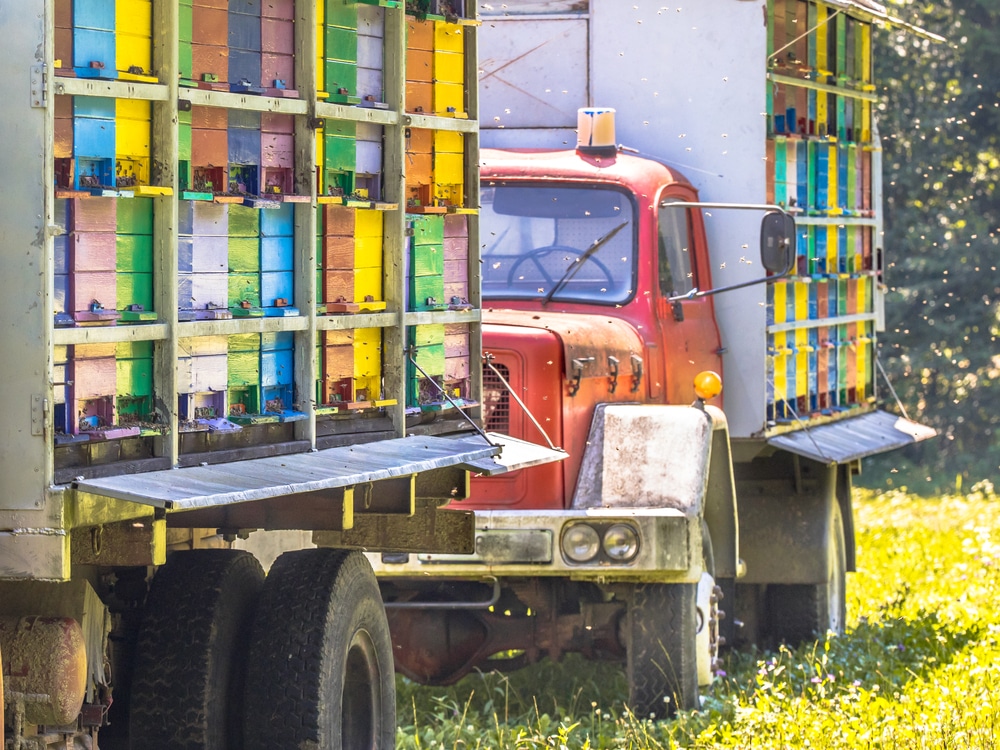
Hive transport is covered by Royal Decree 990/2022 and the applicable animal-health and movement rules. The older Royal Decree 751/2006 should not be used as the current procedural guide.
Do not assume that moving fewer than 15 hives exempts you from transport formalities. The own-consumption hive threshold is not a general national vehicle-registration exemption. Tell the authority who owns the bees and vehicle, the route and the type of movement, and confirm the authorisations and documents required.
The national transport rules include an authorisation category for honey-bee movements within Spain. Transporter and vehicle requirements are separate from registering the apiary. For migratory beekeeping, also check the holding’s classification, animal-health documentation and destination requirements.
The following official Valencian resources are examples of a regional process. Use the current instructions for the autonomous community responsible for your application:
Before moving colonies, check both the transporter’s and the vehicle’s authorisation where required, and the documents that must accompany the bees. A movement notification or an apiary registration alone does not replace all transport requirements.
Obtain any applicable fee directly from the regional authority. There is no reliable national €15–€25 price that covers every transport application.
The specific training and competence-certificate requirements in article 12(1)–(2) of Royal Decree 990/2022 do not apply to the national authorisation category that includes honey bees. This exemption is not a waiver of safe transport, vehicle suitability, animal-health or documentation obligations.
Choosing the location
Check national siting rules together with regional, municipal, protected-area and public-land conditions. Landowner consent is only one part of securing a lawful apiary site.
If you own the land, provide the evidence requested by the authority, such as the appropriate cadastral or ownership details. Ownership does not by itself establish that the site satisfies all siting or land-use requirements.
If someone else owns the land, obtain clear written permission or an appropriate agreement. Prepare a site plan showing the information required by the authority, including relevant roads, occupied buildings and neighbouring apiaries. A verbal understanding can be difficult to prove and should not be assumed sufficient for the application.
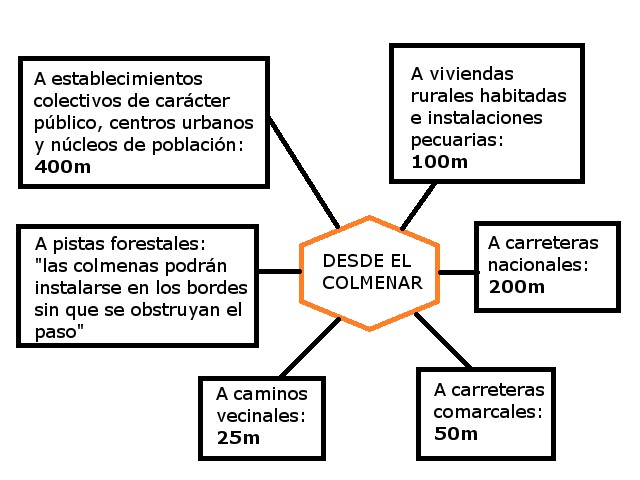
The diagram below illustrates the national siting framework in Royal Decree 209/2002; it is not permission for a particular site. Regional provisions, special rules for own-consumption holdings and the conditions for any distance reductions must be checked before positioning hives.
For the practical factors as well as the legal checks, see our guide to choosing an apiary site in Spain.
Receiving the registration decision and marking the hives
The competent authority will assess the application and notify its decision through the applicable procedure. Keep the submission receipt, respond to any requests for documents, and obtain the registration details and holding record. Do not assume that handing in a form is the same as receiving approval.
Under Royal Decree 787/2023, each hive must bear a visible, legible and indelible holding identification mark. Use the code and format confirmed by the authority; do not invent a shortened code. If an acquired hive already bears its previous holding’s code, the traceability rules require that mark to remain alongside the new one.
A hive branding iron is one possible marking tool for suitable materials. Choose a durable method compatible with the hive and the required identification, and follow the tool’s safety instructions.
Ongoing responsibilities after registration
Registration is the beginning of the record-keeping and health obligations, not the end. In particular:
- Follow the compulsory varroosis-control programme. Royal Decree 608/2006 provides for an annual treatment programme with veterinary involvement. The national annex gives September–November as the treatment period, while allowing the autonomous community to set different dates. Follow the current regional programme and authorised medicine instructions; 15 January is not a universal national deadline.
- Declare the annual hive census before 1 March. Under the national holding rules, report the number of colonies prepared for winter as at 31 December of the preceding year. Keep the holding record up to date and use the regional reporting channel.
Use feed and veterinary products lawfully and for their intended purpose. Keep the required treatment, diagnosis and laboratory records, together with prescriptions and purchase documents where applicable. A feed supplement is not a substitute for an authorised veterinary medicine.
Record movements and comply with the applicable notification and animal-health requirements. Migratory movements to another autonomous community have additional planning and documentation requirements; consult the origin authority before departure.
Provide suitable care and access to water, manage colony health, and keep the apiary and equipment in a condition that supports safe work and hygienic production.
REGA registration and tax registration are different
REGA records the livestock holding. It does not automatically register an economic activity with the Spanish tax authorities, nor does it by itself authorise all food-production and sales activities.
The livestock labels “professional”, “non-professional” and “own consumption” do not select an income-tax or VAT regime. Tax obligations depend on the activity actually carried out, the operator and the applicable rules.
A genuinely private family-consumption activity is different from operating a business. However, “no sales yet” does not always mean “no tax formalities”: preparations to start a business, purchases for that activity, grants or other circumstances may matter. Check the position before treating the activity as exempt.
If you intend to start an economic activity, review the Tax Agency’s start-up obligations, including the census declaration using form 036 where applicable. Registration generally precedes the start of the activity or relevant operations, not just the first paid sale.
IRPF income-tax assessment and VAT are separate decisions. The objective-assessment method (módulos), simplified VAT and the special agricultural, livestock and fisheries VAT scheme (REAGP) are not interchangeable labels. Eligibility, exclusions, records and returns differ. Have the appropriate combination checked for your activities and customers.
Before marketing honey, use the Tax Agency’s current guidance or a qualified adviser to confirm the applicable regime and filing calendar. Selling your own honey, buying honey for resale, providing services and making processed products may not have identical treatment.
When does self-employed Social Security registration apply?
Keeping bees solely as a private hobby is different from carrying on a self-employed economic activity. But there is no general permission to classify several dozen hives as legal “own consumption”: that livestock category has its own 15-hive maximum and family-consumption condition.
According to Social Security’s self-employment registration guidance, a habitual economic activity carried out personally on your own account requires registration, regardless of the income it generates. Do not use the statutory minimum wage (SMI) as a general safe threshold for avoiding registration. Borderline or exceptional situations need an individual assessment by the competent authority or an adviser.
Budgeting for a commercial activity
If you qualify for a reduced contribution or another benefit, its conditions and duration must be checked at the time of registration. A first registration does not by itself guarantee every reduction, and local support is not the same as the national contribution rules.
Normal contributions are linked to the applicable net-earnings system and contribution rules. Use the current official calculation service with your expected earnings and confirm the treatment of any other work you do. Old monthly figures should not be treated as a 2026 quotation.
Keep these situations separate
- Family consumption only: livestock registration and health duties still apply. Tax and Social Security treatment must reflect whether there is genuinely no economic activity.
- Occasional sales: do not assume a small amount or a neighbour as the buyer removes tax or registration obligations. Check the facts before selling.
- Beekeeping alongside employment: being an employee does not automatically exempt a separate self-employed activity. Confirm the applicable Social Security position and tax treatment.
- Beekeeping as your main business: coordinate livestock, food-safety, tax and Social Security requirements before starting, and keep each registration and record current.
Frequently asked questions about becoming a beekeeper
Do you have to register if you keep hives, even if you only have a few?
Yes. A small holding, including one kept for family consumption, must follow the applicable livestock-registration and animal-health requirements. Tax and Social Security registration are separate questions.
How does a non-professional beekeeper pay taxes?
“Non-professional” means fewer than 150 hives under the livestock rules, not a tax regime. Tax treatment depends on the activity and applicable IRPF and VAT rules, not that label alone.
Can I sell my honey without registering with Hacienda?
Before starting sales as an economic activity, check and complete the required tax census registration, normally using form 036. REGA registration alone does not cover the tax or food-safety obligations of selling honey.
Where can a small beekeeper sell their honey?
Possible channels include direct sales and markets, but the permitted activity, hygiene, packaging, labelling and regional or local sales requirements must first be satisfied. Do not assume that a REGA code alone authorises every channel.
How much does it cost to legalise an apiary?
There is no single national price. Ask for current regional fees and quotations for veterinary support, association membership, insurance and any transport authorisations needed.
I am retired and have hives – does this affect my pension?
A pension requires a separate assessment. Some work–pension compatibility routes exist, subject to conditions; it is wrong to say that all retirement pensions are absolutely incompatible with any self-employed activity. Check the official pension-compatibility rules with the INSS before starting sales, particularly if you receive an income-tested supplement.
How many hives can I have without registering as self-employed?
There is no general Social Security exemption defined by a hive count. The habitual nature and circumstances of an economic activity matter. The livestock own-consumption category, separately, is limited to 15 hives and exclusive family consumption.
Can I sell some honey to family or neighbours without being self-employed?
A small or occasional sale is not automatically exempt because the buyer is a relative or neighbour, or because earnings are below the SMI. Confirm the tax and Social Security position before relying on an exception.
Conclusions
The practical route is to define the activity, check the site, register the holding, organise health support and records, and address transport and commercial obligations where relevant.
Good preparation makes the process easier: obtain the current regional checklist, keep copies of everything submitted, and ask for clarification when a requirement is unclear. The competent agricultural office deals with registration; an experienced local beekeeper or association can complement that with practical mentoring.
Once the holding is registered, day-to-day colony care remains your responsibility. Continue learning, use qualified veterinary help when needed and do not mistake completing the paperwork for having mastered beekeeping.
The key distinction is simple: registering an apiary, registering an economic activity and registering with Social Security are separate matters. Sort out the relevant requirements before marketing your harvest, then give your attention to healthy colonies, good records and careful honey production.

ISNI 0000 0005 1801 1100 | Joshua Ivars is the manager of LA TIENDA DEL APICULTOR and the author of this blog, where he shares technical and practical guidance for beekeepers. Drawing on extensive experience in the beekeeping sector, he offers advice and solutions based on beekeepers’ real needs, sharing his knowledge of equipment and essential beekeeping practices.



José Durán Taracido es apicultor y experto en el manejo y cuidado de colmenas. Con una formación previa en derecho, fue colegiado en el Ilustre Colegio de Abogados de Madrid, aportando una perspectiva multidisciplinar que enriquece su visión sobre la apicultura y su entorno normativo


