
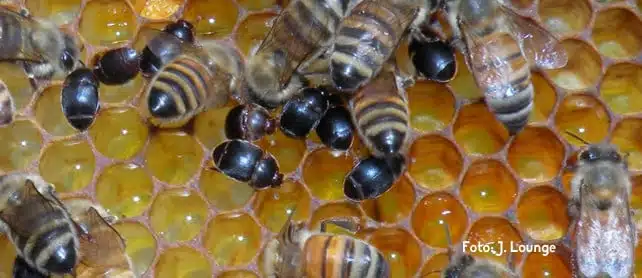
Aethina tumida, the small hive beetle, can seriously damage honey bee colonies and stored comb. Its larvae feed in the hive, but usually leave it to pupate in soil: the whole life cycle does not take place in the comb. Strong colonies are better able to defend themselves, not immune. Spain’s official information reviewed for this article reports no detected outbreaks; in Italy, a new outbreak was confirmed in Lazio in June 2026. Knowing the signs and reporting a suspicion promptly are essential.
Key points
- Adult: usually 5–7 mm long, brown to almost black, with clubbed antennae and wing cases that leave the end of the abdomen exposed.
- Larva: about 1 cm when mature, with three pairs of legs near the head and spines on its body. Do not confuse it with a wax moth larva.
- Warning signs: slimy comb and leaking, fermenting honey, sometimes with an odour of rotting oranges. These signs alone are not a diagnosis.
- Infestation is notifiable. In Spain, contact your autonomous community’s official veterinary service immediately if you suspect it, and follow its instructions before handling or moving material.
What is small hive beetle, and where does it come from?
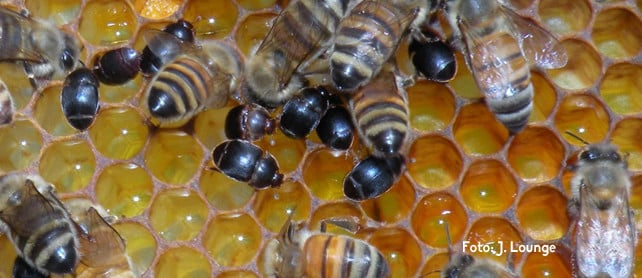
Small hive beetles exploit poorly defended hives. The larvae damage comb while feeding on honey, pollen and brood. A severe infestation can overwhelm a colony, especially one already under stress. Stored honey comb is also vulnerable, because there are no bees to defend it.
The beetle is native to sub-Saharan Africa. African honey bees have defensive behaviours that often limit its impact, but it is misleading to call it harmless or simply the equivalent of wax moth. Its spread beyond its native range has caused substantial beekeeping problems. Europe also had an interception in Portugal in 2004, which was eradicated; the Italian detections of 2014 marked a different, persistent problem.
| Period | Development |
|---|---|
| 1990s | Detected in the United States, followed by wider spread |
| 2014 | Established infestation detected in Calabria, southern Italy |
| 2026 | A secondary outbreak in Gaeta, Lazio, linked to an illegal movement of colonies |
Where is it now? The European situation
Distribution changes, so consult the latest official reports rather than treating a blog table as a movement permit. The following summary was checked on 12 September 2026 against the official sources cited below; the Lazio information comes from the June 2026 notifications.
| Area | Reported situation |
|---|---|
| Calabria | Persistent infestation since 2014; the whole region is covered by the EU emergency measures |
| Sicily | Further detections in 2024 led to the whole region being included in the EU emergency measures |
| Lazio (Gaeta) | Outbreak confirmed in June 2026 and linked to colonies moved illegally from Vibo Valentia, Calabria |
| Other EU territories | Réunion, a French overseas department, has also been affected. The EU measures for Réunion, Calabria and Sicily currently apply until 31 December 2026; other movement rules may also apply |
| Spain | No detected outbreaks reported in the official Spanish information reviewed; surveillance and notification remain essential |
What the Lazio outbreak teaches us
According to Spain’s official June 2026 notification, the Gaeta outbreak was linked to an illegal movement of colonies from Calabria. That is a practical reminder to check the origin, health documentation and current movement restrictions before buying swarms, nucleus colonies or queens. Distance alone is no protection, and documentation must reflect the rules that actually apply to the consignment.
Life cycle
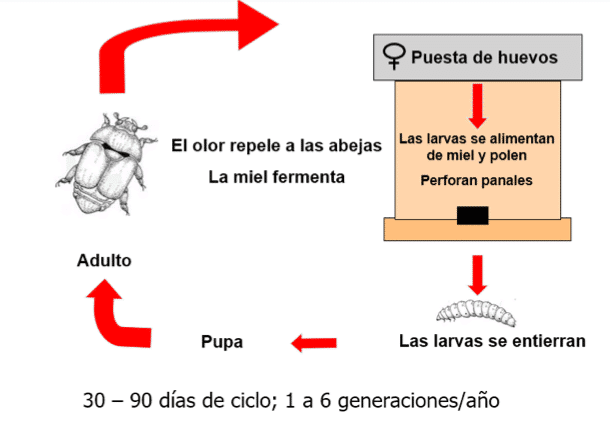
Adults can enter a colony and lay eggs in places the bees cannot readily defend. The larvae feed on hive resources and damage the comb. Their activity contaminates the honey and promotes fermentation, leakage and slimy comb; this is not simply spilled, otherwise sound honey.
Mature larvae leave the hive and normally pupate in the surrounding soil. The adult later emerges from the soil. This outside-hive stage matters for surveillance: an apparently clean box is not proof that an affected apiary is free of the pest.
| Factor | Why it matters |
|---|---|
| Development | Timing varies with environmental conditions; a fixed calendar is not a reliable basis for ruling out infestation |
| Soil | Pupation normally takes place outside the hive, in soil. Local conditions affect survival but do not provide guaranteed protection |
| Seasonal population growth | The capacity for repeated reproduction makes early detection important; climate alone does not determine the risk |
| Colony condition | Weak or poorly defended colonies and stored comb are particularly vulnerable. Strong colonies are better defended, not immune |
Temperature and soil conditions affect development and survival, but dry or compacted ground does not guarantee that the beetle cannot establish. Do not use a particular soil type as a reason to dismiss a suspicious finding.
How to recognise a possible infestation
Warning signs include slimy, damaged comb and leaking, fermenting honey, sometimes with an odour compared to rotting oranges. These signs are not specific enough to confirm an infestation. Adults or larvae may be found before there is conspicuous damage, so do not wait for the smell before reporting them.
The adult beetle

- Usually 5–7 mm long; use several identifying features, not size alone.
- Brown to almost black.
- Clubbed antennae, with an enlarged tip.
- A broad, compact body with a clear division between the thorax and the wing cases.
- Short wing cases, or elytra, which leave the rear end of the abdomen exposed.
The larva: distinguish it from wax moth
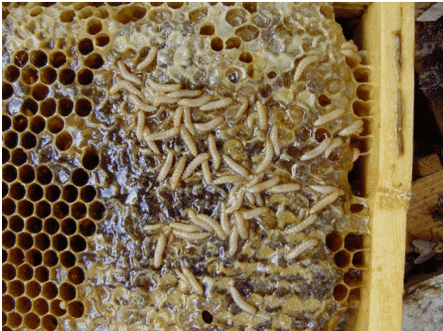
Wax moth and small hive beetle larvae can both be found in damaged comb. Look at the legs, body surface and webbing rather than relying on the damage alone:
| Aethina tumida larva | Wax moth larva | |
|---|---|---|
| Legs | Three pairs of jointed legs, near the head | Jointed legs near the head plus fleshy abdominal prolegs |
| Body surface | Conspicuous spines | No comparable rows of body spines |
| Silk | Does not produce silk webbing | Produces characteristic silk galleries in comb |
| Size | About 1 cm when mature | Larger wax moth larvae may reach 2–3 cm; size varies with species and age |
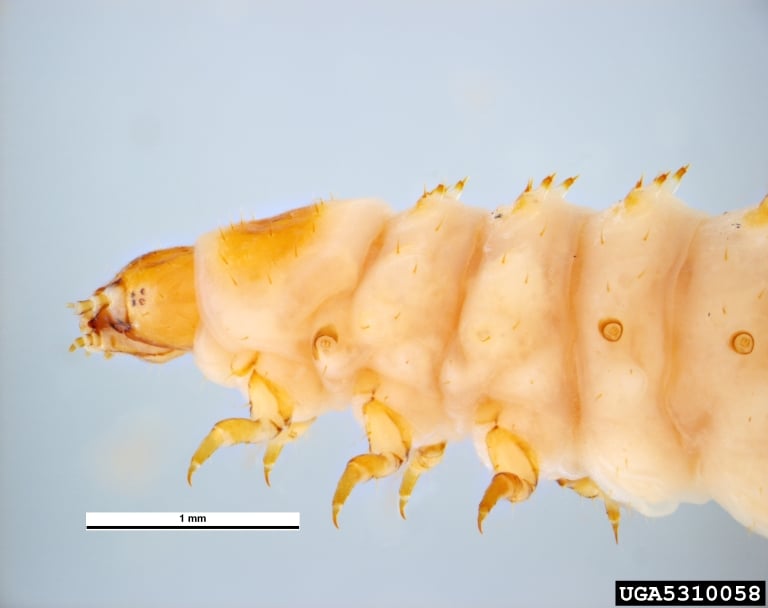
Larvae may also be present on the hive floor or in stored comb. Heavy infestation can cause a colony to abscond, but an empty hive does not identify the cause. Other problems, including severe Varroa infestation (in Spanish), may also precede colony loss. Neither absconding nor an empty box is, by itself, a diagnosis of colony collapse disorder (in Spanish).
Monitoring and control
Several monitoring and trapping devices are used where small hive beetle is established. Designs vary: some fit between frames, while others sit on the hive floor. A device may help detect or reduce beetle numbers, but it is not a substitute for reporting a suspected exotic pest or following official control instructions.
Why narrow openings are not the whole story
Some devices exploit the beetle’s habit of sheltering in spaces that bees cannot readily enter. However, a 4 mm opening is not a universal beetle-only filter, and an entrance slot alone does not guarantee that a beetle will be retained. Use the specifications and instructions for the particular approved or recommended monitoring device.
Do not improvise pesticide-treated cardboard or add household chemicals, boric acid or other substances to a hive. Products and devices used abroad are not automatically authorised in Spain. Any chemical treatment must have the appropriate authorisation and be used exactly as directed by its label and the competent authority; protecting the bees, honey and wax from contamination is part of that decision.
A simple monitoring shelter

The corrugated plastic shown here illustrates the kind of shelter used in some monitoring devices. An empty shelter is an inspection aid, not a guaranteed killing trap. Its presence does not demonstrate effective control or the absence of residues. In Spain, ask the official veterinary service which surveillance method to use rather than experimenting after a suspicious finding.
Good husbandry helps limit vulnerability: keep colonies appropriately strong for the comb they occupy, avoid leaving undefended comb and manage the honey store carefully. These are part of good apiary hygiene, not a guarantee against infestation. If you suspect the pest, stop movements and seek instructions before removing or redistributing material.
What to do if you suspect small hive beetle in Spain
A notifiable infestation
- Do not move colonies, comb or equipment out of the apiary while awaiting official instructions.
- Avoid dispersing insects or larvae. Ask the veterinary service how to document and sample the finding; do not send live specimens or start an improvised treatment.
- Notify the official veterinary service of your autonomous community. Your animal-health association can help you make contact, but a photograph or informal opinion does not replace official confirmation.
- Have recent purchases and movements of live bees or used material, supplier details and health documentation ready for the investigation.
Prompt reporting gives the authorities a better chance to investigate and contain a problem. You do not need to be certain of the species before asking for help, and a suspected beetle should never be moved between apiaries to obtain another beekeeper’s opinion.
Is small hive beetle present in Spain?
The Spanish official information reviewed on 12 September 2026 reports no detected outbreaks in Spain. Italy has had persistent infestation since 2014, with a new outbreak confirmed in Gaeta, Lazio, in June 2026. The French overseas department of Réunion has also been affected. Check official updates before moving or purchasing live bees or used equipment.
How can I distinguish small hive beetle larvae from wax moth larvae?
Small hive beetle larvae have three pairs of legs near the head and conspicuous spines on the body; they do not produce silk webbing. Wax moth larvae have additional fleshy abdominal prolegs and leave silk galleries. These are useful identification clues, but a suspected exotic pest still needs official confirmation.
How big is an adult small hive beetle?
An adult is usually about 5–7 mm long. It is brown to almost black, with clubbed antennae and short wing cases that leave the end of the abdomen exposed. Size alone is not diagnostic: other small beetles can enter hives.
Why do some beetle traps have narrow slots?
Some monitoring devices use narrow openings to offer beetles a refuge that bees cannot easily enter. The dimensions and trapping mechanism depend on the design; 4 mm is not a universal threshold or a guarantee of capture. Follow the device instructions and the official surveillance advice for your area.
What should I do if I suspect small hive beetle?
Do not move colonies, comb or equipment out of the apiary. Contact your autonomous community’s official veterinary service immediately and follow its instructions for inspection and sampling. Small hive beetle infestation is notifiable; photographs can help raise a suspicion, but they do not replace official diagnosis.
Sources checked on 12 September 2026: MAPA’s small hive beetle information, the Italian surveillance reports linked above and EU Decision 2023/110, as amended. For a suspected infestation or a proposed movement, obtain current instructions from the competent veterinary authority.

ISNI 0000 0005 1801 1100 | Joshua Ivars is the manager of LA TIENDA DEL APICULTOR and the author of this blog, where he shares technical and practical guidance for beekeepers. Drawing on extensive experience in the beekeeping sector, he offers advice and solutions based on beekeepers’ real needs, sharing his knowledge of equipment and essential beekeeping practices.


