
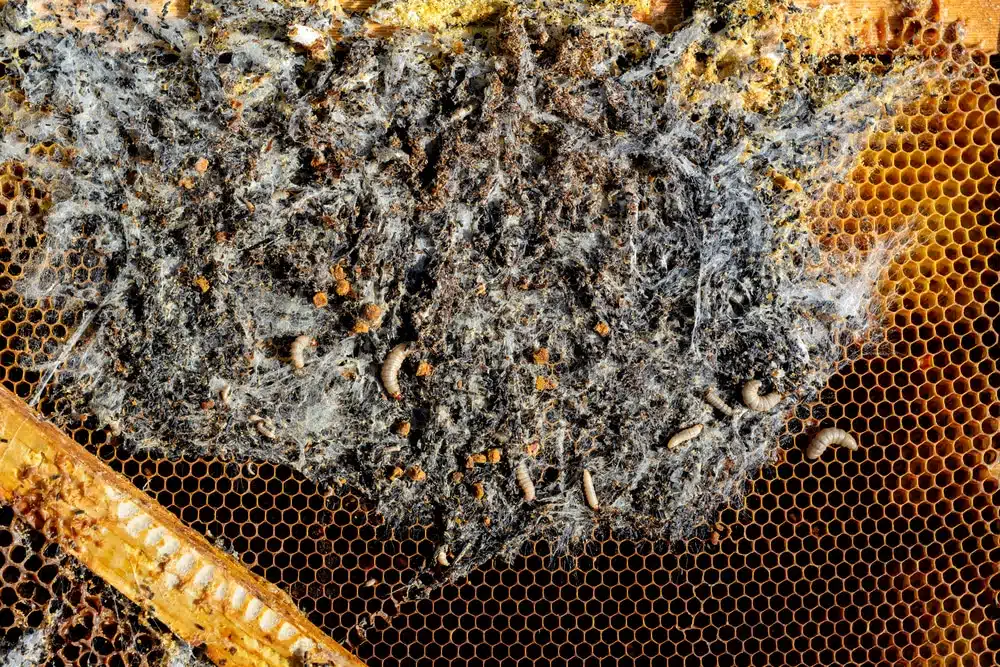
Wax moths, including the greater wax moth (Galleria mellonella), are scavenging pests whose larvae can destroy stored comb and damage weakened colonies. Old brood comb, pollen and cocoon residues are particularly attractive. Strong colonies normally suppress serious damage, but are not completely moth-free. Start with healthy colonies and the right amount of hive space, then protect stored frames. Freezing is a practical option; fumigants and Bacillus thuringiensis products require separate checks on suitability, safety and local authorisation.
Wax moth control at a glance
- In a live colony, investigate serious damage. Check the queen, Varroa, food and bee coverage. Wax moth can exploit an underlying weakness and then make the damage worse.
- Protect stored comb from the start. Warm, dark storage without pest control favours infestation. Sealed storage is useful after effective freezing; sealing untreated infested frames is not a treatment.
- Freezing can kill eggs as well as larvae and adults. Bt acts on feeding larvae, and sulphur is not reliable against eggs. Cold is not the only physical method capable of killing eggs, but heat can damage wax and needs its own validated procedure.
- Renew old brood comb progressively. Roughly a third each year is a rule of thumb, not a universal schedule. Prioritise its condition and the colony’s ability to draw replacements.
In this guide
- Wax moths and waxworms: which stage damages comb;
- greater and lesser wax moth: how they differ;
- the life cycle and the importance of temperature;
- early signs of damage in hives and stored frames;
- prevention through colony and storage management;
- control methods, including their limitations;
- plastic and polystyrene equipment: what the research does and does not show.
What is a wax moth—and what is a waxworm?
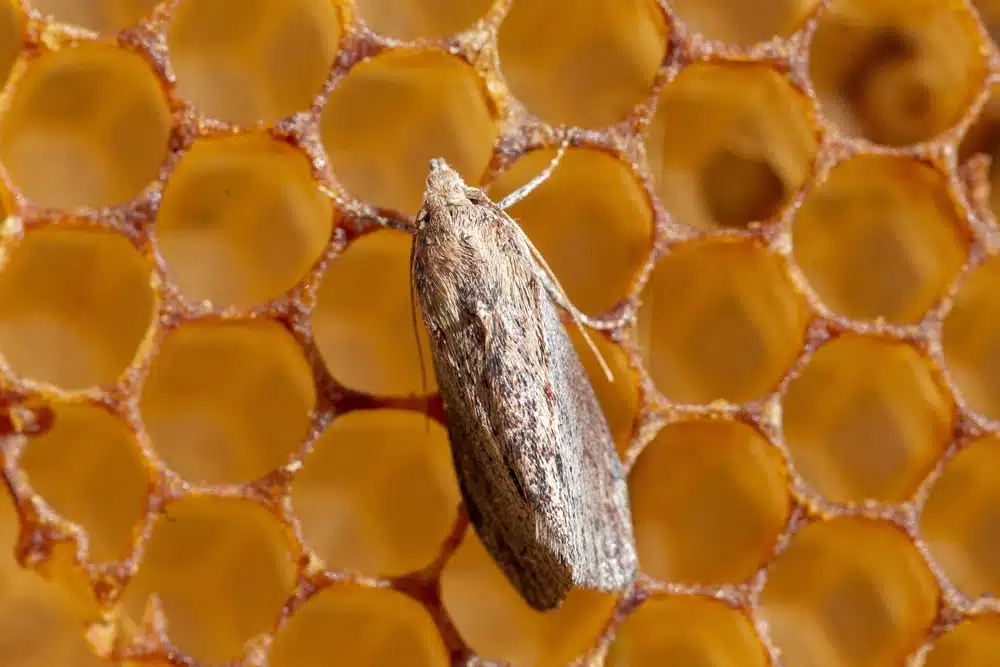
Wax moths belong to the family Pyralidae and are most active as adults at night. The comb-damaging stage is the larva, or waxworm, which tunnels through the comb. Adult wax moths do not do this feeding damage.
“Wax moth” usually means the adult insect, while “waxworm” means its caterpillar. These are different stages, not separate pests. However, the common name covers more than one species: greater and lesser wax moths need to be distinguished.
An important distinction: the attraction is not simply a sheet of clean wax. Used brood comb contains pollen, old cocoons and shed larval skins as well as wax. This richer material is generally more vulnerable than new foundation. That does not mean wax moths cannot consume wax, or that new foundation is guaranteed protection.
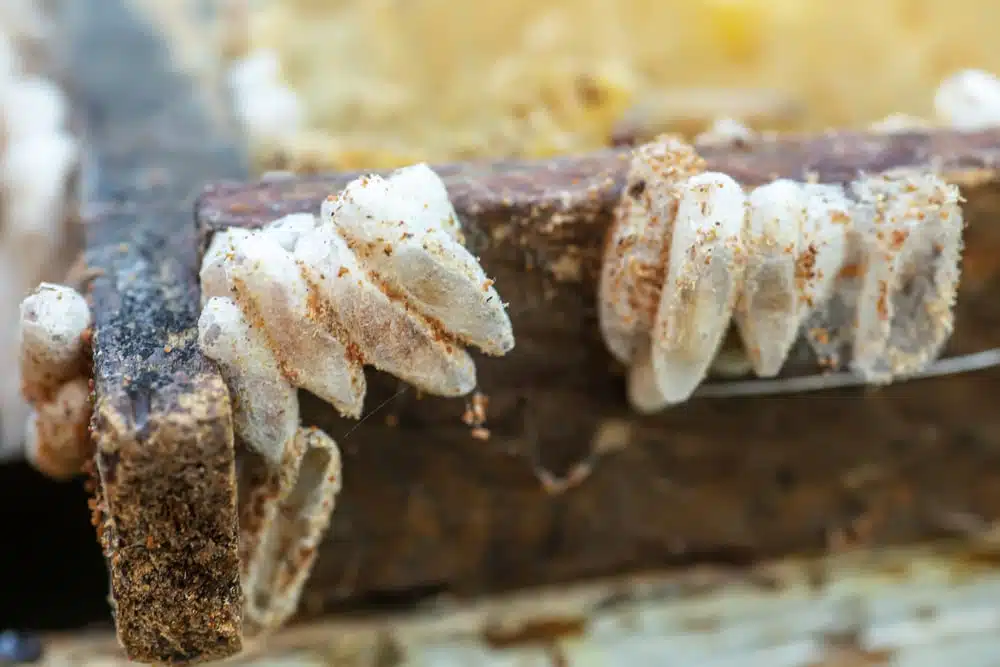
Larvae start by tunnelling through the comb. As an infestation progresses, intact cells are replaced by a tangle of strong white silk, chewed material and frass—the larvae’s droppings.
Greater and lesser wax moth: two different species
Both species occur in European apiaries. The same basic prevention principles apply, but their appearance and damage differ. Product instructions must still cover the intended pest and use:
| Feature | Greater wax moth | Lesser wax moth |
|---|---|---|
| Species | Galleria mellonella | Achroia grisella |
| Adult | Robust, grey-brown; approximately 15–20 mm long | Slender, silver-grey to buff; approximately 10–13 mm long |
| Larva | Cream-coloured; mature larvae can approach 25–30 mm | Generally smaller and more slender |
| Damage | Extensive tunnels and rapid destruction in heavy infestations | Finer tunnels; may cause bald brood and damage stored comb |
| Where to look | Brood comb, supers and stored equipment | Stored comb, debris and poorly defended hive areas |
Reproduction and life cycle
Development depends strongly on warmth and food. A generation can be completed within a few months in favourable conditions, but an eight-week cycle is not a reliable timetable for every species or store. Females lay eggs in protected cracks and joints, close to suitable comb. The stages below are a guide to what to look for, not fixed deadlines:
| Stage | What happens | Timing to bear in mind |
|---|---|---|
| Egg | Eggs are hidden in protected cracks and joints. | Often hatch in about 5–8 days in warm conditions; colder conditions delay development. |
| Larva | The feeding stage tunnels through comb and spins silk. | Several weeks to months, depending on species, food and temperature. |
| Pupa | A silken cocoon protects the insect before adult emergence. | Weeks, and potentially longer in cool conditions. |
| Adult | No feeding damage to comb; moths mate and females lay eggs, mainly at night. | A relatively short adult life, varying with species and conditions. |
Temperature and diet alter development markedly. Cool conditions slow the cycle, so immature stages can remain for extended periods and resume development as conditions improve. Warm storage allows populations to build quickly. Altitude alone is not protection: a warm shed above 1,000 metres can still support an infestation, and a chilly room is not equivalent to a validated freezing treatment.
Recognising damage early
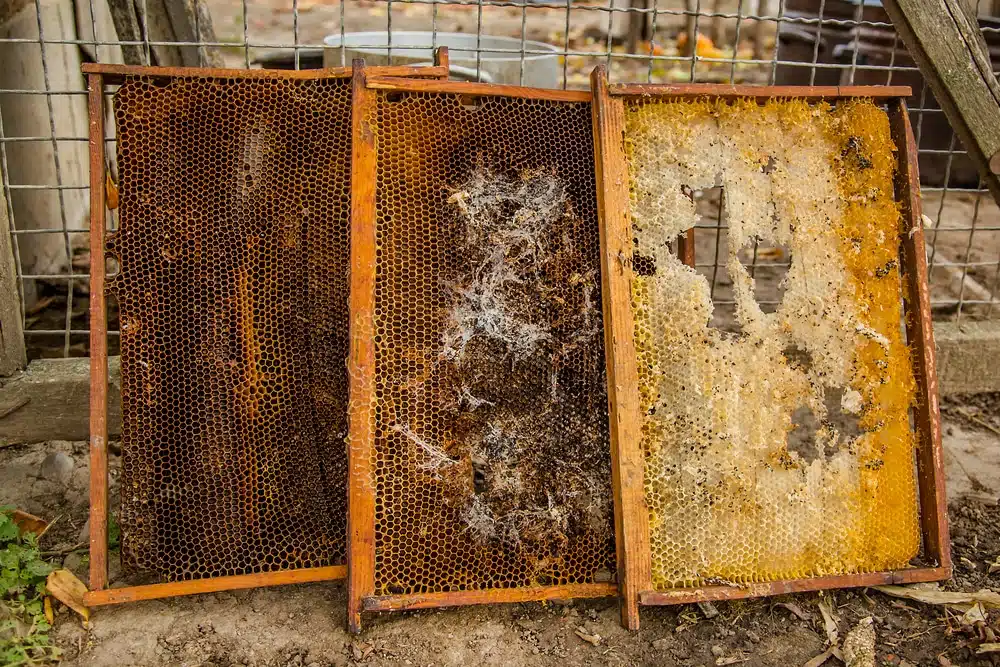
A frame reduced to a mass of silk may no longer be worth keeping. Look for earlier warning signs during each hive inspection and when checking stored equipment:
- White silk webbing between combs, across cells or in box corners.
- Tunnels and damaged cappings, sometimes forming tracks over sealed brood.
- Dark granular frass on the hive floor or beneath stored frames.
- Silken cocoons fixed to frames or hive walls, sometimes associated with grooves in the wood.
- Bald brood: rows of exposed pupae where workers have removed cappings damaged by a moth larva’s tunnel. Inspect the brood; a line of open cells alone is not a complete diagnosis.
In an occupied hive, extensive wax moth damage is a warning to investigate colony strength. Check the queen, Varroa levels, food and whether the bees can cover the comb provided. A single moth does not diagnose queenlessness or disease; equally, allowing an infestation to develop can cause further damage.
Prevention in the apiary and comb store
Healthy colonies and clean, well-managed stores are the foundation of prevention. Comb protection should support that management, not replace it.
- Maintain strong colonies with productive queens. Colony strength and management (Spanish guide) matter, but do not unite a weak colony with another until infectious disease has been excluded. Suspected American foulbrood requires containment, not routine combining.
- Match hive volume to the population. Use an appropriate nucleus box or divider where needed, so brood and pollen comb are not left beyond the area the bees can defend.
- Select well-performing stock and encourage effective hygienic and defensive behaviour, without assuming that this makes a colony immune to infestation.
- Store empty supers in a dry, weather-protected, light and well-ventilated area when conditions suit. Protect them from birds and rodents. Queen excluders are not moth-proof screens, and ventilation alone is not adequate protection for vulnerable dark brood comb. Use effective treatment and pest-proof storage where needed.
- Replace old brood comb in a planned rotation. About 30% a year is a starting point to adapt, not a guarantee of moth control. Old brood residues make comb especially attractive.
- Scrape debris and clean stored equipment. Cleaning reduces hiding places but does not prove that every egg or disease agent has been removed.
Comparing control methods
No method solves every storage problem. The table separates the pest stages affected from practical limitations. A commercial listing is not evidence of regulatory approval or a substitute for the label:
| Method | Target or effect | Main limitation | Use in practice |
|---|---|---|---|
| Sulphur | Historically used against larvae and adults | Not reliable against eggs; gas and fire hazards | Empty stored equipment only where specifically authorised. Follow the product label, not a generic repeat interval. |
| Selected Bt products | Young larvae that ingest treated material | Do not kill eggs or adults, or repair damaged comb | Preventive comb treatment where authorised. B401/B402 currently unavailable in the UK/EU according to Vita. |
| Freezing | All stages, including eggs | Needs sufficient time at the temperature of the whole load; no protection after reinfestation | See the freezing section for temperature, exposure time and protected storage. |
| Cool, light, ventilated storage | Slows development or discourages infestation | Does not establish that every stage is dead | A storage measure, not a substitute for disinfestation of affected comb. |
| Commercial frame protectants | Purpose and claims depend on the exact product | No proven cure for an established attack is assumed here | Check the current label, evidence and local authorisation before relying on a product. |
Sulphur
Sulphur dioxide has historically been used to fumigate empty stored equipment. It should not be relied on to kill eggs. Do not turn that limitation into a universal instruction to repeat treatment after ten days. Use is only an option where a product is currently authorised for that precise purpose, with its specified application, repeat interval and re-entry rules. Swiss Agroscope guidance, for example, states that sulphur is not authorised there for wax moth control; that is a Swiss rule, not a finding about every other country.
Burning sulphur produces a hazardous respiratory irritant and creates a fire risk. It can also damage metal equipment. Do not improvise a fumigation enclosure or assume an ordinary face mask makes the gas safe. Never use it in an occupied hive or with honey intended for consumption. Appropriate operator protection, exclusion of people and animals, ventilation and airing of equipment must come from an authorised protocol. For routine frame storage, a properly managed freezer avoids these gas-handling hazards.
Bacillus thuringiensis
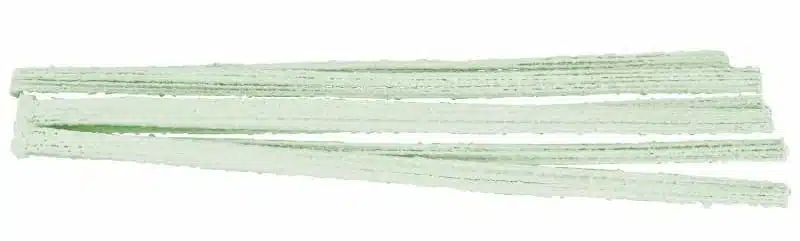
Products based on selected strains of Bacillus thuringiensis act when young larvae feed on treated comb. Not every Bt formulation is suitable for bees or comb storage. Vita describes B402/Certan as a preventive treatment applied to both faces of stored comb after harvest, with drying before storage; it does not kill eggs or restore destroyed comb. The manufacturer currently states that B402 and its predecessor B401 are not available in the UK or EU (checked September 2026). Do not interpret an old B401 catalogue page as permission to use it locally. Where an appropriate product is authorised, follow its current label rather than a generic annual spray recipe.
Freezing
Thorough freezing can kill every life stage, including eggs. For practical empty-frame storage, allow at least 48 hours at −18°C or colder after the entire load has reached the required temperature; packing a warm stack into a freezer does not start that exposure immediately. Avoid overloading and check the actual temperature. Published shorter exposure times apply at the temperature of the comb, not just the freezer display. UF/IFAS discusses this distinction between freezing and cool storage. Protect treated frames promptly in intact moth-proof containers or bags; keep the comb dry and avoid trapping moisture as it thaws. Opening the packaging exposes it to new egg-laying. Freezing for insects is not disinfection against brood-disease spores.
Where the climate and colony population permit, keeping supers on strong colonies until the colder part of the year can shorten warm-weather storage. This is not a reason to leave excess empty space above a weak colony. Match the arrangement to bee coverage, winter stores and local conditions, then reassess in spring.
Wax moths, polystyrene and plastics
What about polystyrene hives? Waxworms can chew into materials beyond the comb, but polystyrene and polyethylene are different plastics. Bombelli, Howe and Bertocchini’s 2017 paper concerned polyethylene degradation by Galleria mellonella larvae. Bertocchini was affiliated with the CSIC–University of Cantabria research institute for that work. It is not evidence that every plastic hive material breaks down in the same way.
Beeswax is a mixture of compounds, including long-chain esters and hydrocarbons—not simply a polymer equivalent to polyethylene. Research into waxworms and plastics is interesting, but chewing holes, chemical breakdown and a scalable recycling process are different claims. Do not take an experimental finding as a complete explanation of wax digestion or a solution to plastic pollution.
The practical point: inspect the hive body as well as its comb, including joints, corners and places where larvae could settle to pupate. This matters with foam equipment as well as wooden frames. Clean before storage and follow the hive manufacturer’s advice on damaged parts; the polyethylene study alone does not establish the susceptibility of a particular polystyrene box.
Frequently asked questions
What is a wax moth?
Wax moths are nocturnal moths whose larvae tunnel through comb and feed on wax and its contents, especially old brood comb and pollen residues. The two main beekeeping pests are the greater wax moth, Galleria mellonella, and the lesser wax moth, Achroia grisella.
Do wax moths attack honey bees?
Their main damage is to comb, but tunnelling and silk can also disrupt brood development. Strong colonies usually keep the pest in check. Serious damage is most likely in weakened colonies or stored comb without bees to defend it.
How do you kill wax moth in stored frames?
Freeze the comb thoroughly, then protect it against reinfestation. Allow at least 48 hours in a freezer operating at −18°C or colder after the whole load has reached the required temperature. A crowded freezer may need much longer to cool the material. Freezing does not make diseased comb safe to reuse.
Does sulphur kill wax moth eggs?
Sulphur dioxide should not be relied on to kill wax moth eggs. That limitation does not justify an automatic ten-day treatment schedule: legal availability, repeat intervals and safe use depend on a currently authorised product and its label. Freezing avoids fumigant exposure.
Are wax moths dangerous to people?
Wax moths do not sting people like bees. Their main importance is damage and contamination of hive materials. Infested comb or stored hive products must still be assessed for hygiene and suitability; finding wax moth does not establish that the honey is safe to sell or eat.
How much brood comb should you replace each year?
A rolling programme replacing roughly a third of old brood comb each year is a useful management rule of thumb, not a universal requirement. Adjust it to comb condition, colony development and bee-health advice. New foundation alone does not prevent infestation.
Sources
- UF/IFAS: lesser wax moth, for biology, bald brood and stored-comb management. Product availability and the Swiss regulatory example are linked in the relevant sections above; neither should be generalised to other countries.
- Bombelli, Howe and Bertocchini (2017), Polyethylene bio-degradation by caterpillars of the wax moth Galleria mellonella, Current Biology 27, R292–R293. DOI: 10.1016/j.cub.2017.02.060.
Educational guidance. Use only products authorised for the intended purpose in your country and follow their current labels. Consult your bee-health adviser or veterinarian if colony weakness or brood disease is suspected. Do not combine suspect colonies or reuse potentially diseased comb without advice.

ISNI 0000 0005 1801 1100 | Joshua Ivars is the manager of LA TIENDA DEL APICULTOR and the author of this blog, where he shares technical and practical guidance for beekeepers. Drawing on extensive experience in the beekeeping sector, he offers advice and solutions based on beekeepers’ real needs, sharing his knowledge of equipment and essential beekeeping practices.


