
Formic acid can be an effective tool against Varroa destructor, but only when used as an authorised veterinary medicinal product, within its specified temperature range, and with the correct ventilation, colony size, and hive type as stated in the product information leaflet. It is not a home remedy: insufficient evaporation will fail, and excessive release may kill brood, adult bees, or the queen.
This guide explains how to decide whether an authorised treatment containing formic acid fits into the apiary’s health programme, what to check before and after application, and why the previous instructions for preparing treatments from bulk acid have been withdrawn. The specific conditions are always those in the current product information on CIMA Vet and the instructions given by the veterinarian responsible for the holding.
Do not prepare formic acid treatments at home
The MAPA considers it fraudulent to administer formic acid in bulk or use authorised products for other purposes under conditions different from those specified. The risk is not only legal: improvised concentration, support, or evaporation rate may cause burns to the beekeeper, lack of efficacy, colony intoxication, and uncontrolled residues in honey, pollen, or wax.
Use only a medicinal product authorised for bees and follow its product information exactly. Do not dilute formic acid, refill diffusers with bulk product or turn an outdated dosage table found online into a veterinary treatment protocol.
What formic acid is and how it acts against Varroa
Formic acid is a volatile organic acid. In hive medicinal products that act by evaporation, the active ingredient is released in a controlled manner and distributed as vapour within the brood chamber. The FormicPro product information leaflet states activity against mites present on adult bees, and also against part of the mites within capped brood.
This capability does not mean it eliminates all Varroa, nor that it performs equally in every colony. The concentration achieved inside the hive depends on external temperature, available volume, ventilation, colony strength, and the colony’s ventilation response. That is why a product based on evaporation has a much narrower application window than the generic phrase ‘apply formic acid’.
The correct decision starts with measuring, not treating
A hive may carry a heavy infestation without visible mites at first glance. Before selecting the active ingredient, measure infestation using a repeatable method, and record date, hive, presence of brood, and result. The wash of a bee sample, powdered sugar, or natural fall monitoring serve different purposes and must be interpreted using criteria adapted to the time of year and region.
Consult our guide to Varroa diagnosis and decision-making. Previous results help determine whether action is needed, and follow-up monitoring confirms whether the treatment actually reduced the population. Without this second measurement, a treatment applied apparently normally may conceal a failure due to weather, placement, reinfestation, or incorrect use.
Five-step control sequence
- Measure: quantify infestation and review brood, population, queen, stores, and expected harvest.
- Choose: select an authorised medicinal product with the veterinary surgeon, according to colony, weather, hive type, and annual programme.
- Prepare: read the current product information leaflet, check weather forecast, and ensure ventilation, personal protection, and record-keeping are ready.
- Apply: follow the dose, placement, duration and restrictions; treat the indicated colonies in a coordinated manner.
- Verify: record incidents, check queen and colony, and repeat the measurement method to confirm efficacy.
Formic acid authorised medicinal products in Spain
The catalogue may change. In the CIMA Vet check conducted on 27 July 2026, FormicPro was listed as commercially available and subject to veterinary prescription; VarroMed was also commercially available without prescription, although its administration remains under veterinary control or supervision. MAQS remains in the database, but its presentations are listed as not commercially available.
FormicPro 68.2 g
What it is and how to use it: formic acid in strips that act by evaporation over seven days in vertical modular hives, as specified in the product information leaflet.
Key control: requires prescription; daytime temperature between 10 and 29.5 °C on the day of application; colony of at least 10,000 bees; ventilation and removal of honey supers.
VarroMed
What it is and how to use it: dispersion of formic acid and oxalic acid dihydrate applied directly onto bees. The protocol depends on colony size, season, and mite fall count.
Key control: do not use it during the honey flow. Follow its own product information and do not apply FormicPro’s placement, temperature or treatment-duration requirements to it.
MAQS
Current status: formic acid in strips with historical authorisation for varroosis.
Key control: CIMA Vet currently lists its presentations as not commercially available. It must not be presented as an available option without rechecking the catalogue.
Checked on 27/07/2026. The valid source for decision-making is always CIMA Vet and the current product information leaflet for the specific medicinal product.
You can consult the FormicPro product information leaflet on CIMA Vet, the VarroMed product information leaflet, and our category of authorised medicinal products against Varroa. The commercial availability listed on La Tienda del Apicultor does not replace veterinary prescription or health decision-making.
FormicPro: critical checks before opening the package
FormicPro releases formic acid via two strips and is authorised for treatment of varroosis in bees. Its product information leaflet does not allow improvisation regarding weather, ventilation, or colony strength. Before application, check all the following points.
1. Expected temperature
Daytime temperatures must be between 10 and 29.5 °C on the day of application. It is not enough to check the temperature at the moment of opening the hive: the product information warns that exceeding the range during the first three days increases the risk of brood mortality and queen loss. If the forecast approaches the limit, postponing is safer than relying on an average.
2. Colony strength, stores, and condition
It must not be used in colonies of fewer than 10,000 bees. A small population may not generate sufficient air flow to maintain a tolerable concentration. The colony must have good stores, and must not be fed inside the hive during treatment. Also assess vitality, disease presence, queen condition, and risk of accumulated stress.
3. Hive type and volume
The product information describes use in vertically modular hives, such as Langstroth or Dadant. Safety and efficacy are not fully proven in horizontal hives such as Layens; in these, use should only be considered after a thorough benefit-risk assessment and review of integrated control alternatives. Do not adapt the placement designed for another model without proper evaluation.
4. Ventilation and setup
The lower hive entrance must remain fully open across the entire width of the hive and at the minimum height specified in the product information leaflet. Remove any reducers or obstacles that restrict airflow. At the same time, the mesh floor boards must remain closed to optimise efficacy. This may seem contradictory, but it is not: the authorised configuration controls precisely where air enters and circulates.
5. Supers, honey and other acaricides
Remove supers containing honey before applying FormicPro. The product information leaflet specifies a zero-day waiting period, but requires that honey stored in supers placed prior to treatment be removed and not intended for human consumption; used strips must be removed before replacing supers destined for harvest. FormicPro must not be combined with other acaricides for varroosis control.
Application: follow the container instructions, not a memorised formula
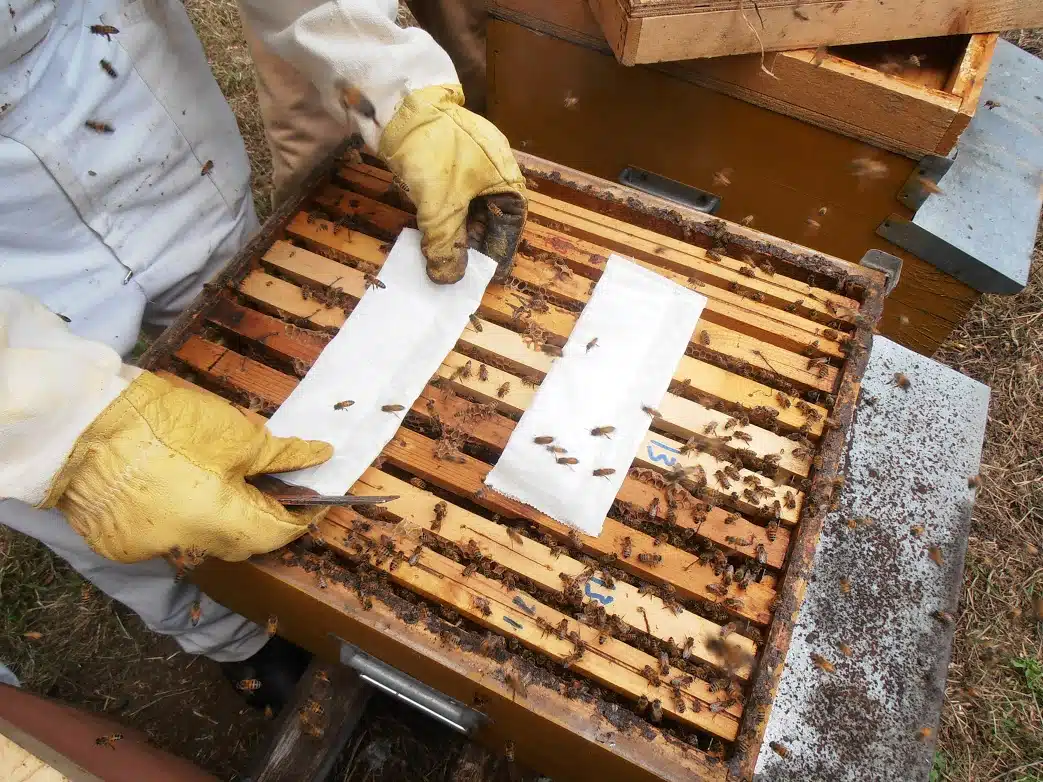
The current FormicPro product information specifies one sachet—two strips—per hive for seven days, with a minimum interval of one month between applications. Separate the strips, but do not remove the paper wrapping, as it controls release. Place them flat on the top bars of the lower brood chamber frames, following the exact layout specified in the leaflet.
Do not open the brood nest or disturb the combs during treatment. Disturbing the colony increases the risk of brood, worker or queen mortality and may cause absconding. Do not reuse spent strips or leave them in the hive when honey supers are put back on. Record the product, batch, date, colonies treated, temperature forecast and any incidents in the holding register.
Applicator protection
- Open the container outdoors and position yourself so that wind carries vapours away from you.
- Wear beekeeping clothing and chemical-resistant gloves in accordance with EN 374.
- Avoid contact with skin, eyes and mucous membranes and inhalation of vapour; keep water readily available.
- Do not eat, drink or smoke during handling, and wash hands thoroughly upon completion.
- Keep children away and avoid contact between the corrosive medication and metal surfaces.
In case of accidental exposure, follow the leaflet instructions and seek medical assistance when appropriate, showing the label or leaflet.
What to monitor during and after treatment
During the first few days, increased ventilation or clustering at the entrance may occur. Do not mistake an expected reaction for absence of risk. The leaflet lists as possible adverse events increased mortality of bees and brood, swarming, queen loss or rejection, and reduced laying, particularly when temperatures are too high, ventilation is insufficient or hive volume is too low.
- Observe without disturbance: monitor the hive entrance and surrounding area without opening the hive for seven days.
- Act in the event of overdose: excessive mortality, absconding or high brood mortality require you to increase ventilation as directed in the product information and contact the veterinarian.
- Check the queen: confirm the presence of an active queen approximately one month after treatment.
- Measure efficacy: repeat the same diagnostic method and record the result. If mite drop or infestation remains high, do not repeat blindly.
- Monitor reinfestation: drift, robbing and untreated nearby hives may increase mite load again.
VarroMed is not a formic acid strip
VarroMed combines formic acid and oxalic acid dihydrate in a dispersion applied directly onto bees. Its dosing is adjusted according to colony size, season and mite drop; it may be used in colonies with or without brood, within authorised conditions. It must not be used during the honey flow.
Do not transfer the application window, placement or duration of FormicPro to VarroMed. They are different medicinal products, with different concentrations, routes of administration and risk profiles. Read the leaflet for the exact format you have and record each application. The fact that a product does not require a prescription does not make it a product without usage conditions.
How to integrate it into an annual Varroa control programme
The MAPA recommends an integrated approach: diagnosis, authorised medicinal products, brood management, prevention of drift and robbing, territorial coordination and efficacy verification. The goal is to keep infestation below damaging levels, not to chain products without measurement.
Plan with your veterinarian from the final harvest onwards and through the development of the winter bees. Coordinate colonies within the same apiary to reduce reinfestation, and alternate strategies according to the risk, authorised conditions and measured results. Our guide to integrated Varroa control explains how to combine monitoring, treatments and management.
Frequently asked questions
Can I use bulk formic acid with a diffuser?
Do not prepare or administer it yourself as a homemade recipe. The MAPA includes bulk formic acid among fraudulent administration practices when used under unauthorised conditions. Any exceptional use outside authorised conditions may only be decided and prescribed by a veterinarian within the applicable legal framework; it does not turn an internet formula into a valid treatment protocol.
Does formic acid kill Varroa inside brood cells?
FormicPro shows activity against mites on adult bees and against part of the mites in sealed brood, according to its technical leaflet. Activity may vary and does not eliminate the need to measure before and after treatment.
Can I apply FormicPro if 30 °C are forecast?
No. The leaflet contraindicates its use when daytime temperature is outside 10 to 29.5 °C on the day of application and warns of risk during the first three days. If the forecast reaches or exceeds the limit, postpone and consult another option with your veterinarian.
Is it suitable for Layens hives?
The safety and efficacy of FormicPro have not been fully established in horizontal hives such as Layens. The leaflet requires a thorough benefit-risk assessment and consideration of alternative integrated management approaches; do not adapt strip placement by intuition.
Is MAQS still available?
In the CIMA Vet database search on 27 July 2026, MAQS is authorised but has no commercially available presentations, whereas FormicPro is listed as commercially available. Check the catalogue again, as this status may change.
Must all hives be treated?
The FormicPro leaflet recommends treating all colonies in the apiary simultaneously to reduce reinfestation, provided each meets the use conditions. A colony that is too small or in another condition must not be forced into the same protocol: consult your veterinarian.
Official sources and review
- AEMPS, FormicPro technical leaflet 68.2 g, review 11/2025.
- EMA, official information on VarroMed.
- MAPA, Varroa infestation and technical documentation.
- MAPA, Varroa control guide for beekeepers.
- Regulation (EU) 2019/6 on veterinary medicinal products.
Content reviewed on 27 July 2026. Medicinal products, their commercial status and their product information may change; always check the current version before treatment.

ISNI 0000 0005 1801 1100 | Joshua Ivars is the manager of LA TIENDA DEL APICULTOR and the author of this blog, where he shares technical and practical guidance for beekeepers. Drawing on extensive experience in the beekeeping sector, he offers advice and solutions based on beekeepers’ real needs, sharing his knowledge of equipment and essential beekeeping practices.


