
Oxalic acid can control Varroa present on adult bees, but it does not penetrate wax or effectively reach mites protected within capped brood. Therefore, success depends equally on the timing and amount of brood, as well as the authorised medicinal product, its route of administration, and strict adherence to the product information leaflet.
This guide replaces old recipes using bulk oxalic acid with a safe process for selecting and applying registered veterinary medicinal products in Spain. It does not provide a universal formula: Oxybee, API-Bioxal, Varroxal, Calistrip Biox, and VarroMed are not interchangeable, even if some share the active ingredient.
Do not prepare oxalic acid for hives using bulk raw materials.
The MAPA lists bulk oxalic acid and authorised products used for other purposes among fraudulent practices when administered under unauthorised conditions. Glycerine wipes, cardboard strips, syrups and sublimator charges made from a generic recipe are also unsuitable.
The problem is not only legal. Altering purity, excipients, concentration, carrier, or dosage may result in lack of efficacy, bee intoxication, uncontrolled residues, and serious exposure risks for the applicator. Use the registered presentation and follow the exact product information leaflet on the packaging.
How oxalic acid works against Varroa
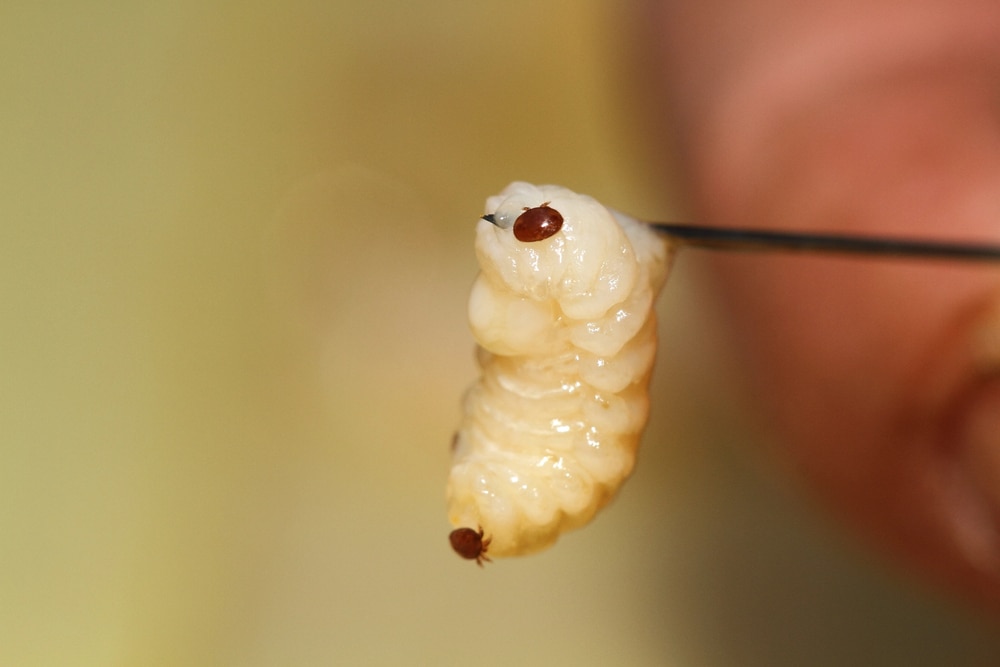
Oxalic acid acts by contact on phoretic mites, that is, those found on adult bees. The leaflets for API-Bioxal, Varroxal, and Calistrip Biox state a decisive limitation: the active ingredient does not penetrate wax and does not eliminate mites remaining under the capping.
A colony with abundant brood may keep a significant proportion of its Varroa population beyond the reach of a fast-acting treatment. When that brood emerges, the mites reappear. Therefore, ‘using oxalic acid’ does not in itself define a strategy: you need to know the infestation level, whether brood is present and the authorised use of the selected formulation.
First diagnose; then choose the treatment
It is not enough to observe bees or wait to see mites with the naked eye. Measure infestation using a repeatable method, record the result, and review colony population, brood, queen, stores, expected harvest, and previous treatments. Consult our guide to Varroa diagnosis and decision-making.
Six-step decision sequence
- Measure: quantify infestation before treatment.
- Review brood: distinguish between colony with no brood, residual brood, or abundant brood.
- Check CIMA Vet: confirm that the medicinal product and its presentation are authorised and commercially available.
- Read the current product information leaflet: check the route of administration, timing, temperature, whether honey supers are present, repeat applications, protective measures and restrictions.
- Apply and record: follow the exact packaging and record product, batch, date, hives, and conditions.
- Verify: re-measure using the same method and assess re-infestation or lack of efficacy.
Oxalic acid medicinal products authorised in Spain
The catalogue may change. In the CIMA Vet check conducted on 27 July 2026, Varroxal, Oxybee, Calistrip Biox, both API-Bioxal presentations reviewed and VarroMed were listed as commercially available. CIMA lists them as not subject to veterinary prescription, but this does not remove the conditions in their product information or the apiary’s animal-health controls.
Dribbling preparations
Oxybee and API-Bioxal 44.2 mg/ml solution have registered instructions for administration by trickling. VarroMed is a different dispersion combining oxalic and formic acid. Each has its own concentration, dose, number of applications and conditions.
Powders with specific authorised routes
Varroxal 0.71 g/g and API-Bioxal 0.71 g/g powder are formulated and registered veterinary medicinal products. Their product information describes the permitted routes of administration and how to prepare or dose each specific formulation. A product authorisation covering trickling, spraying or sublimation does not permit its substitution with bulk oxalic acid.
Registered strips
Calistrip Biox 6.44 g uses strips manufactured for hives and specifies a defined duration in its leaflet. This does not equate to soaking cardboard, cellulose, or wipes with a homemade mixture of acid and glycerine.
Checked on 27/07/2026. Re-check CIMA Vet before purchasing or administering, as commercial availability, leaflet, or use conditions may change.
You may also review our category of authorised medicinal products against Varroa. Availability in the shop does not replace diagnosis nor make different presentations equivalent.
Brood and timing: the variable that most affects outcome
Varroxal is indicated for broodless colonies. The product information for API-Bioxal and Calistrip Biox explains that maximum efficacy is achieved in the absence of brood or when brood levels are minimal, because oxalic acid does not reach Varroa protected beneath the cappings. The specific product information may also restrict the season, temperature or type of colony.
Do not derive a treatment schedule from the calendar date. In temperate areas, brood may still be present when it has already ceased elsewhere. Inspect the colony. If the health programme includes a brood break, it must be planned as part of integrated management, not improvised to justify an oxalic-acid recipe.
Dribbling: exact product and dosage
Dribbling distributes an authorised solution over areas occupied by bees. It may seem simple, but copying a figure from another product may alter concentration and total dosage. Use only the medicinal product, its included components, and the quantities specified in its leaflet or product information.
- Do not prepare the syrup using technical-grade acid or laboratory raw materials.
- Do not extrapolate millilitres per frame between brands or formats.
- Do not repeat applications to ‘compensate’ for brood presence unless specified in the leaflet.
- Avoid disturbing, chilling, or over-wetting a vulnerable colony.
Sublimation or evaporation: the greatest risk for the applicator
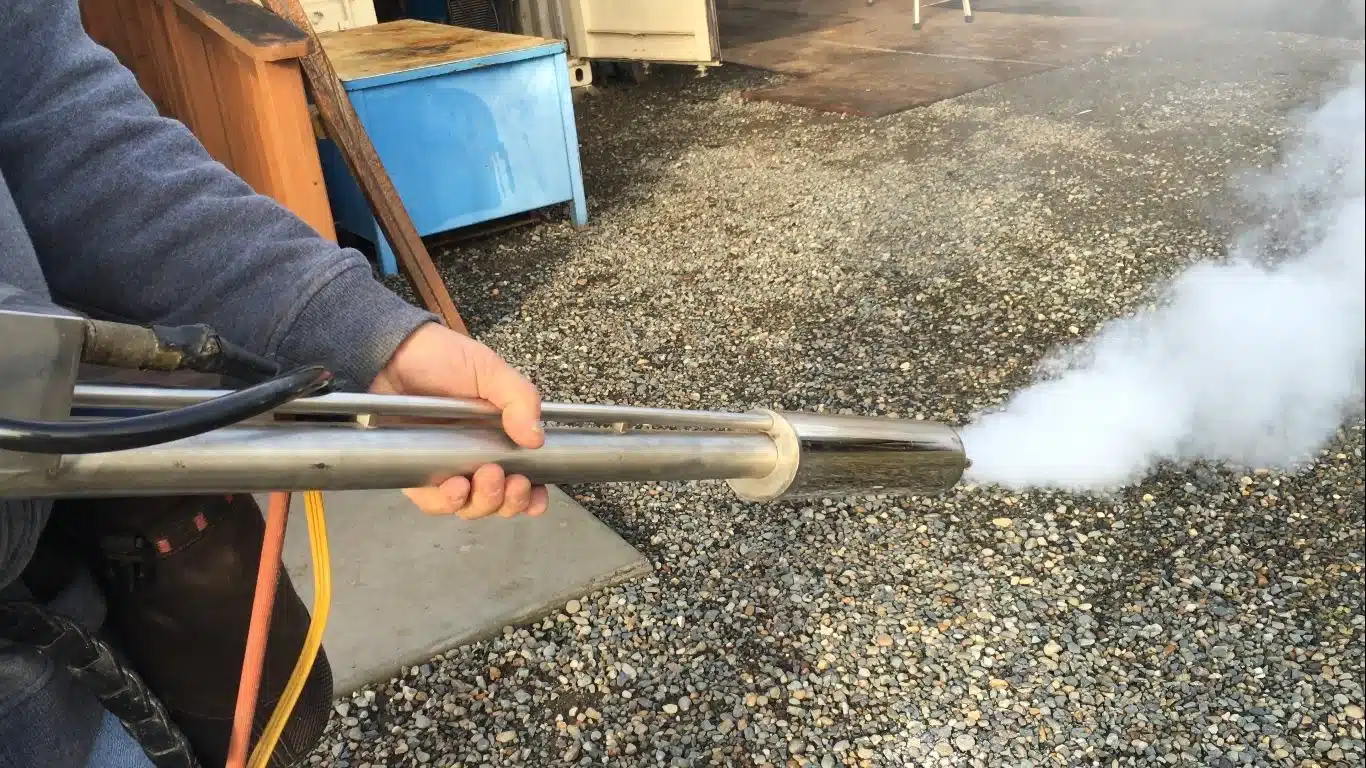
The sublimation route is valid only when specified in the marketing authorisation for the particular product. Owning a sublimator is not enough. The substance may irritate the respiratory tract. Do not inhale the particle cloud or expose other people to it.
The leaflets for authorised powders specify the equipment, respiratory protection, eye protection, gloves, hive conditions, and applicable procedure. Some even distinguish mask level according to route. Do not turn a temperature, charge, or time seen in a video into a general recommendation.
Protection before opening the packaging
- Read the section on personal protection in the current product information leaflet.
- Prepare chemical-resistant gloves, goggles, and the required respiratory protection.
- Handle the product outdoors or in the specified ventilation, and keep others away.
- Avoid contact with skin, eyes, mouth, and clothing; do not eat, drink, or smoke during use.
- Wash hands and dispose of packaging, residues, and equipment according to the leaflet.
Strips: an authorised delivery system, not a homemade carrier
A veterinary strip is not merely a piece of impregnated material. Its active ingredient content, carrier, surface area, release profile and duration are all part of the marketing authorisation. Calistrip Biox must be placed, maintained and removed exactly as specified in its product information; it must not be cut or reused.
Honey supers, honey and treatment record-keeping
A zero-day withdrawal period indicated on a product information sheet does not mean treatment can be carried out at any time. Several formulations of oxalic acid prohibit use during the honey flow or when supers are intended for harvest. Always check the exact restrictions of the medicinal product before opening the hive.
Record at minimum date, product, batch number, hives treated, authorised route, relevant conditions and any incidents. Keep the packaging and leaflet throughout the process. If you observe abnormal mortality, lack of efficacy or an adverse reaction, report it to your veterinarian and follow the appropriate pharmacovigilance channel.
Post-treatment monitoring and annual integration
Repeat the same measurement method after the recommended interval to determine whether the treatment was effective. A visible fall in mite counts is not sufficient to confirm residual infestation levels. Reinfestation may occur due to drifting, robbing or nearby apiaries, even after a correctly applied treatment.
Integrate oxalic acid with diagnosis, brood management, drift prevention, settlement coordination and a reasoned rotation of strategies. Our integrated Varroa control guide explains how to build an annual programme without blindly chaining products.
Errors to avoid
- Using bulk oxalic acid because the active ingredient also appears in medicinal products.
- Copying dosages, concentrations or temperatures from another brand, country or route.
- Treating with large amounts of brood and attributing any rebound to supposed resistance without measuring.
- Repeating a treatment more times than authorised.
- Improvising wipes, cardboard, strips or solvents.
- Working without respiratory protection when required by the product information.
- Treating during the honey flow or with supers without checking the restrictions.
Frequently asked questions
Can I sublimate pure oxalic acid?
You must not use bulk raw material as an apicultural treatment. Sublimation is valid only when it is included in the marketing authorisation for the specific product and carried out at the authorised dose, with the specified equipment, protective measures and conditions.
Does oxalic acid kill Varroa inside brood cells?
It does not effectively reach mites protected within sealed brood cells. This is why low or absent brood levels improve the efficacy of several authorised formulations.
Can I make strips using glycerine?
Not as a homemade recipe. An authorised strip is a complete, evaluated medicinal product; its carrier and release profile form part of the authorisation. It must not be replaced with impregnated cardboard or cellulose.
Do all oxalic acid products work for trickling?
No. The route of administration depends on the formulation. Consult the product information for the exact registration number and do not deduce application method solely from the active ingredient name.
Can I treat if there are honey supers?
Check the exact product information. Several formulations must not be used during the honey flow or when supers are intended for harvest, even if they state a zero-day withdrawal period.
Does a low result indicate resistance?
Not necessarily. First review brood presence, application method, weather, colony condition, reinfestation and measurement accuracy. A poorly chosen or applied treatment may fail without demonstrating resistance.
Official sources and review
- MAPA, Varroa control guide and responsible use of medicinal products.
- AEMPS, product information for Varroxal 0.71 g/g.
- AEMPS, product information for API-Bioxal 0.71 g/g powder.
- AEMPS, technical data sheet for API-Bioxal 44.2 mg/ml solution.
- AEMPS, product information for Calistrip Biox 6.44 g.
- AEMPS, public information for Oxybee.
- AEMPS, public information for VarroMed.
- MAPA, Varroa infestation and technical documentation.
Content reviewed on 27 July 2026. Marketing status and product information may change; always check CIMA Vet before treatment.

ISNI 0000 0005 1801 1100 | Joshua Ivars is the manager of LA TIENDA DEL APICULTOR and the author of this blog, where he shares technical and practical guidance for beekeepers. Drawing on extensive experience in the beekeeping sector, he offers advice and solutions based on beekeepers’ real needs, sharing his knowledge of equipment and essential beekeeping practices.


