
| Your situation | Starting point to compare | Why |
|---|---|---|
| Up to 5 hives | Manual tangential, 2–4 compatible frames | A modest crop may not justify a motor |
| 5 to 30 hives | 3–4-frame tangential, manual or electric | Match the drive and batch size to crop and time |
| 30 to 100 hives | Electric extractor; capacity sized to the harvest | Reduces cranking effort; assess the whole workflow |
| Shallow or medium super frames | Compatible radial | Both comb faces extracted without manual turning |
| Layens frames | Compatible tangential or self-turning tangential | Check basket dimensions and frame support |
| Dadant deep frames used for honey | Compatible tangential or self-turning model | Large-frame clearance and support matter |
| Viscous honey | Suitable tangential model plus appropriate preparation | Higher speed alone is not the solution |
| Professional operation | Large radial, self-turning or horizontal | Choose around throughput, loading and available space |
Start with your frame dimensions, honey and expected crop, not hive count alone. For compatible shallow or medium super frames and free-flowing honey, a radial extractor is a useful starting point. For large frames or more viscous honey, compare suitably sized tangential and self-turning models. The hive-count bands above are illustrative starting points, not fixed capacity limits; yield, available time and loading speed can change the choice.
WHAT A HONEY EXTRACTOR DOES
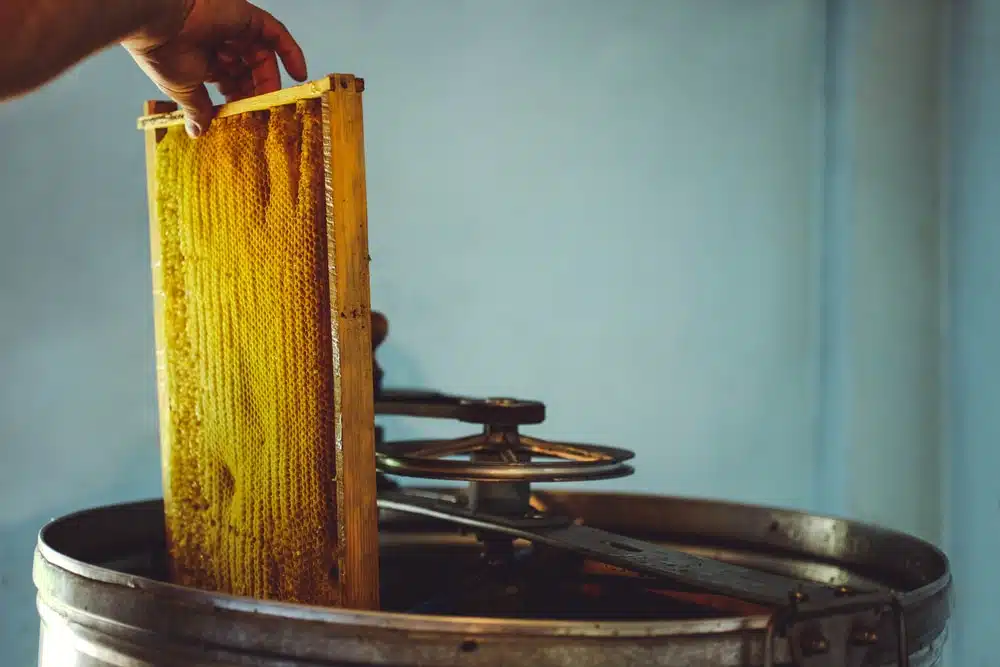
A honey extractor is a piece of beekeeping equipment that uses centrifugal force to remove honey from uncapped combs. Frames rotate inside a drum; honey reaches the inner wall, drains to the bottom and leaves through a honey gate. Correct operation preserves drawn comb for reuse, but excessive force can damage it.
| Part | Function |
|---|---|
| Drum | Collects the extracted honey. It is usually made of stainless steel |
| Basket or frame holder | Holds the frames during rotation |
| Shaft | Enables rotational movement |
| Motor or handle | Operates the extractor |
| Transmission | Can be by gear, belt or direct system |
| Tap or valve | Allows honey to be drained |
| Lid | Provides safety and prevents splashing |
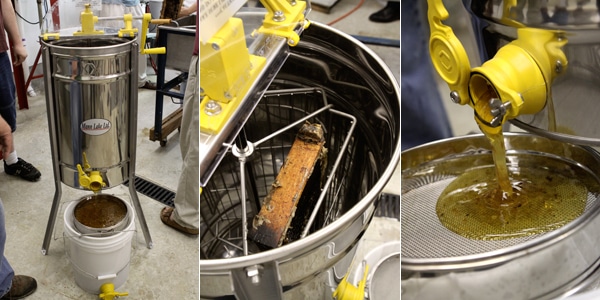
Normal operation with a honey extractor:
- fit frames in the positions specified by the manufacturer, balancing comparable weights across the rotation axis rather than putting all the heavy frames on one side;
- start rotating slowly;
- with a non-reversible tangential extractor, partially extract the first face at low speed, stop completely before turning the frames, extract the second face, then turn them again to finish the first. Follow the manufacturer’s safe stopping and isolation procedure before reaching inside.
Start slowly and increase speed progressively within the manufacturer’s limits. Full combs, especially new or warm wax, need gentle handling. Keep the extractor stable and level, its lid closed and safety devices in place. Never reach into a moving basket; disconnect power before cleaning or maintenance. Use suitable food-contact cleaning products and keep water away from electrical components and bearings, as explained in the LYSON radial and cassette extractor manual.
It is not advisable to focus solely on rpm. Extraction must always begin at low speed and increase progressively according to the extractor diameter, wax condition, frame type and honey viscosity.
If you are looking to buy a honey extractor, the first step is to understand the difference between the two main types of baskets available on the market: tangential and radial.
TYPES OF EXTRACTORS
There are four main types of extractors:
| Type | Typical use | Main advantage | Trade-off |
|---|---|---|---|
| Tangential | Small to medium harvests; compatible large frames | Supported comb face points towards the drum wall | Non-reversible models require manual frame turning |
| Radial | Compatible super frames and free-flowing honey | Extracts both faces during the same spin | Check deep-frame clearance and difficult honeys |
| Self-turning tangential | Larger batches or reduced manual handling | Cassettes swing to extract each face in sequence | Extra cost and moving parts to clean and maintain |
| Horizontal | Professional extraction lines | Rail loading and integration with other equipment | Space, installation and investment requirements |
TYPES OF BASKETS: TANGENTIAL VS RADIAL
Radial Baskets
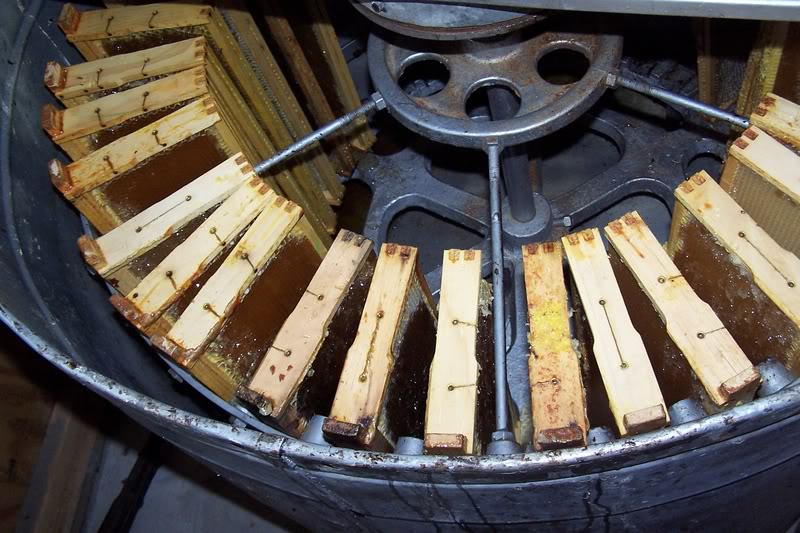
Frames stand around the shaft like the spokes of a bicycle wheel. In many standard radial baskets, top bars face out towards the drum wall; check the exact frame format and loading instructions for your model. Capacity may be quoted for shallow frames, not for the deep frames you own.
ADVANTAGES of radial extractors
A radial extractor can remove honey from both faces during the same spin, without manually turning each frame. Follow the machine’s specified direction or programme. Less frame handling is useful when processing repeated batches of compatible super frames.
Radial layouts often hold more frames within a given drum diameter than tangential baskets. Large professional models may hold dozens of frames. Compare capacity for your exact frame dimensions, however: a headline count for shallow frames is not a count for every hive format.
DISADVANTAGES of radial extractors
Comb breakage is possible with either layout. New wax, heavy combs, excessive temperature, poor support and abrupt acceleration increase the risk. Viscous honey or honey that has crystallised in the comb needs appropriate handling, not simply a faster spin.
It is incorrect to say that a radial basket inherently produces less centrifugal force. At the same rotational speed and distance from the axis, the centrifugal loading is the same. Frame orientation, cell direction, support and honey flow affect how readily the comb empties.
With deep frames, check both physical clearance and extraction performance. In a conventional radial arrangement with top bars outwards, the inner part of the comb is closer to the shaft and moves more slowly than the outer part. A larger drum or a different basket may be needed; the limitation is model-specific.
Do not assume that every radial extractor accepts Layens or Dadant deep frames. Equally, do not rule out a model specifically designed for them. Confirm the manufacturer’s dimensions, supports and recommended use with your honey before buying.
Tangential Baskets
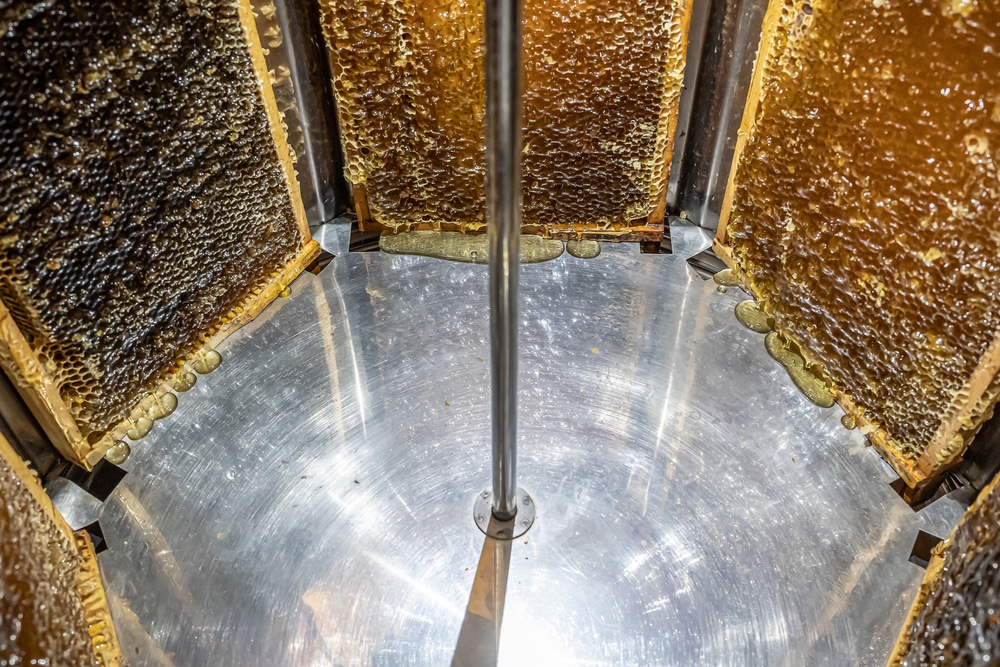
The invention of centrifugal honey extraction is generally credited to Franz von Hruschka in 1865. In a modern tangential extractor, one comb face points towards the drum wall; the plane of the frame is approximately tangent to the basket’s circular path.
ADVANTAGES of tangential extractors
Tangential baskets support the outward-facing comb and can be a practical choice for compatible large frames and more viscous honey. Their advantage is the orientation and support of the comb, not a universal force or energy-efficiency advantage over every radial machine. For gel-like ling heather honey (Calluna vulgaris), a suitable loosener may be needed before tangential extraction; selecting this basket alone does not solve the problem. Thorne’s heather-honey guidance explains this preparation and the alternative of pressing.
DISADVANTAGES of tangential extractors
A conventional tangential basket extracts one face at a time, so the frames must be turned between stages. Stop the machine fully and follow its safe access procedure before doing so. That handling adds labour when running many batches.
Reversible tangential extractors
In a self-turning or reversible tangential extractor, the frames sit in pivoting cassettes. Reversing the basket’s rotation swings the cassettes to present the other face. Both faces are extracted in sequence, not simultaneously, without taking each frame out and turning it by hand. Follow the particular machine’s controller and programme instructions.
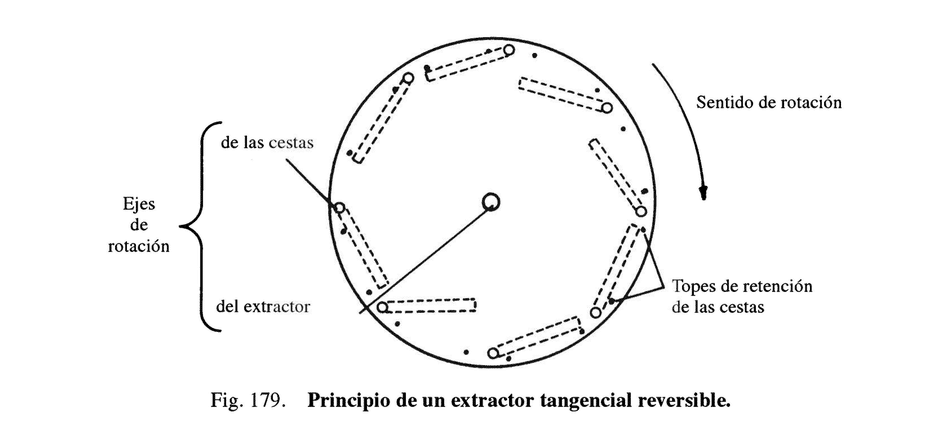
Self-turning machines are available in several capacities, including 6-, 8- and 12-frame configurations. Check the dimensions behind the quoted capacity: the basket must be designed for your Layens, Dadant or other frames.
Larger self-turning machines, including 16- or 20-frame models, are another option. Two smaller machines can offer redundancy and allow one to run while the other is unloaded. One larger machine may suit a different space or staffing arrangement. Compare floor space, power supply, cleaning and the complete workflow rather than assuming either setup is always better.
Radial vs tangential extractor: main differences
In practice, compatible super frames and free-flowing honey often suit radial extraction. Large frames may be easier to handle in a suitably designed tangential or self-turning basket. Check exact specifications, and distinguish viscous liquid honey from crystallised honey and thixotropic ling heather honey.
| Criterion | Radial | Tangential |
|---|---|---|
| Frame position | Like spokes around the shaft | One comb face points towards the drum wall |
| Both faces extracted simultaneously | Yes, in normal radial extraction | No: even self-turning models extract the faces in sequence |
| Handling | No manual turning between faces | Manual turning unless self-turning |
| Capacity at a given drum diameter | Often more compatible frames | Often fewer, supported in baskets or cassettes |
| Free-flowing honey | Often a convenient choice | Also suitable |
| Viscous honey | Check model suitability and preparation | Often worth comparing; not a cure for crystallisation |
| Layens frames | Only in a model explicitly compatible with them | Check basket dimensions and supports |
| Dadant deep frames | Check exact deep-frame compatibility | Check exact deep-frame compatibility |
| Shallow or medium super frames | Often convenient for repeated batches | Suitable where the basket accepts them |
| Comb breakage | Possible if loading, support or speed is unsuitable | Also possible; gradual extraction remains essential |
| Main selection priority | Compatible frame capacity and reduced handling | Frame support, honey characteristics and turning method |
HOW IT WORKS
The most common mistake when using an extractor is starting too quickly. When frames are full of honey, they weigh more and the comb is less able to withstand centrifugal force. Therefore, it is advisable to begin at low speed, extract part of the honey, rotate or invert the frames if required by the extractor, and gradually increase the speed.
Recommended process
- Uncap the frames.
- Fit compatible frames in the specified positions, balancing weights across the axis.
- Begin at low speed.
- Partially extract one side if tangential.
- For manual tangential turning, stop fully and follow the safe access procedure before turning frames. For self-turning models, use the specified programme.
- Increase speed gradually within the manufacturer’s limits, without forcing fragile combs.
- Drain honey through the gate before it can build up into the rotating basket.
- Filter and transfer to the settling tank.
EXTRACTION TIMES
A larger extractor does not always mean higher actual production if considerable time is later lost in loading, unloading, cleaning or balancing frames.
There is no universal requirement to reach 6 m/s in a tangential extractor or 10 m/s in a radial machine. Those figures must not be treated as safe operating targets. Use the manufacturer’s limits and adjust the programme for the frame, comb condition and honey; forcing the last drops out can cost more in damaged comb than it saves.
A batch includes loading, spinning, any turning, unloading and clearing the honey. Its duration depends on the machine, frame size, comb condition and honey temperature and viscosity. Time a representative batch instead of assuming that a published cycle time applies to your crop.
For example, freshly harvested, free-flowing honey may extract readily, while a batch that has cooled in storage may take longer. Oilseed rape honey should be harvested and extracted promptly before it crystallises. Well-capped lavender honey is not automatically difficult: temperature, water content and the actual condition of the honey matter more than the floral name or cappings alone.
For planning, use throughput = frames per batch × average kilograms recovered per frame × completed batches per hour. Measure those values in your own workflow and allow for cleaning and interruptions. A fixed daily yield for a four-frame or 24-frame extractor is not a reliable guarantee without the working hours, crop and loading arrangements.
Warm honey usually flows more readily. A room around 27–30 °C can be an indicative working range, not a universal requirement or a reason to overheat combs. Extract promptly and protect stored supers from pests and contamination. There is no universal 48-hour deadline after which wax-moth eggs hatch; development depends on species, temperature and when infestation began.
An extractor should not be judged by rpm alone. Peripheral speed at a point on the comb = 2 × π × r × n / 60, where r is that point’s distance from the shaft in metres and n is revolutions per minute; the result is metres per second. The relevant radius is not necessarily the full drum radius. At the same rpm, a point farther from the axis travels faster. This explains why dimensions matter, but the formula does not replace the machine’s speed limits or safe loading instructions.
Honey temperature: key to better extraction
Cold honey flows less readily. When practical, extract soon after harvest while supers retain their warmth, or condition them gently in a suitable warm room. Avoid excessive heat or prolonged warming: warm wax also becomes less resistant to deformation. Ling heather’s gel-like behaviour and honey that has already crystallised require different preparation; neither is solved by increasing rpm.
Practical tips:
- Working with honey recently removed from the hives facilitates extraction.
- Avoid cold rooms.
- Do not increase speed to compensate for excessively viscous honey.
- For viscous liquid honey, compare suitable tangential and self-turning models; for ling heather, consider a loosener or pressing.
- Do not leave frames stored longer than necessary before extraction.
Which extractor to choose according to frame type
| Frame type | Selection guidance |
|---|---|
| Layens | Check an explicitly compatible tangential or self-turning basket; do not infer fit from the frame count |
| Langstroth deep frame used for honey | Confirm deep-frame dimensions and support; compare appropriate radial and tangential models |
| Langstroth shallow or medium super frame | A compatible radial often reduces handling; tangential also works |
| Dadant deep frame used for honey | Check deep-frame clearance and support, particularly in radial machines |
| Dadant super frame | Compare compatible radial and tangential baskets according to honey and workflow |
Which extractor to choose according to honey type
| Honey type or condition | What matters | Practical response |
|---|---|---|
| Free-flowing honey | Usually extracts readily | Compatible radial or tangential |
| Heather honeys other than ling | Properties vary with botanical source and batch | Assess viscosity rather than assuming every heather honey forms a gel |
| Oilseed rape honey | Can crystallise rapidly | Extract promptly before crystallisation; do not compensate with excessive speed |
| Ling heather (Calluna vulgaris) | Thixotropic: gel-like at rest | Loosen appropriately before tangential extraction, or consider pressing |
| Well-capped lavender honey | Capping alone does not determine viscosity | Choose by actual honey condition, temperature and compatible frame size |
| Cold honey | Reduced flow | Condition gently if appropriate; avoid overheating wax or forcing the machine |
HORIZONTAL EXTRACTORS
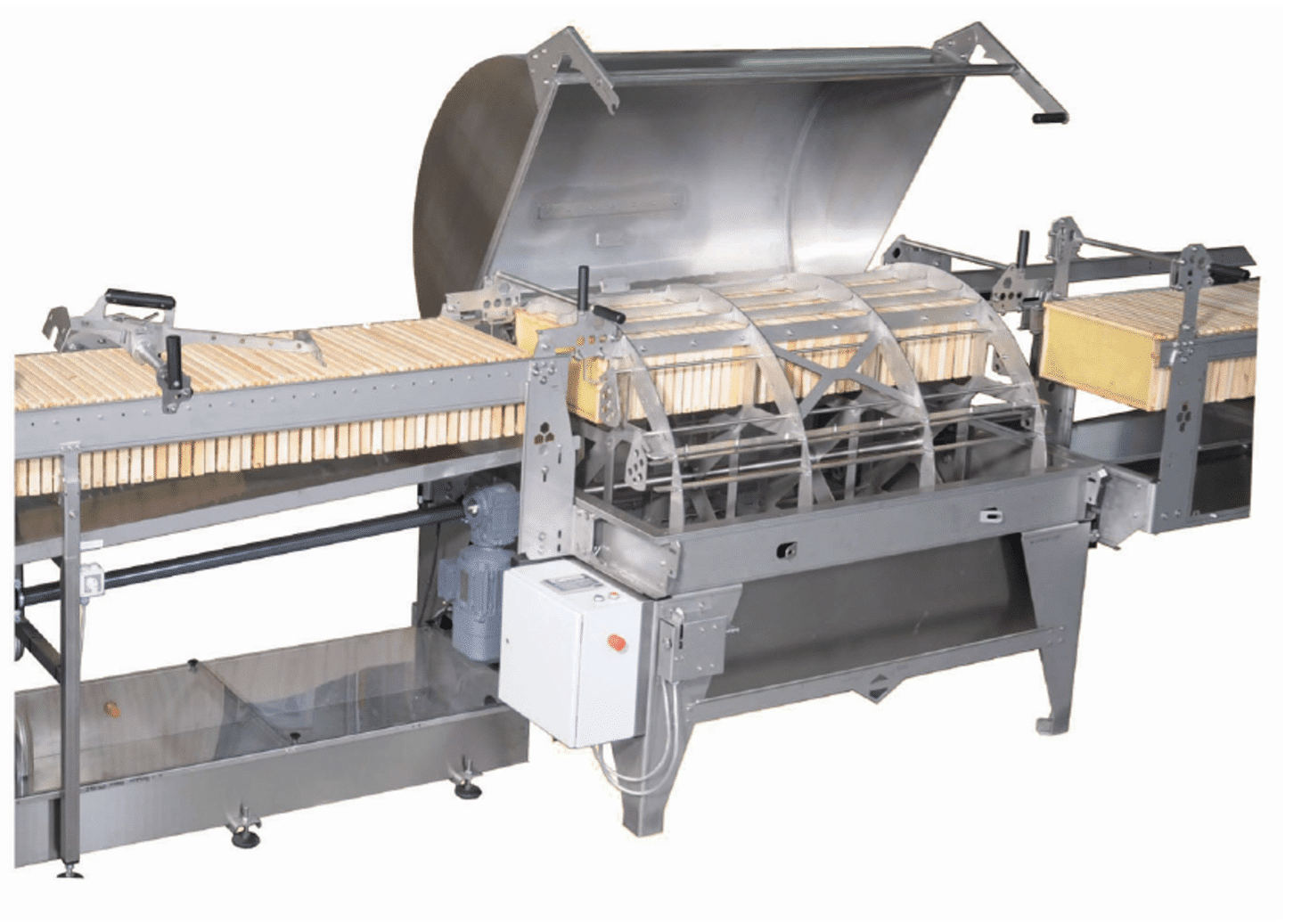
Large professional extraction lines may use horizontal-axis extractors. Uncapped frames are fed along rails into the extraction unit. These machines are normally planned as part of an integrated honey-room installation, with compatible uncapping, loading, drainage and handling equipment.
Their attraction is not just batch capacity: rail loading can reduce repeated manual lifting and handling. The benefit depends on how well the extractor matches the rest of the line, the available space and the harvest volume.
Common mistakes when buying a honey extractor
Buying solely based on number of frames
An extractor with many frames is not always more productive if you later spend too long loading, unloading, cleaning or balancing.
Choosing radial for frames that are too large
Do not buy from the hive name alone. Compare frame height, width, top-bar length, basket clearance and support with the manufacturer’s drawing. A radial model that accepts shallow Dadant frames may not accept Dadant deep frames. Tangential and self-turning models also have size limits.
Starting at too high a speed
This is one of the most common causes of comb breakage. Extraction must begin gently and increase progressively.
Not balancing the load
An uneven mass distribution around the shaft causes vibration. Balance the load across the rotation axis as instructed for that basket; merely placing a heavy frame beside a light one does not by itself determine balance. Stop safely if vibration develops, and check loading, supports and installation.
Spending too little on the motor
For repeated batches, a suitable motor and controllable, progressive start can save effort. Compare speed regulation, available electrical supply, safety controls, spare parts and after-sales service. Motor wattage alone does not establish extraction performance.
Not planning for growth
If growth from 10 towards 30 hives is realistic, compare the cost of extra batches with the price of a larger machine now. Leave room for growth without buying capacity that your honey-room space, crop or budget cannot use.
FAQ
What extractor do I need for five hives?
A compatible manual tangential extractor holding two to four frames may be enough for a modest crop. Electric drive is optional, not a requirement triggered by five hives. Choose according to harvest volume, available time, frame dimensions and the physical effort you are comfortable with.
Radial or tangential for oak honey?
If the honey is free-flowing, either compatible layout may work. Honeydew honeys vary: assess the actual viscosity and temperature rather than selecting by the word oak alone. Take extra care with new combs and large frames; a suitably supported tangential basket is worth comparing where handling is difficult.
What extractor should I buy for Layens frames?
Start by checking models explicitly designed to accept your Layens frame dimensions. Tangential and self-turning tangential baskets are useful options, but their size and supports still need checking. Do not assume that a quoted frame capacity or a generic hive name proves compatibility.
What extractor should I buy for medium super frames?
A compatible radial extractor is often convenient because it extracts both faces without manual turning. Check the exact frame depth and top-bar dimensions, batch capacity and honey characteristics. Tangential extraction remains an option, particularly where the honey or existing equipment makes it practical.
Is a self-turning extractor worth it?
It can save substantial manual turning in repeated batches, especially with compatible large frames. The cassettes extract the two faces in sequence, not simultaneously. Compare the labour saving with purchase price, cleaning, maintenance, available space and your actual annual crop.
How thick should an extractor’s stainless steel be?
There is no single minimum thickness that proves an extractor is well made. Assess the food-contact material, smooth welds, reinforcement, frame support, stable stand, drainage and safety controls together. Compare the manufacturer’s specification for the exact model; thicker sheet alone does not guarantee better hygiene, stability or extraction performance.
Which extractor is right for you?
Radial extractors — often convenient for compatible super frames and free-flowing honey, with no manual frame turning between faces.
Tangential extractors — compare suitably sized baskets for large frames or viscous liquid honey. Deep-frame dimensions refer to the equipment format: do not extract frames containing brood or honey unsuitable for harvest.
Self-turning tangential extractors — reduce manual turning during repeated batches; compare that saving with cost, cleaning and maintenance.
Not sure? Tell us the number of hives, frame type and honey type, and we will recommend the right extractor. You can view the full range at honey extractors.
CONCLUSIONS, SELECTION AND MARKET
At La Tienda del Apicultor we see two common mistakes: buying an extractor too small to save money, or buying a radial extractor without considering the type of frame and the density of the honey. For small-scale operations, we recommend prioritising simplicity and ease of cleaning. For medium and large-scale operations, we recommend evaluating loading and unloading time, reversibility, motor and technical support.
Features of a good extractor:
- recover honey effectively without chasing the last drops at excessive speed
- protect combs and frames when correctly loaded and operated
- be straightforward to load, unload, drain and clean safely.
Taking this into account, we will ask ourselves… What is the ideal honey extractor? The answer will depend on many factors such as the type of hives we have, the variety of honey we usually extract, the number of hives we are managing, and the amount of money we are willing to invest… for this reason it is impossible to definitively choose one model.
Tangential baskets can be useful for supported large frames and viscous liquid honey; radial baskets often reduce handling with compatible super frames. Neither layout is automatically cheaper, more energy-efficient or better for every crop. Compare equivalent models, including guards, motor, cleaning access, spare parts and service.
A cheap extractor can end up being expensive if it forces you to make multiple passes, damages combs, or proves too small during a season. The ideal approach is to buy with not only your current hives in mind, but also the working pace you wish to maintain.
Recommendations:
According to hive type
| Frame type | Selection guidance |
|---|---|
| Layens | Check an explicitly compatible tangential or self-turning basket; do not infer fit from the frame count |
| Langstroth deep frame used for honey | Confirm deep-frame dimensions and support; compare appropriate radial and tangential models |
| Langstroth shallow or medium super frame | A compatible radial often reduces handling; tangential also works |
| Dadant deep frame used for honey | Check deep-frame clearance and support, particularly in radial machines |
| Dadant super frame | Compare compatible radial and tangential baskets according to honey and workflow |
According to approximate hive numbers. These bands are illustrative, not purchase thresholds. A small apiary with a large crop and limited extraction time may need more capacity than a larger apiary with a modest yield.
| Approximate hive count | Options to compare, subject to crop and workflow |
|---|---|
| Up to 5 | Manual 2–4-frame tangential; electric if justified by effort or time |
| 5 to 10 | 3–4-frame tangential or another compatible small model |
| 10 to 30 | Manual or electric model; calculate batches for the expected crop |
| 30 to 100 | Electric extractor with sufficient compatible frame capacity |
| 100 to 150 | Larger radial or self-turning; compare one machine with parallel smaller units |
| More than 150 | Professional radial, self-turning or horizontal system matched to the whole line |
According to honey type
| Honey condition | Selection priority |
|---|---|
| Free-flowing honey | Compatible radial or tangential with an efficient loading routine |
| Viscous liquid honey | Compare supported tangential or self-turning baskets and appropriate conditioning |
| Ling heather honey | Plan loosening before suitable tangential extraction, or pressing |
| Oilseed rape honey | Prompt extraction before crystallisation; avoid excessive warming |
| Crystallised or exceptionally viscous honey | Do not force the extractor; assess the appropriate processing method first |
There are many manufacturers, with several ranges within each brand. The comparison below retains the names and historical brand-origin graphics from the original guide, but it is not a quality ranking or a guarantee of current availability. Compare the exact model and current support. In particular, SAF Natura’s ownership and manufacturing arrangements have changed.
| Brand | Brand origin / manufacturing notes | What to check |

| Italy | Italian-origin brand acquired by LYSON; LYSON states that production moved to Poland. See the manufacturer’s announcement. The Italian flag denotes historical origin, not current manufacturing location. |

| Italy | Italian manufacturer with manual and powered equipment, including radial and tangential options. Verify frame compatibility, drive, cleaning access and support for the chosen model. |

| France | French brand with equipment for small apiaries as well as larger operations. Its current range includes compact manual extractors; it is not restricted to professional-scale beekeepers. |

| Poland
| Polish manufacturer offering radial and self-turning cassette models in several ranges. Compare the specifications and safety equipment of the exact model rather than treating every range as identical. |

| Germany | German brand retained from the original comparison. Check the exact manufacturer, model documentation, parts availability and service before comparing a current or used machine; the logo is not a quality guarantee. |
| TEMAVI | Spain
| Name retained from the original Spanish comparison. Current manufacturer and range have not been independently confirmed for this review; verify model documentation and after-sales support before considering equipment under this name. |
| MAQUINRE | Spain
| Spanish machinery manufacturer whose own catalogue includes honey-processing equipment. Compare the specific extractor and its fit within the rest of the honey-room workflow. |
| MARIANO ESCUDERO | Spain
| Spanish manufacturer describing a range from small stainless-steel machines to larger fixed installations. Assess the particular model, cleaning design and support rather than making blanket durability comparisons. |
For help choosing, tell us your frame dimensions, hive numbers, typical crop, honey type and available extraction time. At La Tienda del Apicultor we can help compare the specifications and current prices of models in our catalogue.

ISNI 0000 0005 1801 1100 | Joshua Ivars is the manager of LA TIENDA DEL APICULTOR and the author of this blog, where he shares technical and practical guidance for beekeepers. Drawing on extensive experience in the beekeeping sector, he offers advice and solutions based on beekeepers’ real needs, sharing his knowledge of equipment and essential beekeeping practices.


