
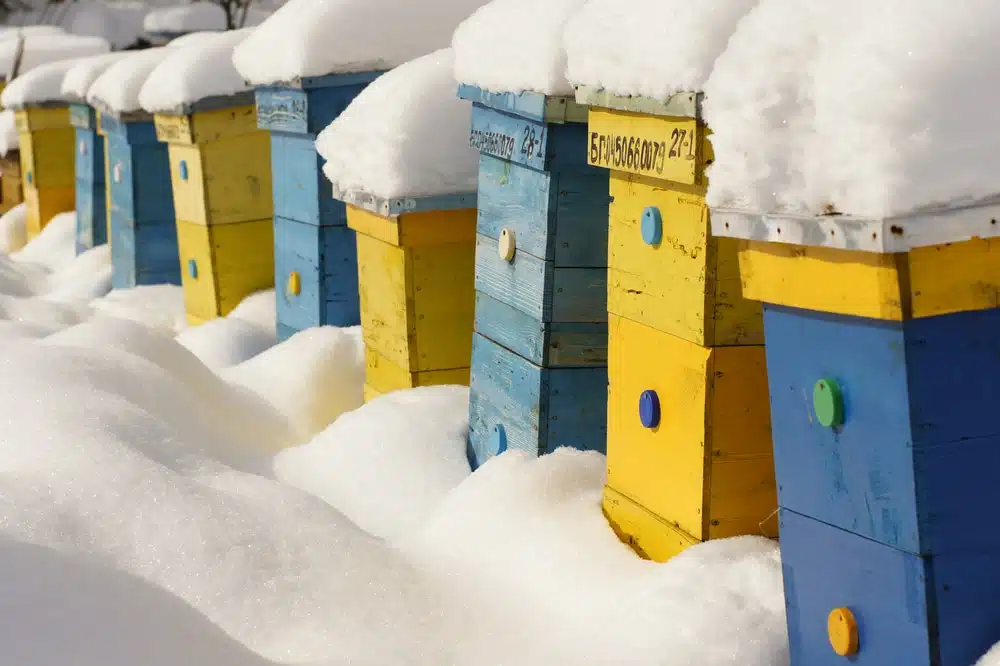
Good overwintering starts before the cold weather arrives. Prepare a queenright colony with enough healthy workers, accessible food stores, suitable hive space and effective Varroa control. In much of the northern hemisphere, this work begins in late summer and autumn; follow your local season rather than fixed calendar dates. Long-lived winter bees need to develop in good condition, not simply receive a last-minute treatment.
Overwintering: the essentials
| Check | What to look for | Why it matters |
|---|---|---|
| Food stores | A locally appropriate reserve of usable stores | The weight of the woodenware is not food; there is no universal total hive-weight target |
| Queen and workers | A functioning queen and a strong population of healthy workers | A young queen alone cannot compensate for disease or inadequate stores |
| Cluster temperature | A warmer interior and cooler outer layer | Conditions vary, particularly between broodless and brood-rearing colonies |
| Varroa | Monitoring and timely, effective control | Protect the workers that will carry the colony through winter |
| Summer workers | Typically live for weeks during active periods | Workload and conditions influence longevity |
| Winter workers | Can survive for several months | They maintain the colony and support the next round of brood rearing |
In this guide
- how the winter cluster works;
- the complete checklist for preparation;
- the queen and feeding;
- varroa control;
- insulation against rain, wind and cold.
Shorter days and declining forage are a reminder to assess the apiary while conditions still allow useful work. A mild coastal winter, a mountain winter and a long continental winter call for different preparation. Use the checklist below alongside local advice and your own colony records.
The winter cluster: how bees survive the cold
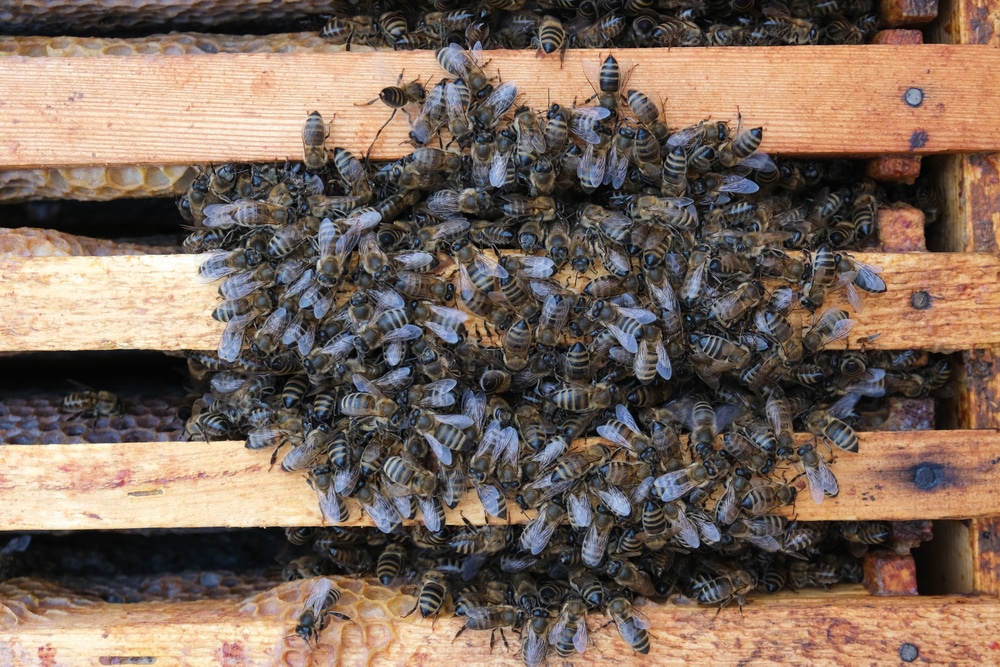
When temperatures drop and conditions become hostile, bees adopt a unique survival strategy: the winter cluster or winter bee cluster. This is a crucial survival behaviour in which bees gather into a compact mass within the hive, forming a core that generates and conserves the heat needed to keep the colony, and especially the queen, alive throughout the cold months.
How the cluster is organised
- Centre of the cluster: Bees form a warmer inner region and a cooler outer layer. The temperature is not a fixed minimum around the queen. A broodless cluster can run cooler than a colony rearing brood; brood rearing requires tighter temperature regulation and uses more stores.
- Changes in density and position: The cluster contracts in colder conditions and loosens as conditions warm. Bees can move within it, but a perfectly coordinated, constant rotation is not a practical sign by which to judge colony health.
- Heat generation: Workers use their flight muscles to produce heat without flying. Honey or suitable stored feed supplies the energy. The bees heat their cluster, not every part of the hive to one uniform temperature.
The role of winter bees
Winter bees, also called diutinus workers, have a long-lived physiological state suited to carrying the colony through periods of limited forage. Many survive for several months, whereas workers in busy summer colonies usually live for weeks. Their stored nutritional resources also help support brood rearing when it resumes. The timing and lifespan vary with climate and colony conditions; not every bee emerging on an autumn date has an identical lifespan.
Observing and monitoring the cluster: practical advice
Do not open a cold hive to look for the queen or assess whether bees are rotating. Check food stores by hefting or weighing, keep the entrance clear, and observe flying activity when weather allows. These observations can flag a concern, but a neat-looking cluster does not prove that a colony is healthy. Plan intrusive inspections for suitable conditions unless urgent intervention is needed.
Preparing the hive step by step
Winter preparation varies according to climate and region, but there are fundamental steps that increase the chances of survival and success during overwintering.
The complete checklist
- Assess the queen: Confirm that the colony is queenright and that the queen is performing satisfactorily. Replace a failing queen in suitable conditions, with time to confirm acceptance and laying before winter. Requeening every colony at the beginning of autumn is not a universal requirement.
- Remove unnecessary empty supers: Match the configuration to the colony and the way your hive system is overwintered. Do not remove boxes that contain essential food stores simply to reduce volume. If bees need to move into an upper box of stores, ensure a queen excluder will not prevent the queen from moving with them.
- Assess weak colonies before uniting: Combining suitable small colonies may improve their prospects, but establish why they are weak first. Do not spread suspected infectious disease by combining them with healthy colonies. Check queen status, disease and Varroa before deciding how to proceed, and seek local bee-health advice where needed.
- Check usable food stores: Total hive weight includes boxes, combs, bees and equipment. Assess the food reserve itself and allow for the expected winter and spring build-up. The UK National Bee Unit gives approximately 20 kg of autumn honey stores as a general guide, not a universal total hive weight. Local needs may be higher or lower. Correct shortages while feeding is still practical.
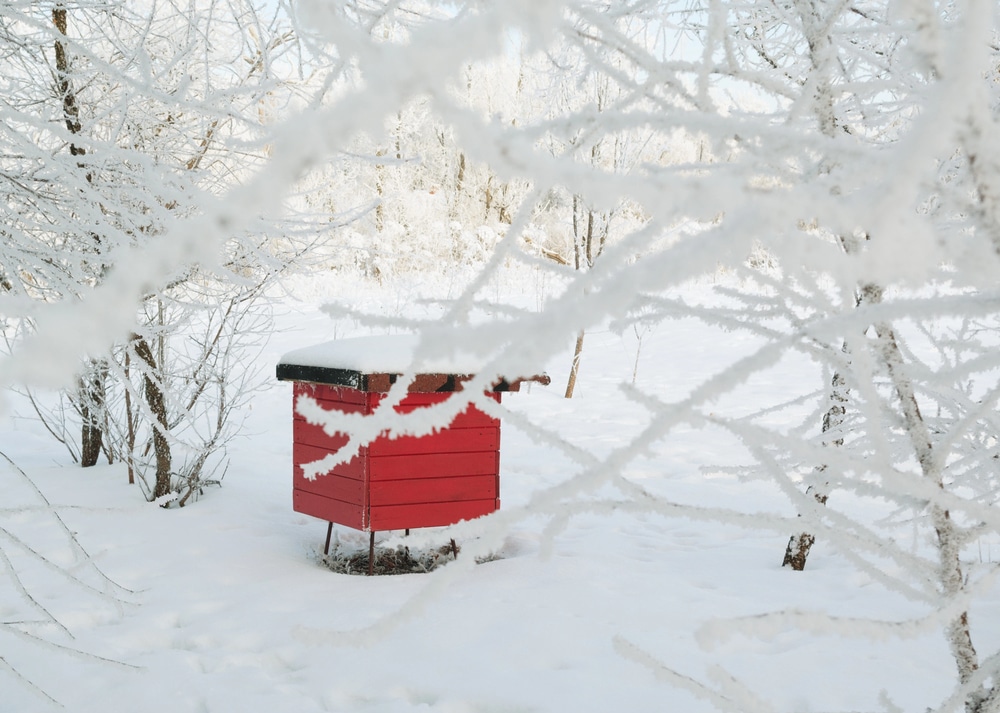
- Checking hive location and protection: Position hives in a sheltered site with good exposure to sunlight, especially in the morning, and protect them from strong winds. In areas prone to heavy rain or high humidity, ensure that the hive roofs and floors are in good condition and drain water properly. If necessary, place stones or other weights on the roof to prevent it from being blown off.
- Protect the entrance without blocking it: Fit an appropriate mouseguard or entrance arrangement for your hive. Keep the opening clear of dead bees and debris, and retain the ventilation needed by the hive system. A reducer does not mean sealing the colony airtight.
- Keep stores accessible: Prepare a continuous route to food suited to the hive configuration. In vertically arranged hives, stores above the cluster matter as well as food beside it. Cold bees may be unable to reach an isolated frame of honey. Complete necessary adjustments in suitable autumn weather rather than breaking up a winter cluster.
- Control Varroa before winter bees are damaged: Use regular mite monitoring and a locally appropriate management programme. Do not wait for winter if mite levels already require action. Broodless periods can provide an additional opportunity for suitable oxalic-acid treatments, but oxalic acid does not kill mites protected inside capped brood.
Use only a veterinary medicine authorised for your location and follow its current label, including application method, temperature conditions, dose, protective equipment and restrictions concerning honey supers. There is no universal 4–16 °C rule for every product. Equipment such as an oxalic acid vaporiser does not replace those instructions. Avoid inhaling the treatment aerosol and protect other people nearby. - Regular monitoring and maintenance of optimal conditions: During winter, inspect hives without opening them, checking weight and observing activity at the hive entrance on sunny days. If significant weight loss is noted, consider adding fondant to ensure adequate food supply. Although handling should be kept to a minimum, discreet observation will help detect problems early.
- Keep a winter record: Record stores, queen concerns, mite checks, treatments and any feeding. Set a realistic schedule for brief external checks and have suitable emergency feed available. Preparation and follow-up reduce avoidable risks; they cannot guarantee a strong colony or a honey crop in spring.
The queen: key to a strong colony
A colony needs a functioning queen for its next season of growth. A young, mated queen may be a sensible replacement for a failing queen, but age alone is not the whole assessment. Consider laying pattern, colony condition, available replacement stock and the time left before suitable inspection weather ends.
Recommended steps for effective replacement:
- Assess performance as well as age: Use the queen’s known history and the condition of the colony. An older queen that is failing may need replacement; do not treat her first birthday as an automatic deadline.
- Allow time for the replacement: Requeen while conditions and available stock make success realistic, leaving time to confirm acceptance and normal laying. Do not leave a struggling colony queenless late in the season without a workable plan.
- Regular checks: Inspect for egg-laying activity to confirm the new queen is performing well before winter.
Tip: A good queen is one part of a sound colony. Requeening is not a substitute for sufficient food, healthy workers and effective mite control.
Winter feeding
In cold periods, bees depend heavily on their stores. In milder regions they may still forage or rear brood, which changes consumption. Keep checking reserves through late winter and early spring, when expanding brood can increase demand before reliable forage returns.
- Monitor the trend in stores: Learn what a well-provisioned hive of your own type feels like, or use a consistent weighing method. Compare like-for-like equipment and keep records. A light hive needs assessment; a single gross weight is not enough to prove that sufficient food is accessible.
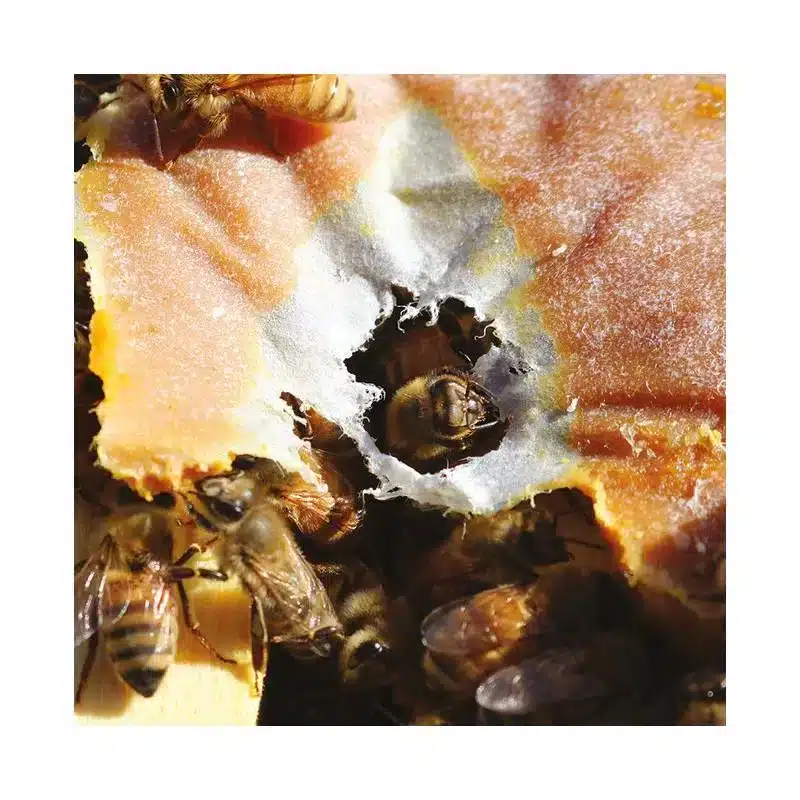
- Choose feed for the conditions: Heavy syrup can build reserves while bees can still take and process it. In cold weather, suitable bee fondant or another locally recommended solid feed is generally more practical. Place emergency feed where bees can reach it with minimal disturbance, rather than expecting them to cross a cold empty space.
- Assess the need for protein supplementation: Pollen substitutes are not an automatic winter requirement. Consider pollen availability, brood rearing and local experience before feeding them:
- Brood-rearing demand: A growing brood nest needs appropriate protein nutrition, but stimulating extra brood also increases the colony’s food and heating requirements.
- Timing for spring: Base supplementation on the actual forage gap and colony condition, not a fixed date that assumes all regions have the same spring.
- No substitute for diagnosis: A protein patty is not an antidote to poisoning or a treatment for a diseased or heavily mite-infested colony.
Choose a feed formulated for honey bees and follow its instructions. Protein percentage alone does not establish nutritional quality. Do not assume that every colony needs a patty every fortnight or a fixed six-week programme; monitor consumption and avoid leaving deteriorating feed in the hive.
How to position the frames
Arrange food so that the bees can reach it as the cluster moves. The best arrangement depends on whether the hive is horizontal or vertical, the brood nest and the frames already occupied; it is not simply a matter of putting honey at both outer edges.
• Check the food route: In suitable weather, check that stores are adjacent to the occupied area and, where the hive configuration allows, above it. Do not split the brood nest or winter cluster to rearrange food.
• Adequate reserves: In cold climates, it is preferable to have surplus reserves rather than shortages. Adjust frames and internal space according to cluster size to prevent sections from becoming inaccessible.
Practical note: If you live in a region with severe winters, check hive reserves towards the end of autumn to make necessary adjustments before weather makes access difficult.
Food can be present and still be inaccessible to a small cluster during a cold spell. Plan the arrangement before winter, monitor the reserve afterwards, and use accessible emergency feed if needed instead of repeatedly dismantling the cluster.
Varroa and other pest control
Pest control, especially against Varroa, is crucial for successful overwintering. Varroa mites weaken bees, making them more susceptible to disease and cold.
Recommendations for Varroa control:
• Choose treatment by evidence and label: Use mite measurements, brood status, season and the authorised product instructions to decide what is appropriate. A blanket recommendation for oxalic acid throughout autumn ignores its limitations in colonies with capped brood.
• Check the outcome: Follow up treatment with appropriate mite monitoring. If control appears inadequate, investigate timing, application and reinfestation and seek competent advice. Do not automatically repeat or combine medicines outside their instructions.
Mouse protection, sound equipment and a clear entrance are also important. Weatherproof the hive without making it airtight or preventing the bees from accessing their stores.
Insulation and protection against rain, wind and cold
Weather conditions can be very harsh in winter, and a hive exposed to the elements is at high risk. Good external protection helps maintain internal temperature.
If your apiary is located in a damp area, it is important to ensure that the hive roofs are in good condition and do not allow water ingress. Wet and poorly ventilated hives can cause internal moisture problems, which are harmful to bees. Where necessary, consider elevating the hives to avoid direct contact with the ground, which will also help prevent flooding.
If your apiary is exposed to strong winds, place stones on the covers or consider installing additional protective measures. Furthermore, if you are in a flood-prone area, take advantage of good weather to move the hives to safer locations and avoid areas where access becomes difficult due to snow or mud in winter.
Insulation and Protection Tips
- Secure the Covers: Covers must be in perfect condition to prevent water entry. Use stones or heavy objects to keep them in place.
- Suitable insulation: Use an insulation arrangement designed for your climate and hive type. Keep it secure and weatherproof, and consider moisture management; wrapping a hive is not a reason to ignore condensation or blocked entrances.
- Prevent moisture inside the hive: Position hives away from shaded areas and from beneath trees where moisture accumulates.
Beyond the specific management tasks, the success of the overwintering period depends on the constant attention and commitment of the beekeeper. Remember that bees, like any living creature, depend on the care provided to them. Use the winter to train yourself and review the overall health of your hives, as well as to maintain regular monitoring of stores and ensure your bees reach spring in the best possible condition.
Use this checklist as a working record, not a promise of success. Healthy workers, accessible stores, appropriate shelter and timely management give the colony a better starting point for spring.
Frequently asked questions
How much food should a hive have before winter?
There is no universal total hive weight. Assess usable food stores separately from equipment, and follow local guidance for your hive type, colony size and winter length. Continue checking stores because consumption changes, especially when brood rearing resumes.
What is the winter cluster?
It is the group of bees that generates and conserves heat in cold conditions. The interior is warmer than the outside, but its temperature is not fixed. Broodless colonies can run cooler than colonies rearing brood.
What are winter bees?
Winter bees are long-lived workers, also called diutinus workers, that can survive for several months and help maintain the colony and support later brood rearing. Their development and lifespan depend on nutrition, health and seasonal conditions.
Should weak colonies be united before winter?
Sometimes, but first establish why they are weak and check their queen and health status. Combining suitable small colonies may help; combining a diseased colony with a healthy one can spread the problem.
Should supers be removed in autumn?
Remove unnecessary empty space according to your hive system, but do not remove essential winter stores. If bees need to move into an upper box, ensure a queen excluder will not prevent the queen from moving with them.
Why protect or reduce the entrance in winter?
An appropriate mouseguard and entrance arrangement help exclude intruders and maintain hive defence. Keep the entrance clear and preserve the ventilation required by the hive system; do not seal the colony airtight.
When should a queen be replaced before winter?
Assess the queen before the season closes and replace her if needed while conditions and available stock allow. Leave time to confirm acceptance and laying. A young queen alone does not guarantee that the colony will survive winter.
Continue reading
- Insulation, condensation and ventilation, the debate on whether to ventilate or not.
- How and when to merge hives (in Spanish), for weak colonies.
- How to introduce a mated queen, if a replacement is needed.
- Varroa: monitoring and integrated control, protecting the workers that will overwinter.
Background reading: Penn State’s seasonal management guide and Mississippi State’s colony growth and seasonal management guide. Veterinary instructions vary by product and country; the current UK leaflets for Api-Bioxal and Varroxal illustrate why one temperature rule cannot replace a product label.

ISNI 0000 0005 1801 1100 | Joshua Ivars is the manager of LA TIENDA DEL APICULTOR and the author of this blog, where he shares technical and practical guidance for beekeepers. Drawing on extensive experience in the beekeeping sector, he offers advice and solutions based on beekeepers’ real needs, sharing his knowledge of equipment and essential beekeeping practices.


