
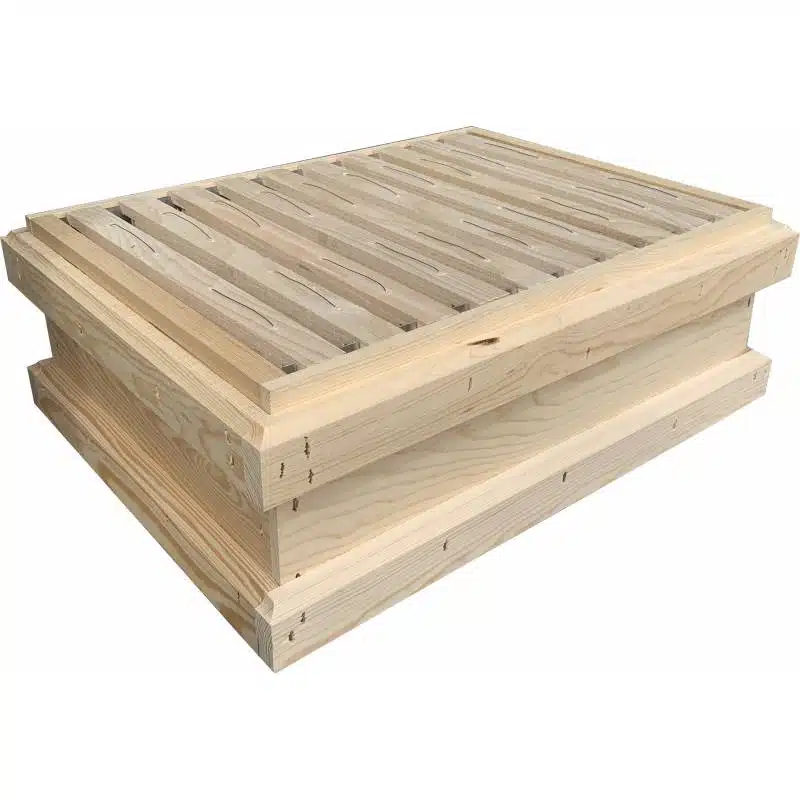
Adding honey supers can be a useful way to adapt a Layens apiary without replacing every hive. It adds storage space above the brood body and changes how you organise the harvest. But there is an important condition: the equipment must be compatible, and your management must change with it. A super is not an automatic promise of more honey or a better return.
Layens hives with and without supers
| Feature | Conventional Layens | Layens with a compatible super |
|---|---|---|
| Space | Frames within one horizontal body | Additional storage above the body |
| Brood and honey | Combs selected within the same body | A separate harvest box; brood exclusion still needs management |
| Crop separation | Requires careful comb selection | Supers can help separate harvests by flow |
| Handling | Individual frames or the hive body, depending on the task | A separate box to remove at harvest |
| Swarming | Monitoring and management required | Monitoring still required; extra space is not a guarantee |
| Investment | Existing setup retained | Super, frames and any necessary adaptations |
In this guide
- the harvesting challenge in a conventional Layens;
- what a super changes;
- the management it requires;
- whether it suits your apiary.
The challenge: brood and honey in one body
Beekeepers often ask whether shallow supers are worthwhile on Layens hives. Our field experience supports considering them as a practical option, provided the colony, equipment and local nectar flows suit the approach.
A honey super provides comb space intended for nectar processing and honey storage. In a conventional horizontal Layens, brood and stores occupy frames within the same body, so choosing combs for harvest requires care. A separate super can make that work easier, but putting another box on top does not, on its own, prevent the queen from laying there.
The quality issue is how the combs and harvest are managed, not the name of the hive. Select suitable honey combs, avoid harvesting brood, and maintain a planned programme of comb renewal and wax handling. Old brood comb deserves attention, but it is not accurate to say that all honey from a Layens will darken, taste of larvae or contain impurities. Monofloral character also depends on forage and keeping crops separate.
What changes when you add a super?
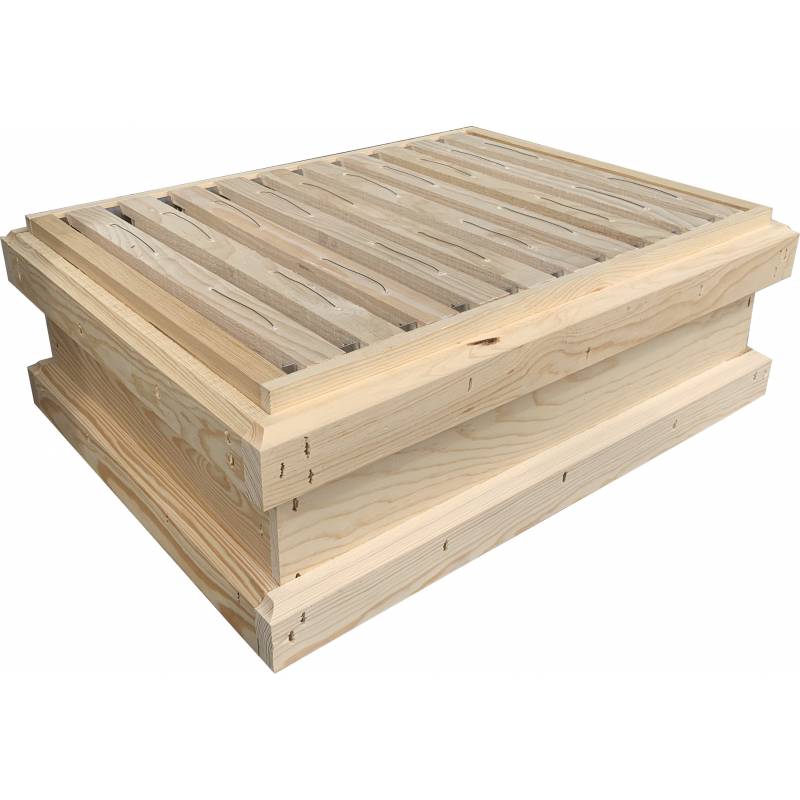
Adding supers gives the hive an upward extension for honey storage. The brood nest can still occupy frames across the Layens body; horizontal space has not disappeared. The practical change is that you now manage brood space below and a separate harvest box above.
That leads to the important question: can you manage it exactly as you did a single-body hive? No. You need to check access between the boxes, judge when the colony will use the super and plan inspections and harvesting around the new arrangement.
Replacing an entire Layens apiary with Langstroth or Dadant means buying compatible equipment and adapting your workflow. Supers may offer a more gradual route, but include any frame, roof or access adaptations in the cost comparison. Existing Layens experience is valuable; it does not mean there is nothing new to learn.
The management changes you need
The aim is not simply to add more work, but to make the right changes at the right time:
- Keep the harvest separate from brood management. Check that the frame top bars and box arrangement give bees proper access to the super. Closed-top-bar Layens equipment may need a compatible adaptation. If you use a queen excluder, it must fit correctly; inspect the honey combs rather than assuming they are brood-free.
- Build an adequate workforce for the flow. Strong colonies can make good use of extra storage; the practical idea behind Farrar’s rule is the value of a large foraging force. A fixed count of brood frames is not a universal target, and population alone does not guarantee a crop.
- Monitor swarm preparations in time. More space can help with congestion, but a super is not a complete swarm-control method. Continue inspecting the brood nest and responding to what the colony is doing.
- Add the super when colony strength and the flow justify it. Consider whether the frames contain drawn comb or only foundation. Do not wait for every brood-body cell to be full, and do not expect a weak colony to use a large empty box immediately.
- Balance honey production with other management needs. Removing bees or brood can reduce the workforce available for the super, but splitting may still be appropriate for swarm control or colony increase. If the super stays unused, check nectar availability, population, comb or foundation, bee access and season; an incompletely occupied brood body is not the only possible explanation.
Is it worthwhile?
For a compatible hive and a well-managed colony, supers can make crop separation and handling more convenient. A shallow box may be easier to lift than an entire loaded hive body, although it still needs safe handling. Honey yield, quality and sale price are not guaranteed by the conversion; they depend on the colony, forage, harvest and market.
Our practical conclusion is yes to suitable shallow supers, but not to half-hearted management. Try the arrangement on a manageable number of hives, assess the work and results, and use that experience before converting the whole apiary.
Frequently asked questions
Can you add a honey super to a Layens hive?
Yes, if the body, frame top bars, bee access and super dimensions are compatible. Some conventional closed-top-bar Layens hives need an appropriate adaptation. Check the equipment rather than simply placing a box over the existing roof or closed bars.
What is the benefit of a super on a Layens hive?
It provides additional comb space above the body and a separate box for organising the honey harvest. That can simplify crop separation and handling, but does not guarantee monofloral honey, a higher yield or the absence of brood in the super.
Does adding a super change the management?
Yes. You need to check bee access, add space in time, monitor swarm preparations and manage brood and harvest combs separately. The brood body still matters; the super does not replace regular inspections.
Why are the bees not using the super?
Possible reasons include a limited workforce, little incoming nectar, reluctance to draw foundation, unsuitable timing or restricted access. Assess the whole colony and equipment. It is not a universal rule that bees must fill every part of the brood body before entering a super.
Should I add supers or change to Langstroth?
Compare the cost of compatible supers and adaptations with a complete change of equipment. Consider local support, frame compatibility, lifting and your plans. Testing a few suitable Layens hives with supers can help you assess the approach before converting the apiary.
Further reading
- Choosing between Layens, Langstroth and Dadant.
- Swarm prevention, an essential part of the new workflow.
- Farrar’s rule and the value of a strong colony.
- Uncapping honeycomb, the next step when harvesting supers.

ISNI 0000 0005 1801 1100 | Joshua Ivars is the manager of LA TIENDA DEL APICULTOR and the author of this blog, where he shares technical and practical guidance for beekeepers. Drawing on extensive experience in the beekeeping sector, he offers advice and solutions based on beekeepers’ real needs, sharing his knowledge of equipment and essential beekeeping practices.


