
The European bee-eater (Merops apiaster) is a protected migratory bird that catches insects in flight, including bees. It may reduce activity and stores in some apiaries, but the impact varies greatly by site, season and year. The appropriate response is to measure the problem and use non-lethal preventive measures, not to persecute the bird.
Studies conducted in Spain identify two possible effects: direct predation and reduced foraging activity when bee-eaters are nearby. They also show that two neighbouring apiaries can face very different levels of pressure. It is therefore wrong to turn an estimate of bees consumed into a claim such as ‘a given number of birds eat one hive’.
What to do
- Record presence, flight activity, hive weight, brood and stores.
- Review location, shade, water, and nearby perches.
- Assess shade netting or relocation if damage is demonstrated.
- Consult the regional environmental authority, ENESA and your current insurance policy.
What not to do
- Shoot, capture or harass birds, or destroy their nests.
- Install electrified perches or nets that may trap birds.
- Rely on noise, silhouettes, or scare devices as a guaranteed solution.
- Attribute any loss to the bee-eater without ruling out disease, starvation or adverse weather.
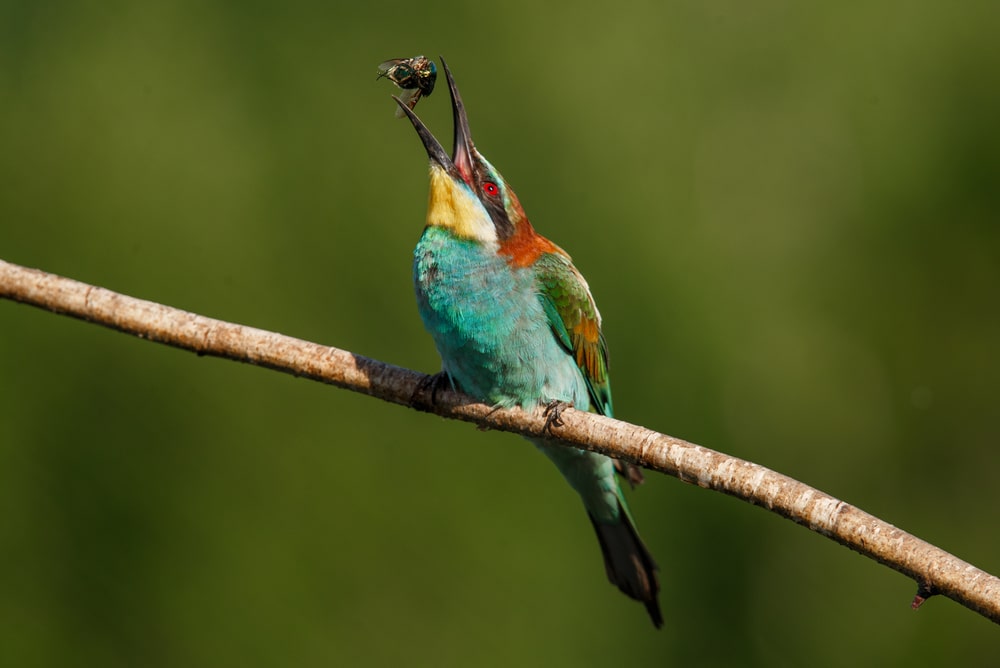
How to recognise a European bee-eater
The European bee-eater is a slender bird with a long curved beak, pointed wings, and plumage in blue, green, chestnut, and yellow. Its call is very distinctive and often allows detection before the bird is seen. It is gregarious: it may travel, feed, and rest in groups.
Populations breeding in the Iberian Peninsula arrive in spring and return to Africa in late summer and during autumn migration. Dates vary by latitude, year and weather; there is no single calendar for the whole of Spain. In some areas, migrating flocks temporarily increase pressure on apiaries even when they do not nest nearby.
Where does the bee-eater build its nest?
It excavates a tunnel in earth or sand banks, road cuttings, gravel pits, gullies, and riverbanks. A breeding colony may concentrate many birds in a small area. Nests and breeding sites are protected: they must not be blocked, dug into, or disturbed in an attempt to deter individuals.
When choosing a new apiary, observe active banks, flight paths, and perches before installing the hives. Our guide for choosing the apiary site helps assess access, water, wind, shade, flora, and security as well.
What European bee-eaters eat and why they visit apiaries
Their diet includes bees, wasps, bumblebees, dragonflies, butterflies, horseflies, beetles and other flying insects. The proportions vary with local abundance. An apiary concentrates thousands of potential prey taking off and landing along predictable routes, which can make it a profitable hunting site, particularly when other insects are scarce.
From a wire, branch, fence or dead tree, the bird locates prey and flies out to catch it. Convenient nearby perches may increase its use of an apiary. This does not justify cutting vegetation, altering habitats or installing harmful devices: prevention begins with site design and safe structures.
How European bee-eaters can affect bee colonies
Direct predation
Bee-eaters capture worker bees and, occasionally, may intercept queens or drones during mating flights. The loss of one bee does not always equate to the same damage: timing, colony strength, replacement rate, duration of pressure, and whether it focuses on nucleus colonies or already weakened hives all matter.
The MITECO report on the Extremadura study estimates that each bird consumes 575 to 2,090 bees per year, with bees making up around 42% of the diet in that setting. This is a regional reference, not a figure for calculating losses in every apiary. Multiplying it by the number of birds and comparing the result with an estimated colony population ignores bee replacement, seasonality and the origin of the prey.
Reduction of foraging activity
The indirect effect may be as significant as direct captures: with birds hunting nearby, entry and exit rates decrease. Less foraging means less nectar, pollen, and water, and may affect brood rearing and stores. It should not be claimed that ‘the call paralyses the hive’ automatically; the sound serves as an indicator of presence, while damage is confirmed through activity, weight, and colony condition.
A highly unequal impact
Pressure tends to rise near breeding colonies, migration routes and perches, and when alternative prey is scarce. Drought, heat and lack of water may aggravate the situation. Yet apiaries only a few kilometres apart can experience very different results, so a site’s vulnerability should be demonstrated before investing in a structure.
How to know if damage is significant: monitoring protocol
A single impression is not enough to distinguish the effect of the bee-eater from Varroa infestation, queenlessness, starvation, heat, drought or a failed nectar flow. Establish a baseline before the birds arrive and repeat observations using the same method.
- Define the period. Note first and last detection, times of highest presence, and changes after rain, wind, or migration passage.
- Record the birds. At fixed intervals, count individuals, observed attacks, calls and occupied perches. Keep direct observations separate from estimates.
- Measure bee activity. Count bee arrivals over the same interval and at the same time of day in marked hives; compare days with and without bee-eaters present.
- Monitor the colony. Record hive weight, frames covered with bees, brood area, honey and pollen stores, queen status and colony health.
- Record contextual factors. Temperature, wind, flowering, water availability, treatments, feeding and hive movements.
- Use a control. If possible, compare with another site or with an equivalent group subjected to a preventive measure.
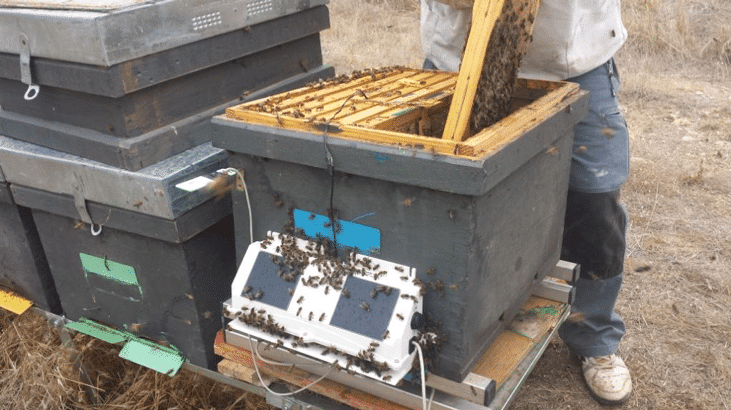
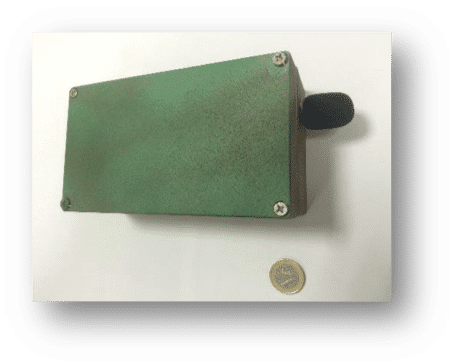
A recorder or acoustic sensor may quantify periods of presence if call identification is properly validated. It does not calculate economic loss on its own nor replace inspection. Photographs, videos, coordinates, visit reports and hive records are also useful if an insurance loss assessment is required.
What studies conducted in Spain show
The first regional studies found variable results and tested enclosures, deterrents and comparisons between areas. The most comprehensive evidence cited by MITECO comes from monitoring 58 apiaries in Extremadura between 2013 and 2015; it was published by Moreno-Opo, Núñez and Pina in 2018.
- Greater bee-eater abundance was associated with lower bee activity and less honey, pollen and brood in the hives. The study did not, however, find a negative effect on colony survival or viability.
- Intensity was not uniform: location, timing and availability of alternative insects influenced the interaction.
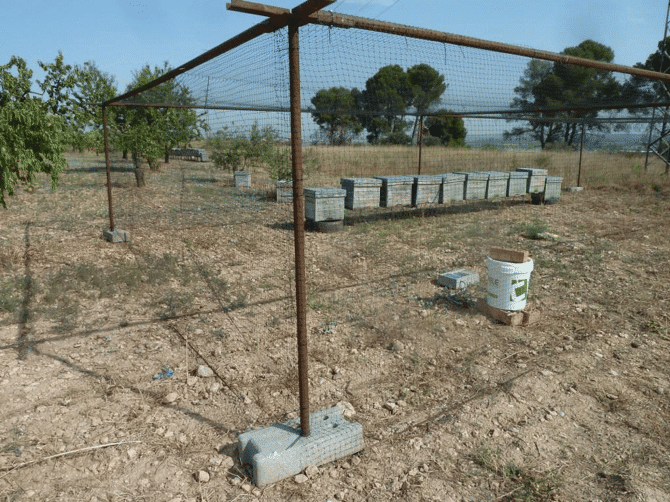
- Shade netting over the apiary reduced close-range predation and moderated hive temperature in the studied context.
- Predator decoys and other deterrent systems did not provide a universal solution and may lose effectiveness through habituation.
The practical conclusion is not that any mesh will work. An open-mesh enclosure around the hives may still allow birds to catch bees once they have flown out. The most favourable result comes from shading the entire apiary and moving the immediate hunting area farther away, using a taut, safe design adapted to the site.
Preventive measures: evidence, limitations and application
| Measure | Supporting evidence | Limitations and checks |
|---|---|---|
| Choose or relocate the site | Reduces exposure to breeding colonies, high-traffic routes and roosting sites. | Requires alternative land, logistics and prior comparison; nests or habitats are not altered. |
| Natural shade | Discourages immediate predation and improves microclimate. | Not every tree is suitable; flight path, access, risk of falling branches and fire must be assessed. |
| Shade net over the hive group | The Extremadura evidence and the MITECO fact sheet describe a reduction in impact. | Investment, wind, assembly, maintenance and landowner permission; design must avoid entrapment risks. |
| Water within the protected zone | Reduces water-collecting flights and helps with heat management. | Keep it clean and stable, with safe landing surfaces to prevent bees from drowning. |
| Small cages or mesh placed only in front of hive entrances | Inconsistent results. | Bees may be captured when leaving; may impede flight. |
| Noise, silhouettes and decoys | Have not demonstrated sustained efficacy. | Habituation, nuisance and continuous effort; must not harm wildlife or neighbours. |
| Temporary relocation | Eliminates local exposure when an alternative exists. | Cost, stress, availability of sites, hive movement and regulations. |
The shade-net structure proposed by MITECO
The ministerial technical sheet describes a shade-net roof with a minimum opacity of 70%, installed about two metres above ground and tensioned over posts. It also specifies a plastic side-net enclosure with a mesh size of approximately 50 × 100 mm and water stations inside the protected area. The aim is to keep birds away from the immediate surroundings without obstructing bees entering and leaving.
These dimensions are design references, not a fixed installation specification for every property. Calculate wind and structural loads, protect guy lines, make sure no bird can become trapped and obtain the landowner’s permission. MITECO distinguishes between fixed and mobile configurations. For a migratory apiary, the cost and assembly time may make moving to another site preferable.
Measures to be discarded
Do not shoot birds, trap them in nets, use falconry to harass them, destroy nests or install electrified perches. In addition to risks to the bird and other species, the evidence cited by MITECO did not demonstrate useful efficacy of the main harassment or deterrent techniques. Any exceptional action on protected wildlife requires explicit authorisation from the competent authority; it is not assumed.
Action plan for an apiary affected by bee-eaters
- Rule out other causes. Check queen status, Varroa levels, food stores, possible poisoning, heat, water, nectar flow and drifting bees.
- Record observations over several days. Document presence, attacks, flight activity, weight, brood, honey and pollen, together with weather data.
- Identify the pattern. Record times, perches, direction of approach, nesting banks—without approaching or disturbing them—and passing flocks.
- Apply simple measures first. Provide safe water and shade, remove any artificial perches you own, and relocate the hives within the property if exposure changes.
- Conduct a pilot test. Test the mesh or site change on a comparable group and measure before extending to the whole apiary.
- Scale up or relocate. If damage persists and the pilot works, expand. If not, avoid further investment and assess temporary relocation.
- Report early. If insurance or aid is available, follow its deadlines and requirements from the first sign; a late expert assessment may be unable to reconstruct the loss.
Minimum record for documenting damage
Date, coordinates and site; number of hives; photographs; birds seen or calls heard per interval; observed attacks; bee entries; weight; frames of bees, brood, honey and pollen; queen; Varroa and treatments; feeding; flowering; temperature, wind and rain; measure applied and outcome.
Legal protection, grants and beekeeping insurance in Spain
Merops apiaster is listed in Spain’s List of Wild Species under Special Protection (LESRPE) under Royal Decree 139/2011. Law 42/2007 prohibits actions aimed at killing, capturing, pursuing or disturbing these species, as well as destroying or damaging nests and sites for breeding, resting or wintering.
If a measure may affect the bird or a nest, consult the regional environmental authority beforehand. A legal exception is not automatic due to economic damage; it requires an application and authorisation under the conditions set by the competent authority.
The ENESA insurance scheme for beekeeping holdings has specific policy documents and may include additional cover for sudden colony depopulation caused by European bee-eaters. Geographic scope, dates, waiting periods and conditions vary between annual plans, and not every loss is covered in every area. Before taking out cover, check the current ENESA line 411 and the latest information from Agroseguro.
Preventive aid also depends on the regional grant programme and the relevant year. Ask about support for mesh structures, technical assistance or agri-environmental measures, and keep invoices, plans, records and evidence relating to the apiary site.
Frequently asked questions about the bee-eater
Is the bee-eater protected in Spain?
Yes. It is included in Spain’s List of Wild Species under Special Protection (LESRPE). It cannot be killed, captured, pursued, disturbed or its nests destroyed. Consult the regional authority before any action that may affect it.
Does the bee-eater only eat bees?
No. It feeds on various flying insects. The importance of bees in its diet varies by location and season. An apiary may concentrate prey when other insects are scarce.
When are bee-eaters present in Spain?
Primarily from the spring arrival until their return to Africa in late summer and during the autumn passage. Dates and peaks of presence vary; record those for your own apiary instead of using a rigid national calendar.
Can an entire hive be eaten?
The question is too simplistic. Birds capture bees from multiple colonies and areas, while each colony produces new workers. Damage depends on accumulated pressure, timing, colony strength and effects on foraging; it must be measured through population, brood, stores and weight, not a simple numerical equivalence.
Does shade netting work?
In the Extremadura study, the structures reduced predation near the hives and improved the microclimate, so MITECO recommends them for exposed apiaries. Not every net will achieve the same result: opacity, height, side panels, tension, safety and maintenance all matter.
Do sounds or silhouettes of raptors help?
They have not demonstrated sustained efficacy, and birds may habituate. Do not base primary protection on them, nor cause nuisance to wildlife, livestock or neighbours.
How do I claim damage?
Review the policy and report the incident within its deadlines. Document presence, location, affected hives, date, strength, brood, stores and weight and other causes ruled out. For aid, consult your regional call; conditions change and are not the same in every region.
Official and scientific sources
- MITECO, protection of apiaries and interaction with the European bee-eater.
- MITECO, Report on the State of Natural Heritage and Biodiversity in Spain to 2020, section on beekeeping and the European bee-eater.
- Moreno-Opo, Núñez and Pina, study of European bee-eater interactions and non-lethal techniques in 58 apiaries.
- BOE, Royal Decree 139/2011 and list of protected species.
- BOE, Law 42/2007 on Natural Heritage and Biodiversity.

ISNI 0000 0005 1801 1100 | Joshua Ivars is the manager of LA TIENDA DEL APICULTOR and the author of this blog, where he shares technical and practical guidance for beekeepers. Drawing on extensive experience in the beekeeping sector, he offers advice and solutions based on beekeepers’ real needs, sharing his knowledge of equipment and essential beekeeping practices.


