
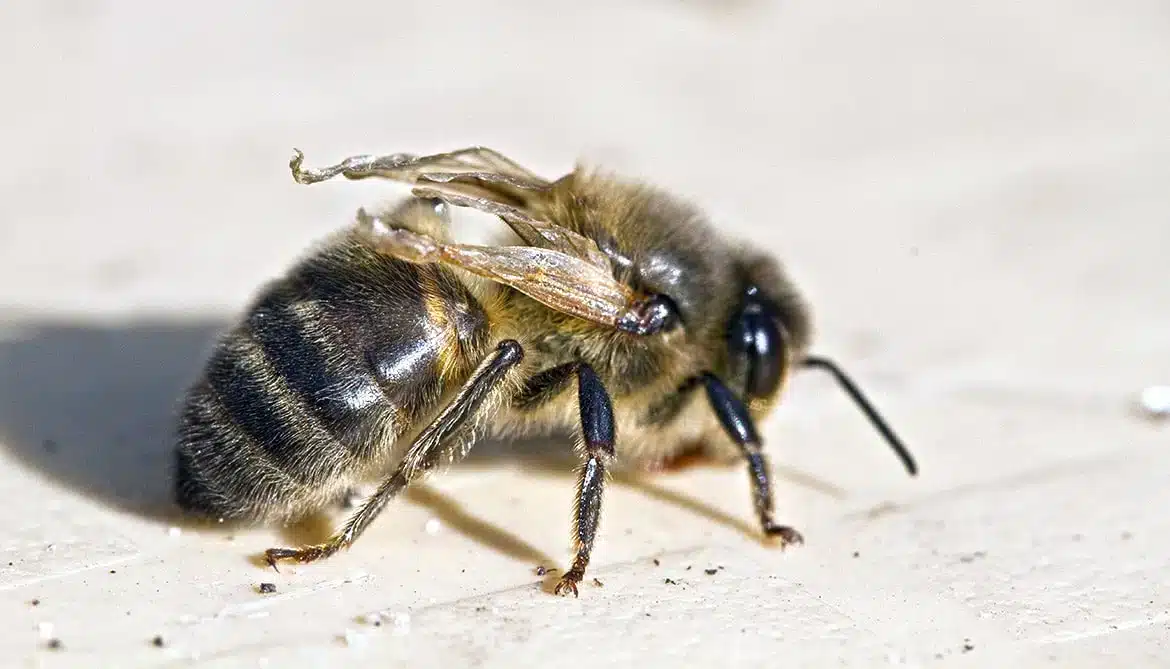
Finding a virus does not, by itself, explain why a colony is failing. Disease depends on the infection and the conditions in the colony —nutrition, prolonged confinement, and especially Varroa, which not only weakens the colony but also acts as a vector.
The five viruses, at a glance
| Viruses | What is seen | Where | Important context |
|---|---|---|---|
| SBV · sacbrood disease | The larva fails to pupate and becomes a fluid-filled sac; its skin remains intact | Brood | Clinical disease varies between colonies; do not infer prevalence from one apiary |
| BQCV · black queen cell | Queen brood changes from yellow to brown and becomes black and disintegrated, stuck to the cell wall, without emerging | Queen brood | Often detected without obvious signs; especially relevant in queen rearing |
| DWV · deformed wings | Bees with wrinkled wings, unable to fly | Adult bee | Most strongly linked to Varroa |
| ABPV · acute paralysis | Tremors and paralysis | Adult bee | Linked to high Varroa loads |
| CBPV · chronic paralysis | Black, hairless bees, trembling, rejected at the hive entrance | Adult bee | Spread through infected bees and contaminated material |
In this guide
- why infection may go unnoticed and the Varroa factor;
- symptoms in brood;
- symptoms in adult bees.
Infection does not always mean visible disease
A colony can carry pathogens without looking ill. Presence, amount and route of infection are different questions; visible signs need to be interpreted alongside colony history and examination.
Viruses are not cells. They contain genetic material and depend on host cells to make new virus particles.
In 2015, Daughenbaugh and colleagues published a study that illustrates why detection and viral load must not be confused.

The researchers screened for 16 pathogens, including American and European foulbrood bacteria, the microsporidian Nosema, and several viruses. The figure uses samples from 54 monitored colonies: 41 weak-colony and 81 strong-colony observations, not 122 independent colonies. The pie-chart percentages describe the composition of positive pathogen-specific PCR detections (122 in weak-colony samples and 292 in strong-colony samples), not the percentage of colonies infected or the amount of each pathogen. Similar detection patterns do not establish equal pathogen loads. A separate, small six-colony analysis found greater amounts of LSV1, LSV2, BQCV and Nosema ceranae in weak colonies; the authors cautioned against wider extrapolation.
Spring mortality is not a diagnosis
The source article uses the historical term ‘May disease’ for spring losses. The name alone does not identify a pathogen: examine affected bees and the colony, and seek diagnostic advice rather than assigning a cause from the month.
The Varroa factor
G. F. White described the disease sacbrood in 1913 and proposed a viral cause. The virus itself was isolated later, in 1964.
The spread of Varroa has changed the impact of several bee viruses. Varroa acts as a vector of disease, in addition to weakening the colony.
The Spanish source describes concern about virus-associated losses around 2020. That historical observation is not a current national prevalence estimate.
Global distribution
These maps reproduce published reports available to a 2020 review; they are not a live disease-surveillance map. Red zones indicate areas where studies report the presence of viruses; green zones indicate screening without detection in the studies reviewed; orange zones indicate the virus has been detected only in Bombus; grey zones indicate no data available.
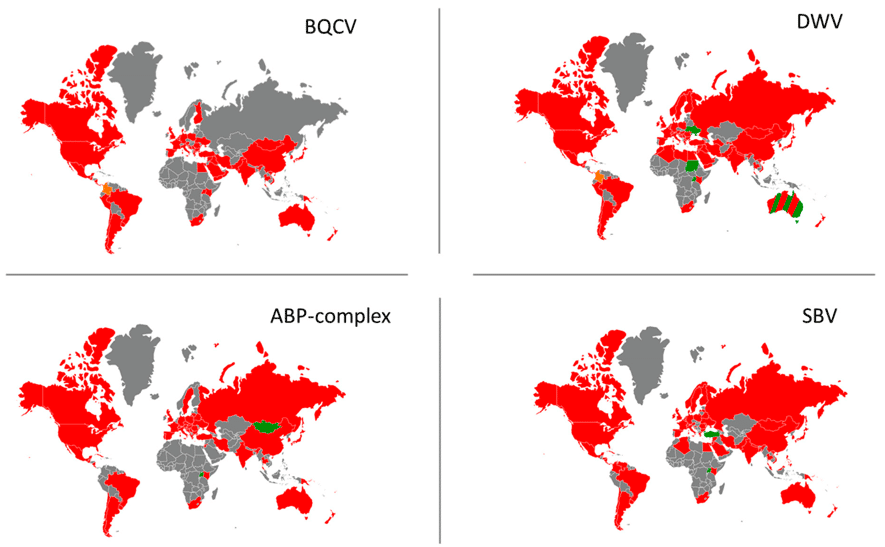
Maps of the global distribution of BQCV (black queen cell virus), DWV (deformed wing virus), the acute bee paralysis complex and SBV (sacbrood virus), from Beaurepaire et al., 2020.
For inspection, it is useful to group the main signs by life stage:
Symptoms in brood
Sacbrood virus (SBV)
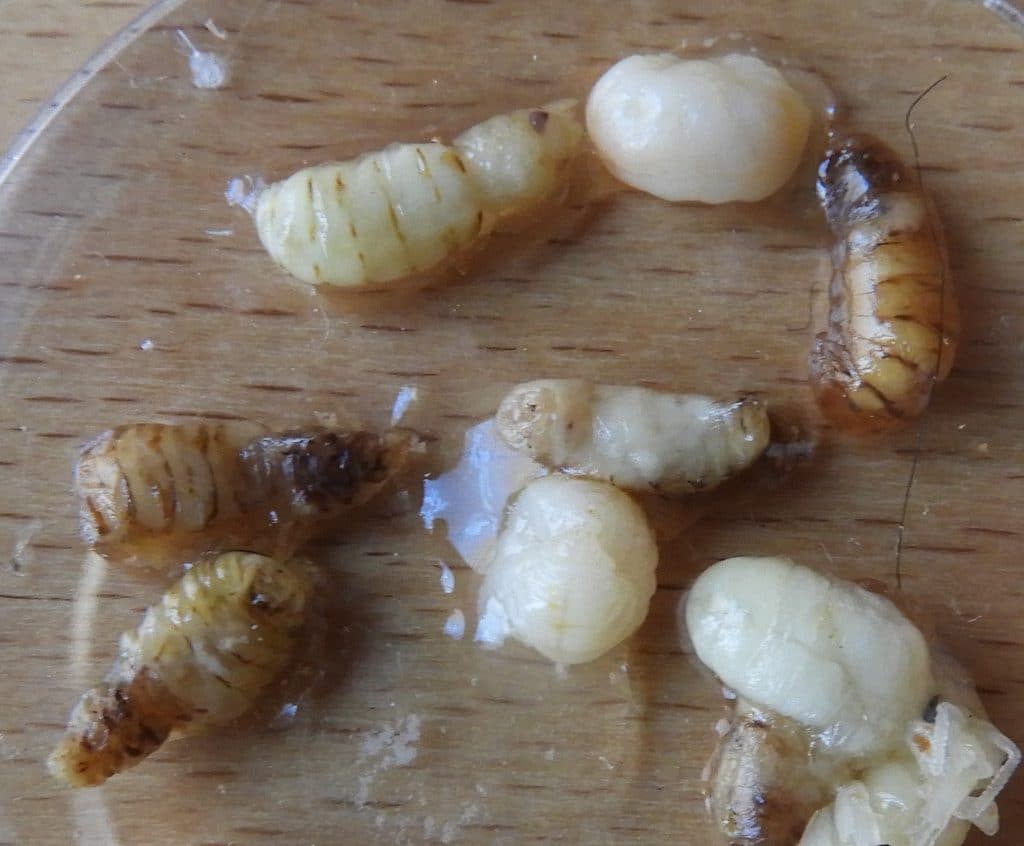
The interior of affected prepupae, recently capped, becomes a brownish-grey liquid resembling dirty water and containing many viral particles. The skin remains intact, giving the larva a sac-like appearance—hence the name sacbrood.
Sacbrood is often noticed in spring. Larvae die before becoming pupae; affected remains can usually be lifted out as an intact sac. Suspected brood disease still needs careful assessment, especially where foulbrood is a possibility.
Black queen cell virus (BQCV)
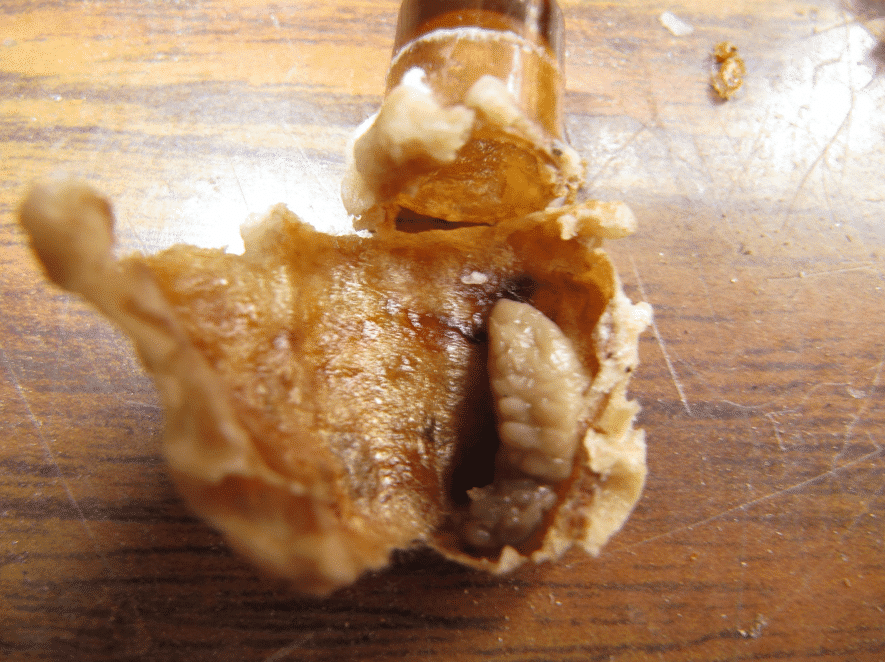
Queen larvae turn yellow first, then brown, and finally become black and disintegrated, stuck to the inner walls of the capped cells, without emerging.
BQCV can occur without visible signs in adult workers. Infection is not explained by genetics alone; food-mediated and queen-to-egg transmission have been documented.
Symptoms in adult bees
Deformed wing virus (DWV)
Severe DWV infection during development can produce adults with misshapen wings. Varroa is an important vector.
Affected bees may be short-lived, and those with badly deformed wings cannot fly normally.
Deformed wings should prompt a mite check, not a guess at the infestation level. Apparently normal wings do not rule out infection.
DWV also has transmission routes other than Varroa, so neither mite absence nor good nutrition guarantees its absence.
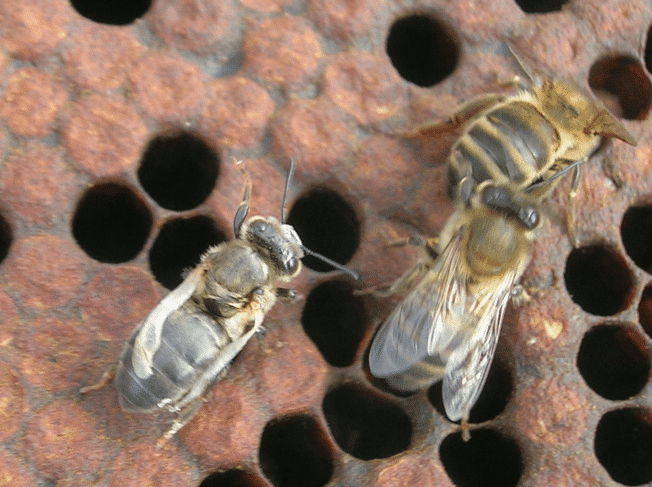
Acute bee paralysis virus (ABPV)
Shaking of wings and bodies.
ABPV can cause trembling, loss of flight and rapid death, especially in colonies with high mite burdens. Signs overlap with other conditions; they are not a laboratory diagnosis.
Hairless, shiny bees and rejection at the entrance can also occur with chronic bee paralysis. Do not separate the two viruses by appearance alone.
An unexplained rise in adult mortality warrants prompt investigation. Do not rely on warmer weather to resolve it, or move suspect colonies to another apiary without advice.

Chronic bee paralysis virus (CBPV)
CBPV is a different virus, not ABPV recurring annually. Bees may tremble, crawl, develop swollen abdomens or become dark and hairless; losses can accumulate at the entrance. Contact with infected bees and contaminated faeces can spread infection.
STRESS FACTORS
Bees have individual immune defences as well as colony-level behaviours such as hygienic removal. Good colony condition helps, but does not confer immunity to every disease.
Varroa is central to managing mite-vectored viruses such as DWV; controlling mites does not directly treat every viral infection.
Poor nutrition and prolonged confinement may add stress. For CBPV, close contact and contaminated material matter; colony strength alone does not predict the outcome.
Exposure to plant protection products is another possible stressor. Suspected poisoning needs its own investigation, not an automatic diagnosis of viral disease.
Select for appropriate, healthy breeding stock and hygienic traits where documented; avoid promises of universal resistance.
WHAT CAN WE DO?
- Clean and disinfect equipment using a method suitable for its material and the suspected pathogen. Do not flame plastics, combs or live colonies.
- Keep colonies well fed, according to stores and forage, with supplementary feeding only where needed.
- Monitor colonies so that you can act as soon as possible: obtain diagnostic advice, limit transfers of bees and equipment, and address confirmed mite or nutritional problems.
Do not use unproven remedies as antiviral treatments. Diagnosis and disease-specific management matter; consult veterinary or bee-health services about severe or unexplained losses.
Frequently asked questions
Do all hives have viruses?
Viruses are widespread, but a positive result does not automatically explain disease. Interpret the test alongside signs and colony history.
What is the relationship between Varroa and viruses?
Varroa can transmit several viruses, notably DWV. Mite monitoring and appropriate control are important, but do not treat all viral diseases.
What is ‘May disease’?
It is a historical description used in the source article for spring losses, not a precise laboratory diagnosis. The season alone cannot identify the cause.
How is sacbrood disease recognised?
An affected larva dies before pupation and can form a fluid-filled sac that is lifted from the cell intact. Ask for diagnostic help when brood disease is uncertain.
What is black queen cell virus?
BQCV can kill developing queens, with darkened remains in queen cells. Adult workers may carry it without visible disease.
Can bee viruses be treated?
Avoid unproven antiviral remedies. Seek diagnostic advice and address the particular disease, mite burden, nutrition and hygiene; there is no single cure for every virus.
Continue reading
- Varroa: monitoring and integrated control, an important driver of several viral diseases.
- How to inspect a hive, where these symptoms are detected.
- Nosemosis, another possible health problem.
- Protein supplementation, because nutrition makes the difference.
Educational content. For abnormal losses, contact your bee-health adviser or veterinary service. In Spain, your ADS may help arrange sampling. Follow the receiving laboratory’s instructions; visual signs alone do not confirm which virus is involved. Further reading: UF/IFAS on honey bee viruses; National Bee Unit: chronic bee paralysis; National Bee Unit: sacbrood.

ISNI 0000 0005 1801 1100 | Joshua Ivars is the manager of LA TIENDA DEL APICULTOR and the author of this blog, where he shares technical and practical guidance for beekeepers. Drawing on extensive experience in the beekeeping sector, he offers advice and solutions based on beekeepers’ real needs, sharing his knowledge of equipment and essential beekeeping practices.


