
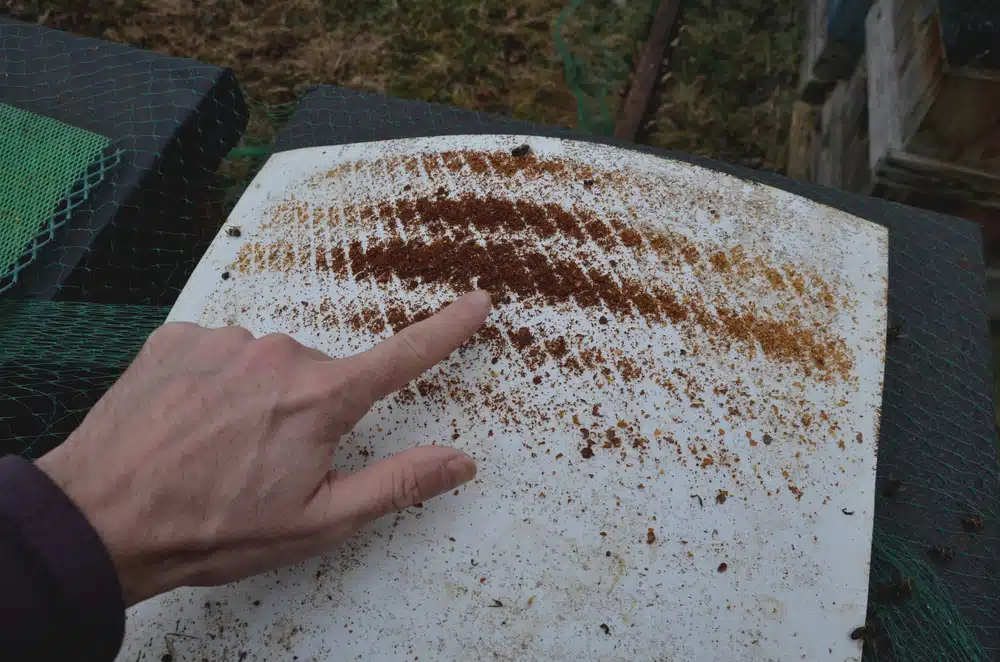
To find out whether a varroa treatment has worked in your apiary, you need to count twice: a sample of about 300 bees on the day you treat and a second one once the treatment has finished working, with the sticky board under the screened floor recording the mite drop in between. If, after the end-of-season treatment, the second sample shows 1 % or more (3 or more mites in 300 bees), the colony is not where it should be and you should talk to your vet before winter, even if the product is a good one.
Varroa is hard to see with the naked eye, and a colony that looks healthy can be heavily infested. Where it shows is in the harvest: in a French study on a lavender honey flow, colonies that arrived with more than 3 mites per 100 bees produced on average 3 kg less honey per hive, and those above 5 almost 6.5 kg less. Counting before and after treatment is the only way to know where you stand, and the equipment costs little.
Is your treatment working? The short answer
- Sample A on the day you treat: about 300 bees from a brood frame. Count the mites and divide by 3: that is the infestation rate.
- Sticky board under the screened floor while the treatment works. Count the mite drop every day.
- Sample B on the day the treatment ends: when you remove the strips on the date in the leaflet or, for a single-application treatment, when the drop on the board falls back to its previous level.
- Compare. Apparent efficacy = (A − B) ÷ A × 100. But what decides is where B ends up: after the end-of-season treatment, below 1 % is fine; from 1 % upwards, you need to act.
After the summer treatment, repeat the count one or two weeks later: it will tell you how many mites are really left and whether the colony has been reinfested.
Jump to: Why count · The 300-bee sample · The board · The second sample · Reading the result · When to count · If it did not work · Equipment
Why putting in the treatment is not enough

An authorised medicine has proven its efficacy in trials, but in your hive it can perform worse because of the brood present, the temperature, poor placement or reinfestation from neighbouring colonies. The summaries of product characteristics say so themselves: the one for Api-Bioxal warns that efficacy can vary between colonies and asks you to monitor the decrease in the number of mites regularly.
Then there is resistance. A large-scale survey in the Valencia region of Spain (University of Valencia and three beekeeping animal health groups, APIADS, APICAL and APIVAL) found that the expected efficacy of coumaphos and pyrethroids varied widely from one area to another, because each mite population carried a different proportion of resistant mites. Amitraz was more consistent, although slightly below what the label promises. In Gómez Pajuelo’s handbook, the two pyrethroids, Bayvarol and Apistan, are also listed with occasional resistance and lack of efficacy. The product that worked for you three years ago may not work today, and you will only know if you count.
Véto-pharma’s integrated pest management guide puts it in numbers: a treatment with 90 % efficacy on a colony with 500 mites leaves 50, but on one with 10,000 it leaves 1,000. The reference goal is to finish the treatment with fewer than 50 mites per colony. That is why knowing how many mites you start with matters as much as knowing how many are left at the end.
And the calendar is tight. In spring and summer the mite population roughly doubles every month, so a colony that starts high reaches the damage threshold sooner. The bees that have to get through the winter are born, according to the same guide, between mid-August and mid-September depending on the region and, if they are healthy, live about 200 days or more, compared with one or two months for summer bees. Waiting until September to deal with varroa exposes them to the mite and the viruses it carries just as they are being raised, and treating late brings the mites down but not the viruses, which stay for several weeks. If those bees go into winter weakened, the colony pays for it in spring, even if you treated afterwards.
Step 1: the 300-bee sample
The varroa you measure in a sample is the varroa riding on adult bees (the phoretic phase). Because it stays mostly on nurse bees, the sample is taken from a brood frame, never from a honey frame, where the infestation comes out lower. Bear in mind that the sample only sees part of the problem: depending on the season, between half and 90 % of the mites are inside the capped brood.
- Take out a brood frame and shake its bees into a bowl or tray. The foragers fly off within a few seconds and mainly nurse bees are left.
- Check that the queen is not in the bowl before taking the sample. On the central frames she can easily be among the bees.
- Fill the jar up to the 300-bee mark. The Varroa EasyCheck has it marked. If you use your own jar, count the bees once to know how far to fill it.
- Separate the mites from the bees with one of the three methods in the table, count them and work it out: mites ÷ bees × 100. With 300 bees, just divide by 3.
| Method | Kills the bees? | What it recovers | How it is done |
|---|---|---|---|
| Alcohol wash | Yes | Practically all the mites | Bees in 70 % alcohol, shake for a good while and strain. Filtered and kept in a closed bottle, the alcohol can be reused. |
| Icing sugar | No | 20 to 30 % may not come off | Freshly opened icing sugar (lumpy sugar is useless), shake without harming the bees and empty onto water in a white container: the sugar dissolves and the mites become visible. |
| CO₂ | No, they recover within minutes | Those that come off under anaesthesia | A few seconds of gas, shake and count, with a Varroa Tester CO₂. |
With alcohol, the mites stick to the wet bees: shake properly and rinse the strainer well. And always note which hive each jar comes from, because sample B has to come from the same one.
How many hives? To monitor the apiary, pick about 10: half from the first row on the side where the bees fly in, which receives more drifting bees, and the other half among those showing signs. To check whether a treatment works, it is enough to mark a few, two or three per apiary, and repeat the sample on those same hives.
Step 2: the board while the treatment works

The sample is a snapshot; the board is the film. With a screened bottom board and a card or sheet coated with petroleum jelly, every mite that falls stays stuck and cannot climb back up. The screened floor on its own does not control varroa (Pajuelo estimates it reduces mite survival by around 26 %): its value is that it lets you measure.
- Before treating, a few days of natural mite drop give you that colony’s baseline.
- During treatment, the drop rises and, when the product stops killing, falls back to roughly where it was before. That is the day you are after.
- Change the sheet every 24 to 72 hours. Leave it longer and the bees chew it or it gets covered in debris, and the count is no longer reliable.
Daily monitoring is only needed the first time you use a product in your hives. Once you know how long it takes to stop dropping mites, the two samples are enough in the following seasons.
Step 3: when to take the second sample
This is where almost everyone goes wrong, and it is the key point that Koldo Belasko, a professional beekeeper from Biscay, kept repeating in a talk for the Asociación Montañesa de Apicultores: sample B is taken when the treatment has just stopped working, not weeks later. If you wait, mites keep emerging from the capped brood, which contact acaricides do not reach, and the second sample mixes the mites that survived the treatment with the new ones. The result looks like a treatment that failed when something else has happened.
That is why strip treatments last for weeks: they have to stay in the hive while the mites that were capped at the start emerge from the brood. Pajuelo puts it at about 40 days of action, and a week more if there is drone brood. Oxalic acid works the other way round: it kills the mites it touches on the first day and, over the next 2 or 3 days, those that were damaged; after that it no longer acts. With oxalic acid, sample B comes after a few days.

When each treatment ends is set by its leaflet. This is when to take sample B depending on the type of treatment:
| Type of treatment | Example | When to take sample B |
|---|---|---|
| Amitraz strips | Apivar | When the strips are removed |
| Pyrethroid strips (flumethrin, tau-fluvalinate) | Bayvarol, Apistan | When the strips are removed |
| Formic acid strips | FormicPro | When the strips are removed, checking on the board that the drop is back to its previous level |
| Thymol gel | Apiguard | When the second application has been used up and the drop is back to its previous level |
| Oxalic acid, single application (trickling or sublimation) | Api-Bioxal | When the drop on the board falls back to its previous level |
Two summaries of product characteristics follow exactly this reasoning (Spanish versions consulted). The one for Apiguard asks you to check the mite drop regularly and, if it is still significant the following winter or spring, recommends a secondary treatment. The one for Varroxal only recommends a second evaporation, after 2 weeks, if the remaining infestation is above 6 % (more than one mite dropping per day) or if the colony keeps capped brood in winter. Counting after treatment is not a whim: it is what tells you whether you are in that situation.
Sample B tells you whether the product worked. To decide whether the colony needs anything else before winter, it is also worth counting one or two weeks after the end of the summer treatment. That count already includes the mites that kept emerging from the brood and those that came in from other hives through robbing or drifting. After a treatment, the population can climb back very quickly.
Step 4: reading the result
Apparent efficacy = (mites in A − mites in B) ÷ mites in A × 100
With samples of the same size, you can use the number of mites counted in each jar directly.
Two examples with 300-bee samples:
- Hive 1. A: 24 mites (8 %). B: 2 mites (0.7 %). Apparent efficacy of 92 % and the colony ends up below 1 %. It worked.
- Hive 2. A: 45 mites (15 %). B: 9 mites (3 %). Apparent efficacy of 80 % and the colony is still at 3 %. It is not clean and you need to act.
Notice that hive 2 would have stayed high even with a good product: it started too heavily infested. That is why sample B matters more than the efficacy percentage. For reference, to authorise a varroa medicine the European Medicines Agency requires 95 % efficacy in field trials for synthetic substances (amitraz, flumethrin, tau-fluvalinate) and 90 % for those of natural origin (thymol, formic acid, oxalic acid), according to Véto-pharma’s guide.
With 300 bees, a difference of one or two mites is noise: do not draw conclusions from a single hive with such low numbers. Compare several and look at the trend.
After the end-of-season treatment, the colony should be below 1 %. For the rest of the year, the reference is to treat when the colony approaches 3 % on adult bees. If you measure in the brood (by uncapping cells), the figures are different, because there are more mites under the cappings: according to Pajuelo, about 3 times more than on adult bees in spring and up to 10 times more when brood declines in summer. That method is covered in Varroa diagnosis: detection and decision-making.

When to count through the year
Véto-pharma’s guide recommends at least four counts a year, and one more whenever something makes you doubt:
- At the start of the season, to have each colony’s starting point.
- After the spring harvest and before the summer ones, so you do not send heavily infested colonies to the honey flow.
- Before the summer treatment, during the last harvest. That is your sample A.
- One or two weeks after the end of the summer treatment, to see the remaining infestation and whether a winter treatment is needed.
In areas with a Mediterranean climate, where the queen keeps laying through the winter, varroa does not stop either: there, the winter count cannot be skipped. And if the count is high before a honey flow, it is sometimes better to give up a flow and treat than to wait until afterwards.
To know whether a figure is high or low for the time of year, these are the reference thresholds:
| Time of year | 300-bee sample (alcohol, icing sugar or CO₂) | Natural drop on the board |
|---|---|---|
| Early spring | 1 % or more | 0.5 mites per day |
| Between two honey flows | Over 2 % | 5 mites per day |
| End of season, before treatment (late July and August) | Over 3 % | 10 mites per day |
| Winter, after treatment | 1 % or more | 1 mite per day |

If the treatment did not work
Mites left after treatment do not necessarily mean that the product failed or that there is resistance. Before drawing conclusions, go over:
- The state of the colonies: whether they were strong and whether they came from a lot of brood or a big harvest, which usually bring a lot of mites.
- The counts before, during and after treatment.
- The dates and how it was applied: placement and duration, according to the leaflet. A treatment shorter than the leaflet says leaves more mites. And contact strips only work if the bees walk over them, in the heart of the brood; Véto-pharma, the maker of Apivar, also advises scraping them halfway through the treatment and repositioning them if the brood nest has moved.
- Whether there could have been reinfestation from a neighbouring apiary or a dead colony. A colony killed by varroa is left full of honey, the hives around it rob it and carry off its mites, which survive about 10 days without feeding. Remove it from the apiary as soon as you see it.
- What treatments those hives received the previous year.
Once you have checked all that:
- Do not repeat the same product on your own initiative or raise the dose. The summary of product characteristics of an amitraz medicine states that a higher dose does not increase efficacy, and the one for Api-Bioxal that a double or triple dose increases bee mortality and weakens the colony for winter. Misusing a product also speeds up resistance: leaving strips in longer than indicated (all winter, for example), reducing the dose or combining treatments in a way that is not authorised.
- Talk to your vet with your counts in hand. With the figures, it is easy to decide whether another active substance or a broodless winter treatment is needed. Alternating active substances helps them keep working: in the 2022 New Zealand colony loss survey, beekeepers who used several treatments over the year lost fewer colonies than those who used only one.
- Treat all the hives in the apiary at the same time. The summary of product characteristics for Apistan advises it to avoid reinfestation through drifting and robbing.
- Write down the results by product, apiary and year. If an active substance starts to fail in your area, you will see it before anyone else.
To review how each treatment fits into the season, read Integrated varroa control: monitoring, treatment and brood breaks.
What you need
- A jar for the sample: the Varroa EasyCheck (alcohol, icing sugar or CO₂), the Varroa Tester 3 in 1 ApiTek (icing sugar) or a CO₂ Varroa Tester if you do not want to sacrifice bees.
- 70 % alcohol or freshly opened icing sugar, a white bowl and a fine strainer.
- A screened bottom board with a tray: the 10-frame screened bottom board, the Dominguez or the ANEL LockFit, with its gridded tray.
- Petroleum jelly for the board sheet.
- A notebook or a spreadsheet: hive, date, sample A, daily drop and sample B.
Frequently asked questions
How many bees should a varroa sample contain?
About 300 bees from a brood frame. With 300 bees, the infestation rate is the number of mites divided by 3: 6 mites is 2 %. The Varroa EasyCheck has a 300-bee mark; if you use another jar, count the bees once to know how far to fill it.
Which is better for counting varroa, alcohol or icing sugar?
An alcohol wash dislodges practically all the mites, but it kills the bees in the sample. Icing sugar does not kill them, but 20 to 30 % of the mites may stay attached, so it underestimates the infestation. CO₂ does not kill the bees either. To compare before and after, always use the same method.
How long should the greased sheet stay on the board?
Between 24 and 72 hours. Leave it longer and the bees chew it or it gets covered in hive debris, and the count is no longer reliable. To find out when a treatment stops working, it is best to change it every day.
What varroa level is dangerous?
It depends on the time of year. As an indicative reference, it is advisable to act at 1 % or more in early spring, above 2 % between honey flows and above 3 % at the end of the season. After the autumn treatment, the colony should be below 1 %.
When do I take the second sample after treating?
When the treatment has finished working: when you remove the strips on the date in the leaflet or, for single-application treatments such as oxalic acid, when the drop on the board falls back to its level before treatment. If you wait longer, the mites that keep emerging from the brood distort the comparison. After the summer treatment, it is also worth counting one or two weeks later to see the remaining infestation.
Can I repeat the treatment if the second sample is high?
Only within what the medicine’s leaflet allows, which sets the number of applications and the interval between them. A higher dose does not give more efficacy and can harm the bees. With your counts, ask your vet: you may need another active substance or a broodless treatment.
If there are still mites after treating, does that mean the product does not work?
Not necessarily. A treatment with 90 or 95 % efficacy always leaves some mites, and if the colony started heavily infested, what is left can be a lot. Before talking about resistance, check the state of the colony, how much brood it had, when and how the treatment was applied and whether it could have been reinfested from a neighbouring apiary.
How many times a year should I count varroa?
At least four: at the start of the season, after the spring harvest, before the summer treatment and one or two weeks after it ends. And whenever something makes you doubt.
Is a screened bottom board enough to control varroa?
No. The screened floor stops fallen mites from climbing back, but on its own it does not control the population: Pajuelo estimates it reduces mite survival by around 26 %. Its value is that it lets you count the drop, even without opening the hive.
Further reading
- Varroa diagnosis: detection and decision-making
- Integrated varroa control: monitoring, treatment and brood breaks
- Formic acid against varroa: safe and authorised use
Sources
- Véto-pharma, integrated varroa management through the seasons (IPM guide, 2024), and the presentation by María Marcilla Corzano, veterinarian at Véto-pharma, at a technical day for beekeepers.
- Spanish summaries of product characteristics from CIMA Vet (AEMPS), consulted on 07/11/2026 (in Spanish): Amicel Varroa (amitraz), Apistan, Apiguard, Api-Bioxal and Varroxal.
- Hernández-Rodríguez, C. S., Marín, Ó., Calatayud, F., Mahiques, M. J., Mompó, A., Segura, I., Simó, E. and González-Cabrera, J. (2021), “Large-Scale Monitoring of Resistance to Coumaphos, Amitraz, and Pyrethroids in Varroa destructor”, Insects 12(1):27.
- Mondet, F. et al. (2016), Innovations Agronomiques 53:63-80: the lavender honey flow figure, cited in Véto-pharma’s guide.
- Stahlmann-Brown, P. and Robertson, T. (2023), Report on the 2022 New Zealand Colony Loss Survey, Manaaki Whenua Landcare Research, cited by Véto-pharma.
- Honey Bee Health Coalition, Tools for Varroa Management (2022).
- Gómez Pajuelo, A., Buenas prácticas en sanidad y alimentación de las colmenas, 4th ed. (2025, in Spanish).
- Koldo Belasko, “Pequeñas técnicas para cambiar tu apicultura”, Asociación Montañesa de Apicultores, part 1 and part 2 (October 2026, in Spanish).
This article is for information only and does not replace your vet’s advice. Varroa medicines must only be used according to the leaflet authorised in your country and the regulations that apply there.

ISNI 0000 0005 1801 1100 | Joshua Ivars is the manager of LA TIENDA DEL APICULTOR and the author of this blog, where he shares technical and practical guidance for beekeepers. Drawing on extensive experience in the beekeeping sector, he offers advice and solutions based on beekeepers’ real needs, sharing his knowledge of equipment and essential beekeeping practices.


