 Apipasta with vitamins 15kg
 Beecomplet® Spring 14Kg
 Beekeeper suit with round veil
 Oxalic acid 1kg
 Beeswax Foundation 5kg
 Fresh royal jelly 20g
 Classic honey jar 1kg comb-lines TO77 - Pack of 16 units
 Promotor L Apis 1 litre


 Share in WhatsApp
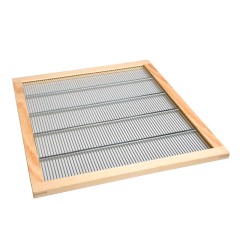
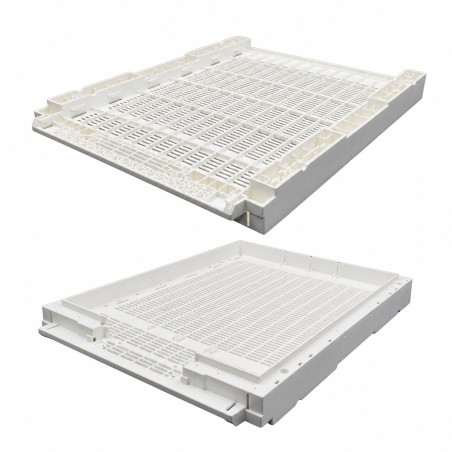
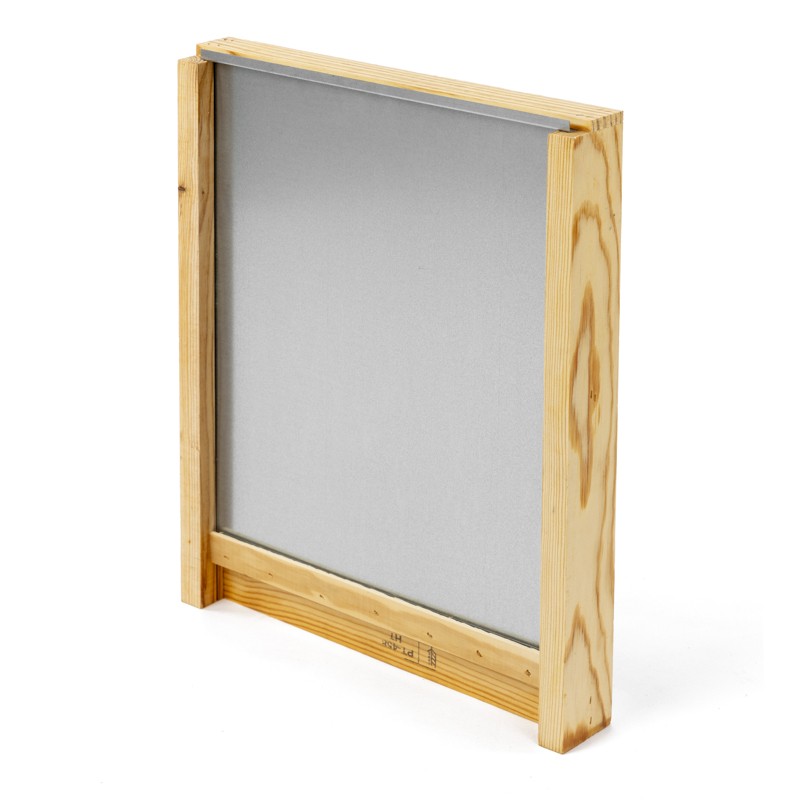
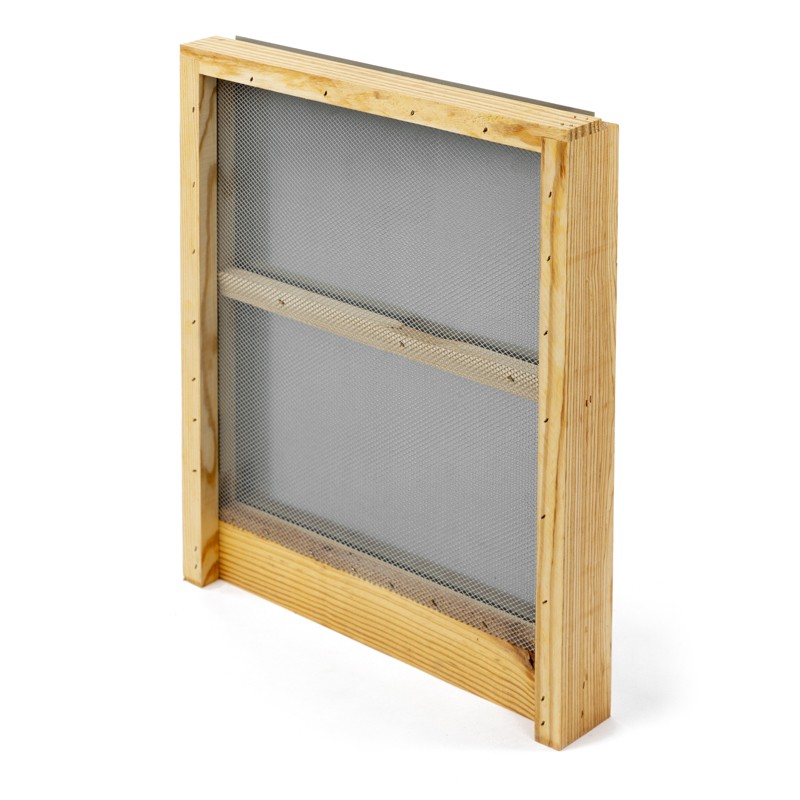
Mesh floor with a removable tray: mites that fall cannot climb back, and a sticky sheet over 24-72 h gives you the daily drop. In summer, with the tray out, it ventilates from below. It replaces the hive floor, it does not go under it. 430 × 515 mm (Langstroth/Dadant US) or 430 × 550 × 65 mm (Dadant Blatt).
|
430 × 515 mm LANGSTROTH / DADANT US |
24-72 h COUNTING WINDOW |
Mesh floor with a removable tray for Langstroth and Dadant US hives, plus a dedicated Dadant Blatt version. It ventilates, drops mites out of the colony's reach and lets you count them.
Above all it is a measuring instrument: the tray is where what is happening inside becomes a number.
01 · THE TWO THINGS IT DOES
The mesh lets a mite that has come off a bee drop through and separates it from the cluster: it lands in the tray and cannot get back. On a solid floor, that same mite reattaches to the next bee that passes. The second function arrives in summer: take the tray out and the floor is open, so the colony ventilates from below, which is the cheapest way for it to shed heat. In winter the tray goes back and the floor works closed. Worth saying what it is not: it is not a treatment. The natural drop it produces does not control an infestation on its own.
02 · HOW YOU MEASURE
Put a sticky sheet in the tray and pull it after 24, 48 or 72 hours. Count the mites and divide by the days: that gives the natural daily drop, which is the number you compare — with the same hive two weeks later, or with the one next to it. As with any counting method, the series matters more than the single figure, so repeat it every fortnight and always the same way. And it has two honest limits: the figure depends on colony size — a strong hive at the same rate drops more mites — and if the apiary has ants, some of what falls disappears before you count it.
03 · WHAT IT IS LIKE
Under the mesh sits the removable tray, and under the tray there is a board: the drawer is closed underneath. That is deliberate, even if it surprises you when you pull it out and the debris does not fall straight to the ground — it is exactly what stops a three-day count from being blown away or rained on. The Langstroth / Dadant US version has a removable landing board; the Dadant Blatt one has it built in. The butterfly catches for anchoring it to the box are bought separately.
04 · BEFORE YOU BUY
The key point: a screened floor replaces the hive floor, it does not go underneath it. If your hive has a fixed floor — built onto the body, as migratory equipment is — it cannot be fitted afterwards: the hive has to be ordered with a screened base from the start. And choose by the body, not by the name: 430 × 515 mm for Langstroth and Dadant US, 430 × 550 × 65 mm for Dadant Blatt.
| ✓ FITS | Hives with a detachable floor in Langstroth, Dadant US and Dadant Blatt (own version). |
| ✕ YOU CANNOT | Add it to a fixed-floor hive: it replaces the floor, it does not sit under it. |
| ⚠ NOT INCLUDED | Sticky sheets, nor the butterfly catches to anchor it to the box. |
| Langstroth / Dadant US version | 430 × 515 mm · removable landing board |
|---|---|
| Dadant Blatt version | 430 × 550 × 65 mm · integrated landing board |
| Material | Pine |
| Floor | Mesh with a removable tray beneath |
| Tray | Drawer closed underneath |
| Summer use | With the tray out, it ventilates from below |
| Monitoring | Sticky sheet 24, 48 or 72 h · daily drop = mites ÷ days |
| Recommended frequency | Every fortnight |
| Anchoring | Butterfly catches, sold separately |
| Weight | 2.4 kg |
Data sheet
Sorry, no results found.
Write your question
Mesh floor with a removable tray: mites that fall cannot climb back, and a sticky sheet over 24-72 h gives you the daily drop. In summer, with the tray out, it ventilates from below. It replaces the hive floor, it does not go under it. 430 × 515 mm (Langstroth/Dadant US) or 430 × 550 × 65 mm (Dadant Blatt).