
-
Beehives
- Complete beehive
- Accessories
-
Nuc hives
- Nucs by format
- With bees & mating
- Spare parts
-
Bee equipment
- For the apiary
- For the beekeeper
-
Clothing
- Clothing Accessories
-
Beeswax
-
Pure beeswax
- Beeswax and foundation
- Beeswax foundations
- Melting and rolling beewax
-
Pure beeswax
-
Bee feed
- Accessories and source materials
- Utensils
-
Bee health
- Varroa Treatments
- Diseases control
- Nutraceuticals
-
Extraction and bottling
- Before extraction
- Honey extraction
- After extraction
-
Bee pollen
- Harvest
- Indicted
-
Honey packaging
- Flasks per utility
- Flasks by size
- Other packaging
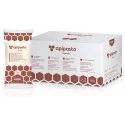 Apipasta with vitamins 15kg
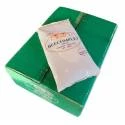 Beecomplet® Spring 14Kg
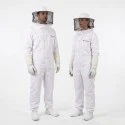 Beekeeper suit with round veil
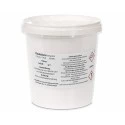 Oxalic acid 1kg
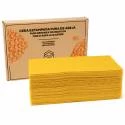 Beeswax Foundation 5kg
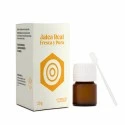 Fresh royal jelly 20g
 Classic honey jar 1kg comb-lines TO77 - Pack of 16 units
 Promotor L Apis 1 litre
Beeswax candles
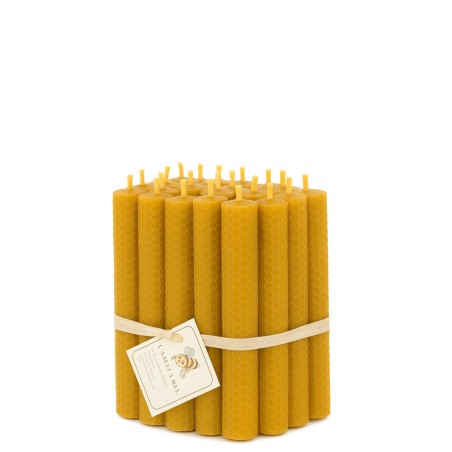
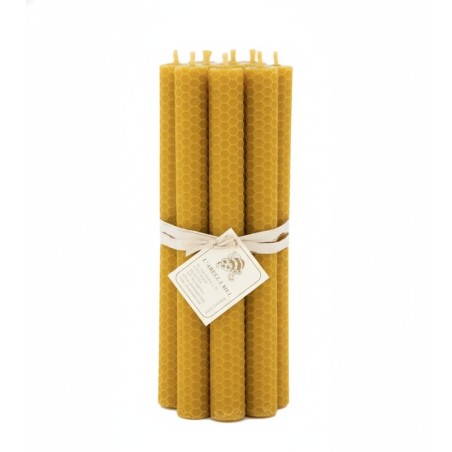
100 % pure beeswax candles, in packs of 12 and in 10×2 and 20×2 cm formats. No paraffin, no dyes, no added fragrance.

The wick matters more than the wax
When a candle tunnels down the middle and leaves the whole wall unburnt, almost nobody blames the wick; they blame the wax. It is the other way round: the wick is undersized for that diameter. Beeswax is denser than paraffin and needs more flame to melt the rim, so a wick designed for paraffin falls short as soon as the candle is over two centimetres across.
The first time you light a new candle, let it burn until the pool of wax reaches the edge. That first burn sets the candle's memory: put it out sooner and you will not fix the tunnel later. And if you get black smoke, it is not bad wax — it is too long a wick: trim it to half a centimetre with the candle cold.
Beeswax candles
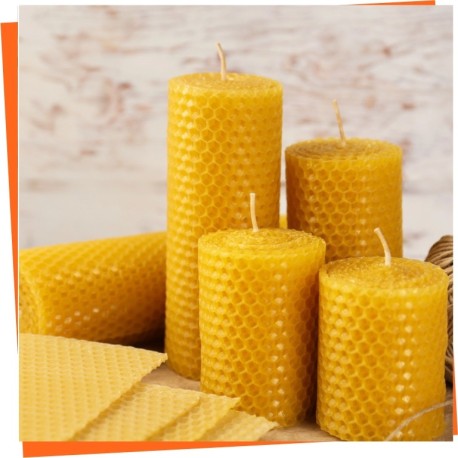
The difference from an ordinary candle is not the wrapper: it is the melting point. Beeswax melts between 61 and 65 ºC, well above paraffin, and that changes how it burns.
What that number means
- It burns more slowly. It needs more energy to turn liquid, so for the same size the candle lasts longer.
- It drips less. Molten wax solidifies again sooner as it runs down the side, as long as the wick is centred and the candle is out of a draught.
- It smells of what it is. The aroma comes from the volatile compounds of the wax itself, not from added fragrance. That is why each batch smells slightly different depending on the bloom.
Formats and how they are used
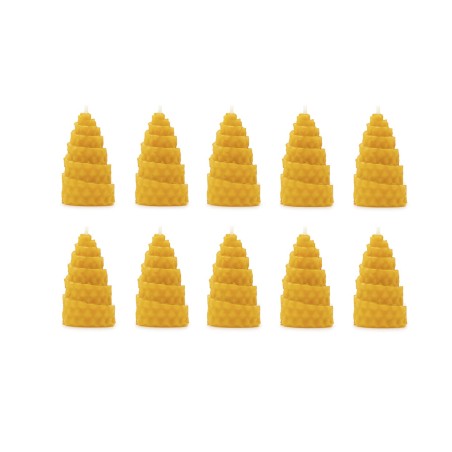
They come in packs of 12: the 20×2 cm at €18.90 and the 10×2 cm at €22.75, plus the tray of 12 mini tapers at €9.95. All are narrow in section, so they want a holder that grips well and a stable surface.
To make them last as they should: trim the wick to about 5 mm before each lighting, snuff rather than blow if you can — less smoke — and keep them away from an open window, because the draught pulls the flame off centre and that is where dripping starts.
If you want to make them yourself
It is one of the best things to do with your own wax: moulds, wicks, holders and oils are in candle-making supplies, and the wax in blocks is there to melt. A candle made at home with your own wax is worth more on a market stall than the same wax sold in bulk.
Where should I not store or place them?
Away from any heat source, and that includes places that do not look risky. Beeswax loses its solid structure from around 46–47 °C, well below its melting point of 61–65 °C: it does not have to melt for a candle to bend, sag or lose its shape. A sunny windowsill in summer, a shelf above a radiator or a car dashboard all reach that easily. Store them upright, somewhere cool, with nothing resting on them; if a candle arrives slightly bent after a July delivery, that is almost always the cause rather than a manufacturing fault.
What is the white film that appears over time?
It is not mould — it is the wax itself. Over time the fatty-acid salts in the wax migrate to the surface and form a matt, whitish film, known in the trade as bloom. It happens to pure beeswax and does not happen to paraffin or blends, so when it turns up it is a good sign rather than a fault. If you prefer the original sheen, it comes off with a gentle rub of a dry cloth or a few seconds near a mild heat source; and if you like the look, it makes no difference whatsoever to how the candle burns.
Do they purify the air or release negative ions?
No, and we would rather tell you so. It is the most repeated claim in the beeswax candle market and there is no peer-reviewed study supporting it: the sites that repeat it cite none. What you can expect from these candles is what can actually be measured — they burn more slowly than a paraffin candle of the same size, they hold up better to warm rooms because their melting point is higher, and they smell of wax because there is no added fragrance. That seems argument enough without inventing another.
Are they 100 % beeswax or blended with paraffin?
100 % pure beeswax, no paraffin. They are handmade and contain no dyes or added fragrance: the honey-and-flower scent you notice when you light them is the wax's own.
That is the difference you cannot see on a label. Many candles sold as «beeswax» are a blend, and a small percentage of wax is enough to put the word on the packaging. If the scent reaches you perfumed and uniform, it is almost always added fragrance rather than wax.
How long does each candle burn?
The 10 × 2 cm one burns for 1 to 1.5 hours; the 20 × 2 cm, up to 4 hours. Both are sold in packs of 12.
What sets the burn time is not length alone: it is the diameter and the wick, because they determine how much wax melts per minute. That is why doubling the length more than doubles the time. To get the expected performance, keep it away from draughts: moving air makes the flame burn to one side and shortens the candle without giving more light.