

At a glance
Meadow and legume honeys
Lucerne, sainfoin, trefoil, escobizo and meadow honey
Colour
White to very light amberup to 35 mm Pfund (48 for meadow)
Aroma
Faint floral aromawith flour-like notes
Taste
Clean sweetnessthe five profiles have simple sweetness
Crystallisation
Moderate to rapidthe grain varies between profiles
Season
Spring and late springdepending on species
Region
Much of the Iberian Peninsulaeach in its own growing area
Pollen reference
45%throughout the group
Conductivity
up to 0.30 mS/cm0.35 for sainfoin
The Iberian guide gives five separate profiles to honeys that can taste remarkably alike. The most useful differences appear in the crystals, the forage records and the laboratory report.
Lucerne (alfalfa), sainfoin, trefoil, escobizo and mixed meadow honey all come from plants in the pea family. All five are very pale, with a faint floral aroma, flour-like notes and simple sweetness.
In a blind tasting it is easy to confuse them. Comparing the pollen spectrum and geography of the harvest gives a better basis for a floral name.
Reading and tasting meadow and legume honeys

This Spanish-language field guide compares botanical origin, tasting and laboratory findings. Use the profile together with the traceability of the lot.
Compare similar pale honeys side by side
- Taste samples of known origin and record their crystal size.
- Use pollen analysis to distinguish closely related floral sources.
The most useful differences
| Lucerne | Sainfoin | Trefoil | Escobizo | Meadow | |
|---|---|---|---|---|---|
| Plant | Medicago sativa | Onobrychis sativa | Lotus spp. | Dorycnium pentaphyllum | Trifolium, Lotus, Melilotus |
| Maximum colour | 35 | 35 | 35 | 35 | 48 |
| Crystallisation | Rapid, medium to fine crystals | Rapid, coarse crystals | Moderate, medium to coarse grains | Moderate, medium to coarse grains | Rapid, medium to fine grains |
| Sucrose | up to 10% | up to 5% | up to 5% | up to 5% | up to 5% |
| Conductivity | up to 0.30 | up to 0.35 | up to 0.30 | up to 0.30 | up to 0.30 |
| Region | Andalusia, Aragón and Lleida | Mountain pasture in central and southern Mediterranean districts and Aragón | Poor pastures in southern Iberia | East-central and south-eastern Iberia | Throughout the peninsula |
| Season | Late spring to summer | Late spring | Late spring | Spring | Spring |
| Minimum pollen | 45% | 45% | 45% | 45% | 45% from the family |
Aroma and taste are omitted from the comparison because they overlap closely across all five. The aroma is delicate, floral and flour-like, and the taste is sweet. In a blind tasting crystal sizeis one clue. The pollen report is more informative.
Two laboratory details to look for
Lucerne honey can contain up to 10% sucrose, compared with 5% in the other four profiles. As with citrus and eucalyptus, the nectar itself can be rich in sucrose. That figure alone does not establish artificial feeding.
Sainfoin has a slightly higher conductivity limit in the guide: 0.35 mS/cm, compared with 0.30 for the others. The difference is small, so interpret it with the pasture and pollen findings.
Where escobizo differs
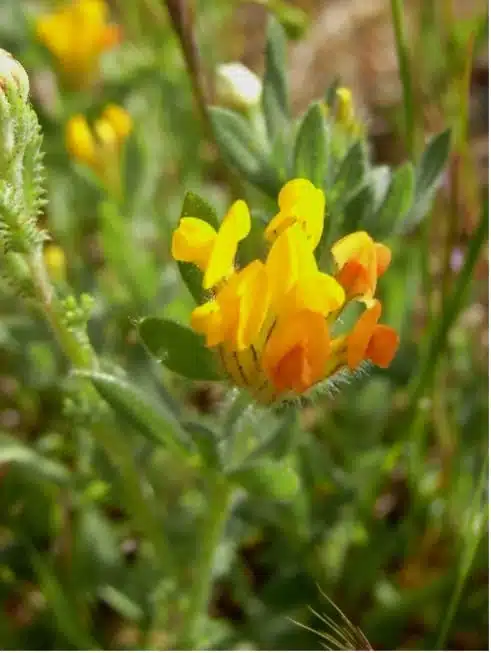
Escobizo, Dorycnium pentaphyllum, also has regional names such as mijediega and socarrell. This legume grows in Mediterranean scrub, unlike the other meadow plants in the group. Rosemary can therefore occur in its pollen spectrum. Its honey retains the pale colour and flour-like aroma typical of these profiles.
Colour
The four monofloral profiles go up to 35 mm Pfund. The mixed meadow profile can reach 48. All sit towards the pale end of the scale, alongside acacia, rosemary (in Spanish) and oilseed rape honey.
Legume honeys on the Pfund scale
In the pale bands. The monofloral honeys occupy the paler bands. The mixed meadow honey goes a little further. On-screen colours are approximate. A laboratory measures the actual value.
Aroma, taste and texture
Sensory profile
Our interpretation of the descriptions in the Guía de mieles monoflorales ibéricas. This shared profile explains why tasting the five honeys can give very similar impressions.
The flour-like note of legumes
A faint aroma of raw flour appears in acacia and albaida honey (in Spanish), and sometimes in rosemary honey (in Spanish) when legumes contribute to the flow. In yellow broom honey it becomes a much stronger leading note. Here the slight flour-like note stands out against a quiet floral background.
For mixed meadow honey the guide notes that the flour-like aroma becomes clearer on the palate.
The clues in the crystals
Sainfoin tends to set with coarse grains, lucerne with medium to fine grains, and trefoil and escobizo with an intermediate grain. Texture is a useful clue, though it cannot settle the origin by itself.
Interpreting the laboratory profile
| Parameter | Reference in the guide | How to interpret it |
|---|---|---|
| Colour | up to 35 mm Pfund (48 for meadow honey) | White to very light amber. |
| Moisture | up to 18% | Fermentation risk increases above the guide value. The general EU limit for blossom honey is 20%. |
| Fructose and glucose combined | at least 60% | The value used for blossom honeys. Meeting it cannot rule out syrup adulteration on its own. |
| Sucrose | up to 5% (10% for lucerne) | Lucerne nectar can be naturally rich in sucrose. |
| Electrical conductivity | up to 0.30 mS/cm (0.35 for sainfoin) | Among the guide’s lower limits, consistent with low mineral content. |
| Free acidity | up to 50 meq/kg | Can rise with fermentation or extended storage. |
| HMF | up to 40 mg/kg | HMF increases with heat and time in storage. |
| Diastase activity | at least 8 Schade units | Indicator of enzyme activity, which can decline with heat. |
| Pollen | at least 45% for all five profiles | These plants can contribute abundant pollen. The percentage is a share of grains counted, not of nectar. |
Reference ranges from the Guía de mieles monoflorales ibéricas, fourth edition (2023). These characterise the variety. Spanish statutory limits are set by Royal Decree 1049/2003 as amended by Royal Decree 68/2025, including a general maximum of 20% moisture and 40 mg/kg HMF, subject to the exceptions in the legislation.
Other pollen in these honeys
- Other legumes
- Rockroses (Cistaceae)
- Daisy family (Asteraceae)
- Brassicas and white wall-rocket
- Mint family
- Viper’s bugloss
- Fruit trees in lucerne honey
- Rosemary in escobizo honey
Where and when they are harvested
The guide places lucerne in irrigated areas of Andalusia, Aragón and Lleida, sainfoin in mountain pasture along parts of the Mediterranean ranges and in Aragón, trefoil in poor southern pastures, and escobizo in east-central and south-eastern scrub. Mixed meadow honey can occur widely. Most flows are in spring or late spring. Lucerne can continue into summer.
Legume honey flows
FloweringFlowering and harvest
A combined calendar for the group. Escobizo and mixed meadows start earlier. Irrigated lucerne can flower again after cutting, extending the flow.
How to recognise these pale legume honeys
- 1Look for a very pale colour. Up to 35 mm Pfund, or 48 for mixed meadow honey.
- 2A faint aroma with a flour-like background. A strong scent is a poor match for this pasture group.
- 3Taste for clean sweetness. Little marked acidity, bitterness or saltiness in all five.
- 4Expect relatively early crystallisation. The set is moderate to rapid in the profiles.
- 5Use pollen analysis to tell them apart. Tasting alone is rarely enough to distinguish similar legume honeys.
For a broader view, see how to assess honey quality and our guide to Spanish honey labelling requirements.
Composition and health claims
Health claims on food are regulated in the EU. The distinguishing features here are its floral origin, conductivity and sensory profile.
These characteristics matter when tasting or using the honey.
- Their mild sweetness works well where you want to preserve the other flavours in a dish.
- Their low conductivity is consistent with a relatively low mineral content.
- They set relatively readily, often to a texture suitable for spreading.
- The flows are linked to forage crops, grazing or, in the case of escobizo, Mediterranean scrub.
Who should take particular care?
Children under 12 months. Do not give honey to infants under one year. It can contain spores of Clostridium botulinum that may cause infant botulism. This applies to all types of honey.
Diabetes. honey is a source of sugars. This also applies to natural and monofloral honeys when planning a diet.
Known allergy. Anyone with a diagnosed allergy to honey or bee products should consult their clinician if unsure what is safe for them.
Frequently asked questions
How do lucerne, sainfoin, trefoil and escobizo honeys differ?
All four are pale (up to 35 mm Pfund), mildly floral and sweet, with slight flour-like notes. Sainfoin usually sets with coarser grains and lucerne with medium to fine grains. The guide allows higher sucrose for lucerne (10% versus 5%) and slightly higher conductivity for sainfoin (0.35 versus 0.30 mS/cm). Pollen analysis and the harvest records are needed for a closer identification.
What is meadow honey in this guide?
It is a plant-community honey from several pasture legumes, such asTrifolium, Lotusand Melilotus. The guide gives at least 45% legume pollen and a maximum colour of 48 mm Pfund. It can be harvested widely across the peninsula in spring.
Why is the sucrose allowance higher for lucerne honey?
Its nectar can be naturally rich in sucrose, as can certain citrus and eucalyptus nectars. The guide gives up to 10% for lucerne and 5% for the other profiles. Sucrose alone cannot diagnose feeding or early harvest.
What is a flour-like note?
A mild aroma reminiscent of uncooked flour. It occurs in several legume honeys, from acacia and albaida to the much more intensely flour-scented yellow broom. In these pasture honeys it sits against a light floral background.
Who should take precautions with these honeys?
Never give honey to infants under 12 months. People with diabetes should count its sugars. Anyone with a diagnosed allergy to hive products should seek individual medical advice.
Where to buy these meadow and legume honeys
These five honeys are not in our present range. Local harvests often form part of spring multifloral honey. For a pale Spanish honey with a mild taste, try our raw rosemary honey or explore our other raw honeys harvested in Spain.
Sources
The reference ranges come from the fourth edition (June 2023) of the Guía de mieles monoflorales ibéricas by J. Orantes, F. Gonell, C. Torres and A. Gómez-Pajuelo, published by Laboratorios Apinevada and Pajuelo Consultores Apícolas. Their work draws on a series reaching back to 1980 and more than 3,600 analyses a year across the two laboratories. The printed guide in Spanish is available in our shop.
This is part of our series on Iberian honeys. Compare the flour-like note with acacia, albaida (in Spanish) and, for a much stronger aroma, yellow broom honey.


