

Reference guide
43 Iberian honeys arranged by colour
36 main botanical profiles plus seven plant communities
Among the palest
Acacia and rosemaryup to 35 mm Pfund
At the dark end
Holm oak honeydew honeyfrom 90 mm Pfund
Low pollen thresholds
8%ling heather and strawberry tree
High pollen thresholds
75%chestnut
Sweetness is only one of the things that honeys have in common. In the tables below you can compare the main Iberian profiles by colour, pollen and season, and open the individual entries for their aromas and textures.
The answer to “how many types of honey are there?” depends on the classification. The Iberian guide presents 36 entries in its main botanical series and seven more for distinctive plant communities. This gives 43 profiles, including the oak honeydew entry. Local multifloral honeys add many other possible combinations.
This is the index to our series. Some very similar botanical entries share an article with a comparison table. Follow the individual profile for exact Pfund values, pollen thresholds, harvest and composition.
A field guide for comparing Iberian honeys

This Spanish-language field guide compares botanical origin, tasting and laboratory findings. Use the profile together with the traceability of the lot.
Compare honeys from the same group
- First distinguish the 36 monofloral profiles from the seven plant-community profiles.
- Use the full profile, including the floral source, tasting notes and analytical results.
Blossom honey and honeydew honey under Spanish rules
Spanish Royal Decree 1049/2003, which implements the EU Honey Directive, distinguishes blossom or nectar honey from honeydew honey by origin. Within blossom honey, beekeepers commonly distinguish monofloral and multifloral harvests. A floral designation requires the appropriate origin and characteristic sensory, physicochemical and microscopic properties.
| Type | Source | How to recognise the profile |
|---|---|---|
| Blossom honey Monofloral | Nectar predominantly from one plant | Pollen, colour, conductivity, aroma and taste vary with the plant. Use its individual profile and harvest records. |
| Blossom honey Multifloral | Nectar from several plants | Often sold as wildflower, blossom or multifloral honey. The mix can change markedly from one site or season to another. |
| Honeydew honey | Sweet material from sap-feeding insects on living plants or from secretions of living plant parts | Conductivity is generally high. EU rules set a general minimum of 0.8 mS/cm with named exceptions. Laboratories can also examine honeydew elements. In Spanish beekeeping, the terms mielato and mela honey. |
are common. The plant communities in the second table are botanical profiles, separate from the legal distinction by origin. Some combine blossom nectar and honeydew.
How the Pfund colour scale works
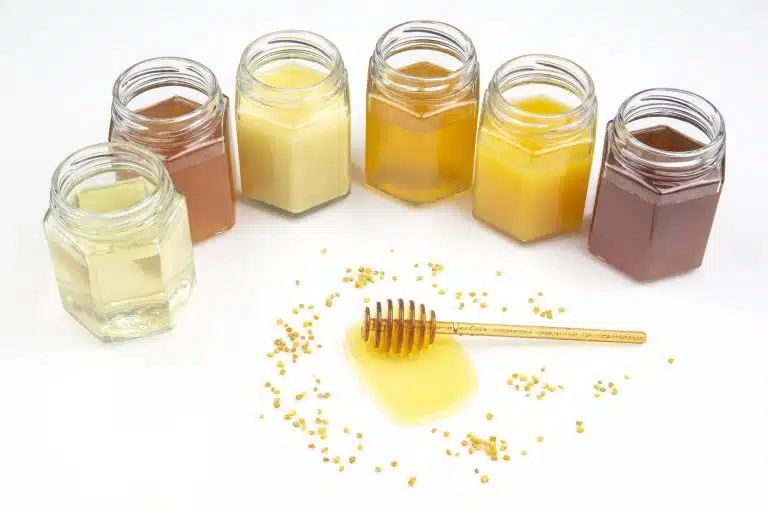
Honey colour can be measured on the Pfund scale, from water white towards dark amber. A jar against a white background gives a visual impression. An actual value in millimetres Pfund requires a suitable measurement.
The complete Pfund scale
The colour bars in the tables use these same bands. They are approximate on-screen representations. An instrument is needed to measure a specific honey.
The 36 main Iberian honey profiles
The entries run broadly from pale to dark. Some share a linked profile because their differences are easier to explain in a side-by-side table. The colour bands below come from the illustrated scale. Use the individual article for the precise limit that applies to each honey.
| Colour | Honey | Plant | Pfund band (mm) | Minimum pollen | Season |
|---|---|---|---|---|---|
| Acacia | Robinia pseudoacacia | 0–34 | 20% | Late spring | |
| Albaida (in Spanish) | Anthyllis cytisoides | 0–48 | 45% | Late spring | |
| Lucerne (in the meadow honey profile) | Medicago sativa | 0–34 | 45% | Late spring to summer | |
| Cotton | Gossypium spp. | 0–34 | 45% | Late spring to summer | |
| Almond | Prunus dulcis | 0–34 | 20% | Early spring | |
| Escobizo (in the meadow honey profile) | Dorycnium pentaphyllum | 0–34 | 45% | Spring | |
| Trefoil (in the meadow honey profile) | Lotus sp. | 0–34 | 45% | Late spring | |
| Rhododendron | Rhododendron ferrugineum | 0–48 | 25% | Summer | |
| Rosemary (in Spanish) | Salvia rosmarinus | 0–34 | 12% | Early spring | |
| Alpine clover | Trifolium alpinum | 0–34 | 35% | Summer | |
| Citrus blossom | Citrus sp. | 9–48 | 15% | Spring | |
| French lavender (Lavandula stoechas) | Lavandula stoechas | 9–48 | 12% | Late spring to summer | |
| Viper’s bugloss | Echium sp. | 9–48 | 70% | Late spring | |
| Oilseed rape | Brassica napus | 9–34 | 45% | Late spring | |
| Sainfoin (in the meadow honey profile) | Onobrychis sativa | 9–34 | 45% | Late spring | |
| Lemon blossom | Citrus × limon | 9–34 | 15% | Spring | |
| Apple blossom | Malus domestica | 9–48 | 20% | Late spring | |
| Wild lavender (in the lavender honey profile) | Lavandula latifolia, L. vera | 18–83 | 5% | Summer | |
| Sunflower | Helianthus annuus | 18–83 | 45% | Summer | |
| Lavandin (in the lavender honey profile) | Lavandula latifolia × L. angustifolia hybrids | 18–48 | — | Summer | |
| Savory | Satureja sp. | 35–83 | 12% | Late spring | |
| Eucalyptus | Eucalyptus camaldulensis, E. globulus | 35–83 | 70% | Summer | |
| Thyme | Thymus spp. | 35–83 | 12% | Late spring to summer | |
| Carob | Ceratonia siliqua | 49–83 | 30% | Autumn | |
| Heather | Erica sp. | 49–113 | 30% | Summer | |
| Calluna (in the heather honey profile) | Calluna vulgaris | 49+ | 8% | Late summer | |
| Chestnut | Castanea sativa | 49+ | 75% | Summer | |
| Coriander | Coriandrum sativum | 49–83 | 20% | Summer | |
| Loquat | Eriobotrya japonica | 49–113 | 30% | Autumn | |
| Blackberry | Rubus sp. | 49–113 | >45% | Late summer | |
| Avocado | Persea americana | 84+ | 25% | Late spring | |
| Strawberry tree | Arbutus unedo | 84+ | 8% | Autumn | |
| Anise | Pimpinella anisum | 84+ | 45% | Summer | |
| Holm oak and oak honeydew | Quercus sp. | 84+ | — | Late summer to autumn | |
| Pennyroyal | Mentha pulegium | 84+ | 12% | Late summer | |
| Yellow broom | Retama sphaerocarpa | 84+ | 35% | Summer |
Seven honeys from plant communities
Some landscapes yield a recognisable honey even when one flower does not predominate. Rosemary and thyme may flower together, pasture legumes can contribute jointly, and Mediterranean woodland can combine flowers with oak honeydew. The Iberian guide describes seven such profiles.
| Colour | Honey | Plant community | Pfund band (mm) | Minimum pollen | Season |
|---|---|---|---|---|---|
| High mountain | Rhododendron ferrugineum + Trifolium alpinum | 0–48 | 15% | Summer | |
| Meadow | Herbaceous legumes | 9–48 | 45% | Spring | |
| Garrigue | Mixed Mediterranean scrub species | 18–83 | — | Late spring | |
| Mixed mint-family honey (in the thyme honey profile) | Mint family, mainly Salvia rosmarinus and Thymus spp. | 18–83 | 15% | Late spring | |
| Forest | Woodland flowers and oak honeydew | 84+ | — | Late summer | |
| Mountain | Montane vegetation | 84+ | — | Summer | |
| Sierra (Alpujarras) | Montane flowers | 84+ | 20% | Summer |
Why pollen percentages do not measure purity
The contrast between ling heather and chestnut is a good example. Why might the guide give 8% pollen for one and 75% for the other?
Different plants deliver very different amounts of pollen alongside their nectar. A flower that contributes abundant nectar but little pollen can be important in a harvest despite a modest count. Heavy pollen producers need higher reference values. The laboratory therefore interprets the proportion for the particular plant and alongside other findings.
| Minimum pollen | Samples | Reason |
|---|---|---|
| 8% | Ling heather and strawberry tree | Very little pollen reaches the honey relative to the floral contribution. |
| 12% | Rosemary, thyme, savory, French lavender, pennyroyal | Mint-family plants often provide abundant nectar but comparatively little pollen. |
| 15% | Citrus blossom and lemon blossom | Citrus pollen is often under-represented. Some navel oranges produce very little viable pollen. |
| 20% | Acacia, almond, apple, coriander | Intermediate pollen representation in these profiles. |
| 25–35% | Avocado, rhododendron, heather, carob, loquat, yellow broom and alpine clover | A substantial pollen contribution in the guide’s classification. |
| 45% | Albaida, lucerne, cotton, oilseed rape, escobizo, sainfoin, sunflower, trefoil, anise and blackberry | Higher reference percentages reflect the abundance of pollen. See the individual profiles for exact cut-offs. |
| 70–75% | Eucalyptus, viper’s bugloss and chestnut | These plants can contribute a particularly high proportion of the pollen. |
| — | Holm oak and other oak honeydew | There is no floral pollen threshold. Honeydew elements and conductivity help characterise the origin. |
For the laboratory method, see why pollen analysis is used in honey honey.
How to read an individual profile
Each profile follows a common sequence so that two honeys can be compared on the same terms.
- Colour in millimetres Pfund. Some profiles give an upper limit, such as 35 for rosemary, others a lower one, such as 49 for chestnut. Eucalyptus illustrates a range, 40–80. The wider bands in these tables reflect the illustrated scale and can extend beyond the precise figure in a profile.
- Smell and aroma. First smell the opened jar. Then notice what reaches the nose from the mouth as you taste. The two impressions may differ.
- Taste. Record sweetness, acidity, saltiness and bitterness independently. Some varieties combine several of them.
- Mouthfeel and crystallisation. Note how quickly the sample sets and whether the grains are fine or coarse. Acacia and oak honeydew can remain fluid far longer than oilseed rape or sunflower honey.
- Composition. Moisture influences storage and fermentation risk. Above about 18% that risk can increase, although the general legal maximum for ordinary blossom honey is 20%. HMF indicates the combined effects of time and temperature. Conductivity reflects dissolved substances, especially minerals, and helps compare origins.
- Pollen spectrum. Check the accompanying plants as well as the main source. They help explain why two lots sold under the same floral name can taste different.
Frequently asked questions
How many types of honey are there in Spain?
It depends on the classification. The law distinguishes blossom or nectar honey and honeydew honey by origin. Blossom honeys can in turn be described as monofloral or multifloral. The Guía de mieles monoflorales ibéricas guide presents 36 main profiles alongside seven plant-community profiles, for 43 Iberian entries. Different local multifloral combinations can be much more numerous.
What is monofloral honey?
One plant contributes all or most of the nectar. A floral designation under Spain’s honey standard must match the origin and characteristic sensory, physicochemical and microscopic properties. A guide’s pollen thresholds are technical references, not universal legal percentages of purity.
Which honeys are darkest and palest?
Holm oak and other oak honeydew honeys are at the dark end, with a profile starting at 90 mm Pfund. Acacia and rosemary are among the palest, with upper limits of 35. The guide contains other very pale profiles too.
Why do some honeys crystallise earlier than others?
Glucose tends to form crystals, and the relative amounts of fructose and glucose influence setting. Temperature, moisture and storage also matter. Acacia, with a guide minimum fructose-to-glucose ratio of 1.5, can stay liquid for a year or two. Oak honeydew often remains liquid for a long time.
Is monofloral honey better than multifloral honey?
These are descriptions of origin. Either can be of excellent quality. Moisture, HMF, diastase, sensory condition, handling and storage all matter when assessing a particular lot.
Sources
The references come from the fourth edition of the Guía de mieles monoflorales ibéricas (June 2023), by J. Orantes, F. Gonell, C. Torres and A. Gómez-Pajuelo, published by Laboratorios Apinevada and Pajuelo Consultores Apícolas. The authors draw on a series begun in 1980 and over 3,600 analyses a year across the two laboratories. The printed guide in Spanish is available in our shop.
Our shop offers raw honeys harvested in Spain, including rosemary, thyme, citrus blossom, heather, eucalyptus, lemon blossom, lavender, loquat, avocado and forest honey, as well as oak honeydew honeycomb.


