
At a glance
Mountain honey
Montane vegetation with little cultivated forage
Colour
Amber to very dark amberat least 80 mm Pfund, sometimes reddish
Aroma
Floral, forest-floor and fruit notesintense
Taste
Sweet with salty and tart notesbitterness can increase with heather
Crystallisation
Slowoften stays liquid
Season
Summera summer flow at altitude
Region
Montane belt600–1,800 m
Pollen profile
Crop pollen absentor present only in trace amounts
Conductivity
up to 0.80 mS/cmhigh
Mountain honey has a botanical and sensory profile in the Iberian guide. If the label also bears the European quality term “mountain product”, the conditions attached to that term must be met.
The authors describe honey from the mixed flora of the Iberian montane belt, at approximately 600–1,800 metres. As with forest honey, the pollen report gives information about the landscape in which the bees foraged.
Reading and tasting mountain honey

This Spanish-language field guide compares botanical origin, tasting and laboratory findings. Use the profile together with the traceability of the lot.
Check the source of the mountain claim
- Record the origin of the lot and the apiary locations.
- Read the pollen profile alongside the conditions for the label.
When the label says “mountain product”
The guide draws attention to a labelling distinction. “Mountain product” is an optional EU quality term. Its use for a honey must be assessed under the applicable rules.
Article 3 of Commission Delegated Regulation (EU) No 665/2014 specifically addresses bee products. The bees must have collected the nectar and pollen exclusively in mountain areas. Check the designated area and the apiary’s records before using the term.
The sensory profile helps interpret a harvest. Eligibility to use the EU quality term depends on where the bees actually foraged and on the applicable rules. A tasting sheet by itself cannot establish that.
Looking for evidence of cultivated crops
Like the guide’s forest honey, this profile calls for crop pollen to be absent or present only in trace amounts. The pollen spectrum supports an interpretation of the forage. Apiary locations and batch records supply the geographical evidence.
Colour
Amber to very dark amber, at least 80 mm Pfund, sometimes with reddish reflections.
Mountain honey on the Pfund scale
The two dark bands, with no stated maximum. On-screen colours give an approximate visual guide. A laboratory measures the actual value.
Aroma, taste and texture
Sensory profile
Our interpretation of the descriptions in the Guía de mieles monoflorales ibéricas. The balance varies with the plants and flows available that year.
Aroma
The aroma is floral, intense and moderately persistent. Heather can add a forest-floor note and bramble a fruity one.
Taste
Sweet, often with salty and tart notes. Heather can contribute a little bitterness, as discussed in our chestnut honey profile.
Crystallisation
Crystallisation tends to be slow. This honey can remain liquid for some time.
Interpreting the laboratory profile
| Parameter | Reference in the guide | How to interpret it |
|---|---|---|
| Colour | at least 80 mm Pfund | Amber to very dark amber, sometimes reddish, with no upper limit stated. |
| Moisture | up to 18% | Fermentation risk increases above the guide value. The general EU limit for blossom honey is 20%. |
| Fructose and glucose combined | at least 60% | The guide uses the blossom-honey sugar profile. The lower threshold used for honeydew honeys is different. |
| Sucrose | up to 5% | One of the sugars reported in the analysis. |
| Electrical conductivity | up to 0.80 mS/cm | Relatively high, consistent with woodland forage and a possible contribution of honeydew. |
| Free acidity | up to 50 meq/kg | Can rise with fermentation or extended storage. |
| HMF | up to 40 mg/kg | HMF increases with heat and time in storage. |
| Diastase activity | at least 8 Schade units | Indicator of enzyme activity, which can decline with heat. |
| Pollen | Crop pollen absent | Or present only as traces, as in the forest honey profile. |
Reference ranges from the Guía de mieles monoflorales ibéricas, fourth edition (2023). These characterise the variety. Spanish statutory limits are set by Royal Decree 1049/2003 as amended by Royal Decree 68/2025, including a general maximum of 20% moisture and 40 mg/kg HMF, subject to the exceptions in the legislation.
What occurs in the pollen spectrum?
- Legumes
- Rockroses (Cistaceae)
- Heath family, including heathers
- Daisy family (Asteraceae)
- Mint family
- Brambles
Growing areas and harvest season
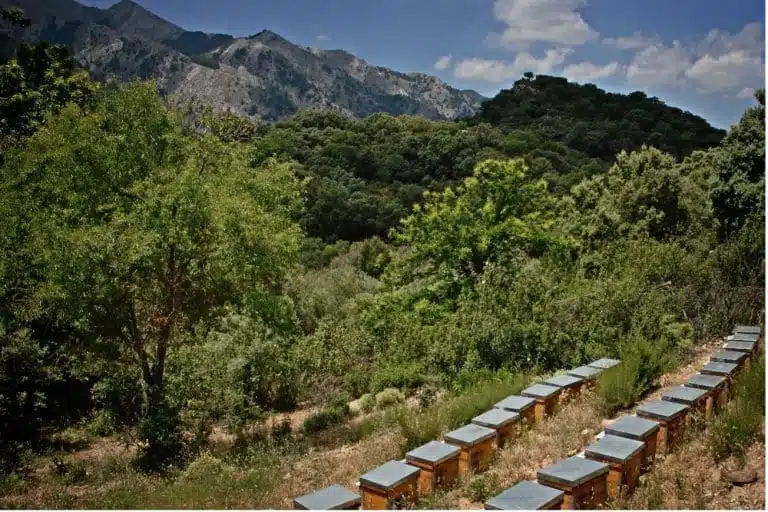
The guide places this summer harvest in the montane belt of Iberian ranges, at 600–1,800 metres. This is below the subalpine meadows and scrub that yield rhododendron and alpine clover honey.
Mountain honey flow
FloweringFlowering and harvest
The guide places the main harvest in summer. The altitude range overlaps that of holm oak honeydew honey, and both flows can reach the same apiary.
How to recognise Iberian mountain honey
- 1Dark, from 80 mm Pfund, sometimes with reddish reflections.
- 2Look for woodland aromas: forest-floor and fruit notes with a moderate-to-strong intensity.
- 3Sweet with salty and tart notes. Heather can add a little bitterness.
- 4Check the pollen report. Check whether crop pollen is absent or only present in traces.
- 5Read any “mountain product” claim carefully. It is a regulated quality term.
For a broader view, see how to assess honey quality and our guide to Spanish honey labelling requirements.
Composition and health claims
Mountain origin is a geographical statement. The EU quality term is regulated, and neither the origin nor the term establishes any special health benefit.
These characteristics matter when tasting or using the honey.
- An absence of crop pollen or only trace amounts is part of the guide’s profile.
- The guide gives conductivity up to 0.80 mS/cm, consistent with a comparatively mineral-rich honey.
- The altitude range of 600–1,800 metres describes this Iberian profile. It is separate from the legal definition of a mountain area.
- Its strong aroma works well with mature cheeses, meat and rustic bread.
Who should take particular care?
Children under 12 months. Do not give honey to infants under one year. It can contain spores of Clostridium botulinum that may cause infant botulism. This applies to all types of honey.
Diabetes. honey is a source of sugars. This also applies to natural and monofloral honeys when planning a diet.
Known allergy. Anyone with a diagnosed allergy to honey or bee products should consult their clinician if unsure what is safe for them.
Frequently asked questions
What is Iberian mountain honey?
The Iberian guide describes a plant-community honey from the montane belt, approximately 600–1,800 metres in Spain and Portugal. Its profile includes colour of at least 80 mm Pfund, conductivity up to 0.80 mS/cm and crop pollen absent or present only in traces.
Can any honey use the “mountain product” label?
No. It is an optional EU quality term. Under Article 3 of Delegated Regulation (EU) No 665/2014, for bee products the bees must have collected their nectar and pollen only in mountain areas. A match to the tasting profile is insufficient proof. Check the geographical eligibility and the records for the lot.
How does it differ from forest honey?
Both profiles allow very little crop pollen. Forest honey includes oak honeydew: the guide gives fructose and glucose together from 45% and conductivity of 0.70–0.90 mS/cm. The mountain profile describes blossom honey, with at least 60% fructose plus glucose, conductivity up to 0.80 and a more floral, sometimes fruity or earthy aroma.
Who should take particular care?
Never give honey to a baby under 12 months because of the risk of infant botulism. People with diabetes should count its sugars in their diet. Anyone with a diagnosed allergy to hive products should seek individual medical advice.
Where to buy mountain honey
We do not currently offer a honey sold under this particular designation. For a related Spanish woodland profile, we carry raw forest honey.
Sources
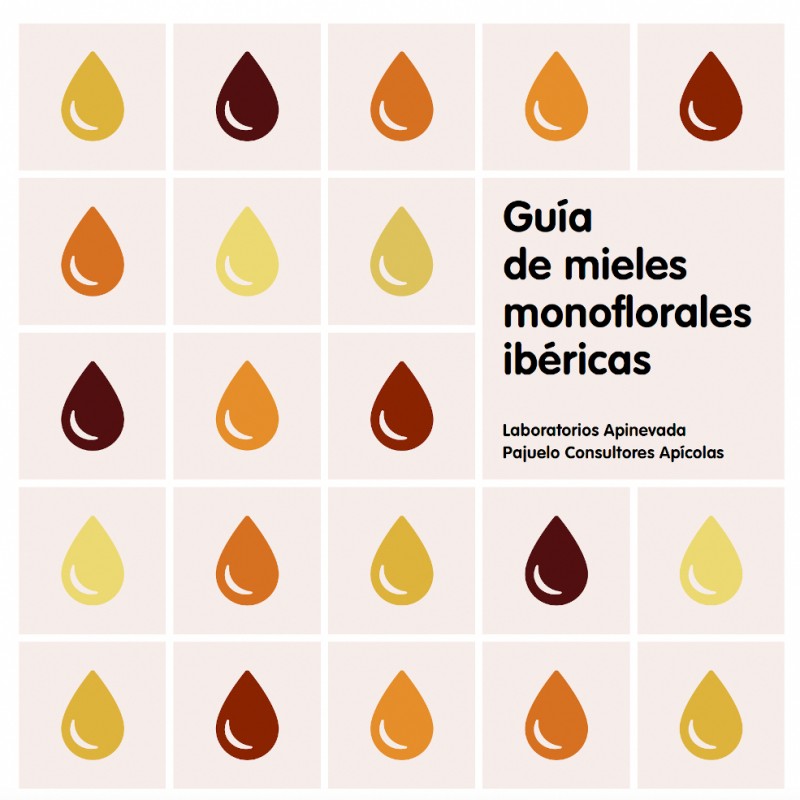
The reference ranges come from the fourth edition (June 2023) of the Guía de mieles monoflorales ibéricas by J. Orantes, F. Gonell, C. Torres and A. Gómez-Pajuelo, published by Laboratorios Apinevada and Pajuelo Consultores Apícolas. Their work draws on a series reaching back to 1980 and more than 3,600 analyses a year across the two laboratories. The printed guide in Spanish is available in our shop.
Discover the other profiles in our series on Iberian honeys. Forest honey also has little or no crop pollen, while high mountain honey comes from the next higher vegetation belt.


