

At a glance
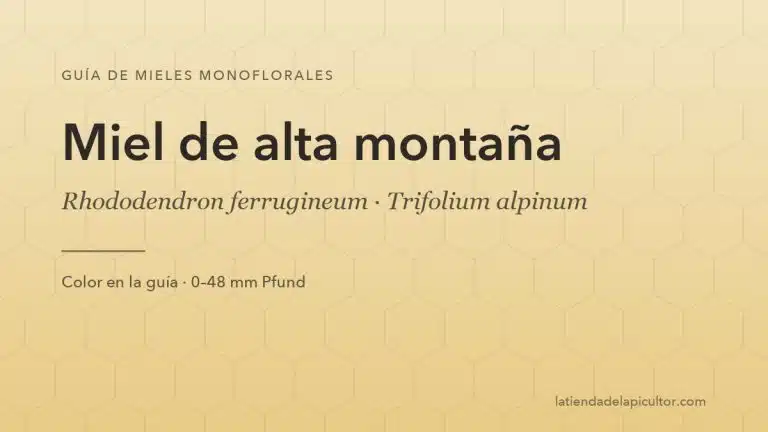
High mountain honey
Rhododendron ferrugineum + Trifolium alpinum
Colour
Light amberup to 40 mm Pfund
Aroma
Floralflour-like and resinous notes
Taste
Sweetwith slight acidity
Crystallisation
Slowoften stays liquid
Season
Summervery short flowering window
Region
Pyreneesaround 1,800 m
Pollen reference
15% + 15%two simultaneous pollen thresholds
HMF
up to 40 mg/kggeneral legal limit; guide reference 50
This is the guide’s unusual two-pollen profile. In one jar it brings together two of the characteristic summer resources of the subalpine Pyrenees.
High in the Pyrenees, rhododendron grows in scrub and alpine clover in adjacent pasture. Where neither dominates enough for a monofloral harvest, their recurring combination can produce the plant-community honey described here.
Reading and tasting high mountain honey

This Spanish-language field guide compares botanical origin, tasting and laboratory findings. Use the profile together with the traceability of the lot.
Look for both pollen types
- Read the rhododendron and alpine clover percentages separately.
- Compare the laboratory findings with the apiary and harvest records.
Two pollen thresholds in the same sample
Minimum pollen proportions: Rhododendron ferrugineum at least 15% plus Trifolium alpinum at least 15% honey.
The defining feature is two thresholds met together. A high count for one of the plants cannot make up for the absence of the other in this profile.
In tasting, the clover contributes a faint flour-like note and the rhododendron a resinous one. Look for both in the floral aroma.
Colour
Light amber. The guide’s sensory description gives up to 40 mm Pfund, like rhododendron honey. The printed composition table contains a conflicting entry, discussed below.
High mountain honey on the Pfund scale
In the four lighter bands. On-screen colours give an approximate visual guide. A laboratory measures the actual value.
A discrepancy in the printed guide. The composition table prints “minimum 40” for colour and “maximum 0.5” for free acidity. The colour conflicts with the sensory description and its illustrated 0–48 range. The source article interprets the figures using the sensory description and the general blossom-honey limit: colour up to 40 mm Pfund and free acidity up to 50 meq/kg honey.
Aroma, taste and texture
Sensory profile
Our interpretation of the descriptions in the Guía de mieles monoflorales ibéricas. The profile falls between its two contributions, more aromatic than clover alone and milder than rhododendron alone.
Aroma
A floral aroma with faint flour-like and resinous notes. These are the respective contributions traditionally associated with clover and rhododendron in the guide.
Taste
Sweet with slight acidity. The tart note is more subdued than in the guide’s monofloral rhododendron profile.
Crystallisation
Crystallisation tends to be slow, as in both of the component honey profiles.
Interpreting the laboratory profile
| Parameter | Reference in the guide | How to interpret it |
|---|---|---|
| Colour | up to 40 mm Pfund | Light amber. See the note on the discrepancy in the printed profile. |
| Moisture | up to 18% | Fermentation risk increases above the guide value. The general EU limit for blossom honey is 20%. |
| Fructose and glucose combined | at least 60% | A characteristic of blossom honey. This figure on its own cannot exclude added syrup. |
| Sucrose | up to 5% | One of the sugars reported in the analysis. |
| Electrical conductivity | 0.45 mS/cm | The guide gives a single reference value, without identifying it as a minimum or a maximum. |
| Free acidity | up to 50 meq/kg | See the note on the numerical discrepancy in the printed guide. |
| HMF | up to 50 mg/kg in the guide | The guide gives the same HMF reference for rhododendron and alpine clover. The legal limit is separate: for ordinary Spanish honey in these categories it remains 40 mg/kg. |
| Diastase activity | at least 8 Schade units | Indicator of enzyme activity, which can decline with heat. |
| Pollen | 15% Rhododendron + 15% Trifolium | Both plants need to meet their own threshold. |
Reference ranges from the Guía de mieles monoflorales ibéricas, fourth edition (2023). These characterise the variety. Spanish statutory limits are set by Royal Decree 1049/2003 as amended by Royal Decree 68/2025, including a general maximum of 20% moisture and 40 mg/kg HMF, subject to the exceptions in the legislation.
What else appears in high mountain honey?
- Daisy family (Asteraceae)
- Legumes
- Pollen from earlier flows
Growing areas and harvest season
The guide describes summer forage around 1,800 metres in subalpine Pyrenean scrub and pasture. The mixed harvest is possible in years when neither plant supplies enough nectar for its own monofloral lot.
High mountain honey flow
FloweringFlowering and harvest
The guide places the main harvest in summer. The summer flow lasts only a few weeks. Hive moves and harvesting have to take account of changes in the weather.
How to recognise Pyrenean high mountain honey
- 1Pale, up to 40 mm Pfund. A strong amber colour falls outside the sensory description.
- 2Look for both aroma notes. Flour-like clover and resinous rhododendron. A single note by itself calls for comparison with the pollen report.
- 3Sweet with slight acidity. Little marked bitterness or saltiness.
- 4It crystallises slowly. The jar can remain liquid for a long time.
- 5Check the pollen report. The pollen report is especially informative: each of the two plants should account for at least 15% of the pollen.
For a broader view, see how to assess honey quality and our guide to Spanish honey labelling requirements.
Composition and health claims
The high-mountain description refers to the origin and forage. It does not establish a health benefit. EU rules concern health claims on all foods.
These characteristics matter when tasting or using the honey.
- Both pollen thresholds must be met to match the guide’s description.
- The guide places this harvest at about 1,800 metres in the Pyrenees.
- Flour-like notes from the clover mingle with resinous notes from the rhododendron.
- The mild taste works well with mountain cheese, dairy desserts and pastries.
Who should take particular care?
Children under 12 months. Do not give honey to infants under one year. It can contain spores of Clostridium botulinum that may cause infant botulism. This applies to all types of honey.
Diabetes. honey is a source of sugars. This also applies to natural and monofloral honeys when planning a diet.
Known allergy. Anyone with a diagnosed allergy to honey or bee products should consult their clinician if unsure what is safe for them.
Frequently asked questions
What is Pyrenean high mountain honey?
It is a plant-community honey from high Pyrenean scrub and pasture, combining rhododendron (Rhododendron ferrugineum) and alpine clover (Trifolium alpinum), around 1,800 metres. The guide gives it a separate analytical profile.
Why are two pollen percentages given?
The profile is defined by the simultaneous presence of at least 15% rhododendron pollen and 15% alpine clover pollen. A high percentage for only one of them is insufficient.
How does it differ from rhododendron honey?
The guide’s monofloral rhododendron profile requires at least 25% rhododendron pollen. The mixed high mountain profile calls for at least 15% of each plant, combining the clover’s flour-like note with rhododendron’s resinous aroma.
Does the law allow more HMF in this honey?
No special exemption applies to this Pyrenean honey. The guide records up to 50 mg/kg for high mountain, rhododendron and alpine clover profiles, but the general legal maximum for ordinary Spanish honey in these categories is 40 mg/kg.
Who should take particular care?
Never give honey to a baby under 12 months because of the risk of infant botulism. People with diabetes should count its sugars in their diet. Anyone with a diagnosed allergy to hive products should seek individual medical advice.
Where to buy Pyrenean high mountain honey
We do not currently stock this particular profile. For a local harvest, ask beekeepers in the Catalan, Aragonese or Navarrese Pyrenees. For a pale, mild Spanish honey from our range, see our raw rosemary honey.
Sources
The reference ranges come from the fourth edition (June 2023) of the Guía de mieles monoflorales ibéricas by J. Orantes, F. Gonell, C. Torres and A. Gómez-Pajuelo, published by Laboratorios Apinevada and Pajuelo Consultores Apícolas. Their work draws on a series reaching back to 1980 and more than 3,600 analyses a year across the two laboratories. The printed guide in Spanish is available in our shop.
Explore our series on Iberian honeys, including the two component profiles, rhododendron and alpine clover.


