

At a glance
Viper’s bugloss honey
Echium spp. · viborera, argamula
Colour
White to light amberup to 48 mm Pfund
Aroma
Delicate but persistentlow intensity
Taste
Clean sweetnesswith a rich, coating feel
Mouthfeel
High viscositysmooth and unctuous
Crystallisation
Slow, scattered crystal clustersdeveloping upwards from the bottom
Season
Late springafter rosemary
Region
Siliceous pasturesouthern half of the peninsula
Pollen reference
70%among the highest thresholds in the guide
Among the guide’s tasting profiles, this is the honey for which texture is especially revealing. The authors compare the sensation left in the mouth with familiar rich foods.
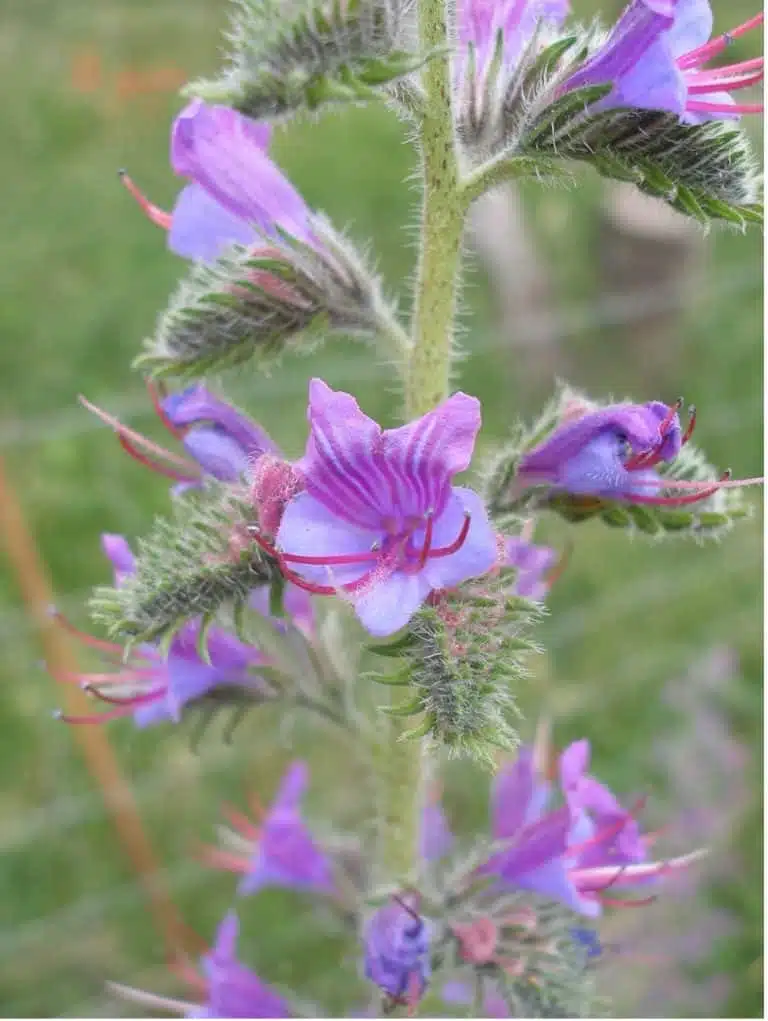
Spanish names for Echium include chupamieles, viborera and argamula. Its blue flower spikes and rough stems are familiar in poor pastures in southern Iberia. The honey is pale and mildly sweet, with an unexpectedly coating texture.
Reading and tasting viper’s bugloss honey

This Spanish-language field guide compares botanical origin, tasting and laboratory findings. Use the profile together with the traceability of the lot.
Taste for texture as well as sweetness
- Note viscosity, crystal size and persistence.
- Compare these with the origin and pollen spectrum of the lot.
A rich, coating mouthfeel
The guide describes high viscosityand a rich, coating mouthfeel, comparing the sensation to the finish of rich cured ham, lard or a blue cheese such as Cabrales or Roquefort.
. The comparison concerns texture, a separate perception from sweetness.
French lavender honey can look similar in colour and texture in the jar, but it usually lacks the pronounced coating mouthfeel. Tasting the two side by side helps separate them.
The guide also mentions this mouthfeel in its rosemary profile (in Spanish) when the bees have gathered a sizeable contribution from viper’s bugloss.
Crystals that appear in clusters
As in French lavender honey, crystallisation can start slowly with scattered groups of crystals forming near the bottom of the jar. As they develop, they may look like a little cloud reaching upwards.
Colour
White to light amber, up to 48 mm Pfund. It is a pale pasture honey, with little influence from honeydew in the guide’s profile.
Viper’s bugloss honey on the Pfund scale
In the pale bands. On-screen colours give an approximate visual guide. A laboratory measures the actual value.
Aroma, taste and texture
Sensory profile
Our interpretation of the descriptions in the Guía de mieles monoflorales ibéricas. This aroma is described as delicate but persistent, an unusual combination in the guide.
Aroma
The floral aroma is faint but persistent. It may be easy to miss at first, yet it lingers after tasting.
Taste and mouthfeel
The taste is essentially sweet. Its character lies chiefly in its high viscosity and the rich, coating impression it leaves on the palate.
Interpreting the laboratory profile
| Parameter | Reference in the guide | How to interpret it |
|---|---|---|
| Colour | up to 48 mm Pfund | White to light amber. |
| Moisture | up to 18% | Fermentation risk increases above the guide value. The general EU limit for blossom honey is 20%. |
| Fructose and glucose combined | at least 60% | A characteristic of blossom honey. This figure on its own cannot exclude added syrup. |
| Sucrose | up to 5% | One of the sugars reported in the analysis. |
| Electrical conductivity | up to 0.50 mS/cm | Low to moderate. |
| Free acidity | up to 50 meq/kg | Can rise with fermentation or extended storage. |
| HMF | up to 40 mg/kg | HMF increases with heat and time in storage. |
| Diastase activity | at least 8 Schade units | Indicator of enzyme activity, which can decline with heat. |
| Echium pollen | at least 70% | An unusually high threshold, comparable to eucalyptus. The plant contributes abundant pollen. |
Reference ranges from the Guía de mieles monoflorales ibéricas, fourth edition (2023). These characterise the variety. Spanish statutory limits are set by Royal Decree 1049/2003 as amended by Royal Decree 68/2025, including a general maximum of 20% moisture and 40 mg/kg HMF, subject to the exceptions in the legislation.
Other pollen in viper’s bugloss honey
- Legumes
- Daisy family (Asteraceae)
- Rockroses (Cistaceae)
- Mustard family
Growing areas and harvest season
The guide describes a late-spring flow on siliceous pastures in southern Iberia. Viper’s bugloss is associated with poor, acidic ground, including the granite and slate landscapes of Extremadura and Andalusia. These are quite different settings from the limestone scrub typical of many thyme or rosemary flows.
Viper’s bugloss honey flow
FloweringFlowering and harvest
The guide places the main harvest in late spring. An important nectar source in the south-western siliceous pastures as spring comes to an end.
How to recognise viper’s bugloss honey
- 1Notice the coating texture. A rich mouthfeel is the most characteristic feature in this guide.
- 2Pale, up to 48 mm Pfund. A stronger amber colour falls outside the profile.
- 3A faint but lasting aroma. It lingers even at low intensity.
- 4Taste for clean sweetness. The texture is more distinctive than the mild taste.
- 5Look at the first crystals. Clusters developing upwards from the bottom of the jar are a recognised pattern.
For a broader view, see how to assess honey quality and our guide to Spanish honey labelling requirements.
Composition and health claims
Health claims on food are regulated in the EU. The distinguishing features here are its floral origin, conductivity and sensory profile.
These characteristics matter when tasting or using the honey.
- The combination of high viscosity and a rich mouthfeel is particularly marked in this profile.
- Its taste is mild and straightforwardly sweet.
- The Iberian profile comes from acidic, siliceous pasture and open dehesa landscapes in the south-west.
- Its body makes it an interesting partner for blue cheese or mature cheese.
Who should take particular care?
Children under 12 months. Do not give honey to infants under one year. It can contain spores of Clostridium botulinum that may cause infant botulism. This applies to all types of honey.
Diabetes. honey is a source of sugars. This also applies to natural and monofloral honeys when planning a diet.
Known allergy. Anyone with a diagnosed allergy to honey or bee products should consult their clinician if unsure what is safe for them.
Frequently asked questions
What does “rich mouthfeel” mean here?
The honey feels viscous and coats the palate. The guide compares this with the impression left by rich cured ham or blue cheese. It describes a texture that can be felt independently of the honey’s sweetness.
Which plant is called chupamieles?
In this profile it refers to Echium species, also known in Spain as viborera or argamula. These rough-stemmed, blue-flowered plants are common in poor siliceous pastures in the southern half of the peninsula.
How does it differ from French lavender honey?
Both can be pale and mild, but French lavender honey lacks the pronounced rich, coating texture described for viper’s bugloss. Use taste and texture together with pollen and origin.
Why do clusters of crystals seem to rise from the bottom?
Both viper’s bugloss and French lavender honey can start to crystallise slowly in scattered clusters. These grow from the bottom upwards and can resemble a little cloud. That early pattern is distinct from a separation into liquid and solid layers.
Who should take particular care?
Never give honey to a baby under 12 months because of the risk of infant botulism. People with diabetes should count its sugars in their diet. Anyone with a diagnosed allergy to hive products should seek individual medical advice.
Where to buy viper’s bugloss honey
We do not currently stock this honey. Much of the southern pasture harvest is sold as spring multifloral honey. Ask beekeepers in Extremadura or western Andalusia about a monofloral lot. For a pale, mild Spanish honey in our range, see our raw rosemary honey.
Sources
The reference ranges come from the fourth edition (June 2023) of the Guía de mieles monoflorales ibéricas by J. Orantes, F. Gonell, C. Torres and A. Gómez-Pajuelo, published by Laboratorios Apinevada and Pajuelo Consultores Apícolas. Their work draws on a series reaching back to 1980 and more than 3,600 analyses a year across the two laboratories. The printed guide in Spanish is available in our shop.
This is part of our series on Iberian honeys. Compare it with French lavender honey for similar colour and early crystal clusters, but a different mouthfeel.


