

At a glance
French lavender honey
Lavandula stoechas · cantueso, tomillo borriquero
Colour
White to light amberup to 50 mm Pfund
Aroma
Faint floral aromafaint camphor-like notes
Taste
Sweetsometimes a little tart
Crystallisation
Slow, scattered crystal clustersdeveloping upwards from the bottom
Season
Late springand summer
Region
Southern plateau and south-westAndalusia, Extremadura and Portugal
Pollen reference
12%as for thyme and rosemary
Conductivity
up to 0.50 mS/cmmoderate
In a jar of French lavender honey, the first little clusters of crystals may appear near the bottom before extending upwards. The Iberian guide likens the effect to a constellation.
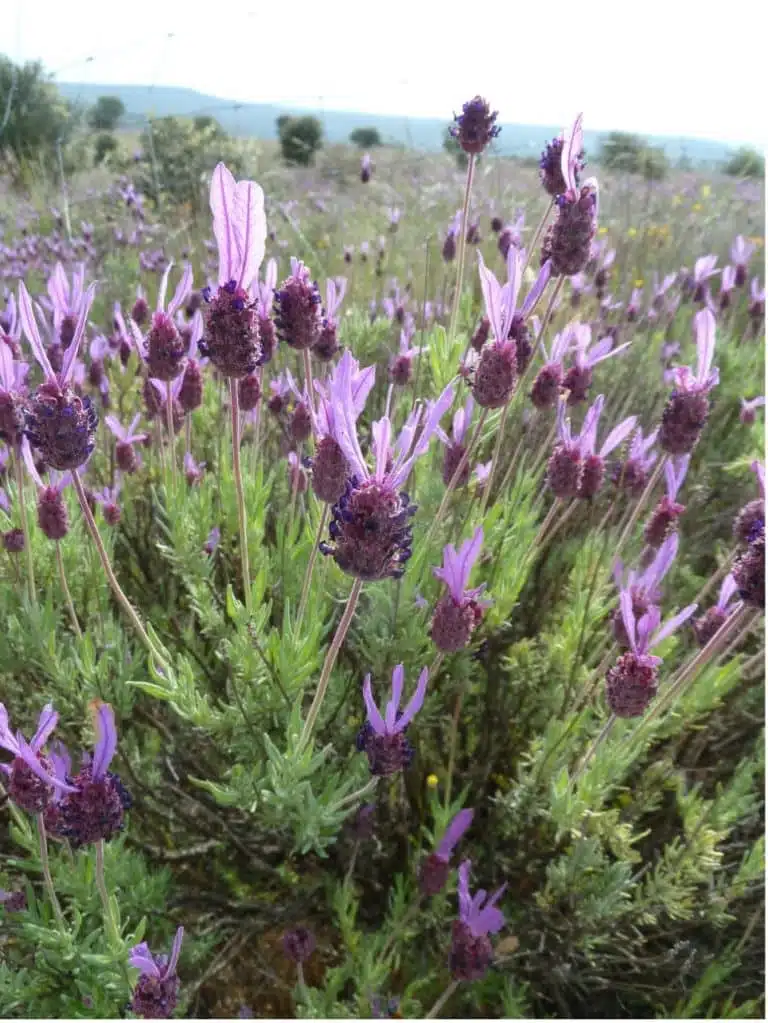
This wild lavender is easy to recognise by the upright purple bracts at the tip of each flower spike. It grows in rockrose scrub and pine woods in central and south-western Iberia. Its honey is pale and mild, with a particularly noticeable early crystallisation pattern.
Reading and tasting French lavender honey

This Spanish-language field guide compares botanical origin, tasting and laboratory findings. Use the profile together with the traceability of the lot.
Watch the crystals develop
- Record where crystals first appear in the jar.
- Compare the texture in the mouth with the viper’s bugloss profile.
Crystals that appear in clusters
The guide describes a change that you can follow by looking through the glass, as well as the eventual texture.
Crystallisation is slow and often begins at the bottom, developing upwards in scattered clusters of tiny opaque crystals.
Small opaque points can develop in a liquid jar over several weeks, gradually forming a cloud from the base upwards. This is an early stage of natural crystallisation and is distinct from separation into two layers. See why honey crystallises.
French lavender or viper’s bugloss? Compare the mouthfeel
Both honeys are pale and mild, and their early crystal patterns may look alike. The guide suggests paying attention to the way each one feels on the palate.
Honey from viper’s bugloss honey (Echium spp., viper’s bugloss) leaves a rich, coating mouthfeel , compared in the guide with that left by rich cured ham or blue cheeses such as Cabrales and Roquefort.
The honey from French lavender lacks that pronounced coating feel. This is one of the clearest sensory differences between the two profiles.
Colour
White to extra-light amber, with an upper limit of 50 mm Pfund. The upper value is somewhat above those of rosemary and acacia.
French lavender honey on the Pfund scale
In the lighter colour bands. On-screen colours give an approximate visual guide. A laboratory measures the actual value.
Aroma, taste and texture
Sensory profile
Our interpretation of the descriptions in the Guía de mieles monoflorales ibéricas. The aroma is discreet. The first changes in a slowly crystallising jar are particularly characteristic.
Aroma
The floral aroma is faint and fades quickly. Sometimes there is a delicate camphor-like note, most evident on the palate. Rosemary honey (in Spanish), another member of the mint family, can also have a camphor-like aroma.
Taste
Sweet, sometimes with a little acidity. It lacks the strong coating feel described for viper’s bugloss honey.
Crystallisation
It sets slowly. The clusters described above may be the first visible sign.
Interpreting the laboratory profile
| Parameter | Reference in the guide | How to interpret it |
|---|---|---|
| Colour | up to 50 mm Pfund | White to extra-light amber. A strong amber colour falls outside the profile. |
| Moisture | up to 18% | Fermentation risk rises as moisture increases. The general Spanish statutory limit is 20%. |
| Fructose and glucose combined | at least 60% | A characteristic of blossom honey. This figure on its own cannot exclude added syrup. |
| Sucrose | up to 5% | One of the sugars reported in the analysis. |
| Electrical conductivity | up to 0.50 mS/cm | Moderate, with a profile limit between rosemary (0.30) and thyme (0.60 mS/cm). |
| Free acidity | up to 50 meq/kg | Can rise with fermentation or extended storage. |
| HMF | up to 40 mg/kg | Tends to rise with heat and time. Levels are usually low in freshly harvested honey. |
| Diastase activity | at least 8 Schade units | Indicator of enzyme activity, which can decline with heat. |
| Lavandula stoechas pollen | at least 12% | The flowers supply abundant nectar and relatively little pollen. The threshold refers to the pollen counted. |
Reference ranges from the Guía de mieles monoflorales ibéricas, fourth edition (2023). These characterise the variety. Spanish statutory limits are set by Royal Decree 1049/2003 as amended by Royal Decree 68/2025, including a general maximum of 20% moisture and 40 mg/kg HMF, subject to the exceptions in the legislation.
Other pollen in French lavender honey
- Legumes
- Daisy family (Asteraceae)
- Viper’s bugloss
- Other mint-family plants
Growing areas and harvest season
The Iberian guide lists the southern plateau, Andalusia, Extremadura and Portugal. French lavender thrives in rockrose scrub and pine woods on poor soils, in landscapes where rosemary may be less abundant.
French lavender honey flow
FloweringFlowering and harvest
The guide places the main harvest in late spring and summer. Flowering starts relatively early and can last some time. In many areas it follows rosemary and overlaps with the start of thyme or rockrose flowering.
How to recognise French lavender honey
- 1Pale, up to 50 mm Pfund. White to extra-light amber. A darker colour calls for checking the accompanying forage.
- 2Expect a mild aroma. Look for a faint floral aroma that fades quickly.
- 3Find the subtle camphor note. Very slight, and usually clearer on the palate.
- 4No strongly coating feel. A pronounced rich texture is closer to the viper’s bugloss profile.
- 5Look at the first crystals. Small crystal clusters developing from the bottom are a characteristic early pattern.
For a broader view, see how to assess honey quality and our guide to Spanish honey labelling requirements.
Composition and health claims
The properties of essential oil from the plant cannot be assumed to apply to its honey. EU rules govern health claims on foods.
The useful differences show up in analysis, tasting and cooking.
- Its restrained aroma makes it useful for sweetening without dominating other flavours.
- Small early crystals can give an agreeable texture once it sets.
- The guide gives a maximum conductivity of 0.50 mS/cm, consistent with a relatively low mineral content.
- Try it with dairy desserts, light pastries, tea or fresh fruit.
Who should take particular care?
Children under 12 months. Do not give honey to infants under one year. It can contain spores of Clostridium botulinum that may cause infant botulism. This applies to all types of honey.
Diabetes. honey is a source of sugars. This also applies to natural and monofloral honeys when planning a diet.
Known allergy. Anyone with a diagnosed allergy to honey or bee products should consult their clinician if unsure what is safe for them.
Frequently asked questions
What is cantueso?
In this profile it refers to Lavandula stoechas, or French lavender, is a wild lavender recognised by the tuft of purple bracts at the tip of the flower head. Some Spanish speakers call it tomillo borriquero. It grows in rockrose scrub and pine woods in central, southern and western Iberia, including Portugal.
Why are crystals forming at the bottom of my jar?
The guide describes slow crystallisation that can begin with scattered groups of tiny opaque crystals near the bottom, gradually extending upwards. This pattern can be quite natural and differs from a separation into two layers.
How can I distinguish it from viper’s bugloss honey?
Taste for texture. Viper’s bugloss can leave a rich, coating sensation reminiscent of blue cheese. French lavender honey is usually lighter on the palate.
What does French lavender honey taste like?
Mainly sweet, occasionally a little tart. The floral aroma is mild and short-lived, sometimes with a faint camphor-like note that becomes clearer as you taste.
Who should take particular care?
Never give honey to a baby under 12 months because of the risk of infant botulism. People with diabetes should count its sugars in their diet. Anyone with a diagnosed allergy to hive products should seek individual medical advice.
Where to buy French lavender honey
We do not currently stock this honey. Some harvests enter spring multifloral blends. For a monofloral lot, ask beekeepers on the southern plateau, in Extremadura or in western Andalusia. For another mild, pale honey from Spain, our range includes raw rosemary honey.
Sources
The reference ranges come from the fourth edition (June 2023) of the Guía de mieles monoflorales ibéricas by J. Orantes, F. Gonell, C. Torres and A. Gómez-Pajuelo, published by Laboratorios Apinevada and Pajuelo Consultores Apícolas. Their work draws on a series reaching back to 1980 and more than 3,600 analyses a year across the two laboratories. The printed guide in Spanish is available in our shop.
This is part of our series on Iberian honeys. Compare it with rosemary (in Spanish), thyme and other lavender honeys to see how the mint family produces quite different profiles.


